The two women barely looked at each other. A private war the public was never meant to see. The contempt between them was real, yet it never made it into the photographs. To understand what those two women were to each other by the time they stood together beneath their black veils, you have to go back much further than Dallas, before the White House, before Hyannis Port.
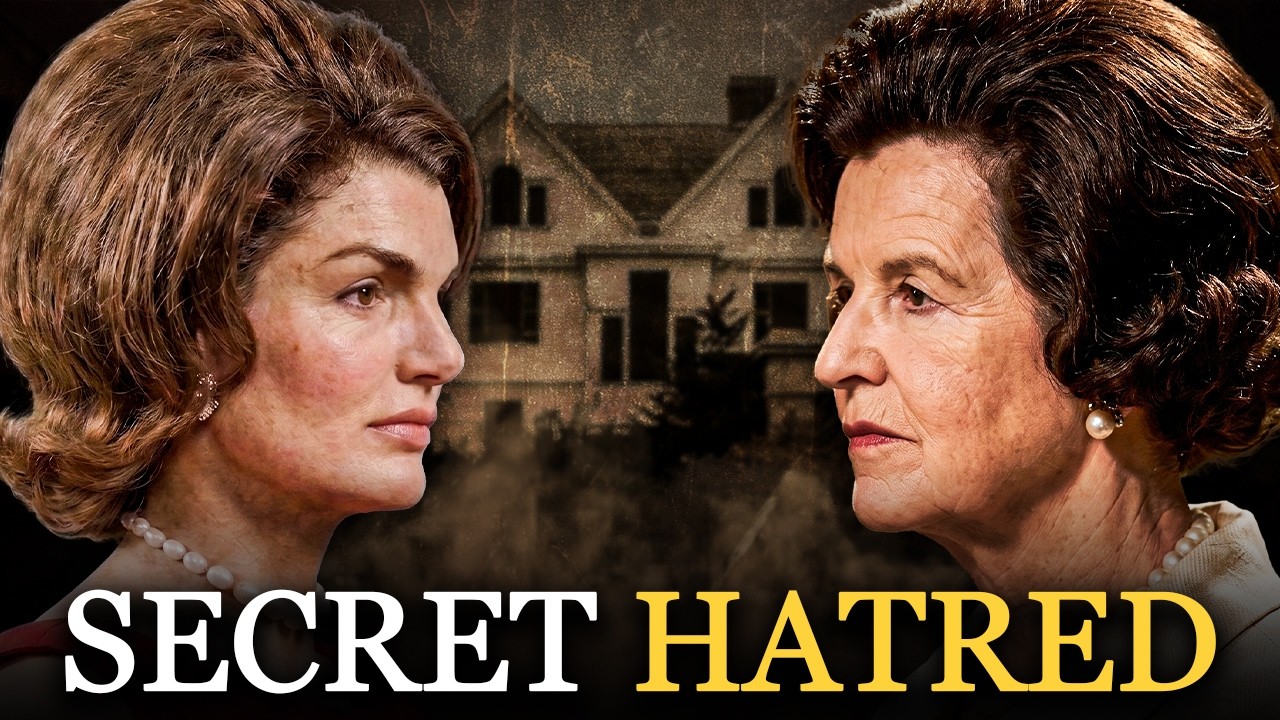
The distance between Rose Kennedy and Jacqueline Bouvier was not made by grief. It was there long before tragedy gave them a reason to stand in the same frame. This is the story of two women who lived 20 years inside the same family and never once agreed on what that family was for. The photographs told a single, seamless story, but it was also a performance, organized with the same discipline the family brought to everything else.
Joseph Kennedy did not simply accumulate; he engineered. Rose did not simply raise her children; she documented them. She once said that no one would ever feel sorry for her, and that single sentence holds her entire character inside it—the pride and the armor both. Consider the girl who would one day marry into all of that, shaped by almost exactly the opposite forces.
What Jackie wanted was not simply wealth, because she had grown up beside wealth and watched it fail to hold a family together. The man who brought the two women into the same house was John Fitzgerald Kennedy, born on May 29th, 1917. For the first decades of his life, he was the sickly one, the second son, the boy who read in bed while his stronger brother took the lead. He carried the same restlessness that had run through his father, the same instinct to compartmentalize a life into rooms that never met.
The two women walked into Jack’s life carrying opposite strategies for surviving the same wound, formed years before either knew the other existed. The Kennedy and Bouvier families wanted a traditional spectacle appropriate to a political marriage. The bride stood inside an enormous dress she had not chosen, while photographers recorded the union of two Catholic dynasties. Rose had once said that if you got the raising of your children wrong, nothing else you did with your life mattered very much.
She too believed motherhood was the central work of her life, but the two women meant entirely different things by the word. When Jackie became first lady at 31 years old, one of the youngest in the country’s history, she did something the family had not authorized and could not fully control. The summers at Hyannis Port gave the public its most persuasive images—the sailboats, the swims, the football, the long crowded meals with cousins everywhere. After Jackie became first lady, that expectation collapsed.
The older woman’s silence should never be mistaken for warmth. Joseph Kennedy’s affairs had taught Rose to detach her husband’s behavior from the survival of the marriage, to stay, to endure, to convert private humiliation into public authority. She understood exactly what the family expected of her because Rose’s whole life was the instruction. In the weeks after they buried their son, something between John and Jackie eased in a way their friends had not seen in years.
It was rare because of everything that had come before it. Another child, a slower life, a second term, a reconciliation perhaps between the two women whose quiet war had never once been spoken aloud. All of it depended on time, and time was the one thing this family had learned never to count on. John could not afford to let the state’s Democrats tear each other apart a year before he had to face the country again.
For the first time in a long time, they would do the public work of the presidency as a couple who actually wanted to be near each other. In November 1963, John was pleased and relaxed, watching Jackie win over a state he badly needed, watching the rebuilt marriage do in public exactly what he had hoped it would do in private. The walls of their suite had been hung overnight with original paintings borrowed from local collectors and museums—a Monet, a Van Gogh—chosen because the city knew the first lady loved art. Then Jackie came down, there was a breakfast at the Chamber of Commerce, and the short flight to Dallas.
What happened next took only seconds. His body would not stay behind in Texas. A public that had spent three years consuming the Kennedys as entertainment discovered that it had, without quite noticing, come to love them. The family protecting him decided at first not to tell the older generation about the worst of it.
The result was a sequence of images that entered the country’s memory permanently. Caroline was five, John was three, and the public absorbed the family’s most intimate hours as though they had a right to them. Jackie possessed something Rose never could, and she did not need a single word spoken to claim it. She told Theodore White that her husband at night before sleep had liked to play the cast recording of a Broadway musical called Camelot, and that the lines he returned to were the ones about a brief and shining moment that should not be forgotten.
She did not stay to become the family’s widow. She had come to hate what public life in America had cost the people she loved, and she said in the plainest terms that if this was what happened to Kennedys, she wanted her children out of the country that kept killing them. The bridge that Robert Kennedy had been was gone, and with it the last strong reason to remain inside the boundaries Rose had spent her life drawing. Jackie appeared at the public events, presenting the family’s enormous accumulation of tragedy the only way she had ever known how—through the language of faith and duty and endurance, never inviting pity, never letting the grief show as weakness.
She took a job as an editor, first at Viking Press and later at Doubleday, reading manuscripts, developing books, keeping a professional schedule that was, for a woman whose face was known on every continent, remarkably ordinary. She had walked into a house the family had not given her any authority over, and she had left behind machinery that would preserve it for every administration that followed. Rose told her own story on her own terms. That was not a thing Rose did on the page or anywhere else.
The two of them were, by then, the last living authorities on a marriage and a rivalry that the rest of the world knew only from the outside. Rose lived long enough to watch the younger woman build an entire life outside the family, and then lived eight months beyond her. No source establishes that Rose regretted anything or forgave anything or came at the end to understand the daughter-in-law she had never approved of. The private world these two women had built and fought inside became, in the decades after they were gone, one of the most reconstructed families in American memory.
The compound at Hyannis Port still stands on its stretch of Cape Cod coast, the physical embodiment of Rose’s belief that a family survives by returning to one another. More than 60 years on, people still come to stand beside it in the quiet, drawn by a name and a story whose private truth almost none of them will ever know. What does not remain is any complete private record of what passed between the two women. The people who claim to know supplied their stories late, after both women were beyond contradicting them.
The feud survives only in fragments—a private sentence about a rosary in a book, two households that never quite merged, two irreconcilable ideas of how to raise the same children, and the unmistakable transfer of power that followed the deaths. Rose Kennedy and Jacqueline Kennedy were not opposites in every way. Both stayed in marriages wounded by the same kind of betrayal. Both believed to the center of themselves that protecting their children was the most important work a mother could do.
In the end, they were only two women beneath black veils in the November cold, standing inside the same grief, each already at work preserving her own version of what had been lost.