On the morning of January 13, 1968, a 27-year-old man stood before the altar of Kongens Lyngby Kirke, a small whitewashed Lutheran church on the northern edge of Copenhagen, and made a choice that no law required of him, but that the machinery of royalty would punish all the same. His name at the start of that morning was His Highness Prince Ingolf Christian Frederick Knud Harald Gorm Gustav Viggo Valdemar Aage of Denmark. By the time the ceremony was finished, it was not. The woman beside him was Inge Tørni, the daughter of a hardware store owner from Copenhagen.
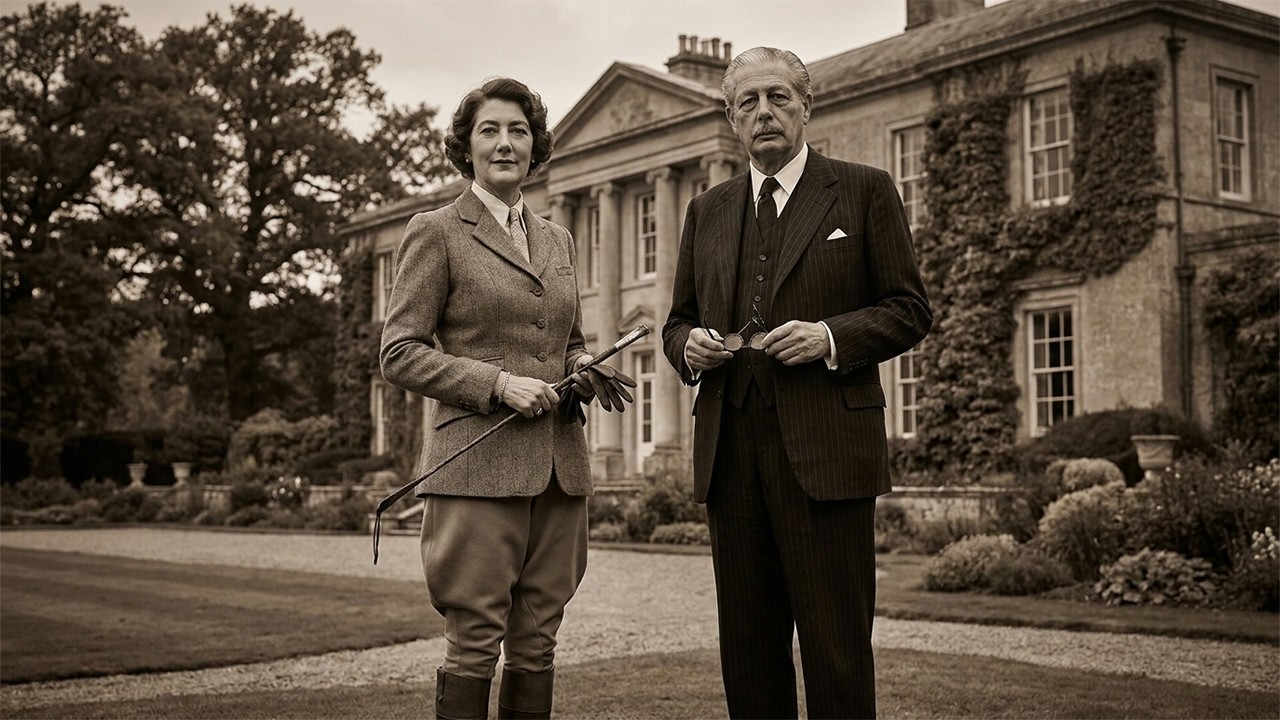
She was not noble and held no title. By the cold arithmetic of the Danish royal court, she was exactly the wrong kind of woman. Ingolf married her anyway, without asking permission, without seeking the blessing of the king, and without a letter to the Council of State. He did not ask because he already knew the answer.
Denmark stripped him of his name forever. This is the story of Count Ingolf of Rosenborg, a man born into the innermost circle of a kingdom’s future, displaced by a law he could not change, and who responded with a quiet stubborn love that cost him everything the palace had promised. To understand what Ingolf surrendered, you must first understand what had been given to him at birth. He arrived on February 17, 1940, at Sorgenfri Palace, a pale neoclassical country house along the banks of the Mølleåen river in Kongens Lyngby, just north of Copenhagen.
The name Sorgenfri means “free from sorrow” in Danish. It was a name chosen in easier centuries, when the palace served as a summer retreat for the Danish crown. By the time Ingolf was born there, it was the permanent home of his father, Hereditary Prince Knud. His father was the younger of two brothers.
The elder had become King Frederick IX in 1947. Knud, therefore, was the heir presumptive, the man who, by every existing rule of Danish succession, stood to inherit the throne if his brother died without a male heir. And Frederick IX had no sons. He had three daughters: Margrethe, Benedikte, and Anne-Marie.
Under the law as it then existed, the old Salic-influenced system of agnatic primogeniture that had governed Scandinavian succession for centuries, daughters could not inherit. Only sons counted. Which meant that when Ingolf arrived at Sorgenfri Palace in February 1940, the arithmetic of the dynasty pointed, eventually, to him. His father would be king, and then, in turn, Ingolf would be king.
He was given a name to match. Ingolf Christian Frederick Knud Harald Gorm Gustav Viggo Valdemar Aage. Nine names strung together like a genealogy, each one borrowed from the long catalog of Danish royal history. The Haralds and Gorms and Valdemars reaching back to the Viking age.
The family lived as Danish royals of that generation often did, in a state of formal but genuine domesticity. Prince Knud had trained as a naval officer and held to a certain military plainness. The household was structured, religious, and patriotic. Ingolf and his siblings, elder sister Elizabeth, born in 1935, and younger brother Christian, born in 1942, were raised within the routines of obligation: the military education that shaped every Danish prince, the ceremonial appearances, the sense that one’s private life was always in some degree the property of the state.
For the first seven years of his life, the order of things was clear. His grandfather, King Christian X, sat on the throne. Ingolf was third in line. Then in 1947, King Christian X died and his uncle Frederick IX ascended.
Ingolf’s father became the heir presumptive. Ingolf, the spare to that spare, stood now in second place, close enough to the throne to feel its gravity. Then in 1953, everything changed. Not through any choice Ingolf made, but through a stroke of constitutional revision that rearranged the entire future of the Danish royal house.
The story of the 1953 Act of Succession is in one sense a story about democracy at work. King Frederick IX and Queen Ingrid had three daughters and no sons. Under the old rules, when Frederick died, the throne would pass to his brother Knud, and then to Knud’s sons. The problem was that Hereditary Prince Knud was, by most accounts, deeply unpopular.
He was considered stiff, remote, and ill-suited for the modernizing monarchy that Frederick had come to embody. The prospect of Knud as king alarmed the Danish political establishment. The government, in consultation with the palace, began the laborious process of amending the constitution to allow women to inherit. The referendum was held on May 28, 1953.
The Danish people voted 78. 8 percent in favor of the change. It was, on its surface, a progressive measure, a step toward gender equality in the most visible institution in the land. Princess Margrethe, Frederick’s eldest daughter, became heiress presumptive.
She would eventually reign as Queen Margrethe II from 1972 until her abdication in January 2024, one of the longest and most admired reigns in modern Danish history. But the 1953 Act was not only a gain for Margrethe. It was a displacement for Knud, and by extension for his sons. Ingolf, 13 years old when the referendum passed, was shifted behind his uncle’s three daughters in the order of succession.
He did not disappear from the line. He was still a prince, still addressed as His Highness, still educated and prepared for a life of royal service. But the throne, which had once seemed a plausible destination, was now a horizon that had moved. His father, by multiple accounts, never quite recovered.
Prince Knud reportedly experienced the constitutional revision as a personal diminishment, a quiet humiliation dressed in the language of democratic progress. He was given the title Hereditary Prince, a courtesy rank that softened the blow without altering the fact. He lived the rest of his life at Sorgenfri in what one might charitably call dignified restraint, and less charitably call a long, proud wound. Ingolf was not his father, or perhaps more precisely, Ingolf chose not to be.
By the early 1960s, he was a young man navigating the particular limbo of the secondary royal: royal enough to carry obligations and restrictions, but no longer close enough to the throne to have the power that might have justified them. He completed his military education, was commissioned as an officer, and threw himself into agricultural and rural work that would define his public life for decades. He was drawn to the flat, windswept farmland of Jutland, Denmark’s mainland peninsula, where the soil is sandy and the winters are long, and the people measure a person by what they actually do. In 1967, the year before his marriage, Ingolf purchased Egeland Gods, a working estate near the town of Egtved in Southern Jutland.
He would live there for more than 50 years. It was not a palace. It was a farm, a functioning agricultural enterprise worked and managed with his own hands. The move to Egeland was itself a kind of statement made quietly, without announcement: a prince who chose to become a landowner, who chose the rhythms of the harvest over the rituals of the court.
It was in this world, somewhere between Copenhagen’s formal drawing rooms and the muddy fields of Jutland, that Ingolf encountered Inge Tørni. The precise circumstances of their first meeting are not preserved in any official record. What the documents tell us is the outline of her life. Inge Tørni was born on January 21, 1938, in Copenhagen, two years older than Ingolf, and by every measure of the Danish social hierarchy, from a different world.
Her father, Georg Tørni, ran a hardware store. She was, to use the palace’s preferred term, a commoner, which is to say, she was what most human beings are, and what the machinery of monarchy was designed to exclude. By the accounts that have filtered through over the years, she was quietly steady, not dazzled by his origins, not intimidated by the apparatus around him. She did not need the royal connection.
Perhaps that was part of what he found sustaining about her: someone for whom he was simply Ingolf, rather than a position in a dynastic order. By the mid-1960s, they were together, and the question became unavoidable. To marry her in a church, with a register and witnesses and a legal record, Ingolf would need the formal consent of the king. That was the law as written in the 1953 Act of Succession.
Royal marriages required royal assent, granted in the Council of State. Without it, any union would be morganatic. The prince would be stripped of his title, his place in the line of succession, and his rank of Highness. The palace would close its formal doors.
Prince Knud, Ingolf’s father, tried. He went to his brother, King Frederick IX, and argued, reportedly with some force, that an exception should be made, that Ingolf should be allowed to keep his royal title even if he married without seeking permission. The king was privately sympathetic. He was not a cold man, but he refused.
His reasoning was institutional rather than personal. If Ingolf were allowed to retain his rank after marrying a commoner, then the other members of the dynasty who had already been demoted to Counts of Rosenborg upon similar marriages might attempt to reclaim their status. The precedent would destabilize the order of things. The rule had to hold.
Ingolf did not fight this publicly. He did not petition or protest. He simply decided. He married Inge Tørni on January 13, 1968, at Kongens Lyngby Kirke, the same parish that lay just outside the gates of Sorgenfri Palace where he had been born.
Without requesting the Council of State’s permission, and therefore without any possibility of keeping what he had been born with. His Highness Prince Ingolf of Denmark ceased to exist on the day of his wedding. King Frederick IX, in the formal language of royal protocol, granted him a new style: His Excellency Count Ingolf of Rosenborg. The “of Denmark” was gone.
The “Highness” was gone. What remained was a count’s title and the name of a royal palace that had for two centuries been used to designate Danish princes who had stepped outside the dynasty through marriage. He was now one of a series. The title Count of Rosenborg had existed since the early 20th century, first granted to Danish princes who made what the court called unequal marriages.
Counts Aage, Erik, and Viggo, cousins of the earlier generation, had received it. Ingolf received it. His younger brother Christian would receive it three years later, in 1971, when he married Anne-Dorthe Maltoft-Nielsen, also without the king’s permission. The family produced two Counts of Rosenborg in three years.
What Ingolf gave up on January 13, 1968, was not merely a title. He gave up a position within one of the most visible and symbolically powerful institutions in Danish society. He gave up the formal acknowledgement that he was by blood part of the reigning house. He gave up the precedence, the salutation, and the ceremonial place in the national story.
What he gained was the right to live with the woman he had chosen. The years that followed were, by every outward measure, ordinary, which is to say they were extraordinary for a man who had been raised to inhabit the extraordinary. Ingolf and Inge moved to Egeland Gods, the estate he had purchased the previous year. They farmed.
He managed the land. He took on the patronages and protectorates that the Danish state allowed him as a former prince: organizations related to agriculture, to the military, to the border region of South Schleswig, to the Danish communities on the German side of the frontier. He wore his uniform. He showed up.
He did the work. There were no children. Inge and Ingolf had none from their 28-year marriage, and Ingolf would have none from his second marriage either. The question of an heir, which had once been, when he was a child, a matter of national interest, became in private life simply an absence, carried quietly.
What the couple built at Egeland was not glamorous. The estate was a working farm: grain fields, livestock, the particular rhythm of a rural enterprise that demands attention in all seasons. Ingolf became, in the eyes of the rural Jutland communities around him, not a former prince managing a romantic exile, but simply a landowner and neighbor. He attended local events.
He served on agricultural committees. He drove his own car on roads his neighbors also drove. The uniform came out for official occasions. The rest of the time, he was a man who knew the price of diesel and the timing of the harvest.
Royalty, when it produces exiles, tends to produce spectacle: the abdicated king who cannot stop pretending, the disgraced duchess who courts the press, the rejected prince who nurses his grievance in public. Ingolf produced none of that. He simply lived. Quietly, consistently, with remarkable constancy, he lived the life he had chosen.
The uniform persisted through all of it. The gold braid and the military decorations appeared at every engagement, every ceremony, every formal gathering where he represented the organizations that still called upon him. He had been stripped of one kind of identity, but he put on another, not as a replacement for what had been lost, but as evidence that service itself was the point. He carried out official engagements at a rate that would have taxed most working royals: somewhere around 200 days of the year, according to the newspaper Jyllands-Posten, mostly in Jutland and the Southern Borderlands, mostly relating to agriculture and defense.
200 days a year for a man whose name had been taken, for a man whose country had formally reclassified him. He showed up wearing the uniform of a duty that had never been formally rescinded, serving an institution that had publicly diminished him. Whether that persistence was loyalty or stubbornness or something more complicated is a question his own biography does not answer directly. He was not a man who gave long interviews.
He was not a man who explained himself. The relationship with his royal cousins, and in particular with Margrethe, who acceded to the throne in January 1972 when Frederick IX died, was from the outside one of cordial continuity. Margrethe’s rise had directly corresponded with Ingolf’s family’s displacement. They maintained closeness.
He was invited to major royal occasions. He and Countess Inge attended weddings and anniversaries. He was listed on some occasions among the royal family, on others among non-royal guests, but given precedence immediately after his sister Princess Elizabeth. The boundary was always present, always slightly ambiguous.
He was of the family without being formally in it. His father, Prince Knud, died on June 14, 1976, after years of official duties carried out with dignity, but without the authority that had been taken from him in 1953. His mother, Hereditary Princess Caroline Mathilde, outlived her husband by 19 years, dying at Sorgenfri Palace on December 12, 1995. Both were buried at Roskilde Cathedral.
Then the following year, Inge died. The cancer came quietly, and the record does not speak in detail about those months. What the record preserves is the date: July 21, 1996. She died in Vejle, in Jutland, not far from Egeland, the estate where they had made their life together.
She was 58 years old. She was buried at Øster Starup Kirkegård, a small country churchyard near the estate. No royal cemetery, no cathedral. The churchyard of the parish where she had lived.
Ingolf was 56. They had been married for 28 years. She had been the reason he had given up everything he was born with, and she was gone. Two years after Inge’s death, in 1998, Ingolf married again.
Her name was Sussi Jeppesen, born in Copenhagen on February 20, 1950. A lawyer by profession, again a commoner, again a woman with no claim to any dynastic rank. The ceremony took place on March 7, 1998, at the town hall in Egtved. Not a church this time, but a civil register office, the simplest and most modern of ceremonies.
She became Her Excellency Countess Sussi of Rosenborg. By 1998, the palace rules had already begun to change. In 1995, Queen Margrethe had allowed her own children to marry commoners who held neither title nor noble blood. The rigidity that had cost Ingolf his name in 1968 had softened slowly, too late for his title, but not too late for his life.
Ingolf and Sussi built something together at Egeland in the years that followed. He continued his engagements: the agricultural organizations, the defense patronages, the South Schleswig committees. She brought her own independence and her legal mind. In December 2022, the couple moved from Egeland Gods into a smaller, more modern house nearby, which they named Det Hvide Palæ, “the white palace,” a name that might be read as ironic or might simply be read as the comfortable self-knowledge of a man who knew exactly what he was and was no longer troubled by it.
In January 2023, he sold Egeland, the estate he had purchased the year before his first marriage, the land where he and Inge had farmed for more than five decades. He left it without public ceremony. He turned 85 on February 17, 2025. He is the last surviving member of the displaced branch, the Knud line that had once stood to inherit Denmark’s throne and instead became, through the revision of a constitution and the choices of two sons, a family of counts.
His brother Christian died in 2013. His sister, Princess Elizabeth, maintained her royal status, having not married in a way that forfeited it, and she remains in the line of succession. Ingolf’s allowance from the Danish state, currently around 1. 4 million kroner annually, is understood as compensation for his displacement in the line of succession, a financial acknowledgement that something was taken, even if the taking was technically constitutional.
He has no children. The count’s title of Rosenborg in his branch of the family ends with him. There is a detail that appears in the records almost as an afterthought. He is godfather to his grandnephew, Leopold Rosenborg, the grandson of his brother Christian.
There is a continuity there, a connection across the generation, a presence in the family’s future, even without heirs of his own. He holds his place not through blood succession, but through the ordinary human fact of being present and being loved. Ingolf was born with a name that was really a promise written for him by a dynasty before he could read. The name said, you will be important.
You will be protected by protocol and precedent and the weight of centuries. It said, if you wish to marry, ask permission. Ask the king, ask the council, ask the institution that shaped you, and wait for the institution to decide. He did not ask.
He married the daughter of a hardware store owner on a January morning in a whitewashed Lutheran church without a word to the palace and let the institution strip him of everything it had promised. What the record shows across the 57 years since that morning is not a man who regretted it, not a man who nursed a wound in public, not a man who used his story to seek sympathy or attention. It shows a man who went to Jutland and farmed, who showed up for 200 days a year wearing the uniform of a service he still believed in, who loved two women in succession, and who carried out his duties without asking anyone to feel sorry for him. The uniform matters here.
It is the central image of his life. A man who had been told that his service was conditional, that his belonging was conditional, declined the condition and then kept wearing the uniform anyway, not to prove anything, not to protest, but because the service itself was real to him in a way the title had never entirely been. Sorgenfri, “free from sorrow. ” It was the name of the palace where he was born.
He did not stay there. He chose a harder, plainer life on Jutland farmland. He married for love. Denmark took his name.
He kept showing up.