On April 20, 1945, Soviet forces reached the eastern suburbs of Berlin, marking the start of the Battle of Berlin. The date was also Adolf Hitler’s 56th birthday. Ten days later, Hitler was dead in his bunker beneath the Reich Chancellery Garden, and on May 2, the Germans surrendered the city to Soviet forces. The battle produced some of World War II’s most enduring images, including the famous photograph of a Soviet soldier raising the red flag over the Reichstag.
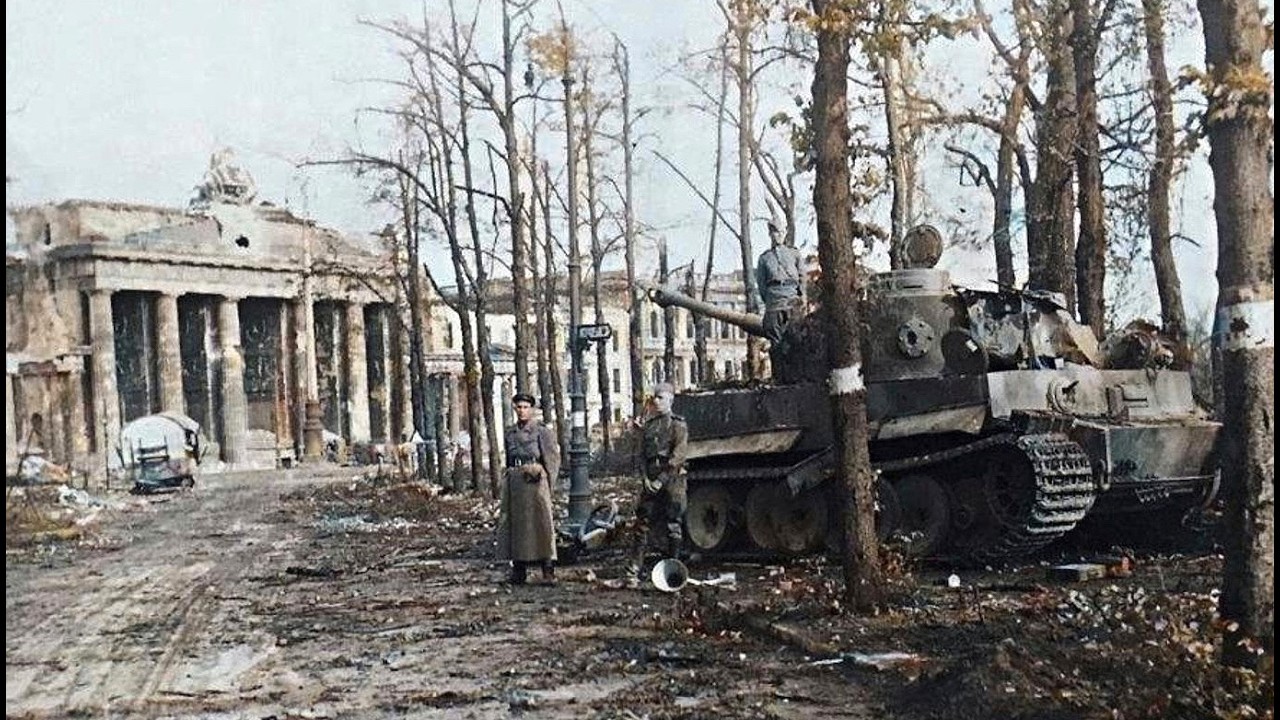
Another well-known photo shows a destroyed Tiger I tank sitting roughly 100 meters in front of the battered Brandenburg Gate. That tank, a symbol of German armored power, had been reduced to a wreck before one of Germany’s greatest military monuments, itself heavily damaged. The image seemed to capture the scale of the Soviet victory. The story of how that Tiger tank came to rest there is tied to the final stand inside Berlin’s government district.
The city’s last defensive position east of Berlin, the Seelow Heights, had collapsed under a massive Soviet offensive that opened on April 16, 1945. By April 19, Soviet forces had broken through despite heavy losses and were advancing on the city itself. German units that survived fell back to Berlin and its three defensive rings. One of those units was the ad hoc Müncheberg Panzer Division, formed in late February 1945 from training and tank demonstration units at the Kummersdorf testing grounds.
It began with a small collection of heavy tanks, including Tiger IIs, a Tiger I, and a Jagdtiger, and was later expanded with Panzer IVs and a Panther. The division fought at the Seelow Heights before being withdrawn on April 17 and ordered into Berlin. By April 24, the Müncheberg was fighting in the northeast sector of the city. On April 26, it joined the 11th SS Panzergrenadier Division Nordland in a counterattack toward Tempelhof Airport and Neukölln.
Ten tanks took part in the attack, but it failed. The division then fell back to defense sector Z, known as the Zitadelle, or Citadel. This was the central government district, packed with massive ministry buildings and monuments. Thousands of SS, army, navy, and air force troops, along with Volkssturm home guards and Hitler Youth, were tasked with holding the Citadel and protecting Hitler in his bunker.
The area was heavily defended. Large flak towers equipped with high-caliber guns allowed German forces to fire on Soviet tanks as they advanced through the city. The Müncheberg used its remaining operational tanks to reinforce the defenses of the Tiergarten, the large central park where the Germans had set up an emergency landing strip on the Charlottenburger Chaussee. The control tower for the airfield was the Victory Column, one of Berlin’s most famous monuments.
From its top, Luftwaffe air traffic controllers directed flights in the final days of the city’s defense. Soviet forces crossed the Moltke Bridge over the Spree River and attacked the Ministry of the Interior, which they called Himmler’s house, before launching frontal assaults on the Reichstag across Königsplatz. The Reichstag’s defenses included a flooded U-Bahn tunnel, anti-tank ditches, infantry trenches, 88-mm guns, and firing positions in the building itself. Supporting fire also came from the Zoo Flak Tower behind it.
A Müncheberg Tiger I, numbered 323, was positioned beside the Reichstag, covering the upper end of the Tiergarten in front of the Brandenburg Gate. Low on fuel, the tank was meant to act as a blockhouse, engaging any Soviet armor that approached the sector. Another Tiger I was probably positioned near the Zoo Flak Tower at the other end of the Charlottenburger Chaussee. The location where Tiger 323 was photographed after the war may not have been exactly where it fought.
The tank appears to have been moved by Soviet engineers after the battle to clear the road for military traffic. The gun is turned rearward in the photographs, as if ready for transport, and the tank sits among linden trees that would have limited the traverse of its long gun barrel. Major General Werner Mummert, commanding the Müncheberg Division, set up his command post in the Zoo Flak Tower. An armored vehicle sometimes identified as a StuG III or IV in photographs near the Victory Column was likely a Müncheberg armored ammunition carrier based on the Panzer IV.
It may have been hauling ammunition from the flak tower to Tiger 323 when it was destroyed. Tiger 323 fought until May 1, 1945, when it was destroyed by its own crew and abandoned, likely due to battle damage or lack of ammunition. Records indicate that only one of its five crew members survived the Battle of Berlin. The Reichstag finally fell on May 2.
Although Soviet forces had raised a red flag over the building on April 30, fighting continued inside room by room and floor by floor for several days. A second flag-raising photograph, the one most widely known today, was taken from the roof after the fighting ended. After the German surrender on May 2, Tiger 323 remained in the Tiergarten and became a popular subject for Soviet soldiers taking photographs. It is often described as the last Tiger to fall in Berlin, but that distinction belongs to a Tiger II with turret number 314 of the 503rd SS Heavy Panzer Battalion.
That tank made a final stand outside Potsdamer Railway Station, credited with knocking out 39 Soviet tanks and assault guns before it was destroyed by a German mine when it attempted to move. That happened several hours after Tiger 323 was destroyed at the Brandenburg Gate. By the time American and British forces arrived in Berlin in July 1945, Tiger 323 had apparently been removed. No photographs exist of Western Allied soldiers posing with it.
The tank was eventually stripped and scrapped by the Soviets at a central collecting point. Visitors today can stand at the exact spot where Tiger 323 was destroyed, and the trees in the area remain the same as those visible in the wartime photographs. None of the knocked-out German tanks were preserved by the Soviets in museums, but Soviet T-34-76 tanks involved in the battle are preserved at the Soviet War Memorial in the Tiergarten, not far from where Tiger 323 sat.
Behind that memorial lies a cemetery containing about 2,500 Soviet dead from the Battle of Berlin, a small fraction of the roughly 80,000 Soviet soldiers who died trying to take the city.