Few names in history blur the line between man and myth as completely as Ragnar Lothbrok. The Norse sagas paint him as a towering, golden-haired warrior-king, a direct descendant of Odin himself, and a terror who made kings tremble and armies scatter. But the truth is far messier. Historians have spent centuries trying to separate the flesh-and-blood man from the legend that grew around him, and many now believe the Ragnar Lothbrok we know never existed at all, at least not as a single person.
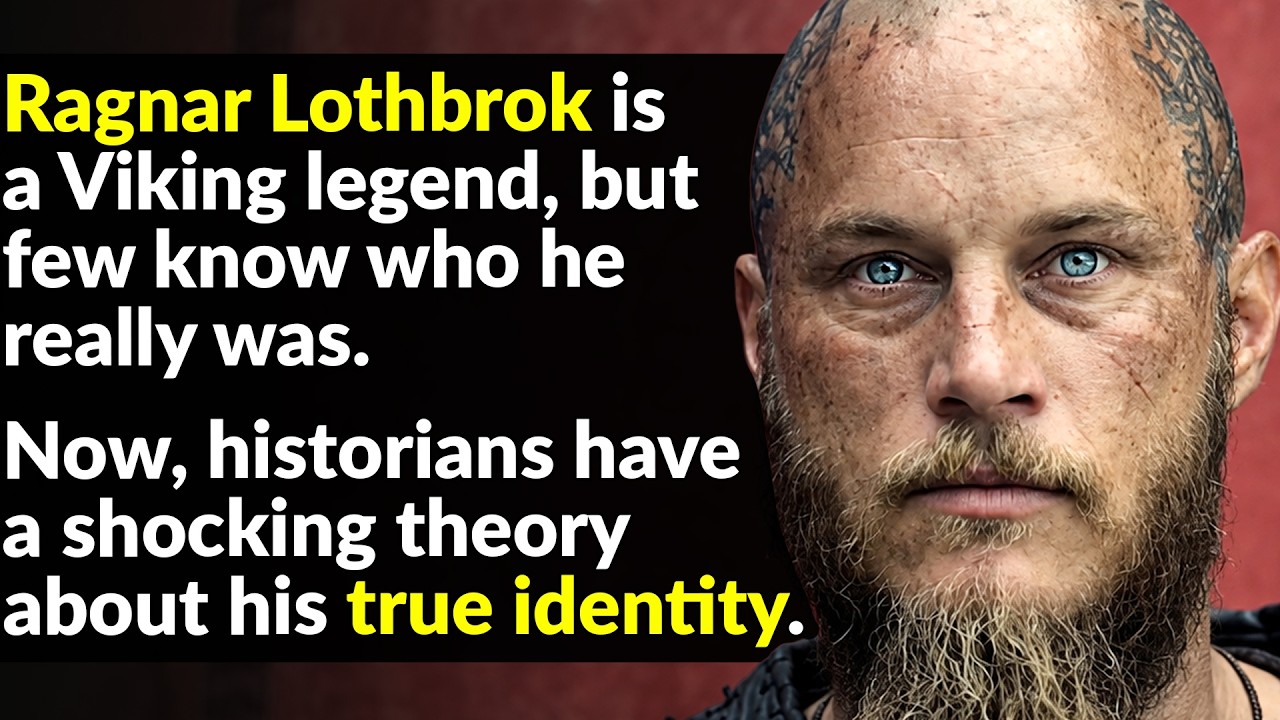
What we do know comes almost entirely from sources that are part history, part tall tale. The old Icelandic sagas, the epic poems, and the chronicles of the Norse world all describe Ragnar as the perfect Viking: massive in stature, handsome beyond measure, wise in council, generous to his loyal men, and merciless to his enemies. He was said to be the son of Sigurd Ring, a famous king of the Swedes and Danes, and his mother was Alfhild, a Swedish princess from the small kingdom of Alfheimr. Royal Nordic blood ran through him, but Ragnar claimed something far greater.
He boldly declared himself a direct descendant of Odin, the All-Father. That claim was not just arrogance. It gave his rule legitimacy and struck fear into the hearts of his enemies before he ever set foot on their shores. The problem is that Ragnar and his raiders were apparently too busy raiding and pillaging to keep detailed records of where they went and what they plundered.
The richest accounts of his deeds come from Icelandic sagas written decades, sometimes centuries, after his time. This has led many scholars to conclude that Ragnar Lothbrok was a composite figure, a single legendary name attached to the real exploits of several different Viking warlords whose victories were gradually merged into one heroic story. Even the name itself is inconsistent in the historical record. The Anglo-Saxon Chronicle, one of the most reliable sources for Viking activity, mentions two powerful Viking raiders around the year 840, one called Ragnall and another called Reginherus.
Most experts believe these names both refer to the same man, and that his deeds were truly epic. But the uncertainty has never fully resolved. The earliest heroic act attributed to Ragnar reads like something straight out of a fairy tale. According to legend, he faced a giant serpent, sometimes described as a dragon, that was guarding the beautiful maiden Thora Borgarhjort.
Once he killed the beast, he rescued the girl and won her hand in marriage. But most historians agree that Thora was not his first wife. That honor belonged to Lagertha, a fierce warrior woman. To win her hand, Ragnar had to kill a bear and a massive hound that prowled outside her home.
The Danish historian Saxo Grammaticus provides some of the only accounts of Ragnar’s turbulent marriages and private life. He claims Ragnar fathered a son named Fridleif and two daughters with Lagertha. Despite the fruitful marriage, Saxo records that Ragnar later divorced his first wife. Thora Borgarhjort, his second wife, was no mere damsel in distress.
She was a princess, the daughter of the Swedish king Herrod. Saxo again lists Ragnar’s sons by Thora: Radbard, Dunvat, Sigurd Snake-in-the-Eye, Bjorn Ironside, Agnar, and Ivar the Boneless. However, most historians believe the famous sons of Ragnar had a different mother. According to the sagas, Thora died of an unknown illness.
After that, Ragnar fell in love with Kraka, a woman of exceptional beauty and wisdom. The Saga of Ragnar Lothbrok states that Ivar the Boneless, Bjorn Ironside, and Sigurd Snake-in-the-Eye were the fruits of Ragnar’s marriage to Kraka, not Thora Borgarhjort. When Ragnar met Kraka, she was living with a poor farming couple, but that was not her true identity. She was actually Aslaug, the hidden daughter of Sigurd Fafnisbane, the famous dragon slayer himself, and the fearsome warrior woman Brynhildr.
Unlike his marriages to Thora and Lagertha, Ragnar did not have to kill any monster to win this bride. In Gesta Danorum, Saxo’s most prominent work, another woman appears in Ragnar’s life. While most sources agree he had only three wives, Saxo lists a possible fourth wife named Svanlaug. It is possible that Svanlaug was simply another name for Aslaug.
Ragnar was not known for his fidelity, though. Saxo records that Ragnar fathered another son, Ubbe, from a possibly extramarital affair with an unnamed woman. The stories of Ragnar killing dragons and battling great hounds may be pure legend, but his sons were certainly real. Multiple historical records from different times and places confirm that many of Ragnar’s sons actually existed.
Ivar the Boneless, Ubbe, Sigurd Snake-in-the-Eye, Fridleif, Halfdan Ragnarsson, and Bjorn Ironside are all confirmed historical figures. Nearly every one of them would go on to outshine their father. Because his sons were real, historians have worked hard to find conclusive evidence that Ragnar himself was also a real man and not just a myth. One piece of evidence often cited comes from the Chronicon Roskildense, a twelfth-century historical document that describes Ragnar as the father of the harsh Norse king Ivar, likely Ivar the Boneless, and his brothers.
Around the year 1190, the Danish historian Sven Aggesen became the first person in recorded history to use Ragnar’s full name as we know it today. Aggesen’s account carried more weight because he claimed that Ragnar’s son, Sigurd Snake-in-the-Eye, conquered Denmark, sent its king to Valhalla, married the king’s daughter, and then took the throne himself. That is all largely accurate. By the twelfth century, whether true or false, Ragnar’s legend had spread throughout the Norse world.
The Icelandic scholar Ari Thorgilsson, writing between 1120 and 1133, confirmed details of Ragnar’s exploits, specifically claiming that Ivar, son of Ragnar Lothbrok, was the one who put an end to King Edmund of East Anglia. The ninth-century poet Bragi Boddason composed Ragnarsdrapa, a skaldic poem that cemented Ragnar’s legendary status. While there is some debate over the poem’s exact origins, its story is clear. The words praise Ragnar, son of Sigurd, and speak of his magnificently decorated shield.
Part of the difficulty in confirming Ragnar’s life and deeds is that almost all information about him comes from Norse sources. That changed when the Norman historian William of Jumieges wrote about King Lothbrok of Denmark, who exiled his son Bjorn Ironside from his kingdom. History certainly records that Bjorn raided and plundered from Normandy to the Mediterranean. While writing the history of the Archdiocese of Hamburg-Bremen, the chronicler Adam of Bremen briefly mentioned Ragnar.
He wrote about the cruelty of Ivar the Boneless and his Norse warriors toward Christians, and he was careful to note that Ivar was the son of Ragnar Lothbrok. The famous stone tomb at Maeshowe in the Orkney Islands contains the only confirmed runic inscription that actually mentions Ragnar. The tomb was built long before Ragnar’s time, but the inscription speaks proudly of his sons. It says his sons were bold, and men of their strength and skill were rarely found.
The mention of his sons has led some to believe that Ragnar was actually a warrior woman, a shieldmaiden. Whatever the truth, whether man or myth, whether male or female, Ragnar was above all terrifying. Multiple sources confirm that he was a master of the Viking way of fighting, a terrifying style of lightning warfare. By striking with force and speed, and only when he had the advantage, Ragnar sowed fear in his opponents before they could even organize a proper defense.
The Siege of Paris in 845 is one of the best-documented Viking raids in history, and it was certainly Ragnar’s doing. Frankish accounts of the siege and sack specifically name Reginherus as the leader of the attack, though historians hesitate to definitively claim that Reginherus was Ragnar Lothbrok. But only Ragnar could have done something as horrific and grand as what happened next. Before reaching Paris, while making his way up the Seine, Ragnar was said to have raided Rouen.
This forced Charles the Bald to split his army in half, which allowed Ragnar to easily destroy both halves. But he did not stop there. Reports indicate that Ragnar took more than a hundred prisoners and hanged them on an island in the Seine to demoralize the Frankish troops. With his forces defeated and Paris sacked and burned, Charles the Bald had no choice.
He had to surrender to Ragnar. And this legendary Viking’s terms were outrageous. Just to make him leave, and to hope he never returned, Charles the Bald paid Ragnar an astonishing seven thousand livres of silver, one of the largest ransoms ever paid to Vikings. The Frankish chroniclers were understandably rather sore about the ransom they paid to Ragnar and his Vikings, but if their accounts are accurate, justice came quickly.
They claim that shortly after leaving Paris, Ragnar fell violently ill and died in Denmark. Christian writers called it divine retribution. But in Saxo Grammaticus’s Deeds of the Danes, Ragnar continued raiding after leaving Paris. Grammaticus claims Ragnar raided the Irish coast in 851 and even established a settlement near modern-day Dublin.
From there, Grammaticus writes, Ragnar sailed back and forth along the Irish and English coasts doing what he did best. Grammaticus was not alone in contradicting the Frankish accounts. The Icelandic sagas supported his claim that Ragnar went raiding in England, where they say he met a terrible end. According to these records, the Anglo-Saxon king Aella of Northumbria captured Ragnar and threw him into a pit filled with snakes in the year 865.
Other accounts of Ragnar’s death are less mythical. One account suggests he most likely perished doing what he loved: raiding. According to these stories, Ragnar met his end between 852 and 856 in a storm in the Irish Sea. Many scholars agree that this version of Ragnar’s final days is probably more accurate.
According to the thirteenth-century Icelandic Saga of Ragnar Lothbrok, by the time he sacked Paris, his sons Bjorn Ironside and Ivar the Boneless had already established their reputations as fearsome Vikings. But Ragnar did not want his sons to overshadow him. So he sailed to conquer England with only a small force of men and just two ships. Thus, according to legend, King Aella was able to defeat him.
When Ragnar’s sons learned of their father’s death, they did what any true Viking would do. They flew into a rage. They assembled a force of four thousand warriors and sailed for England. The Great Heathen Army was unlike any army the world had seen before.
When they reached Thetford, they put their swords to work against their enemies immediately, killing Edmund the Martyr in a famous incident. After that, they marched toward the city of York, where they fulfilled their father’s final prophecy. In that battle, Ragnar’s sons defeated King Aella and sent him to Valhalla, where Ragnar was waiting for him. This victory paved the way for Viking occupation and eventually led to the creation of the Danelaw.
Ivar led the Great Heathen Army for another five years and eventually died in Dublin in 873. After that, Halfdan took command of the Norse forces and conquered Wessex. When the Danish king Bagsecg fell during the Battle of Ashdown, Halfdan seized the opportunity to make peace with Wessex’s new and powerful king, Alfred the Great. Meanwhile, the rest of Ragnar’s sons were causing chaos elsewhere.
Between 857 and 859, historical records mention a fearsome Viking and skilled naval commander who raided Paris and its surroundings. The chronicle names this warrior simply as Bjorn. According to some sagas, Bjorn Ironside became king of Sweden and Uppsala, then passed the crown to his son Erik. Historians note that these accounts, if taken literally, contain chronological inconsistencies.
The legend of Ragnar Lothbrok, with its tales of dragon slaying and prophecy, may have all been a carefully constructed story to pave the way for Viking raids. Some historians believe that most of what we know about Ragnar was simply political propaganda. If it was, it was effective. Many of his sagas mention that the mere mention of his name was enough to spread panic among his enemies.
For centuries after his death, across the Norse lands, everyone wanted a piece of Ragnar’s glory. Kings, chieftains, and the fiercest Viking warriors all claimed descent from the legendary Ragnar Lothbrok, the man whose true face history may never uncover, but whose shadow stretched across an entire age.