Before reality television or social media ever existed, three sisters from Budapest turned glamour, charm, and an extraordinary string of marriages into a multi-decade public obsession. Between them, Magda, Zsa Zsa, and Eva Gabor married a combined 19 times, survived the Nazi occupation of Europe, and built lives that made them among the first celebrities famous simply for the force of their personalities. The story began with their mother, Jolie Kende, born in 1894 into a socially ambitious Hungarian family. She had dreamed of an acting career, but her parents arranged her marriage to a businessman named Vilmos Gabor, roughly twice her age.
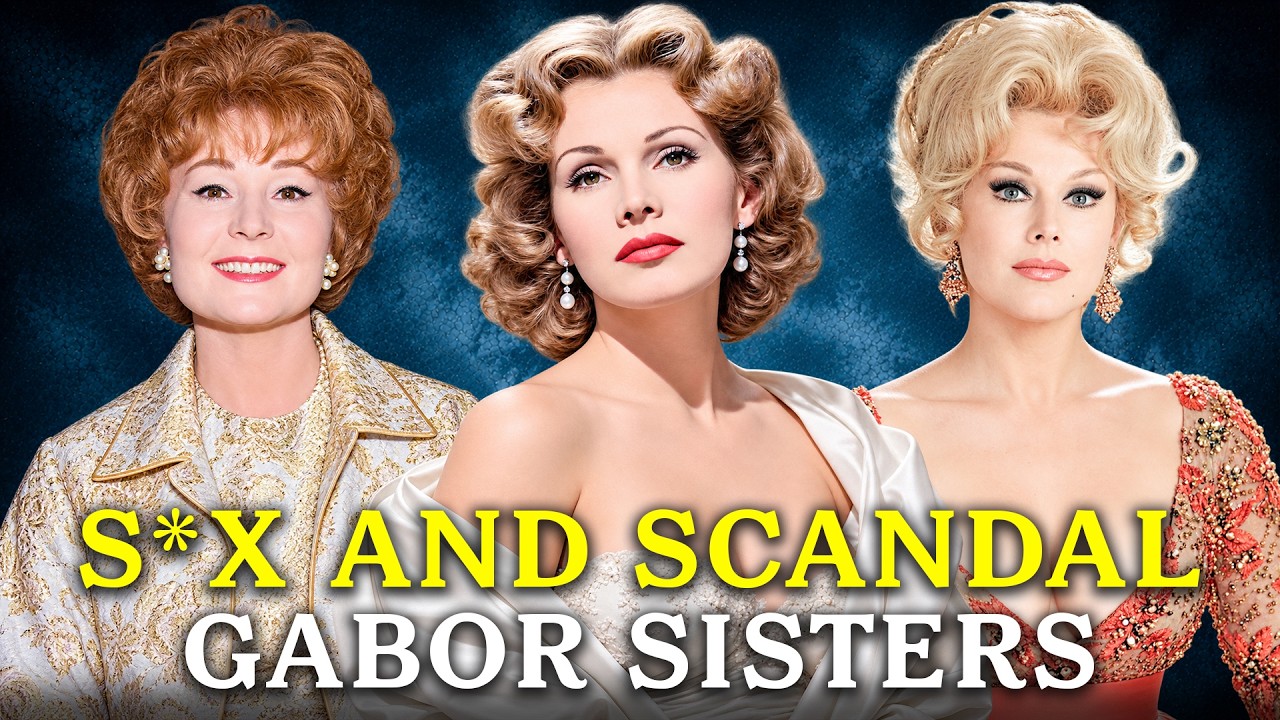
Only six months into the marriage, Jolie asked for a divorce, but discovered she was pregnant before the split was finalized. The union continued for another 22 years, producing three daughters: Magda in 1915, Zsa Zsa in 1917, and Eva in 1919. Jolie gave up her own stage ambitions and instead built a jewelry business in Budapest while devoting herself to raising daughters she was determined would achieve the success that had eluded her. From a young age, she trained them in the art of charm, beauty, and social presence, positioning them to capture the attention of wealthy and powerful men.
Biographers later described her approach as strategic, treating poise and fashion like serious academic subjects and ensuring her daughters mixed in elite European social circles. The family’s comfortable life was permanently upended by the rise of Nazism. Although the Gábors had converted from Judaism to Catholicism in 1928, that offered little protection when Hitler’s forces invaded Hungary in 1944. Magda, along with both her parents, was arrested after reportedly becoming involved in anti-Nazi underground resistance efforts.
Her survival depended on her personal relationship with the Portuguese ambassador stationed in Hungary, whose diplomatic maneuvering secured their release during one of the most dangerous chapters of the war. It was an experience that permanently shaped Magda and one she rarely discussed publicly in the decades that followed. Zsa Zsa, the most famous of the three, won the title of Miss Hungary in the 1930s while still a teenager. She married her first husband, a Turkish diplomat named Burhan Belge, in a union that ended in divorce.
In 1941 she followed her sister Eva to the United States, settling in New York before making her way to Hollywood. In 1942, she married hotel magnate Conrad Hilton, placing her at the center of one of the wealthiest business families in the country. She was 25; he was 55. The marriage produced her only child, daughter Constance Francesca Hilton, born in 1946.
Behind the glamorous public image, however, the marriage concealed a difficult private struggle. Zsa Zsa’s mental health deteriorated significantly during these years, and she was diagnosed with bipolar disorder, a condition carrying enormous social stigma at the time. In 1945, she was institutionalized against her will, a decision made by Hilton. Friends and biographers later described the experience as one of the most traumatic chapters of her life, one she rarely discussed openly.
After her divorce from Hilton in 1947, Zsa Zsa’s romantic life continued along a path that made her one of the most married women in American celebrity history. She married actor George Sanders in 1949, a union lasting roughly six years. Following his divorce from Zsa Zsa, Sanders went on to marry her elder sister, Magda, in 1970, reportedly out of a desire to needle his former wife rather than genuine romantic devotion. That marriage lasted barely a month.
Zsa Zsa reportedly found the strange episode more amusing than upsetting. She continued marrying through the following decades, taking husbands including an oil magnate, an investment banker, and several others. Her ninth and final marriage, in 1986, was to a man calling himself Prince Frederic von Anhalt, and the two remained legally married until her death three decades later. Von Anhalt’s claimed title proved complicated, with royal genealogists questioning its legitimacy and noting it was reportedly acquired through a legal adult adoption arranged with a member of the German aristocracy rather than hereditary lineage.
Across her nine marriages, Zsa Zsa developed a reputation for candid and often funny public reflections on love. She famously joked that every woman ought to have at least three husbands and that she always kept a former husband’s house whenever she left him. She appeared on shows ranging from Gilligan’s Island to The Love Boat, delivering quotable commentary that made her a consistently entertaining television presence. In June 1989, Zsa Zsa was driving her Rolls-Royce through Beverly Hills when police officer Paul Kramer pulled her over for expired registration tags.
According to the officer, she became belligerent and slapped him across the face. Gabor maintained she had acted in self-defense, claiming the officer had mistreated her. The resulting criminal trial in September 1989 became a media spectacle, with Gabor arriving at court in elaborate outfits each day, accompanied by her husband, her daughter, and even her personal hairdresser. At one point she walked out of the courtroom entirely during contentious testimony.
She was found guilty of battery against a police officer, along with driving with an expired license and possessing an open container of alcohol, which reportedly belonged to her husband. She was sentenced to three days in jail, fined, and required to complete community service and a psychiatric evaluation. Rather than expressing remorse, she suggested jail might actually prove pleasant since it would give her time to write her memoir. The incident, remembered as the slap heard around the world, cemented her reputation as one of the most unpredictable public figures of her generation.
While Zsa Zsa built her fame around personality and marriages, her younger sister Eva pursued a more disciplined acting career. Eva was the first sister to arrive in the United States, immigrating after her 1937 marriage to Swedish osteopath Eric Drimmer. She appeared in respected films throughout the 1940s and 1950s, including A Royal Scandal and The Last Time I Saw Paris. In 1953 she was given her own television talk show.
Her most enduring role came in 1965 when she was cast as Lisa Douglas in the CBS sitcom Green Acres, running six seasons and remaining popular in syndication for decades. She later voiced the character Duchess in Disney’s 1970 animated film The Aristocats. Despite her professional success, Eva reportedly lost the man she considered the true love of her life under circumstances she rarely discussed publicly. Magda remained the most private of the three sisters, a contrast biographers attributed to the trauma she endured during the Nazi occupation.
Despite her lower public profile, she accumulated six marriages, including the brief, famously spiteful union with George Sanders. She had begun an acting career in Hungary before the war, appearing in a handful of film productions, but once in America she largely stepped back from acting and focused on managing a jewelry business, echoing her mother’s earlier career. Those close to the family often described Magda as the more grounded and emotionally guarded of the three. Behind the glamour, the family carried genuine tragedy.
Zsa Zsa’s only child, Francesca Hilton, worked as a photographer, actress, and publicist. Her relationship with her mother grew increasingly strained following Zsa Zsa’s marriage to von Anhalt, with Francesca battling her stepfather for years over access to her ailing mother and control of Zsa Zsa’s finances. Francesca died in January 2015 at age 67 following an apparent heart attack and stroke. By that point Zsa Zsa, then 97, required around-the-clock care following a series of health crises, including a 2005 stroke, a broken hip, and the 2010 amputation of one leg due to gangrene.
Zsa Zsa Gabor died on December 18, 2016, at age 99, from heart failure at her Bel Air home. Eva had died decades earlier on July 4, 1995, at age 76, following complications from a fall suffered while on vacation in Mexico. Magda passed away on June 6, 1997, at age 81. Their mother, Jolie, lived to the age of 98, passing away in April 1997.
Between them, the sisters married a combined 19 times, survived a devastating world war, built genuine careers across film, television, and business, and became among the first celebrities famous simply for the sheer force of their own personalities. One slapped a police officer in front of international news cameras and turned the resulting trial into spectacle. Another lost the only man she ever truly loved, a heartbreak she rarely spoke of. And the eldest spent so much of her life avoiding the spotlight that most people never learned her full story, one that included genuine wartime survival.
Their story captures both the genuine allure and the very real human cost of lives lived deliberately in the public eye.