On the afternoon of April 14, 1865, a widow named Mary Surratt traveled from her boarding house in Washington to a tavern in Maryland, carrying a package for a lodger she trusted. She asked no questions. By nightfall, Abraham Lincoln was dead. That errand appeared ordinary at the time, but it became the detail that sent her to the gallows.
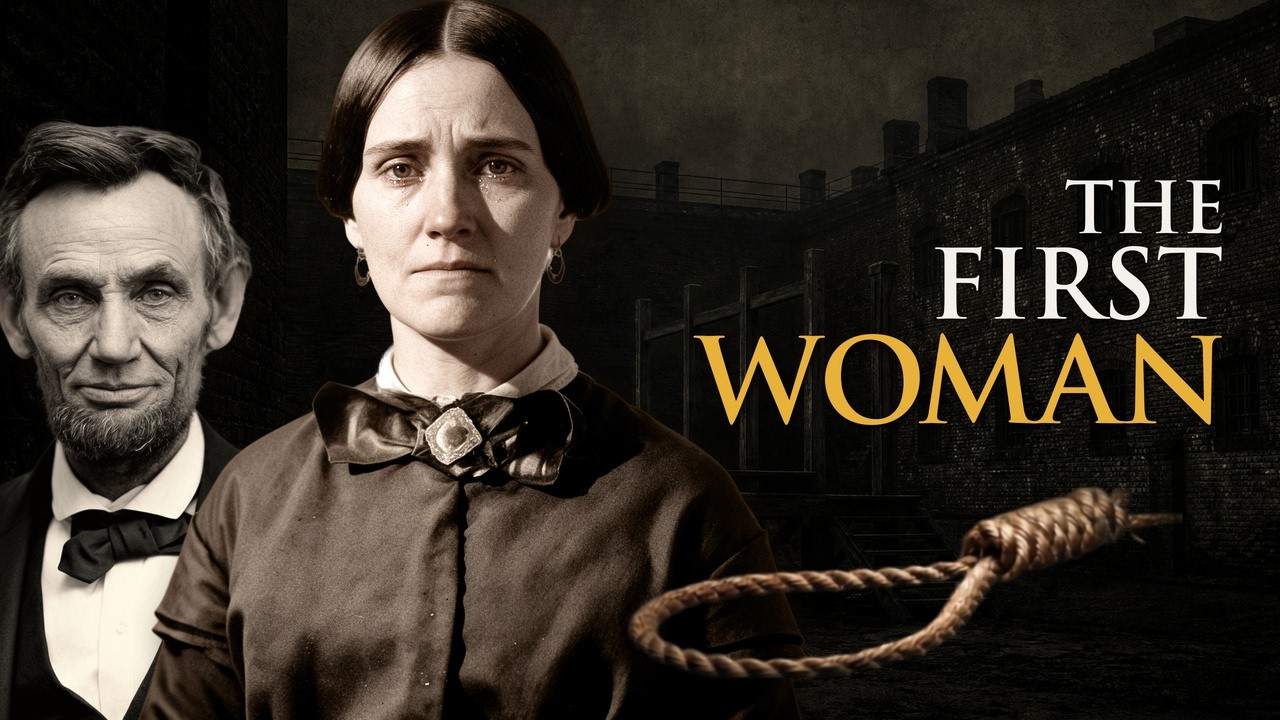
Mary Elizabeth Jenkins Surratt was born in the early 1820s near Waterloo, Maryland. No record survives to fix the year precisely, so historians estimate her age in her early forties. Her father died when she was young, and at twelve she was sent to a Catholic academy in Alexandria, where nuns taught her to read the Bible, keep household accounts, and never raise her voice. She kept all three habits for the rest of her life.
At sixteen, she married John Harrison Surratt, a farmer eleven years her senior. In 1851, a fire destroyed the home they were building. Two years later, they completed a tavern instead, thirteen miles southeast of the capital, at a crossroads that would eventually bear their name: Surrattsville. Mary ran the local post office there for a time, sorting mail for neighbors who trusted her without hesitation.
The family moved to Washington during the war, when the capital’s population tripled and decent lodging became scarce. The Surratts owned a narrow house at 604 H Street, and Mary, now a widow facing heavy debts, turned it into a boarding house. She rented rooms and served meals twice a day at a long table in the front parlor. She kept a rosary in her apron pocket, attended Mass every Sunday, and maintained a strict sense of propriety.
Her boarders were mostly government clerks far from their families. One of them, a quiet young clerk named Louis Weichman, rented a room in the winter of 1864 and would later describe her under oath as a perfect lady. He meant it as a simple observation, the kind a lodger makes about a landlady he respects. He had no idea how much those words would later matter.
In January 1865, an actor known for visiting the house began coming by. He arrived first to see her son, John. He was charming, restless, and free with money that never seemed to come from anywhere clear. He brought small gifts and made the younger lodgers laugh.
Mary set a place for him at her table as she did for anyone who came through her son’s door. His name was John Wilkes Booth. By late winter, the number of visitors to 604 H Street had increased. They often came in the evening and climbed to the room occupied by John Surratt.
Booth was among them. Weichman, from his room at the end of the hall, began noticing things he could not fully explain: maps of Virginia back roads, low voices that stopped when a lodger passed, a pistol left carelessly on a bed. For most of that winter, the plan behind those closed doors was not to kill the president. It was to kidnap him.
The conspirators hoped to seize Lincoln on a Washington road, smuggle him south, and exchange him for thousands of Confederate prisoners rotting in Union camps. On March 17, they attempted it, waiting along a route Lincoln was rumored to take. He never came. His schedule changed at the last minute for reasons unrelated to them.
The men returned to Washington and gathered again under Mary’s roof. In March, a stranger with broad shoulders who called himself Mr. Wood rented a room for several days. He introduced himself to the other lodgers as a Baptist preacher passing through the city.
His real name was Lewis Powell, a former Confederate soldier who would later put a knife to the throat of Secretary of State William Seward. Mary served him breakfast at her table and said grace over his plate. She had no way of knowing who he truly was. Weichman remembered one evening when Booth spread a map across the parlor table, tracing a route south with his finger while John and two other men leaned in close.
Mary entered with a tray of tea and set it aside. According to Weichman’s account, she left the room almost immediately, returning to her room without a word about the map laid out on her furniture. This is the chapter historians have never been able to close. What did Mary Surratt actually know as she sat at her table while these men talked?
Weichman, who watched more closely than anyone, testified under oath that there were maps, pistols, and whispered plans in her house. But he also testified that Mary herself usually left the room when the talk turned serious, that she went to bed early. Defense lawyers pointed out that a respectable Catholic widow in 1865 would not have sat in the middle of men’s business, even in her own home. Prosecutors drew the opposite conclusion: that a landlady misses nothing under her own roof.
What is certain is that her son had become one of Booth’s closest men in the conspiracy. John Surratt was present in the planning, trusted with its details, gone for days on errands his mother did not ask about. He would come home some nights smelling of horses and river mud, say little, and leave again before breakfast. Whatever Mary knew or did not know about the larger plot, she knew her son was involved in something serious.
In early April, Richmond fell. The Confederacy Mary had quietly supported for four years collapsed within days. For Booth, this changed everything. The kidnapping plot had been designed to force a prisoner exchange, but with no Confederate government left to bargain with, it became pointless.
Something darker began replacing it in the room above the kitchen. The woman setting the table below did not know the plan had stopped being a kidnapping at all. On the afternoon of April 14, Mary Surratt hired a carriage and rode to the tavern at Surrattsville, ostensibly to settle a debt a neighbor owed the family for a piece of land. Before she left Washington, Booth stopped at the house and spoke with her privately for a few minutes on the front doorstep.
At the tavern, she handed the keeper, John Lloyd, a package wrapped in paper. Lloyd testified under oath that it contained a field glass. He said Mary told him the firearms hidden in the tavern should be ready that night because someone would come to collect them. Her lawyers spent the rest of her life insisting Lloyd had a motive to lie and that his drinking made his memory unreliable.
Both were true. Neither settled the question. She returned to Washington that evening and ate dinner with her lodgers like any other night. She had no way of knowing the purpose of that field glass.
By the time she sat at her table, Abraham Lincoln may have had only three hours left to live. That night at Ford’s Theatre, John Wilkes Booth entered the president’s box and shot Lincoln once behind the left ear before leaping to the stage and escaping into the darkness. Lincoln died the next morning. Within hours, Washington was a city under siege.
Bridges were guarded, trains stopped, and a bounty was posted for Booth. Within a day, investigators had a name that kept appearing in Booth’s known movements: Surratt. On the morning of April 17, three days after the assassination, soldiers came to 604 H Street to arrest Mary and everyone in the house. They searched the rooms one by one, removed the crucifix and the picture of the Sacred Heart from the parlor wall to look behind them.
Anna, Mary’s daughter, wept and begged an officer for a few minutes alone with her mother to pray. While the search was under way, there was a knock at the front door. A large man stood on the step, carrying a pickaxe over his shoulder and a coat sleeve rolled up. He said he had been hired to dig a drain for Mrs.
Surratt and had come to ask when she wanted the work done. It was Lewis Powell, the quiet boarder who had eaten breakfast at her table in March, arriving at that exact moment while soldiers stood in her parlor. He was recognized within the hour. Hours earlier, he had broken into Seward’s home and stabbed him nearly to death.
When asked whether she knew the man, Mary said she did not, that she had never seen him in her life. Depending on which account one believes, that was either a lie that sealed her fate or a moment of genuine confusion in a house full of armed strangers. She was arrested anyway, along with Anna and every lodger still under her roof. The government’s key witness was the same young clerk who had once called her a perfect lady.
Louis Weichman had been arrested himself, held in custody, and questioned for hours by men who made clear what happened to boarders who protected conspirators. Like most men in his position that month, he chose to testify rather than raise suspicion. His statements about the maps, the guns, and a landlady whose rooms were visited by dangerous men became the backbone of the government’s case. Her lawyers would describe him for the rest of the trial as a man who traded a woman’s life to save his own.
The trial began on May 9, 1865, inside the Old Arsenal Penitentiary, in a courtroom built for soldiers, not defendants. There was no jury because there was no jury at all. Nine Union Army officers sat behind a long table, authorized to convict her and sentence her in one motion. The summer heat of Washington pressed into the room through closed windows, and armed guards stood along every wall.
Mary was the only woman among eight defendants. By order of the court, she wore a heavy black veil throughout most of the proceedings. Her health deteriorated early; she suffered fainting spells severe enough that a military surgeon was called more than once. Her Catholic priest, Father Jacob Walter, visited her cell throughout the seven-week trial.
He later described a woman who prayed constantly and insisted to him privately that she knew nothing of any conspiracy against the president’s life. A priest’s account of a private conversation was not evidence the court could consider. But it remains the closest thing history has to Mary Surratt’s honest voice from inside that cell. Her legal defense was hopelessly unequal from the start.
Reverdy Johnson, a former U. S. senator and one of the most respected lawyers in the country, agreed to take her case but was forced off it within days after commission members objected that Johnson had once questioned the loyalty oath they required of witnesses. She was left with two young lawyers, Frederick Aiken and John Clampitt, both in their twenties, neither with real experience in capital cases.
Anna Surratt attended most of the trial. She filed repeated petitions to visit the White House and plead her mother’s case in person, and according to more than one account she was turned away at the gate before the trial even ended. It was the beginning of a vigil that would not stop for weeks. The government’s case rested heavily on Weichman’s testimony, which placed Mary at the center of the conspiracy.
Her lawyers argued that she was a widow running a boarding house, not a mastermind running a plot, and that her silence in her own parlor was a matter of propriety, not guilt. The prosecution responded that the house was not neutral ground: dangerous men had gathered under her roof for months, eaten at her table, and hidden weapons in her tavern. On June 30, after seven weeks of testimony, the commission convicted all eight defendants. Four were sentenced to prison.
Four others—Powell, Herold, Atzerodt, and Mary Surratt—were sentenced to death by hanging. She was the first woman in the history of the U. S. government to receive a federal death sentence.
The verdict contained one detail the newspapers did not publish in their first editions. Five of the nine officers who had sentenced her to death also signed a petition asking that her sentence be commuted to life in prison. Their reasons included her age, her sex, and the weakness of the evidence against her compared with the men beside her. The paper passed from the commission to Judge Advocate General Joseph Holt, whose duty was to deliver the complete record, including the petition, to President Andrew Johnson for final review.
What happened next depends entirely on which man’s account one believes. Holt insisted for the rest of his life that he placed the full record before Johnson with the petition on top, and that the president read it and signed the death warrant anyway. Johnson insisted just as firmly that he never saw any petition for mercy at all. He signed the death warrant, he always maintained, believing no recommendation was attached to it.
No document has ever emerged to settle which one was telling the truth. The night before the execution, Anna Surratt went to the White House herself. She had been trying to reach the president for weeks. According to multiple accounts, she was stopped before she could reach Andrew Johnson and turned back at the gate or the steps by men who refused to let the daughter of a condemned woman pass.
She knelt and pleaded on the steps as long as they allowed her to stay. She returned to the prison empty-handed, in time only to say goodbye to her mother through the bars of a cell neither of them had ever expected to see. The execution was set for noon the next day, July 7, 1865, in the yard of the Old Arsenal Penitentiary. The temperature reportedly exceeded one hundred degrees Fahrenheit.
Soldiers ringed the yard. A photographer named Alexander Gardner was permitted to place his camera at a distance. His photographs of the gallows, the ropes, and the four hooded figures standing over four freshly dug graves remain among the only surviving images of a federal execution from that century. Before the four were led out, Lewis Powell turned to the officers guarding him and said plainly that Mary Surratt did not deserve to die and knew nothing of the conspiracy.
He was the same man who had once eaten breakfast at her table under a false name, the same man whose pickaxe had appeared at her door on the morning of her arrest. It changed nothing. He was hanged minutes later beside her. Mary Surratt was so weak that guards had to support her by the arms as she walked to the gallows.
An umbrella was held over her to shield her from the sun. She is said to have murmured, as the noose was adjusted around her neck, a single plea to the officer beside her: “Please, don’t let me fall. ” Whether those were her exact words has been debated by historians for a century and a half, but the fact that she said something very close to that in that moment is not seriously disputed by anyone who has studied the case. At 1:26 p.
m. , the platform dropped beneath the four prisoners at once, and the yard fell silent except for the creaking of ropes. Mary Surratt became, at that moment, the first woman ever executed by the federal government of the United States. Her son, the reason all of it had happened in the first place, was not there to see it.
He had left the country weeks earlier, hidden under another man’s name and another man’s clothes, and would remain gone for nearly two more years. The government that could not catch him executed his mother instead. John Surratt Jr. was in Elmira, New York, on an errand as a Confederate courier on the night of Lincoln’s assassination, according to his later account, far from Ford’s Theatre and far from his mother’s house.
News of the assassination and his mother’s arrest reached him within days. He did not return home. He did not surrender. He fled.
Reward notices printed within days offered a bounty for John Surratt second only to the one for Booth himself. He crossed into Canada within a week, moving through a network of Catholic priests and Confederate sympathizers who hid him in rectories and farms around Montreal for months. Federal agents combed the border cities while his mother sat in a cell in the Old Arsenal Penitentiary. They found nothing.
By September 1865, two months after her execution, he slipped aboard a ship bound for Europe under an assumed name. In Rome, he joined the Papal Zouaves, a volunteer army defending what remained of the Pope’s territories, calling himself John Watson. He trained and marched under that name for more than a year, serving as a soldier in the Vatican while an American noose waited for him at home. Fellow Zouaves knew him only as a religious, unremarkable recruit.
His run ended by chance: a fellow recruit, a Canadian named Henri Beaumont de Sainte-Marie, recognized him from newspaper sketches and reported him to American diplomats for a reward. Papal police arrested Surratt in the town of Veroli in November 1866. He escaped custody within days and fled south to Alexandria, Egypt, where American consular officials finally captured him for good. He was returned to the United States in early 1867 to stand trial for the same conspiracy that had sent his mother to the gallows twenty months earlier.
By then, the legal ground had shifted. The military commissions that had tried the other conspirators had lost their authority over civilians in peacetime, after a Supreme Court ruling issued just months after Mary Surratt’s execution. That ruling held that military courts could not try civilians while ordinary courts remained open and functioning—the same protection Mary Surratt had been denied. John Surratt would be tried in a civilian court instead, with a proper twelve-person jury and all the safeguards his mother never had.
The trial ran from June to August 1867, longer than his mother’s had. Witnesses largely told the same story Weichman had told two years earlier: maps, weapons, a house on H Street, a plot that shifted from kidnapping to murder. The jury deliberated for days and could not reach a verdict. Eight favored acquittal.
Four insisted on conviction. The judge declared a mistrial and discharged them. The prosecution considered retrying him, then reconsidered before the statute of limitations on the remaining charges quietly expired in 1868. The government dropped the case.
John Surratt walked out of custody a free man, never convicted of anything. In 1870, he stood on a stage in Rockville, Maryland, and delivered a public lecture describing his role in the Confederate courier network and the original kidnapping plot. It was the first and only time he spoke publicly in any detail about those years. He denied, as he always did, any role in the killing itself.
The lecture stirred enough public anger that he never gave another. He went on to marry, study for a time, and work for decades as a treasurer for a steamship company in Baltimore. He had children who knew their father as a quiet, respectable man. He died in 1916, fifty-one years after his mother’s execution, outliving nearly everyone else in this story.
Five officers had once signed a petition asking for Mary Surratt’s life, and no one could later agree whether the president who executed her had ever seen it. Her son needed no petition. A jury he was legally entitled to, and a mother he had left behind, did the rest. Anna Surratt lived thirty-nine years after her mother’s execution.
By nearly all accounts, she spent almost none of them talking publicly about it. She married in 1869 and took her husband’s name, moving away from the newspapers that had once printed her tear-stained face outside the White House gates. She raised her children in relative quiet. When she died in 1904, she was buried not under the name the nation had made infamous, but under the name she had chosen for herself.
Mary Surratt was not moved to a cemetery immediately. She was buried, along with the three men hanged beside her, in a shallow grave inside the prison walls, the ground left unmarked so it would not be easy to find. President Andrew Johnson did not approve the family’s request to recover the remains until 1869, four years later. She was reinterred at Mount Olivet Cemetery in Washington under a headstone bearing her name and nothing else.
No mention of a trial, a commission, or a noose. The house at 604 H Street did not remain a boarding house for long. The family sold it a few years after the trial, and it passed through a series of owners and businesses over the following century. A visitor walking that part of H Street today finds a restaurant occupying the ground floor of the same brick building.
The windows of the dining room overlook the same corner where lodgers once climbed the stairs for dinner. Few of the people eating there know what the building once was. The Old Arsenal Penitentiary itself no longer stands as it did that July. Its ground is now part of Fort Lesley J.
McNair, an active military installation. A small marker there is one of the only public recognitions that four people were hanged on that ground in the summer of 1865. The petition that might have saved her life still exists. It is preserved today in the National Archives: one page, five signatures, the document Joseph Holt and Andrew Johnson each swore for the rest of their lives that the other man mishandled.
Holt spent most of his remaining years publishing pamphlets and affidavits defending his conduct in the case. No new evidence has ever emerged to settle which man was telling the truth. The paper itself offers no opinion. It simply remains, creased and yellowed, long after the two men and the woman it was meant to save are gone.
Her story resurfaced in 2010 when a feature film about her trial reintroduced Mary Surratt to audiences who had never heard her name. The controversy it revived was the same one that had split the commission that convicted her: whether a landlady’s silence was evidence of guilt, or simply a woman keeping to her own side of the parlor. The table at 604 H Street is not set for anyone now. CONTENT:
On the afternoon of April 14, 1865, Mary Surratt, a widow who ran a Washington boarding house, rode thirteen miles into rural Maryland on an errand she treated as routine.
She delivered a small package to the keeper of a tavern she owned, said nothing more than what she was asked to say, and returned to the capital in time to prepare dinner for her lodgers. That evening, Abraham Lincoln was shot at Ford’s Theatre. The package, meant for John Wilkes Booth, was later described as a field glass. Within days, investigators had a name that kept surfacing in Booth’s movements: Surratt.
Mary Elizabeth Jenkins Surratt was born in the early 1820s near Waterloo, Maryland, though no record fixes the exact year. Left fatherless young, she was educated by nuns in Alexandria, who taught her scripture, household accounts, and silence. At sixteen she married farmer John Harrison Surratt, who was eleven years her senior. A fire destroyed their home in 1851, and by 1853 they had built a tavern at a crossroads that would become known as Surrattsville, Maryland, with Mary running the post office there for a time.
After her husband died in 1862, she was left with debts, three children—Isaac, Anna, and John—and no income of her own. She turned the family’s townhouse at 604 H Street in Washington into a boarding house. She served meals twice a day at a long table in the front parlor, attended Mass every Sunday, kept a rosary in her apron pocket, and insisted on quiet grace before every meal. Her lodgers were mostly government clerks who saw her as a stern but caring figure.
One clerk, Louis Weichman, would later describe her under oath as a perfect lady. Her older son Isaac had joined a Confederate regiment in Texas. Her youngest, John Jr. , worked as a Confederate courier, carrying messages south across the Potomac, often absent for days.
In January 1865, a charismatic actor named John Wilkes Booth began visiting the house, first to see John Jr. Booth brought gifts and charm, and Mary set a place for him at her table without question. By late winter, Booth’s visits had turned serious. In a room upstairs, he and a circle of men—including John Jr.
—spent hours over maps of Virginia back roads, plotting first to kidnap Lincoln and exchange him for Confederate prisoners. That plan failed in March when Lincoln did not appear along the route they had chosen. The men regrouped at H Street. At one point a stranger calling himself Mr.
Wood rented a room for several days. Mary served him breakfast; he was Lewis Powell, who would later attack Secretary of State William Seward with a knife. Weichman, watching from the end of the hall, noticed maps, a pistol left on a bed, and voices that stopped when anyone passed. When Booth once spread a map across the parlor table, Mary entered with a tray of tea, set it down, and left the room without a word.
That moment became the core of a century-long dispute: whether she knew what was being planned beneath her roof, or whether she observed the bounds of a respectable widow who did not sit among men’s business. In mid-April, with Richmond fallen and no Confederate government left to bargain with, Booth abandoned the kidnapping plan for something far darker. On Holy Saturday, April 14, Mary hired a carriage and drove to Surrattsville, ostensibly to settle a small debt. Before she left, Booth spoke with her privately on the doorstep.
At the tavern, she handed keeper John Lloyd a package wrapped in paper, which he later testified contained a field glass. She reportedly told him the weapons hidden in the tavern should be ready that night because someone would come for them. Lloyd’s testimony—and his credibility, given his drinking—would become central to the case against her. She was back in Washington by evening and ate dinner with her lodgers.
Hours later, Booth shot Lincoln at Ford’s Theatre. Lincoln died the next morning. Within days, Mary and everyone in the house were arrested. On the morning of April 17, while soldiers searched the rooms, Lewis Powell knocked at the front door, saying he had been hired to dig a drain for Mrs.
Surratt. Asked if she knew him, Mary said she did not. Powell, recognized within the hour and linked to the attack on Seward, stood nearby as she denied ever seeing him. She was taken into custody along with Anna and every lodger still inside.
Her trial opened May 9, 1865, before a military commission of nine Union Army officers. There was no jury. She was the only woman among eight defendants and wore a heavy black veil throughout. Her health collapsed under the strain; she fainted repeatedly, and a military surgeon was called more than once.
Her original lawyer, Reverdy Johnson, a former senator, was forced off the case within days after commission members objected to his earlier criticism of loyalty oaths. She was left with two young attorneys in their twenties. The prosecution leaned heavily on Weichman, who had been arrested, held, and questioned before testifying that Mary had been present during key planning sessions and had known about the weapons. The defense argued she was merely a landlady whose silence was propriety, not complicity.
No written evidence ever placed a gun or a plan directly in her hands. On June 30, the commission convicted all eight defendants. Four were sentenced to prison. Mary Surratt, along with Powell, David Herold, and George Atzerodt, was sentenced to hang.
She was the first woman in American history to receive a federal death sentence. A crucial detail was not published at first. Five of the nine officers who voted to convict her also signed a petition asking that her sentence be commuted to life imprisonment. They cited her age, her sex, and the weakness of the evidence against her compared to the men beside her.
The petition, with the full record, went to President Andrew Johnson through Judge Advocate General Joseph Holt. What happened to that petition remains unresolved. Holt insisted until his death that he placed it before Johnson, who signed the death warrant anyway. Johnson insisted until his death that he never saw any petition for mercy.
No document has ever settled the dispute. Anna Surratt spent the weeks before the execution trying to reach the president. According to multiple accounts, she was turned away at the White House gate more than once. On the night before the hanging, with her mother’s death just hours away, she returned and pleaded on the steps outside the White House until she was refused again.
She made it back to the prison only in time to say goodbye through the bars of a cell. The execution took place at 1:26 p. m. on July 7, 1865, in the yard of the Old Arsenal Penitentiary, in heat that reportedly exceeded one hundred degrees.
Mary was so weak that guards had to support her as she walked to the gallows. Witnesses said she asked the officer beside her, “Please, don’t let me fall. ” Before the trapdoor opened, Lewis Powell turned to the soldiers and said Mary Surratt did not deserve to die and knew nothing of the conspiracy. She was hanged beside him minutes later.
A photographer named Alexander Gardner recorded the scene; the images survive as among the only pictures of a federal execution from that era. Her son John Jr. was not there to see it. He was in Elmira, New York, according to his own account, and went into hiding when he learned of the assassination and his mother’s arrest.
He fled to Canada, then to Europe, and eventually served in the Papal Zouaves in Rome under the name John Watson. He was recognized by a fellow recruit in 1866, arrested in Italy, and finally captured in Egypt. By the time he was returned to the United States for trial in 1867, the legal world had changed. The Supreme Court had ruled that military commissions could not try civilians while civilian courts were open, meaning John could not be tried the way his mother had been.
He faced a civilian court with a jury and full legal protections. The trial ended in a hung jury: eight favored acquittal, four favored conviction. Prosecutors declined to retry him, and the charges quietly expired in 1868. He walked free, never convicted of anything.
Surratt later gave a single public lecture in 1870, describing his role as a Confederate courier and his involvement in the kidnapping plot, but denying any part in the murder itself. It drew enough public anger that he never spoke publicly about the matter again. He married, raised a family, and worked for decades as a treasurer for a Baltimore steamship company. He died in 1916, fifty-one years after his mother’s execution.
Anna Surratt lived for thirty-nine years after her mother’s death. She married in 1869 and rarely spoke of the trial. She was buried under her married name. Mary Surratt’s body remained in an unmarked grave inside the prison walls until 1869, when President Andrew Johnson approved the family’s request to recover the remains.
She was reburied at Mount Olivet Cemetery in Washington under a simple headstone bearing her name. The petition that might have saved her life survives in the National Archives, a single page with five signatures. Joseph Holt, who insisted he had delivered it to the president, and Andrew Johnson, who swore he never saw it, both carried their competing versions of events to their graves. No document appears to have ever resolved the question.
The house at 604 H Street was sold by the family a few years after the trial. It is now home to a restaurant, where few of the diners know what the building once was. The prison yard is now part of Fort Lesley J. McNair, marked by a small sign.
The last public note of her story came in 2010, when a feature film re-examined her case and revived the same question the commission could not settle: whether a woman’s silence in her own home was proof of her guilt, or proof only that she lived, and died, within the narrow bounds of what her world allowed a respectable widow to be.