On June 3, 2000, Queen Elizabeth II walked into Highgrove, her eldest son's country house in Gloucestershire, for a birthday party. The guest of honor was King Constantine of Greece, celebrating his 60th birthday. Nothing about the evening seemed suspicious on paper, yet within a day this particular party would dominate front pages.
Camilla Parker Bowles was somewhere on the guest list. The Queen had long kept Camilla at a strict formal distance that had hardened over time into something resembling an avoidance policy. The Queen knew Camilla would be there. She attended anyway, and what passed between the two women that evening stayed inside the walls of Highgrove.
What leaked afterward concerned the attendance itself. By the next day, the palace told journalists the timing was right, an explanation so bland it could have been printed on a biscuit tin. Newspapers treated the party as the Queen's first official acknowledgment of the relationship between Charles and Camilla, the woman many Britons still blamed for the collapse of his marriage.
For Elizabeth II, the attendance spoke louder than any speech. She rarely communicated in words, relying instead on where she chose to appear. Twenty-two years later, that same Queen would tell the entire nation she sincerely hoped Camilla would carry the title of Queen Consort.
Between those two dates lies a story the tabloids reduced to a single word, "hate," along with a darker rumor about martinis at Balmoral and the phrase "that wicked woman." Which version is accurate? Did Elizabeth II truly despise Camilla, or was something colder and more calculated behind all those years of frost?
As far as the documented record allows, the answer runs through a love affair that failed in the early 1970s, a royal marriage that collapsed in public view, a Queen Mother who, according to one royal author, hated Camilla, and an institution that had already lost a king to a romantic relationship in the twentieth century.
Hate sums it up neatly. The real motive looks less like a grudge and more like risk management in royal dress.
The tabloid theory deserves a fair hearing before being dismissed, because the evidence at first glance looks damning. Throughout the 1970s and 1980s, the Queen kept a strict formal distance from Camilla, and once the relationship became public in the 1990s, that distance looked less like protocol and more like total rigidity.
But distance alone proves nothing. The Balmoral story, by contrast, seems like conclusive evidence, at least on first hearing. According to an unnamed source cited by investigative journalist Tom Bower in his biography "The Rebel Prince," Charles confronted his mother at Balmoral in 1998 and asked her to soften her hostility toward Camilla. The Queen, after several glasses of martinis, refused to countenance his adultery and allegedly called Camilla "that wicked woman."
If true, it is among the harshest statements ever attributed to her. The April 2005 wedding offers further evidence. When Charles finally married Camilla, the Queen and Prince Philip stayed away from the civil ceremony at Windsor's Guildhall, and press coverage at the time framed her absence as a personal insult. A mother announcing her feelings in the only language a monarch can use without opening her mouth.
Placed side by side, the evidence seems to write the prosecution's closing argument. A mother who avoided Camilla for years and then skipped her wedding looks like a woman nursing a grudge worthy of a Jacobean revenge tragedy, martinis or not.
Part of the story's appeal is its simplicity, because almost every family on earth has a version of the disapproving mother-in-law. No one needs a courtier to understand it. A queen balancing constitutional risks over three decades, on the other hand, demands far more patience from an audience.
One problem undermines the case. Nearly every piece of that evidence carries a second reading. The most vivid element, the "wicked woman" phrase, rests on an unnamed source and clashes with portraits drawn by other Elizabeth II biographers.
Worse for the prosecution, the defense holds a document: a written statement issued to the country in February 2022, in which the Queen herself asked that Camilla carry the title of Queen Consort. So what moved Camilla from exile on the edge of royal life to the Queen's explicit endorsement?
The trail begins in 1970 with Charles and a young woman the palace quietly classified as unsuitable. That word turned out to carry a very specific meaning in those days. Palace officials kept a reference list.
In 1970, Prince Charles met Camilla Shand and the two began a relationship. Royal writers spent half a century repeating a line Camilla allegedly said early on, noting that her great-grandmother, Alice Keppel, had been famously involved with Charles's great-great-grandfather, King Edward VII. Whether she phrased it that way or not, the joke aged strangely.
For a time, the romance looked like it might lead somewhere. The palace saw things differently. Camilla was viewed as an unsuitable queen consort, and in early 1970s Britain, the job description for a future king's wife came with a list of requirements capable of giving a modern HR department a panic attack.
According to her biographer Sally Bedell Smith, the objection came down to something shockingly direct. Lord Mountbatten and the royal family did not approve of the match, essentially because Camilla was not a virgin, a rule that sounds today like it was lifted from a medieval marriage contract but was then a strict prerequisite for any royal bride. The rule, it should be noted, applied only to brides.
What worried the palace behind the curtain of moral strictness concerned the job, not the woman. No one at court in 1970 asked whether Charles enjoyed Camilla's company. They asked whether she could ever become queen consort, wife to a king and perhaps mother to another. On that narrow question, the answer was no.
Half a century later, the story ends in exactly that role, with Elizabeth II herself requesting the title. In 1973, the Royal Navy sent Charles to sea. While he was away, Camilla married Andrew Parker Bowles, closing the first chapter of the romance with a wedding at which someone else stood at the altar.
A retrospective on the couple published by the Ukrainian outlet Barabel summed up the following decades with a headline claiming the royal family spent half a century trying to keep them apart. As for the Queen herself, the public record shows the stance she would hold on the subject for much of three decades: maintaining precise formal distance, silent in public, her name attached to nothing that might suggest a personal opinion.
Her silence left no paper trail. Nothing in the records accuses the young Camilla of cruelty or scheming. Since the objection concerned her suitability for a position measured by old, unforgiving standards, that split between the person and the position runs through everything that followed.
Everyone's life changed in the 1980s. Charles married Lady Diana Spencer in 1981, while Camilla settled into life as Mrs. Parker Bowles, and for a few years the old romance seemed finished, folded away as one of those youthful flings the British aristocracy produces in abundance and then politely declines to mention.
But that file refused to stay closed. By 1986, while each was still married to someone else, Charles and Camilla resumed their affair. According to The Guardian's account of Camilla's long rise from ostracized royal mistress to queen-in-waiting, the public still knew nothing. Five years separated the royal wedding from the resumption of the relationship, and everything about Charles's later defense hinges on exactly when his marriage stopped working.
Charles would later insist on camera that his adultery began only after his marriage had irreparably broken down, a phrase carrying the chill of a divorce filing. Whether people believe him depends on which side they take in the Charles and Diana war. No document can settle it.
What the Queen knew about the resumed relationship, and when she knew it, is something the documented record cannot establish. The records show only the same strict formal distance she had maintained through the 1970s, a stance that looks less like a personal judgment on Camilla and more like the habitual approach of a queen who refused to acknowledge anything official documents did not require her to see.
Palace life, at least as outsiders imagine it, runs on a simple principle. If something does not appear in a written document, it never happened. But the 1990s would put a great deal in writing.
In 1992, author Andrew Morton published a book about Diana, entering British public life like a stone through a very old stained-glass window. Among its revelations was the relationship between Charles and Camilla, shown to the public for the first time. Suddenly, the palace's years of practiced silence protected nothing.
A year later, in 1993, recordings of a private phone call between Charles and Camilla leaked to the press. The tabloids, unable to resist an easy suffix, dubbed the scandal "Camillagate." Its most embarrassing passage became a joke that followed both of them for years. Everyone's dignity would be safer if that passage stayed buried in 1993, where it belongs.
In 1994, Charles decided to speak. In an authorized documentary with broadcaster and royal biographer Jonathan Dimbleby, he admitted his adultery. For Charles, this counted as a formal confession, delivered on camera in living rooms across the country rather than as another rumor. Dimbleby, it turned out, would also offer the most persuasive defense of one of the Queen's most criticized decisions.
For Camilla, the fallout came fast and harsh. Royal biographer Penny Junor describes how the British public branded her a marriage wrecker and an adulteress. An International Business Times piece, drawing on Junor's account, went further, portraying Camilla after the affair leaked as effectively a prisoner. In the court of public opinion, Camilla now played the villain.
From inside Buckingham Palace, the picture looked grim. Charles's marriage was collapsing in front of the country, and Camilla, utterly lacking in popularity, seemed to many a threat to the monarchy's standing. The Queen, known for her sensitivity to public opinion, faced a problem with no clear solution. Acknowledging Camilla might look like approving the relationship, while attacking her would only feed the story.
Charles's television confession deepened the dilemma. Every future appearance by the Queen beside Camilla, or every deliberate refusal to appear, would now be scrutinized in light of that confession. Silence was the cheapest option. No one can quote or distort words a queen does not speak. For Elizabeth II, who guarded her neutrality as carefully as the crown jewels, this logic needed no explanation.
By some measures, the scandal was the worst public relations disaster to hit the crown since Edward VIII abdicated in 1936, when a king gave up his throne to marry the woman he loved. For Elizabeth II, that abdication was not distant history. It put her father on the throne and made her next in line. A royal love affair capable of shaking public confidence could easily look to her like an old ghost returning to haunt the place.
Faced with years of scandal, the Queen chose a strategy that at first glance looks like no strategy at all. She remained constant with exceptional discipline. The clearest traces of that constancy appear in official palace actions and in the Court Circular, the official daily record of royal engagements, where the absence of a name can speak as loudly as its presence.
No one reads the Court Circular for excitement. It lists who met whom and for what official purpose in language dry enough to use as kindling. Yet that dry list proves more honest than any number of anonymous quotes, because it records the Queen's actions rather than others' guesses about her feelings. A handshake at a garden party can be read as a blessing. A smile in a photograph can travel the world as a kind of endorsement.
So absence became the most effective tool in the Queen's kit during the Camilla years. The Queen's presence anywhere is itself a statement. Until June 2000, the Queen effectively avoided any occasion that might place her in the same frame as Camilla. This kind of formal distance involves no shouting and no doors slammed in faces. It relies on a carefully managed diary and an inexhaustible talent for being busy elsewhere whenever a certain name appears on the guest list. The Queen appears to have practiced that talent quietly and steadily for most of the previous three decades.
The silence had one clear weakness. From the outside, a queen refusing to be in the same room as Camilla looks exactly like a queen who despises her, and an audience hungry for royal drama found no reason to separate policy from feeling. That explains how the hate theory took hold.
Nor was the Queen ever assessing the problem alone. According to royal author Christopher Andersen, the Queen Mother hated Camilla for bringing the monarchy to the brink of collapse, and her disapproval heavily influenced her daughter's early refusal to accept Camilla. Most families, royal ones included, contain at least one elderly woman whose opinions no one dares challenge over lunch.
Andersen goes further, claiming Elizabeth II pledged not to approve Charles's marriage to Camilla for as long as her mother lived. If accurate, that promise turned the Queen Mother's life into an unannounced countdown clock. The claim rests on one author's account rather than any palace document. Yet it fits a timeline documented with uncomfortable precision. It also suggests that resistance to Camilla in the early decades belonged as much to an entire generation of the family and the institution behind it as to one woman's dislike.
A strange legal window opened in the mid-1990s. Camilla divorced Andrew Parker Bowles in 1995, and Charles and Diana formally ended their marriage in 1996, meaning that for the first time in more than 20 years, neither Charles nor Camilla was married to anyone else. By August 1997, a public relations campaign to legitimize Camilla was quietly accelerating, nudging a skeptical public toward accepting her as a permanent part of Charles's life. One small, carefully managed step at a time.
Diana died in a car crash in Paris at the end of that month. The country sank into mourning, and in that atmosphere any attempt to polish Camilla's image, at a time when many blamed her for the collapse of Diana's marriage, would have looked far worse than merely inappropriate. The campaign organizers pulled back. For the moment, the Camilla rehabilitation project simply stopped, and the machine that had just started running went silent again. Timing, not for the last time in this story, beat strategy, and everyone settled in to wait for a public mood no one could hurry.
The calendar turns to 1998, and the scene shifts to Balmoral, where Charles, if Tom Bower's unnamed source tells the story accurately, prepares to ask his mother for something she never intends to grant. That conversation would eventually become the favorite evidence of anyone convinced Elizabeth II loathed Camilla. Hindsight turned it into legend.
In Bower's account, Charles asks the Queen to soften her opposition to Camilla. The Queen, reportedly after several glasses of martinis, firmly refuses to countenance her son's adultery. According to the source, she referred to Camilla as "that wicked woman," a phrase that sounds less like a constitutional monarch and more like a character in a Victorian drama. As for breakfast the next morning, the source stays silent.

Even martinis have an agenda. A queen who insults Camilla in full sobriety looks like a queen announcing a policy. A queen who insults Camilla after several drinks looks like Elizabeth II revealing her private feelings. That detail pushes readers toward the second interpretation without any further evidence. Frankly, the scene arrives gift-wrapped with alcohol, a castle, a stiff mother, a son asking her to soften, and dialogue that reads as though a screenwriter polished it. No wonder the claim resurfaced when The Independent sorted fact from fiction in the final season of "The Crown." Television loves a villain in a crown. Once a claim starts appearing in articles about a hit TV show, it can begin to look like documented history, and the anonymous source behind it quietly fades out of the narrative.
These sources deserve closer scrutiny. Bower relies heavily on anonymous insider leaks, and the "wicked woman" phrase comes from an unnamed source, so no known witness supports it in his account. The portrait he draws, of an emotional and vindictive queen attacking others while drinking, also clashes directly with the portrait drawn by Giles Brandreth and other biographers, who consistently describe Elizabeth II as a practical woman who avoided emotional outbursts.
None of this proves the exchange never happened. Mothers and sons argue, queens included, and a person can stay guarded for decades and then lose their temper on one bad night in Scotland. Still, a single anonymous quote cannot carry the full weight of a claim like "Elizabeth II hated Camilla." Anyone examining the evidence should treat it as an allegation, not a verdict.
Read another way, even Bower's story points to duty. In his account, the Queen's objection centers on her son's adultery, and Camilla enters the sentence as a name attached to the offense rather than as the offense itself. That fits a queen who saw the whole matter as a grave failure of Charles's royal obligations. Even at her most venomous, the tale is about the job.
Two years after the alleged Balmoral confrontation, in June 2000, the Queen walked into Highgrove knowing Camilla would be there. With that single entrance, she ended an effective boycott and formally acknowledged Camilla's permanent place in Charles's life. The palace explanation, as relayed at the time by Guardian journalist Vikram Dodd, amounted to diplomatic evasion. The timing was right. No one apologized for the years of frost.
That nonchalance implicitly admits a great deal, because declaring the timing right means the timing for years before had seemed wrong. The palace never came close to publicly admitting that the Queen's distance from Camilla had lasted for years as deliberate policy rather than a passing mood. Courtiers and journalists read every royal appearance the way others read tea leaves.
The Highgrove venue itself adds another layer, because it belongs to Charles, and by attending, the Queen steps onto her son's ground rather than summoning anyone to hers. The gesture looks in retrospect like a concession to Charles as much as a nod to Camilla.
Why June 2000, and why that party? The record leaves room for interpretation, but the timing suits a queen who moved only when she judged the public ready. Nearly three years after Diana's death, and at an event built around a foreign guest rather than the couple themselves. Anyone hoping for a Hollywood-style reconciliation would leave disappointed. The record contains no embrace and no moving speech on the lawn, only a queen attending a party she could easily have skipped, which for Elizabeth II amounts to something like a formal declaration of peace.
In 2002, the Queen Mother died. If Christopher Andersen reads the family situation correctly, her death removed the largest remaining obstacle to Charles's second marriage. Since the Queen had reportedly pledged not to approve such a marriage while her mother lived, Andersen's claim casts new light on the Highgrove party, because acknowledging the relationship without blessing a marriage fits exactly the approach a daughter who promised her mother no wedding would take. Few families enjoy hearing that a wedding had to wait for a funeral, but Andersen's account suggests precisely that.
Even then, no one rushed. Three more years passed before any engagement announcement, and in the meantime the long, exhausting effort to clean up Camilla's public image continued. Camilla herself began winning the Queen over through a style so unglamorous it barely counts as a style.
Patience paid off in unexpected ways. Camilla spent those years under scrutiny, without glamour and without complaint, while the Queen watched her carry the weight of public attention without once turning to the newspapers for sympathy.
On February 10, 2005, Clarence House announced that Charles and Camilla would marry. Even the announcement came with a caveat. Camilla would take the title Duchess of Cornwall rather than Princess of Wales. When Charles eventually became king, the stated plan called for her to be Princess Consort rather than Queen. It was a very royal form of approval.
Windsor Castle topped the list of proposed venues, but the castle's license for civil marriages would have meant opening it for three years to other couples wanting to wed there. So the ceremony moved to Windsor's Guildhall. Somewhere in the palace, one imagines an official picturing a queue of hopeful brides at the castle gates and quietly asking for Guildhall's phone number.
Legal questions followed the couple even there. Lawyers and commentators debated whether a member of the royal family could legally marry in a civil ceremony at all, until the government confirmed the marriage's legality. The calendar intervened again. The wedding, originally set for April 8, was pushed back a day because of the funeral of Pope John Paul II, which Charles attended. For a couple whose relationship had survived more than three decades of interruptions, one extra day hardly counted as a setback.
On April 9, 2005, Charles and Camilla married in a civil ceremony at Windsor's Guildhall, with Prince William and Tom Parker Bowles, Camilla's son, as witnesses. Neither the Queen nor Prince Philip attended. Press coverage that day framed the absence exactly as the hate theory predicted, as the personal disdain of a mother who could not yet bring herself to approve.
Jonathan Dimbleby, the broadcaster behind Charles's 1994 confession, eventually offered a very different explanation. According to Marie Claire, Dimbleby explains that the Queen was entirely firm in her decision to stay away, and confirms she had no objection to the wedding itself. He points instead to her role as Supreme Governor of the Church of England, since the holder of that office, as he put it, simply stays away from civil ceremonies. A civil wedding, by definition, takes place outside the church.
The head of the Church of England sitting in a town hall watching her heir marry could easily be read as a statement about the church itself, and a queen who spent her life avoiding statements she did not mean to send declined to send that one. The distinction seems fine, but it fits the Queen's approach to the Camilla problem from the start. Separate the position from the person, and let the position decide which doors you enter.
Later that day, the picture flipped. At St. George's Chapel inside Windsor Castle, the Archbishop of Canterbury, Rowan Williams, led a televised service of prayer and dedication. There, directly in front of the cameras, the Queen and Prince Philip sat prominently and unmistakably present.
During that service, Charles and Camilla took part in an act of penitence drawn from the 1662 Book of Common Prayer. A confession including the words: "We acknowledge and bewail our manifold sins and wickedness." That last word echoes strangely. Seven years after the alleged Balmoral conversation that put "wicked" in the Queen's mouth, Charles and Camilla acknowledged their existence, her presence, and their wickedness in seventeenth-century English. Whatever the Queen thought in that moment, she kept it to herself, which fairly summarizes her entire career.
The Grand National race coincided with the same afternoon as the reception at Windsor Castle, which the Queen herself hosted. The Queen compared her son's love story to Britain's most brutal steeplechase, telling guests the couple had cleared "Beecher's Brook" and "The Chair," two of the most terrifying fences on the course, along with other kinds of frightening obstacles. At the end of her speech, she expressed great pride. According to Gloucestershire Live's account of the day, her words drew loud laughter from the guests.
Beneath the joke lies a deeper meaning. A mother acknowledging before family and friends that the road to this day ran through years of wreckage, and finally choosing to stand at the finish line beside the winners. There are plenty of candidates for fences in this race. A rejected relationship, two marriages to other people, a book that exposed the affair, a leaked tape, an on-camera confession, and a national tragedy. The Queen left her guests to connect the events.
During that single Saturday, the Queen skipped the marriage ceremony, attended the religious blessing, hosted the reception, and greeted the couple with a joke about horse racing. A sequence that seems odd until the rule she was following becomes clear. The Supreme Governor of the Church of England stayed away from the civil ceremony, while the mother attended everything that followed.

As expected, headlines focused on the absence. For the tabloids, the Queen's absence from Guildhall made a far better story than her public appearance at St. George's Chapel, which may explain why the insult lingered in popular memory long after the racing jokes faded.
The blessing settled the question of forgiveness, but respect, the thing the Queen later granted Camilla, came slowly and from a far less glamorous source. According to biographer Giles Brandreth, author of "Elizabeth: An Intimate Portrait," the Queen's warmth toward Camilla grew from Camilla's work ethic, displayed without complaint. For Elizabeth II, work was the most eloquent statement.
In Brandreth's account, Camilla modeled herself on Prince Philip's stoic philosophy, his approach to royal life favoring less talk and more work. That approach left a deep impression on the Queen. The choice of model carries a certain logic. Philip spent his married life as the consort to a reigning queen. Camilla, if things went as planned, would one day hold the same position beside Charles. Borrowing Philip's rulebook amounted to training for the job she would eventually hold.
Much of what convinced the Queen about Camilla came down to what the latter refused to do. Above all, Camilla refused to complain to the press. That self-restraint looks clearer when compared with the media wars of the 1990s. Silence in this family counts as a skill in itself.
Alongside that silence came sustained dedication to charitable duties, the ribbon-cutting side of royal life that rarely makes headlines or wins public popularity. Charles himself changed too. Accounts of the relationship point to the calming influence Camilla exercised on him. For a mother whose son had spent years at the center of one public storm after another, a steadier son may have meant more than any number of flattering photographs.
In the 1970s, Camilla failed the suitability test the palace set for reasons unrelated to her character. Three decades later, she passed the Queen's test based almost entirely on her character. On discretion and a willingness to carry the work without asking for applause. That transformation took more than 30 years.
In the end, the Queen appears to have judged Camilla, once the crown's greatest burden, to be the most reliable support Charles could find, and she chose to put that judgment in writing. Writing, for this Queen, meant continuity.
Placed side by side, the sources describe two entirely different women wearing the same crown, and only one of them matches the behavior recorded in the public record. Bower's queen turns moody after several martinis and aims an insult at Camilla behind castle walls. Brandreth's queen stays level-headed. She appears practical and cautious to the point of stillness, a queen who treated emotional outbursts the way most people treat an unexploded bomb.
Andersen muddies things further. In his version, part of what looked like personal coldness from the Queen toward Camilla actually belonged to the Queen Mother, carried out by a dutiful daughter who gave her word and kept it until the day her mother died.
The 2005 wedding produces the same split. Tabloids at the time read the Queen's absence from Guildhall as an insult, while Dimbleby read it as constitutional protocol. The Queen's behavior for the rest of that day, from the blessing at St. George's Chapel to the racing jokes at the reception, fits his version more smoothly than theirs.
Beyond the wedding speech and the written statement, the Queen never explained herself publicly on the subject, and she left no memoir. Every account of her private stance, friendly or hostile, involves someone else speaking for her, whether that person holds a book contract or a grudge.
Behavior remains the measure, and anyone can verify behavior. The places the Queen chose to appear and the statements she chose to sign leave traces in the records, and over time each of those traces bends in the same direction, away from distance and toward acceptance.
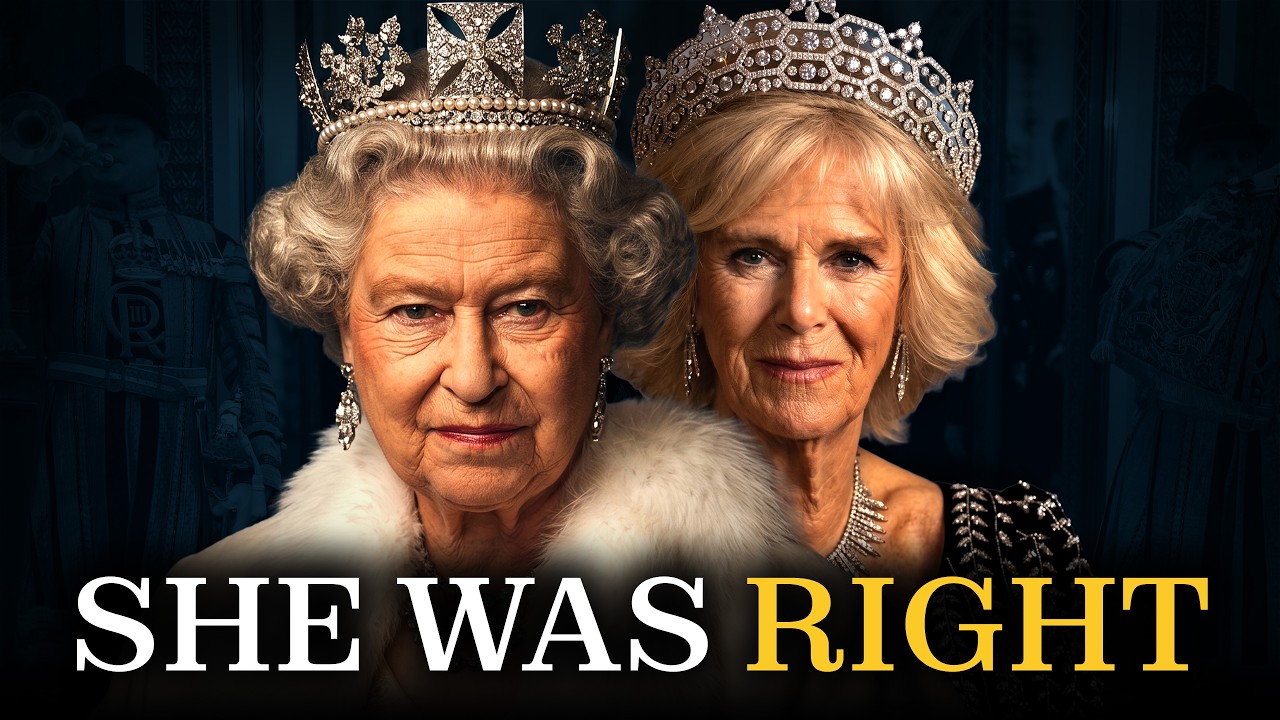
On February 5, 2022, approaching 70 years on the throne, the Queen issued a written message to the nation on Accession Day in her Platinum Jubilee year. The message then turned to the future. She asked the public to give Charles and Camilla the same support they had given her, and described her sincere wish that Camilla carry the title of Queen Consort when the time came.
The Mirror called the message historic, its headline sounding almost surprised. With one sentence, the 2005 plan to make Camilla Princess Consort evaporated, and a question that had hovered over the monarchy like an unpaid bill for nearly two decades was settled. The title Princess Consort always carried a faint whiff of a test, or at least suggested one.
By asking the public to give the couple the same support they had given her, the Queen placed Charles and Camilla inside her own legacy and handed them 70 years of accumulated goodwill as a kind of inheritance. She framed the request as a wish rather than an order. From a queen who spent 70 years on the throne letting her actions speak for her, such a wish carries the force of a royal decree.
The timing looks deliberate. By tying the request to the anniversary of her accession, the moment she herself became queen, Elizabeth II linked Camilla's future title to the biggest milestone of her reign, making it nearly impossible to dismiss the request as a passing remark.
Seven months later, in September 2022, the Queen died. When Charles succeeded her, Camilla received the title the late Queen had requested, and by May 2023 The Guardian traced her rise from a hated royal mistress to a queen-in-waiting. A few years on, magazines like Marie Claire refer to her without any fuss as Queen Camilla.
Whether Elizabeth II hated Camilla, the question in the headline finally deserves a direct answer. Based on the documented evidence, the answer is no, at least not in the personal, vindictive sense the word suggests. The story the records tell is colder than any tabloid feud, because it concerns policy rather than personality.
No single reason explains the Queen's long coldness, which cannot be easily summarized, but it fits the evidence. Instead, the records point to overlapping crises piling on top of one another. In the 1970s, Camilla failed the old suitability tests of that era, and in the 1980s and 1990s, she became the catalyst for the crown's worst public relations disaster since Edward VIII's abdication. Duty was the foundation beneath it all.
The Queen's life revolved entirely around her duty to the crown, and she viewed her son's adultery and its fallout as a grave breach of his royal obligations, a judgment her mother reinforced forcefully, according to Christopher Andersen. Saying hate attributes excessive emotion to the Queen and underrates her strategy.
Instead, the records show a queen managing a risk, keeping Camilla at a distance as long as that risk remained, then, once the relationship proved a permanent reality rather than a destructive whim, reassessing it with the same level-headed eye and reaching the opposite conclusion.
The ledger states it more clearly than any rivalry could. The early columns contain a failed suitability test, an affair, a leaked tape, a television confession, and the worst publicity since 1936. The later columns fill with years of silence toward the press, charity work, a calmer son, and a woman who carried the responsibility without complaint, until the second column simply outweighed the first.
Stripped of gossip, the Queen's relationship with Camilla looks like a case of institutional preservation carried out with unmatched patience. She never needed to hate Camilla to keep her at a distance in 1993, and she never needed to love her to endorse her in 2022, because the decisive question in both years concerned what the crown could withstand. Feelings came second.
The Balmoral quote remains what it appeared from the start, a vivid and contested line from an unnamed source that may or may not have recorded the Queen's actual words. Either way, even that account of her objects to adultery, not to Camilla herself.
Seven years later, the same Queen made a joke about Beecher's Brook. In the early 1970s, the palace judged Camilla unsuitable to be the wife of a future king. For decades afterward, the Queen avoided any official occasion Camilla attended. Camilla, once said to have been called "that wicked woman," now carries the title of Queen. The request for that title came in writing from Elizabeth II herself.