The Alamo is remembered as a heroic stand of 188 men against impossible odds, but the fuller history behind the 1836 battle reveals a far more complicated story shaped by slavery, leadership failures, and a fortress ill-suited for the siege it faced. Anglo settlers who poured into Mexican Texas in the 1820s and early 1830s were driven largely by the profitability of cotton and viewed the region as an extension of the American Deep South’s plantation economy. They openly disregarded Mexico’s requirements of Catholic conversion and formal naturalization, and more significantly, they systematically violated Mexico’s 1829 emancipation decree. Thousands of enslaved African Americans were brought across the border and held in bondage despite repeated Mexican prohibitions.
Planters used legal fictions such as calling enslaved people indentured servants on paper, preserving the institution that fueled their wealth. While cultural and religious tensions existed between Protestant settlers and Catholic Mexico, the central fracture was slavery. Mexico’s increasingly forceful attempts to eradicate it collided directly with the settlers’ determination to expand the plantation economy, making peaceful coexistence structurally impossible. Mexico’s shift from federalism to centralism in 1835 was not simply a bureaucratic reorganization.
It was a conservative counterrevolution aimed at ending chronic instability, but it fatally alienated peripheral regions like Texas by stripping away the autonomy that had lured settlers in the first place. The 1824 federal constitution had promised significant self-governance, but by the mid-1830s, fiscal collapse and regional revolts led conservative elites backed by Antonio López de Santa Anna to dismantle that framework. The 1835 Siete Leyes replaced state legislatures with appointed departmental governors, centralized taxation and military control, and signaled aggressive enforcement of national laws, including tariffs, immigration quotas, and the long-ignored ban on slavery. For Anglo settlers already operating illegally beyond their empresario grants and dependent on enslaved labor, this centralization felt like an existential threat.
Settler rebellions erupted not from abstract devotion to federalism but from what they saw as self-preservation. Their economic model of cotton monoculture sustained by slavery and speculative land claims depended on evading Mexican authority. Mexican officials diagnosed the unrest as the predictable consequence of unchecked illegal immigration from the United States, where thousands had entered without naturalization or conversion. A persistent myth claims Texas rebels were principled defenders of republican federalism against Santa Anna’s dictatorship.
While many waved the 1824 Constitution as a rallying symbol, their core motivation was far more material: preserving slavery and evading centralized regulation. Their initial 1835 declarations insisted they fought only to restore the old federal system, yet once independence was secured, they established a slaveholding republic that barred free Black people and enshrined slavery in its 1836 constitution. The “Come and Take It” cannon stand at Gonzales marked the moment when settler defiance crystallized into armed rebellion. The six-pound cannon had been issued to Green DeWitt’s colony in 1831 for legitimate frontier defense against Comanche raids.
When Colonel Domingo de Ugartechea demanded its return in 1835, triggered by reports of colonists attending consultation meetings that questioned centralist authority, the colonists refused. Raising the flag was a calculated act of political theater. Within days, their numbers swelled beyond 160, and a dawn assault on October 2 routed the Mexican force, sending it retreating toward San Antonio. This skirmish ignited the revolution not because of the cannon’s military value, but because it forced both sides into irreversible positions.
The confrontation was the foreseeable culmination of years of deliberate lawbreaking, illegal retention of enslaved people, unauthorized expansion beyond granted boundaries, and participation in proto-revolutionary assemblies. The Alamo itself was not a purpose-built fortress. Originally Mission San Antonio de Valero, founded in the early 18th century to convert and control local indigenous populations, it had been reduced to a decaying shell by the 1790s. Only in the 1830s did Mexican troops convert the sprawling adobe mission into a provisional military post.
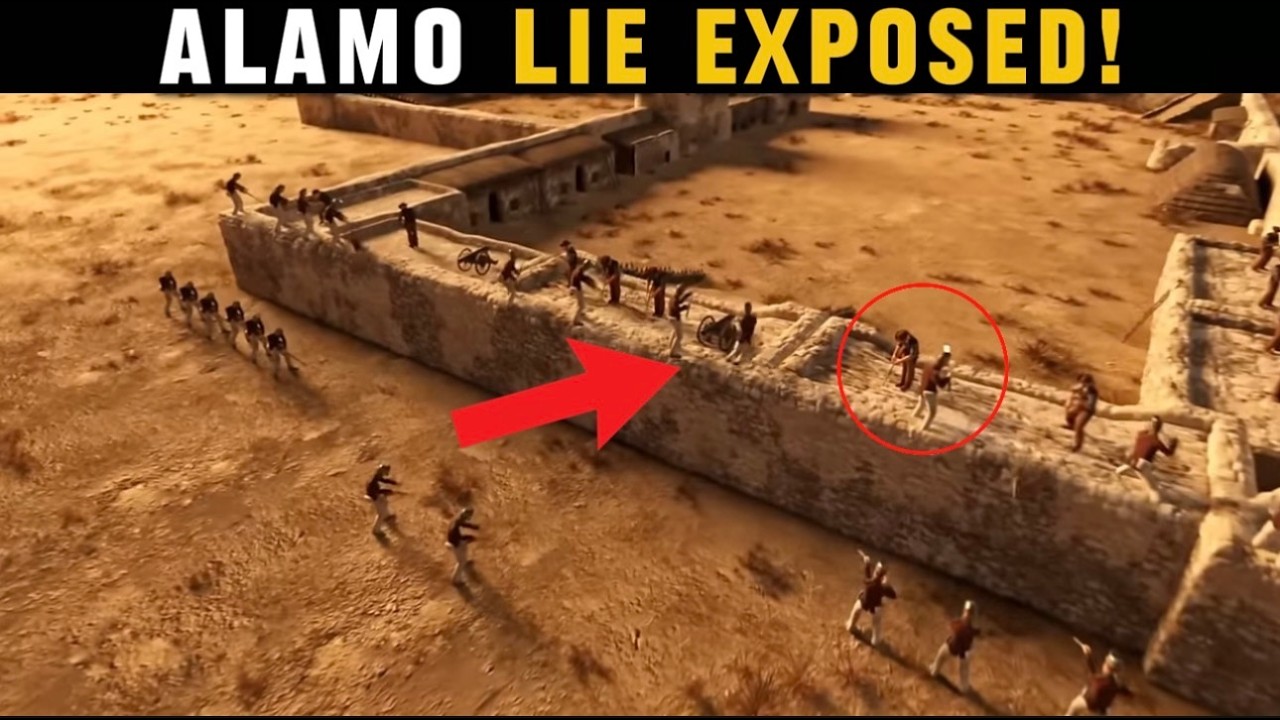
The defenses, thick but uneven walls, a few cannon placements, and rudimentary elevated platforms, were adequate against hit-and-run raids by Comanche or Apache horsemen but catastrophically inadequate against disciplined artillery and infantry assaults. Lacking proper loopholes or embrasures, defenders had to expose themselves at the top of the walls to fire outward. The sprawling, irregularly shaped perimeter demanded far more men to hold than the Texians could muster. The command crisis in early 1836 exposed the Texian army’s structural weakness: a volunteer force undermined by individualism and desertion in the absence of enforceable military discipline.
After Gonzales, most of the hastily assembled militia melted away. Unprepared for sustained campaigning, the garrison shrank to under 200 men by late 1835. Sam Houston appointed James Neill as commander in December, but Neill abandoned the post in February 1836, citing family illness. Leadership defaulted to William Barrett Travis, a young regular officer whose rigid notions of hierarchy clashed with the egalitarianism of frontier fighters.
Many men preferred James Bowie, whose legendary reputation made him seem the natural leader. Bowie won a soldier’s vote but then undermined his own authority by getting drunk and creating chaos in camp. The eventual compromise of joint leadership merely papered over irreconcilable differences in style and strategy, leaving the garrison divided at the moment unity was most critical. Santa Anna’s march on the Alamo was driven by more than battlefield logic.
It was a personal assertion of sovereignty against what he saw as foreign invaders who had mocked Mexican law, clung to slavery, and challenged the integrity of the republic. His demand for unconditional surrender and the no-quarter policy stemmed from this view. He framed the conflict as a defense against American filibusters, and executing them served as both punishment and deterrent, consistent with 19th-century military practice. At the Alamo, commanders Travis and Bowie faced a grim calculus.
Supplies were dwindling, the garrison remained under 200 effective fighters, and the mission’s walls offered little protection. James Neill’s earlier plea for reinforcements had already been rebuffed by Sam Houston, who judged that no sizable force could reach Béxar in time. Houston instead ordered Bowie to destroy the artillery and abandon the post, recognizing it as indefensible. Bowie defied that directive upon arrival, lacking draft animals to move the heavy guns and convinced the Alamo could serve as a rallying point.
The decision to hold reflected a catastrophic misreading of Santa Anna’s speed and resolve. Mexican forces marched with ruthless efficiency through winter terrain and arrived far sooner than the Texans anticipated, trapping the defenders in a siege they could neither win nor escape. The siege began on February 23, 1836. As Santa Anna’s vanguard approached, civilians fled San Antonio de Béxar, leaving the town eerily empty except for the men barricaded in the mission compound.
Santa Anna entered with roughly 1,500 disciplined troops. The garrison consisted largely of untrained civilians and adventurers, short on powder, shot, food, and medicine. The raising of the red flag, Mexico’s traditional signal of no quarter, made the stakes clear: surrender or death. Rather than negotiate, Travis responded with a cannon shot, a gesture of psychological defiance.
Internal divisions nearly unraveled even that resolve. Bowie, appalled by what he saw as needless provocation, sent an envoy seeking terms. Travis, furious, countered with his own messenger. Mexican officers rebuffed both, reiterating unconditional surrender as the only option.
The dual humiliation finally forced reconciliation, and the two commanders jointly ordered another cannon blast, sealing the garrison’s fate. By February 24, the siege’s second day, James Bowie was incapacitated by a severe undiagnosed illness, likely tuberculosis or pneumonia worsened by chronic alcoholism and old injuries. He formally yielded command to Travis on February 26. He died in his cot during the final assault on March 6, along with every other combatant.
Mexican troops under no-quarter orders killed all 188 defenders but spared the non-combatants: women, children, and a few enslaved people. Conservative estimates suggest the defenders inflicted 400 to 600 casualties on Santa Anna’s force of roughly 1,800 to 2,400 men. The heavy price delayed the Mexican advance by 13 days, giving Sam Houston critical time to organize his army. The slaughter forged the slogan “Remember the Alamo,” turning despair into resolve and fueling the decisive victory at San Jacinto.
Bowie’s illness was devastating, not a minor setback. It destroyed the fragile unity he had created, left the distrustful garrison under Travis alone, and stripped the defense of vital morale precisely when it was most needed, ensuring the Alamo’s stand became far more powerful in memory than it was in execution.