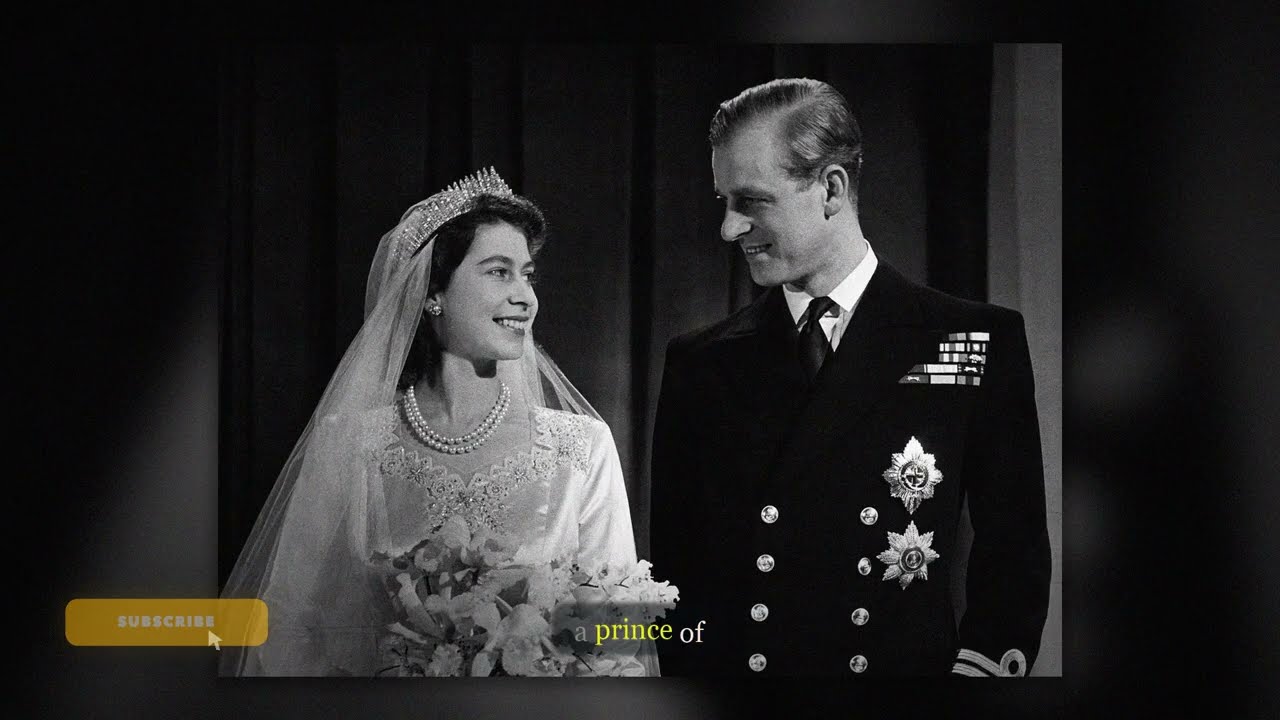
On November 20, 1947, Philip Mountbatten stood at the altar of Westminster Abbey in the uniform of the Royal Navy. The BBC had run cables through the old stone for the broadcast. An estimated 200 million people listened worldwide as 2,000 guests filled the pews.
Outside, despite the November cold and the rationing that still governed what most Britons could put on their tables, crowds had slept on the pavement since the previous night for a glimpse of the wedding.
Philip was 26 years old. He had spent the previous eight months dismantling the legal architecture of his own identity to stand there.
In March 1947, he renounced his Greek and Danish royal titles in the London Gazette. He adopted the surname Mountbatten from his maternal family, the anglicized version of his grandfather's German-origin name, Battenberg, which had itself been discarded during the First World War when anti-German sentiment forced British royals with German names to reinvent themselves.
In October 1947, he converted from the Greek Orthodox faith to the Church of England, with his baptism regularized by the Archbishop of Canterbury. The day before the wedding, King George VI bestowed the style of Royal Highness on him. On the morning of the wedding itself, he was created Duke of Edinburgh, Earl of Merioneth, and Baron Greenwich.
Before noon that day, Philip had passed through at least four different legal and religious identities.
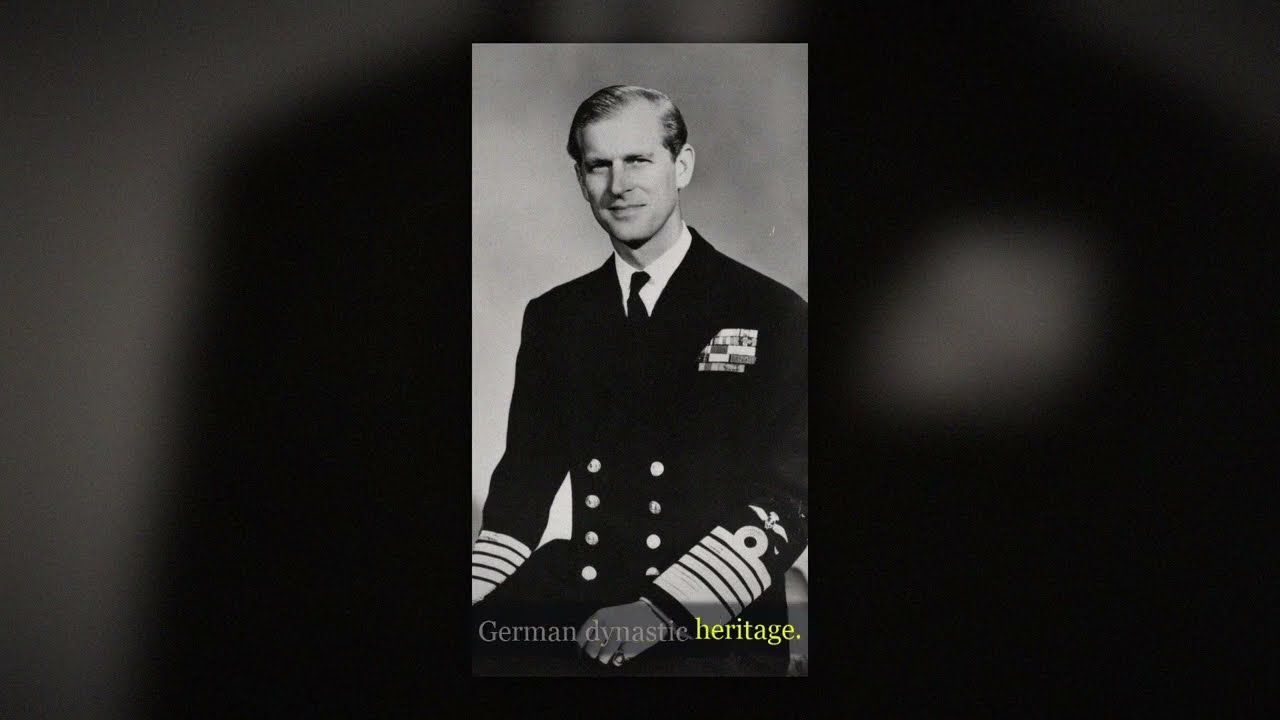
His active naval career, the one thing he had built entirely on his own merit, would outlast the wedding by barely four years. He had graduated from Dartmouth as the best cadet in his course. He had controlled the searchlights during the Battle of Cape Matapan in March 1941 and was mentioned in dispatches. He commanded HMS Magpie from 1950, becoming one of the youngest frigate commanders in the Navy.
When Elizabeth acceded to the throne in 1952, that career was over. The role of royal consort required his complete attention and allowed for nothing else. He was, in almost every meaningful sense, starting from scratch.
In the royal box, directly behind the gathered British royal family, sat two women whose relationship to this man would define the next five decades of his life.
His mother, Princess Alice of Battenberg, wore a gray two-tone dress and wimple, a plain religious habit reflecting the spiritual vocation she had been deepening for years. Among the morning coats, tiaras, and silk of 2,000 formally dressed guests, she was strikingly plain. She had contributed the last of her jewels toward the engagement ring Philip had given Elizabeth.
She sat in the royal box in the row immediately in front of Philip's surviving sisters, who were not present. They had been excluded from the guest list because their husbands' wartime Nazi associations made their attendance politically impossible so soon after the war.
In the row immediately in front of Princess Alice sat the woman who wore a different kind of armor entirely: the smile. Queen Elizabeth, the Queen Consort, mother of the bride, wife of the king, wore gold silk brocade and moved through the abbey with the practiced ease of someone who had spent 16 years mastering the art of public warmth at scale.
She acknowledged guests, turned to whisper to Princess Margaret, and inclined her head toward the right people at precisely the right moments. There was no camera angle from which she didn't look exactly like the picture of maternal grace.
When the organ struck up and the procession began, her expression was that of a woman who had arranged everything perfectly, which in one sense was exactly what she had attempted to do. The man at the altar had not been her arrangement.
She wasn't a fan of the man her daughter was marrying.
When Prince Philip married into the British royal family, he gave up his career, his name, and his religion. But the one thing he couldn't escape was the relentless, quiet hostility of his mother-in-law.
Behind the closed doors of Buckingham Palace, the Queen Mother didn't just dislike Prince Philip. According to multiple royal biographers and accounts from palace circles, she actively despised him, and she made sure everyone in the royal household knew exactly what she called him.
Before the wedding, before the engagement, even before Philip had been formally considered, the Queen Mother had a different picture in her mind of how her daughter's future should look.
Hugo Vickers, the royal historian and authorized biographer of the Queen Mother, has stated it plainly. During the war years, with Princess Elizabeth and Princess Margaret resident at Windsor Castle and a Grenadier Guard stationed in the vicinity, a particular officer had caught the Queen Mother's attention as a suitable prospect.
Hugh, Earl of Euston, later the 11th Duke of Grafton, was everything she would have prescribed: an English aristocratic guards officer embedded in exactly the social world she understood and trusted. "She would have loved her to marry Lord Euston," Vickers told Fox News Digital. "I think it was slightly in the cards at one point."
According to Vickers, Lord Mountbatten, Philip's influential uncle, navigated events in the other direction by securing Euston a posting to India at the relevant moment, effectively removing him from proximity to the princess.
Philip's correspondence with Elizabeth had been running since she was 13. Her attachment was already fixed, whatever her mother preferred.
The Queen Mother's concerns about Philip weren't purely personal. His foreign birth, his lack of personal fortune, and his family's German connections were genuine liabilities in postwar Britain, the kind that multiple royal advisers and senior politicians shared. She was described in one account as very cynical about the match.
What distinguished her position from the general establishment anxiety wasn't the existence of those concerns, but what she did with them after they had been overruled. After the engagement was announced, after the wedding was celebrated, after Philip and Elizabeth had begun building a life and then a reign together.
The question isn't whether she had reservations in 1947. The question is what it means that she was still expressing those reservations in private 20 years later, 30 years later, to the day she died.
The Queen Mother had constructed one of the most impenetrable public images in British history. She had stayed in London during the Blitz alongside George VI, visiting bombed sites in the East End while Buckingham Palace itself took hits from German aircraft.
When crowds jeered and threw rubbish at her car in the early Blitz visits, hostile because she appeared in expensive clothes while they lost their homes, she kept going back. She explained her wardrobe philosophy with characteristic precision: if the public came to see her, they would wear their best clothes, so she should reciprocate in kind.
Adolf Hitler reportedly called her the most dangerous woman in Europe because her popularity posed a direct threat to German morale objectives in Britain.
In public, the warmest face of the monarchy. In private, something rather harder was operating.
Cecil Beaton, the celebrated photographer and her friend, someone whose access to her world was sustained over decades, described her as a marshmallow made on a welding machine. The authorized biography was even more precise: she looked everything that she wasn't — gentle, gullible, tenderness mingled with dispassionate serenity, cool, well-bred, remote. Behind this veil, she schemed and vacillated, hard as nails.
These observations came from admirers, people who sat at her table, accepted her hospitality, and moved comfortably in her social world, and who still couldn't miss the mechanism behind the warmth. Philip, who moved in that world without belonging to it, would have had an even clearer view.
The term "the Hun" is worth understanding before it becomes the centerpiece of this story. It originated as British slang during the First World War, an ethnic slur deployed by the Allied press, by government propaganda, and by military culture to dehumanize German and Austrian soldiers.
The Kaiser's own address to departing troops in 1900 had used the word "Huns" as a self-description, and Allied propagandists locked on to it immediately. By the time the Second World War ended, the term had been in active British circulation for 30 years.
Using it to describe someone in private company in 1947, in the family circle of the royal household, about the man your daughter had just married wasn't a neutral reference to his ancestry. It evoked invasion, brutality, the wartime enemy. It was a slur with a specific history and a specific intention.
And the Queen Mother wasn't a stupid woman. She knew precisely what it communicated. It communicated that she didn't consider Philip a legitimate member of the family. It communicated that she was still litigating the question of his foreign origins after the marriage had already happened. It communicated to anyone in the household who heard it — and such things travel in households — exactly where she stood.
Multiple royal biographies and accounts from palace circles have reported the nickname. Lady Colin Campbell's book, "The Queen Mother: The Untold Story," documents that she privately referred to Philip as the Hun. The Daily Express reported in 2022 that she would use the term not altogether jokingly. The Daily Mirror had noted as early as 2007 that she applied the term in reference to his German dynastic heritage.
A documentary production synopsis for the film "Prince Philip: The Plot to Make a King" described her as having privately referred to Philip as the Hun.
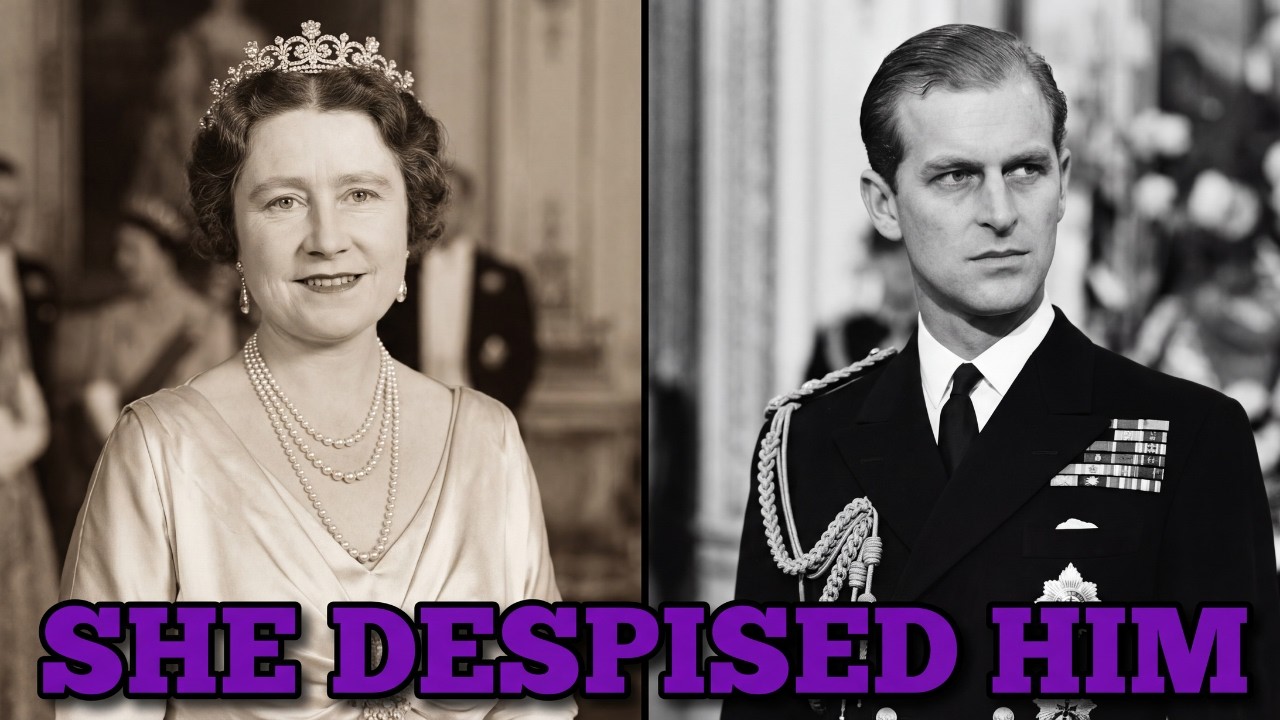
The care in that phrasing — the word "privately" — tells you something honest about the nature of the sourcing chain. No letter in her hand, no diary, no recorded conversation locks this claim in primary evidence. What we have is a consistent pattern of independent reporting across separate sources over multiple decades, each accounting for the same private nickname used in the same private context. The pattern is the evidence.
What she had to work with in terms of his actual background was real, and she made maximum use of it. Philip's full dynastic surname was Schleswig-Holstein-Sonderburg-Glücksburg. This wasn't a distant technicality. It was a German-origin cadet branch of the Oldenburg dynasty, the same lineage that had supplied monarchs to Denmark and Greece.
His maternal family, the Battenbergs, had anglicized their name to Mountbatten during the First World War for exactly this reason. Anti-German sentiment in Britain made a German dynastic name professionally untenable, even for royals with impeccable British loyalties.
The very surname Philip adopted in 1947 to make himself acceptable to British opinion was itself an anglicization of a German name that had previously been changed for the same reason.
In 1933, Philip had attended the German school Schule Schloss Salem. Its Jewish founder, Kurt Hahn, had already fled Nazi persecution and reestablished the school as Gordonstoun in Scotland, where Philip followed him after two terms.
Three of his four surviving sisters had married into German aristocratic families with documented Nazi party and SS affiliations. His youngest sister, Sophie, had married Prince Christoph of Hesse, an SS officer who headed the Forschungsamt, the security and surveillance service operating under Hermann Göring's direct command — the apparatus that monitored communications and tracked individuals considered unsympathetic to the Nazi regime. Christoph was killed on the Eastern Front in 1943.
Sophie's own unpublished private memoir, drawn on in a 2015 Channel 4 documentary, describes attending a luncheon with Hitler and finding him charming and seemingly modest.
His sister Margarita married Gottfried, Prince of Hohenlohe-Langenburg, a Nazi party member and Wehrmacht officer who was injured on the Russian front. His sister Cecilia, killed in a plane crash at Ostend in 1937, had joined the Nazi party with her husband Georg Donatus that same year.
When Philip was 16, he traveled to Darmstadt for Cecilia's funeral. Photographs from that day show him in the procession, flanked by brothers-in-law in Nazi uniform. He was a teenager who had just lost his sister. He had no control over who stood beside him or what they wore.
And he had no control over what those images would mean in the years that followed — that they would circulate in postwar Britain as visual shorthand for his family's entanglement with the regime he had personally fought against in four years of Royal Navy service.
Those four years of service are the other half of the picture the Queen Mother preferred not to look at. Philip served throughout the Second World War in the British, Mediterranean, and Pacific fleets against the Axis, including against the German forces whose uniforms his brothers-in-law had worn.
He was involved in the Battle of Crete and at Cape Matapan in 1941. His management of HMS Valiant's searchlights during the night engagement contributed to the decisive British victory. He was mentioned in dispatches.
He earned the Greek War Cross during the Allied invasion of Sicily in 1943 as second in command of the destroyer HMS Wallace. He saved his ship from a night bomber attack by devising a decoy of a raft fitted with smoke floats. The bombers hit the decoy while the ship slipped away unnoticed.
This was the actual wartime record of the man she privately called by a wartime slur.
Philip's sisters were excluded from the wedding in November 1947, a decision of the royal establishment, not of Philip, because of their husbands' Nazi associations and the sensitivities of a Britain still counting its dead from the war. He stood at the altar in Westminster Abbey without a single sibling present.
The man who had fought the Axis through four years of active service was required to answer for the choices his sisters had made in their own marriages, in the same year he was being denied a family seat at his own wedding.
And the woman in the gold silk in the royal box, who had spent the war as one of its most effective morale symbols, chose to commemorate his German dynastic origins privately with a slur that had been designed to dehumanize the enemies Britain had just spent six years fighting.
There is a reason Philip's mother belongs in this story, and it has nothing to do with invented phrases from fictionalized television dramas.
Princess Alice of Battenberg was born at Windsor Castle on February 25, 1885, in the Tapestry Room, in the presence of her great-grandmother, Queen Victoria. She was diagnosed with congenital deafness as a child. Her grandmother identified the problem when Alice was slow to talk, recognizing the signs, and by age eight she had learned to lip-read fluently in English and German. French followed. After her engagement to Prince Andrew of Greece in Denmark, she learned Greek.
She was, by the time of Philip's birth in 1921, fluent in four languages despite never having heard a word of any of them.
Her marriage and her family's political situation collapsed together. In 1922, after the Greek military disaster in the Greco-Turkish War, a revolutionary court banished her husband, Prince Andrew, from Greece for life. The British naval vessel HMS Calypso evacuated the family from Corfu. Philip, 18 months old, was carried to safety aboard in a fruit crate improvised from what was available.
The family settled in St. Cloud outside Paris in a house lent to them by a wealthy relative. Her daughters married German princes over the following decade, one by one, and left for Germany. Her husband drifted to Monte Carlo, and in 1930 Princess Alice began to unravel.
She had converted to Greek Orthodoxy, deepened her religious practices, and begun claiming that she was receiving divine messages, that she was in communication with Buddhist and Christian figures, that she had healing powers.
Her diagnosis, paranoid schizophrenia, assessed first by Thomas Ross and confirmed by Ludwig Binswanger at his sanatorium in Kreuzlingen, Switzerland, led directly to her forcible removal from her family. Binswanger and his colleague Ernst Simmel sought consultation from Sigmund Freud, who concluded that her condition derived from sexual frustration. His recommended treatment was X-rays applied to her ovaries to accelerate the onset of menopause and suppress her libido.
The treatment failed, condemned her to lifelong health complications, and did nothing for her mental state. She remained at Kreuzlingen for two years. Philip, 10 years old, was sent to live with maternal relatives in England. He would have, as one summary of his biography describes, little contact with his mother for the remainder of his childhood.
She recovered. She returned to Athens. She lived in a two-bedroom flat near the Benaki Museum and worked among the urban poor. She founded a Greek Orthodox nursing sisterhood in 1949, the Christian Sisterhood of Martha and Mary. She gave away her remaining possessions to fund it.
But before that, there was 1943.
By April 1941, the German army had occupied Athens. The occupation would last until October 1944. Most of the approximately 75,000 Greek Jews in the country were deported to Nazi concentration camps during this period. Roughly 60,000 out of 75,000 were sent to Auschwitz and other death camps, and all but around 2,000 of them died.
The German and Italian occupying forces controlled food supplies, movement, and communications. Princess Alice remained in the city, in her brother-in-law Prince George's three-story house in the center of Athens.
She organized soup kitchens, worked with the Red Cross, flew to Sweden under the pretext of visiting her sister, Crown Princess Louise, and used the trip to bring back medical supplies. She organized two shelters for orphaned children and ran a nursing circuit through poor neighborhoods. She did this while the Gestapo operated openly in the streets below her window, and while her own son-in-law, Prince Christoph of Hesse, was serving the SS in an intelligence operation based in Berlin.
In September 1943, the situation changed. The fall of Mussolini and Italy's surrender to the Allies brought the German army into direct control of Athens. The roundups of the Jewish population began in earnest.
Rachel Cohen was a widow. Her husband, Haki Cohen, a Jewish former member of Parliament from Trikala, had died before the occupation. In 1913, Haki Cohen had aided King George I of Greece when the royal family required it. Now, 30 years later, with her city occupied and deportation imminent, Rachel Cohen's family remembered.
One of her sons reached out to Princess Alice, one of only two remaining members of the Greek royal family who had stayed in Athens rather than going into exile. Princess Alice took Rachel Cohen and at least one of her children into her home. They stayed there concealed until Athens was liberated in October 1944.
When the Gestapo came to question her about suspicious activity, when German officers knocked on her door and asked her about the people in her house, Princess Alice used her deafness as a weapon. She pretended not to understand their questions, performed the bewilderment of an elderly hard-of-hearing woman until they eventually gave up and left. The Cohen family remained in the house.
Harold Macmillan visited Princess Alice in the days after liberation in late 1944 and described her as living in humble, not to say somewhat squalid, conditions. In a letter to Philip written around that period, she acknowledged that in the last week before the city was freed, she had had nothing to eat except bread and butter. She had given her food rations to others.
Yad Vashem recognized Princess Alice as Righteous Among the Nations in 1993, the highest honor Israel grants to non-Jews who risked their lives to save Jewish people during the Holocaust.
Prince Philip traveled to Israel the following year for the ceremony and visited his mother's grave at the Church of Mary Magdalene on the Mount of Olives in Jerusalem, where she had requested to be buried near her aunt, Grand Duchess Elizabeth Feodorovna.
Standing at the ceremony, Philip told those gathered: "I suspect that it never occurred to her that her action was in any way special. She was a person with deep religious faith and she would have considered it to be a totally human action to fellow human beings in distress."
Now set that biography alongside Westminster Abbey, November 20, 1947.
Princess Alice in her gray nun's habit sat in the royal box at her son's wedding, the same austere garment that signaled to every carefully dressed guest in the building exactly what mattered to her. She had contributed the last of her personal jewelry toward the engagement ring Philip had given Elizabeth. She had, in the years immediately preceding this wedding, hidden Jewish people from the Gestapo while eating bread and butter in a city under military occupation.
In the row directly in front of her sat the woman who was privately applying a wartime slur to her son — the same derogatory term that the Allied press had used to describe the soldiers of the regime Alice had spent two years quietly working against at personal risk in a city full of Gestapo.
The Queen Mother looked like the picture of maternal warmth. Princess Alice looked like a nun who had sold her last jewel. Both women were in that box. Only one of them had actually been in the war.
The precise phrases sometimes attributed to the Queen Mother about Princess Alice — specifically, in contemporary popular discussion, certain compound slurs, certain mockeries of Alice's deafness or religious vocation — trace back to viewers discussing the fictionalized Netflix series "The Crown," not to the historical record. Dramatists invented those lines for dramatic effect.
What the historical record does establish is that the Queen Mother viewed Philip's entire background — his family, his origins, his German dynastic lineage — through the lens of permanent, irremediable foreign contamination. Princess Alice was of that background. The Hun slur encompassed her as surely as it encompassed him.
And the choice to keep using that word year after year in private meant dismissing, implicitly and constantly, everything that background actually contained. It contained a woman who had faced down the Gestapo with a performance of deafness to protect people who had nowhere else to hide.
On February 6, 1952, a Tuesday morning in Kenya, Philip and Elizabeth were at Sagana Lodge on the edge of the Aberdare Forest, two days into their Commonwealth tour. Elizabeth had gone to bed the previous night, having spent the evening at Treetops, a hotel built into the canopy of a giant fig tree in the game reserve, watching a watering hole from the terrace. Philip was with her.
The king was at Sandringham, where he had spent the previous day shooting and had seemed by all accounts in better health than he had been for months. Sometime before dawn on February 6, King George VI died in his sleep. He was 56 years old.
The news reached Philip through an aide — the precise route varies in different accounts — and it was Philip who had to wake his wife and tell her. She was 25 years old. She was 6,000 miles from home in a borrowed lodge on a game reserve.
When Philip walked out of that room, he had just delivered to the woman he loved the simultaneous news that her father was dead and that she was now the Queen of the United Kingdom and the head of the Commonwealth of Nations.
The royal party flew home immediately. Elizabeth stepped off the aircraft at London Airport, still 25 years old, in a black dress. Winston Churchill was at the airport. The officials who greeted the plane called her "Your Majesty."
Philip was no longer the husband of the heir presumptive. He was consort of the sovereign. Everything about the formal structure of his life rearranged itself in the hours following that flight.
For the Queen Mother, the rearrangement was of a different kind entirely.
As queen consort, Elizabeth Bowes-Lyon had held the highest female precedence in the kingdom, second only to the king. She maintained her own household, her own formal staff, her own authority within the principal royal establishment. She had occupied that position for 16 years.
From December 1936, when her husband unexpectedly ascended the throne following Edward VIII's abdication, until February 1952, she had spent those 16 years building with exceptional skill and evident genuine pleasure the most effective and beloved royal public image of the century. She was, in the cultural imagination of postwar Britain, the monarchy's warmest face.
On February 6, 1952, she became a dowager. The title itself was the problem. She couldn't be called Queen Elizabeth; that was her daughter's title now. She became Queen Elizabeth the Queen Mother, a designation engineered specifically to prevent confusion.
She vacated Buckingham Palace. Clarence House, the London home that Philip and Elizabeth had lived in since 1949, where Philip had put his mark on every room, where Princess Anne had been born in August 1950, was prepared for the Queen Mother's residence.
The Royal Collection Trust's own account of the house's history records what happened to Philip's study. The Queen Mother converted it into the morning room, installing a Georgian marble chimneypiece and a new plaster ceiling bearing her own crowned cipher.
She then spent nearly 50 years making the house and the elaborate social world it anchored entirely her own. She opened out two ground-floor rooms in 1960 to create the garden room, a large sunlit space well suited to entertaining large groups of guests. She furnished the house with the art collection she had built across a lifetime of passionate collecting — Piper, Sutherland, Sickert, Augustus John.
Foreign heads of state called there for tea on the first afternoon of every state visit. She hosted luncheons and evening receptions with the frequency and precision of a professional. She ran a court, and it wasn't Philip's court.
Elizabeth II, meanwhile, confirmed by Order in Council that the Duke of Edinburgh was to take place, pre-eminence, and precedence next to Her Majesty on all occasions and meetings. Philip formally outranked the Queen Mother in the ceremonial hierarchy of the royal family.
For a woman who had occupied the apex of that hierarchy for 16 years, this wasn't a procedural adjustment. The person she had privately dismissed as an unsuitable foreign interloper was now constitutionally and formally above her.
Then came the surname.
Philip had adopted Mountbatten in March 1947 as a deliberate act of self-reinvention, rooting himself in British identity, connecting himself to his uncle Lord Mountbatten's distinguished wartime record as Supreme Commander Southeast Asia Command. It was the anglicized form of a German-origin name that had already been changed once, in 1917, for the same reasons Philip was now changing his.
When Elizabeth acceded to the throne in 1952, the standard convention in such circumstances was that the royal house would take the consort's name. Philip proposed at minimum a compromise: the House of Edinburgh, after his dukedom, if not Mountbatten itself.
The argument went against him entirely. Churchill objected, invoking the memory of King George VI. Queen Mary, the late king's mother, had already written to the prime minister to register her opposition. Multiple biographers note that the Queen Mother supported retaining Windsor out of loyalty to her late husband and the dynastic identity he had inherited from his father George V, who had changed the royal house name from Saxe-Coburg and Gotha to Windsor in 1917 specifically to erase its German origin from public consciousness.
The irony of a Windsor name adopted to escape German associations being used to exclude the man bearing the next anglicized form of that same German-origin family line seems to have been lost on those who made the decision.
Philip's response has been widely reported across royal biography: "I am nothing but a bloody amoeba. I am the only man in the country not allowed to give his name to his own children."
He absorbed this. He waited. He didn't publicly direct his frustration at his mother-in-law.
In 1960, eight years later, after Queen Mary and Churchill were both dead, Elizabeth issued an Order in Council declaring that their male-line descendants without royal titles could use the hyphenated surname Mountbatten-Windsor. A partial victory, won after nearly a decade of formal exclusion from the basic right that every other married man in Britain took for granted.
The Queen Mother's position in the surname dispute had not been loudly confrontational. It never was. Her influence moved through existing channels — through the loyalties of senior court figures, through the conservative establishment's deference to her preferences, through the quiet, enormous weight of being the most beloved woman in Britain. She didn't need to argue loudly. She had the field.
The household Philip found himself navigating after 1952 wasn't hostile in any open or confrontable way. It was hostile in the way that well-run institutions are hostile to people who threaten their culture — through precedent, through loyalty, through the gentle collective memory of how things were done before the new person arrived.
Brian Hoey, writing about life in the royal household, observed that the senior aides attached to the Queen Mother, the upstairs staff of Clarence House, maintained their primary loyalty to her with a consistency that decades of service had made instinctual. These were people who had organized their professional lives around her preferences, her rhythms, her social calendar.
Philip, who came from a naval background where directness was professional currency, was described by those who served around him as someone who engaged with household staff directly, who noticed people, who addressed them, who didn't look through them in the manner of royals who had been performing unconscious authority since childhood.
A fragment from Ingrid Seward's work on the marriage captures the contrast: staff noted his presence, which implies that some presences in that world were routinely not noted. In a household where the Queen Mother's invisible preferences shaped behavior from above, Philip's directness would have registered on both sides of any room he walked into.
The child-rearing question was another front, and it was personal in a way the surname dispute wasn't.
Philip favored Gordonstoun for Charles, his own alma mater in the north of Scotland — rigorous, deliberately outside the English establishment, run on principles of self-reliance and outdoor endurance that Philip credited with forming his own character.
The Queen Mother favored a traditional English public school, almost certainly Eton, the kind of institution that produced Grenadier Guards and Earls of Euston, the kind of establishment she had always regarded as the correct formation for the right kind of man.
Philip prevailed. Charles attended Gordonstoun. Charles reportedly found it difficult. The Queen Mother reportedly found Philip's choice of school difficult.
She was an indulgent and affectionate grandmother to Charles specifically, offering the warmth and comfort that Philip's sterner expectations didn't. And the dynamic between those two presences — Philip's toughening, the Queen Mother's softening — became one of the structuring tensions of Charles's childhood, with Elizabeth holding the middle ground between two irreconcilable models of what the heir to the throne should be made of.
Ben Pimlott, in his authoritative biography "The Queen," portrays Elizabeth as perpetually navigating between Philip's modernizing energy and the established order's gravitational pull toward continuity, with the Queen Mother as the most culturally significant figure at the conservative center of that pull.
Philip wanted to update the monarchy's relationship with the press and public, rationalize the household's administration, bring the institution into the second half of the 20th century. The Queen Mother's Clarence House was, by temperament and aesthetic, a daily counterargument — a place where the older courtiers could go and be reminded that the way things had been done wasn't simply the way things had been done, but the way they ought to be done.
It attracted politicians, writers, and artists of an older generation. It preserved a social world in which Philip was an outsider by definition, because the world it preserved predated and implicitly rejected the version of the monarchy he was trying to build.
Philip completed 22,219 solo royal engagements after 1952 and delivered 5,493 speeches. He walked into rooms alongside the Queen Mother at major state occasions, family gatherings, royal weddings, and funerals — every significant event across five decades at which both their presences were required. At every one of those occasions, he gave the public exactly what was expected of him.
Giles Brandreth spent years with Philip in the course of writing his biography, first published in 2004 as "Philip and Elizabeth: Portrait of a Royal Marriage," then revised and expanded in 2021 as "Philip: The Final Portrait." The revised edition was prepared, Brandreth noted, as a great privilege from someone who had known the Duke for years and been given special access to his circle.
What that book conveys across more than 500 pages is a picture of a man who had made a clear-eyed bargain in 1947 and spent the next seven decades honoring every term of it. Philip understood his role precisely. He was there to support Elizabeth. Everything else — his career, his name, his religion, his preferences about dynastic succession, his feelings about whatever the household threw at him — was secondary to that function.
He once described himself on the surname question as a bloody amoeba. He never described himself in any recorded or reported statement during his lifetime in comparable terms about the Queen Mother. Not once. Not in the presence of a biographer, not in a recorded interview, not in 54 years of attending the same family events, sitting at the same tables, appearing in the same group photographs as a woman who was privately calling him by a wartime slur.
His self-control in this specific context was its own statement. It also made her behavior look exactly like what it was: unchecked. She could count on his restraint. She could deploy her private contempt without any risk that it would surface publicly as a conflict, because Philip would never give her the retaliation she could have used against him.
He absorbed it and kept going, year after year, appearing beside her at every occasion the family calendar required, performing the unity that the institution demanded.
The length of that performance is worth being specific about. Philip and Elizabeth married in November 1947. The Queen Mother died on March 30, 2002, at Royal Lodge, Windsor, aged 101. The period from the wedding to her death is just over 54 years.
Fifty-four years of family occasions. Fifty-four Christmases at Sandringham. Fifty-four years of being related by marriage to a woman who had chosen a specific wartime slur as her private name for him and had apparently seen no reason to stop using it.
The structural account of the 1952 accession makes the Queen Mother's hostility comprehensible. She lost power, and Philip represented the regime that displaced her. But comprehensible isn't the same as justified, and the timing is wrong for that explanation to be sufficient.
Her skepticism about the match preceded the engagement. Her coolness toward Philip was documented in multiple accounts before the wedding. The power she lost in 1952 was lost to Elizabeth, not to Philip, who had given up a career and a name to stand 6,000 miles away from his mother-in-law and still not be accepted as a legitimate member of the family.
What the 1952 accession did was remove the last plausible rationalization. Before that date, she was the mother of the heir presumptive, responsible for protecting her daughter's interests, entitled to have opinions about the match. After that date, Elizabeth was the sovereign. Philip was demonstrably what she needed — her working partner, her confidant, the person Giles Brandreth described as the joint author of her reign's success.
The concerns about his suitability had not materialized. The disaster had not arrived. The man she had been calling the Hun in private had spent five years supporting the new queen with precisely the strength and competence that Elizabeth herself, in a speech marking their golden wedding anniversary in 1997, would call him her strength and stay.
The hostility continued anyway.
Hugo Vickers, in the authorized biography produced with the cooperation of the royal family, presents the Queen Mother largely in favorable terms — which is precisely why the characterizations that appear within that authorized account carry such weight. A marshmallow made on a welding machine. Behind this veil she schemed and vacillated, hard as nails. These judgments are in the authorized biography. They came from her friends.
Vickers also notes, fairly, that late in her life the Queen Mother told the biographer Tim Heald that Philip was an English gentleman. The record contains both formulations: the Hun in private, the English gentleman for posterity.
Whether her view genuinely shifted over 54 years of working proximity, or whether "an English gentleman" was the kind of comment a consummate public figure naturally produces when speaking to a biographer who will publish it, the record can't definitively settle.
What it can settle is that Philip, who heard both versions of what she said, who knew there were two, never said a public word about either one.
Philip gave up a Greek Orthodox upbringing for the Church of England. He exchanged a Greek and Danish royal title for a British dukedom. He walked away from an active naval career that had earned him distinction across three theaters of the Second World War. He surrendered his name, winning back a hyphenated compromise only after nearly a decade of formal exclusion.
He then spent 54 years as the second most prominent person in every room he walked into, attending family functions with a woman who had privately been calling him by a wartime slur since before his children were born.
The Queen Mother was willing to describe him at the end as an English gentleman. She had also spent years calling him something else in private.
In the household where the staff listened, where the courtiers circulated, where the culture of the institution was set from the top by the most beloved woman in Britain. Stephen Tennant had noticed the gap between those two registers. Cecil Beaton had noticed it. It's visible in the authorized biography. It's visible in the surname dispute, in the child-rearing disagreements, in the 49 years of Clarence House operation that maintained a permanent alternative social gravity to Philip's version of the monarchy.
Philip outlived her by 19 years. He was 99 years old when he died at Windsor Castle on April 9, 2021. He never publicly accounted for what the relationship had cost him.
He had made his choice in November 1947. He had given up his name and his religion and his career and his home to marry Elizabeth. And sustaining that choice meant absorbing everything the household threw at him, including the sustained private contempt of the woman who had sat immediately in front of his mother in the royal box at the wedding.
His mother, who had hidden Jewish people from the Gestapo, died in December 1969 at Buckingham Palace, aged 84, having given away everything she owned. She left three dresses.
Philip visited her grave in Jerusalem in 1994 and told the people gathered that it had never occurred to her that what she had done was in any way special.
That was one version of what a royal title, a royal upbringing, and a position of extraordinary privilege could produce. The other version spent 50 years waving from Clarence House and calling her son-in-law the Hun.
A royal title, a charming smile, and the most effective public image in 20th-century British history will buy nearly anything: public adoration, historical reverence, the near-universal agreement for generations that you were one of the great figures of the age.
What it can't buy is the private verdict of the people who lived inside the institution with you, who heard what you said in the rooms where the cameras weren't running, who watched you perform warmth toward a man you were dismissing elsewhere, and who had to decide year after year which version of you was the one that counted.
Philip gave her the benefit of the doubt publicly for 54 years. He gave the monarchy a working partnership that sustained its public standing through some of its most difficult decades. He gave the children he wasn't allowed to name after himself the best version of a father he knew how to be.
He was a bloody amoeba who ended up as the longest-serving royal consort in British history. He was called the Hun in private and never once answered back in public. He was a man whose mother hid children from the Gestapo, while his mother-in-law applied the Gestapo's slang to his name.
Character shows not in the performance prepared for cameras, but in what you do in the rooms where no one records you. The Queen Mother understood this principle better than almost anyone who ever held a royal title. She gave a masterclass in it in both directions for over half a century.
The rooms she thought no one was listening in turned out to matter after all.