In 1937, the wealthiest publisher in America was drowning in debt, and the woman the world dismissed as his kept mistress wrote a personal check for $1 million, sold her jewels when that wasn’t enough, and quietly saved him from ruin. Her name was Marian Davies, and four years later a single film taught the country she was a talentless fool. She was not the only one. The mistress who shaped a railroad baron’s fortune and then erased her own birth to keep it.
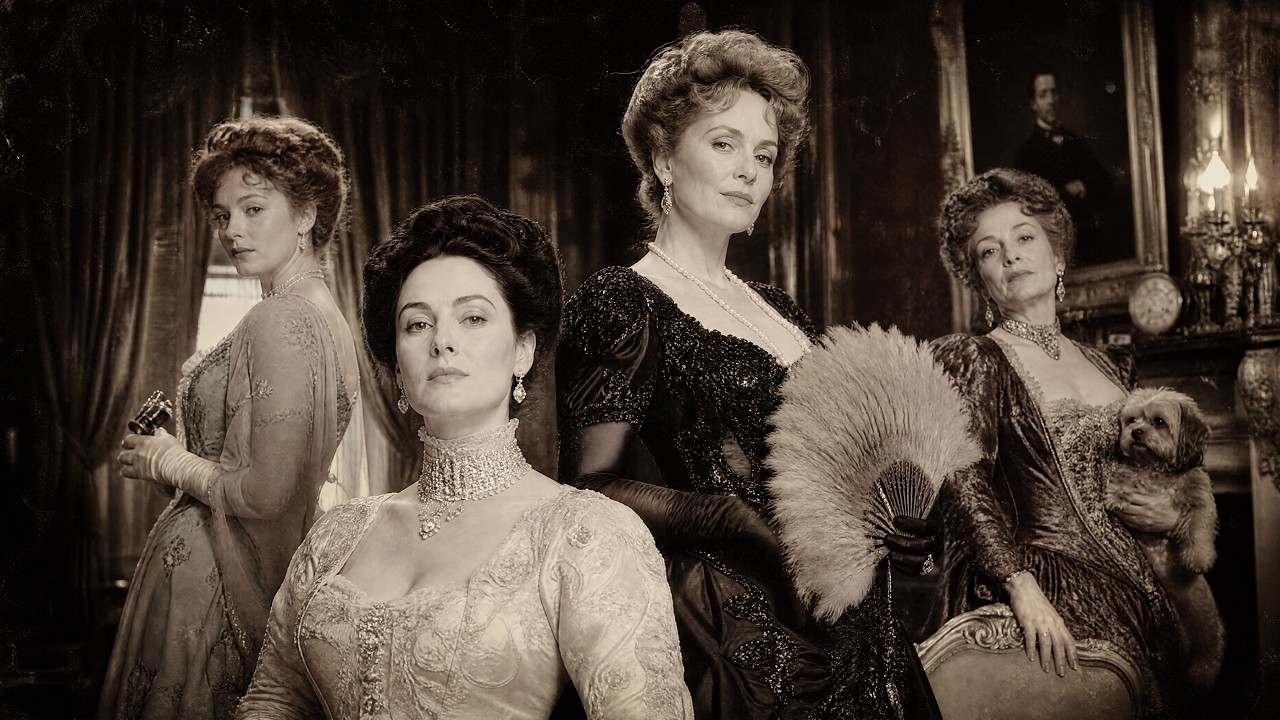
The healer whose hands revived the richest man in New York until his family bought her a ticket out of the country. The woman in the mansion the press called the house of mystery, whose life was sold piece by piece to strangers. The beauty two men destroyed each other over, buried in Paris with three mourners at her grave. These are five women who reached the center of American power and were made to disappear from the record of it.
The question left behind is who did the erasing—and whose hands were really on the money. The era that produced these women was built on contradiction. By the 1860s, New York law permitted a married woman to own property, keep her wages, and inherit in her own name. But in the marble rooms where money actually moved, clerks still looked past the woman at the counter and waited for the man whose signature made things real.
The law had opened a door; the world held it shut with one shoulder. The machine that ran these women’s lives had several gears. The first was coverture, the old doctrine that folded a wife’s legal person into her husband’s. The second was society, presided over by the woman the columns called “the Mrs.
Astor. ” A wife might spend a lifetime trying to be received inside the famous 400; a mistress was outside by definition. A man could keep a woman in emeralds and still be forbidden to be seen with her at Delmonico’s. The wealth was private; the disgrace was public.
The press was the third gear, a weapon in either direction. Papers could make a woman famous overnight or unmake her just as fast. A gossip weekly called Town Topics traded in the private lives of the wealthy, and a vanity book called Fads and Fancies invited the rich to pay for flattery—and silence. The fourth gear was the most frightening and the easiest to forget.
A woman who became inconvenient could be made to disappear into a private asylum. Commitment did not always require much more than a doctor’s signature and a family’s wish. The threat sat under every one of these lives like a trap door. Most fundamentally, each of these women held nothing in her own right—unless she was clever enough to seize it.
The house was in his name. The jewels could be reclaimed. The invitations were his to grant or cancel. A woman could lose in an afternoon everything a decade had built.
And not one of the five could vote. Their power was real, and it ran entirely through men. The story begins with the one who understood the machine better than anyone—because she did the erasing to herself, and she did it first. No birth certificate has ever been found for Arabella Duval Yarington, born most likely in Richmond, Virginia, in 1850 or 1851.
“Most likely” is necessary because she spent a lifetime making sure nothing firmer could ever be proven. Her father, a carpenter, died in 1859, leaving a widow and five children with very little. Her mother took in boarders on a main street in Richmond, in a wartime district thick with gambling parlors and cheap hotels. Accounts still disagree about what kind of house it was.
She made the fog on purpose. Watch what she did with her name. She was Belle Yarrington, then Belle Worsham, calling herself the widow of a Richmond gambler named John Worsham. She became Mrs.
Collis Huntington, and at the end, Mrs. Henry Huntington. She gave one birthplace to a ship’s passenger list and another to a marriage register in Paris. The dates she offered drifted later as she aged, so that on paper she grew younger while the calendar said otherwise.
When she died, she had arranged for the bulk of her personal papers to be destroyed. They were, by a trusted friend, over the protest of the man who loved her. In a surviving letter, she signs herself with her maiden alias and ends with a plain instruction: “Do tear up this awful thing. ”
She understood earlier and colder than almost anyone that the record was the thing that could hurt you.
She drew the only correct conclusion. If they were going to try to erase her anyway, she would erase herself thoroughly, on her own terms, and keep the fortune in the fog where no one could reach it. Every other woman in this story had the erasing done to her. Arabella did it to herself first, by choice—and she is the only one who kept everything.
The foggy, self-denying woman ended her life as, by common description, the richest woman in America. She owned the taste behind a collection of European art that now fills wings of great museums on two coasts. She was courted at different times by two of the wealthiest men the country produced—an uncle and his nephew—and married them both. While Collis Huntington was still married, a young woman with no past he would name was quietly building a fortune in her own name.
Collis was one of the “Big Four” who drove the Central Pacific and then the Southern Pacific Railroad across the American West. He was nearly 30 years older than she was. He kept her, set her up in fine houses—and gave her money that she did not spend on gowns and dinners, but turned coolly into more money. By the time she was 27, she owned property in her own name worth, in today’s money, roughly $6.
5 million. The question of her first husband only deepens the fog. She always called herself the widow of John Worsham, the Richmond gambler. The records tell a different story.
Worsham had a wife already, a woman named Annette, and he did not die when Arabella’s account needed him to. He went back to Virginia and lived on for years. It is doubted the two ever legally married at all. That invented widowhood covered the deepest question of her life: the parentage of her only child, Archer, born March 10, 1870.
No record states his city of birth or the name of his father. People whispered he was the splitting image of Collis Huntington, and Collis did treat him as a son. But no proof survives, and one careful modern historian has suggested Belle herself may not have known who fathered her child. When Elizabeth Huntington died of cancer in 1883, within about a year Collis married Arabella.
The mistress became the wife—and the wife became a serious collector, the real eye behind one of the greatest art fortunes America ever assembled. She taught herself French, crossed to Paris to buy at least 22 times across four decades, and dealt with the most powerful art dealer of the era, Joseph Duveen—dealing not as a rich man’s ornament but as a buyer who knew exactly what she wanted. In 1907, the collection of a Paris financier came onto the market through Duveen. Arabella bought, among other things, a Rembrandt—the great canvas of Aristotle Contemplating a Bust of Homer—along with French decorative art, for a sum that in today’s money runs to about $16 million.
The modern scholar of the family is blunt: the Huntington collection of French 18th-century art “is imbued with the taste, the knowledge, and the guidance of Arabella. ” The men signed the checks. The hands on that collection were hers. She was the one client Duveen could not simply dazzle.
She had taught herself over decades to see. Old New York never quite took her. But in San Francisco on Nob Hill, she threw dinners in a Spanish style that became a genuine society fashion, praised in the papers and imitated by her betters. That distance mattered.
She built over some 20 years roughly eight great residences. There was the anticipation of her own rise. Before her marriage, while still the mistress with the buried past, she bought a house on West 54th Street and rebuilt its insides into a fantasy of arrival—rare woods, a stained-glass skylight, a Moorish smoking room, a Turkish bath, a Japanese bedroom, one of the first private elevators in any New York home. When she married Collis, she sold the whole house furnished to the Rockefellers.
When that house was finally torn down, its finest rooms were saved and carried into museums. Today you can walk into the Brooklyn Museum and stand in her Moorish smoking room, into the Metropolitan and stand in her dressing room, into the Virginia Museum of Fine Arts and stand in her bedroom. The lady who built them is a caption on the wall, if she is named at all. There survives a letter from 1871, written in her alias while her infant son lay sick far away in Texas.
It is the rawest thing in the record of her. She writes to Collis that she is so worried she does not know what to do, that she is ashamed to ask, that he has been so kind, that he is the only friend she has in the world. Then the line that tells you what the arrangement really was: she is “perfectly willing to agree to any proposition he may make. ” Everything after it grew from that one letter and the bargain inside it.
In 1903, the woman the papers called the richest in America handed a blackmailer $10,000—in today’s money, about a quarter of a million—and then fled the country to dodge a subpoena. The blackmailer was a colonel named Mann, who ran the society gossip weekly and the vanity book Fads and Fancies. Most who bought their way into his flattering pages paid a modest fee. Arabella paid many times the going rate.
She was not buying vanity. She was buying silence. When the law began circling Mann’s operation, she sailed for Europe in 1905, putting an ocean between herself and the questions. She could command the price of a Rembrandt, and she could not afford at any price to have her origins spoken aloud in an American courtroom.
What was she so anxious to conceal? The honest answer, given even by the institution that keeps her memory today, is that we will probably never know—because she made sure of it. Collis Huntington died in 1900, leaving her roughly two-thirds of an estate running into tens of millions, while his nephew Henry took the other third. In 1913, in a church in Paris, she married that nephew, Henry Huntington, and the two halves of the fortune closed back into one pair of hands—hers.
Henry adored her. One of Henry’s own relations wrote plainly that he was madly in love with “Aunt Belle,” and that among the wives and daughters of the Huntington circle, a distinct bitterness and dislike of Arabella had set in years before the wedding. She died on September 16, 1924, in her house on Fifth Avenue. The woman who spent a lifetime erasing when and where she was born delivered the last and most perfect proof of her success.
Henry Huntington had to write to her own son to ask his late wife’s true date of birth—because she had hidden it so completely that even her husband could not supply it for her grave. She does not even lie beside the man she wore black for. Collis rests at Woodlawn in the Bronx; Arabella lies 3,000 miles away in California beside Henry. A marker with her name was set next to Collis in New York, but it is a cenotaph, an empty stone.
She left a genuine hand in good works: $100,000 to found what became one of the first cancer research funds in the country, and money for schools for Black students at a time when few of her class would. Marian Davies was born Marian Cecilia Doris in Brooklyn on January 3, 1897. The first thing to correct is the thing the movies got wrong on purpose. She was not a slum waif.
Her father was a New York lawyer who became a city magistrate. She was schooled by nuns. The poverty and vacancy later painted onto her were painted from outside. What was true was the stammer.
She stuttered badly from childhood, and children are cruel. She turned the wound into comic timing. When her mother corrected her that the word was “stammer,” not “stutter,” the girl shot back that she did not see what difference it made. She would spend a career being told what she was and answering back that the label did not change the fact of her.
She left school early, danced in the chorus, modeled for magazine illustrators, and by 1916 had a featured place in the Ziegfeld Follies. The stammer kept her to dancing rather than speaking parts. She said it herself with dry honesty: she could not act, she liked to say, but silent pictures appealed to her because she could not talk either. Then Hearst built her a studio.
Not a role, not a contract—an entire film company, Cosmopolitan Productions, raised up around this one young woman. He signed her at $500 a week when the stage had been paying her 45 or 50. He poured an estimated $7 million of promotion across the years—in today’s money, past $150 million. By 1924 she was the number one woman at the American box office, crowned queen of the screen.
Here is the cruel joke buried in all that promotion, and she saw it before anyone. The love was manufactured so loudly that it curdled. She remembered the signs going up all over New York City until people got so sick of the name Marian Davies that they would stop her in the street to insult her. She had a real gift that got buried under the very machine built to display it.
Film historians now put it plainly: she was one of the best comedians the silent screen produced. Across roughly 20 years, she made close to 45 feature films. When pictures learned to talk, her sound test came back so strong that a great studio signed her for five more years. The break came over exactly the thing that had built her: a rich man forcing a career.
Hearst wanted her cast as Marie Antoinette and in another prestige picture; both parts went instead to Norma Shearer. Hearst pulled his newspapers’ weight away from that studio and moved Marian to Warner Brothers. The parts there were thinner, and the public had moved on. By the end of the 1930s, her film company had folded, and she had left the screen for good.
What almost no one noticed was how much of her own fortune she built with her own head. She was a shrewd buyer of property, a genuinely successful investor in Los Angeles land and buildings. She drove a hard bargain on beautiful things. There is a story of her wanting a great English portrait and beating the dealer down from $600,000 to $140,000.
That was Marian Davies away from the camera. She had a gift for mimicry. In one celebrated picture, she impersonated the reigning dramatic queens of the screen, sending up their grand poses with wicked accuracy. Audiences howled.
The stammer that had shamed her sat beside a gift for physical comedy few rivals could touch. By 1937, the richest publisher in America was more than $100 million in debt. The Depression, the overreach, the castles, and the collecting had left Hearst owing $126 million. The empire that had made Marian a star was days from collapse.
Marian Davies sat down and wrote him a personal check for $1 million. When that was not enough, she gave him her jewelry—the diamonds and the whole glittering evidence of what the world assumed he had lavished on her—handed back to be sold to keep him afloat. She did not need his money. She had made millions of her own.
She could have walked. Instead, she liquidated her own security to rescue the man. The jewels that were meant to be the badge of her dependence became the proof of the opposite. They were not what he gave her.
They were what she gave up for him. Why did she do it? The answer is the least fashionable one and the true one. She loved him, and had for 20 years.
They never married because Hearst had a wife, Millicent, a Catholic who would not divorce him. A friend remembered Marian saying she would give everything she had to marry that silly old man—not for the money, but because he gave her the feeling she was worth something to him. He could be petty, she said, and he snored, and he had sons nearly her own age, but he was kind to her, and she would never walk out on him. She ran the social power of his empire from two of the most extraordinary houses in America: San Simeon, the hilltop castle of about 165 rooms, and Ocean House on the sand at Santa Monica—about 110 rooms, 55 bathrooms, 37 fireplaces, $4 million on furnishings alone, a marble saltwater pool crossed by a bridge modeled on the Rialto in Venice.
They called it the Versailles of Hollywood. Through those rooms came Charlie Chaplin, Douglas Fairbanks, Greta Garbo, Clark Gable, Winston Churchill, Calvin Coolidge, Charles Lindbergh, and Amelia Earhart. She made the most powerful people alive feel the party mattered because she was in it. Asked about not being his wife, she said she had been very happy the way they were, that they were together, and that was all that mattered.
It held for 30 years, without a ring or a legal claim. In 1941, a young man named Orson Welles put a talentless drunk in a lonely castle, called her Susan Alexander, and the country decided she was Marian Davies. Citizen Kane is one of the greatest films ever made, and it was for one living woman a weapon. Its hero, Charles Foster Kane, is unmistakably built on Hearst.
Audiences did the arithmetic the film invited: Kane was Hearst, Xanadu was San Simeon, and Susan Alexander was Marian Davies. The biographers say it without hedging: the release of Citizen Kane destroyed Marion Davies’s reputation. The real Marian did drink. The film took that private sorrow and made it her defining trait.
The real Marian liked jigsaw puzzles. The film turned a harmless pastime into the emblem of a hollow, kept, purposeless life. It reached into a real person, pulled out a few true fragments, and rebuilt them into a lie the whole country could see. Hearst’s papers banned mention of the film.
But you cannot ban a masterpiece. The men who made the film eventually came to regret it. Herman Mankiewicz, who wrote it and had been her friend, counted it among his deepest regrets that people thought his Susan was Marian. Welles himself, decades on, recanted publicly: in an introduction to her memoir, he called her one of the most delightfully accomplished comedians in the history of the screen and said his Susan Alexander bore her no resemblance at all.
She bore it with grace. She said she had no anger toward Orson Welles—that everyone is made to do their very best. She liked, she said, to keep the waters calm. Hearst declined for years; she nursed him through it.
On August 14, 1951, he died at their house in Beverly Hills, age 88. His will left her real power: 170,000 controlling shares in the Hearst Corporation. Within weeks, she signed them over to his widow, Millicent, for $1, and stepped back into the shadows she had lived in for 30 years. Her own account of those days is what stays.
She told it that she had been persuaded, exhausted, to take a sedative, and that while she slept, Hearst died, and his sons moved through the house and stripped it of every trace of their father—and that she, who had nursed him to the end and once saved him from ruin, was not even told of the funeral. She woke and he was gone, and so was every sign he had ever been there. Eleven weeks and a day after Hearst died, she married a sea captain named Horace Brown, in a rush friends read as pure loneliness. The marriage was unhappy; she twice began to leave it and twice did not.
Asked why she had taken him back, she said she supposed it was because he was standing right beside her crying, and added, “Thank God we all have a sense of humor. ”
She died in the autumn of 1961, age 64, of cancer of the jaw, and was buried in Hollywood. She had given more than a million to children’s charities in her great days, and later close to $2 million to build a children’s clinic that still treats the sick in Los Angeles under a newer name. She also told the true story of her life with Hearst into a tape recorder—a memoir published only after she was gone.
Orson Welles wrote its introduction. Tennessee Claflin, called Tennie, was born in the mid-1840s, one of a swarm of children of a man named Buck Claflin, whom even the plainest histories call a snake-oil salesman posing as a doctor. He advertised his girls as mediums. He billed little Tennie as the wonder child, built himself grandly as a “king of cancer,” and sold a worthless tonic under her name.
There was a clinic in Illinois where the family’s quackery was blamed for a patient’s death, and the whole clan had to flee. Spiritualism ran right up into the great houses. Cornelius Vanderbilt, the Commodore, kept faith with mediums for years. He believed he could speak with the dead, with his own mother, and, so the accounts say, with the shade of George Washington himself.
He believed he was haunted by two ghosts: a boy he had run down with his fast trotting horses near the Central Park reservoir, and a railroad worker cut apart under the wheels of one of his own trains. In the autumn of 1868, barely a month after his first wife died, the 74-year-old richest man in America sent for Tennie Claflin. What passed between them is the most hedged material in this whole story, and honesty requires the hedges stay on. The affair and the money were denied at the time and never admitted by either.
Much of what we have comes from servants’ gossip, a doctor’s private notes, and later courtroom testimony. With that warning in place, here is what the biographers weighing it all have concluded. The two became lovers. She was his “magnetic healer.
” He called her his “little sparrow. ” In his downtown office, he would sit her on his knee while he talked railroads, and let her tug his whiskers and call him “old boy. ” His own physician said the old man was lucky to have so willing a plaything to divert him. Out of that knee came something no woman had ever built before.
Vanderbilt backed the sisters in setting themselves up as stockbrokers. In early 1870, they opened Woodhull, Claflin and Company on Broad Street across from the stock exchange—the first brokerage in American history run by women. The city lost its mind. On the first day, some 4,000 people crowded to see them; it took about a hundred policemen to hold the crush.
The papers called them the “bewitching brokers” and the “queens of finance. ” A sign in their office reportedly warned gentlemen callers to state their business and retire at once. Asked point-blank by a reporter where the money came from, Tennie answered that the Commodore was her friend, and she would say nothing more about that matter. The sisters used the fortune not only to play at broking but to become the loudest women in America.
They founded Woodhull and Claflin’s Weekly and turned it into a battering ram for every idea respectable people feared: votes for women, free love, spiritualism, reform of the money system. The weekly even printed the first American edition of the Communist Manifesto, between advertisements for stocks. In the spring of 1871, under oath in a family lawsuit, Tennie declared she was a clairvoyant and spiritualist, that she had power and knew her power, that many of the best men in the street knew her power—and that Commodore Vanderbilt knew her power. She admitted in the same breath that she had humbugged people, but insisted that when she did, she did it to make money.
In 1872, the Weekly printed a sensational exposé of the most famous preacher in America, Henry Ward Beecher, accusing him of an affair with a married parishioner. The issue sold 100,000 copies; reprints changed hands for $40 apiece. The sisters were arrested for sending obscene matter through the mail. They spent election night of 1872 in a cell in Ludlow Street Jail.
The brokerage did not survive the panic of 1873. By about 1871, Vanderbilt’s new young wife had insisted the “little sparrow” be put out of his life. Vanderbilt died January 4, 1877, leaving a fortune of some $100 million and a family at war over it. One son, cut nearly out, contested the will, arguing his father had been of unsound mind, enthralled to spiritualists.
The Claflin sisters were named again and again as star witnesses—and then quite suddenly they left the country for England. The trial went on without them. What is documented is that they were expected witnesses and did not testify. What was widely rumored and never proven is that the winning side of the family quietly paid to put them beyond the reach of an American court.
No cancelled check exists. But the shape of it is unmistakable. Tennie was erased from the Vanderbilt story, pushed out of his life and then out of the nation. But she was not destroyed.
In 1885 she married Francis Cook, a merchant prince and holder of a Portuguese title; Queen Victoria soon made him a baronet. The barefoot medium from Homer, Ohio became Lady Cook, a viscountess with palaces in England and Portugal. She reportedly told the widowed Cook she had received a message from his departed wife urging him to marry her. The dead had always been her most reliable business partners.
She outlived her husband, and his fortune came to her. She died in England in the early 1920s, and the New York papers that once called her a bewitching broker noted in a small obituary that “Lady Cook” had died—a spiritualist and suffragist who had made a stir half a century before. Charles Tyson Yerkes began in Philadelphia, where a financial panic caught him short of the city’s money and sent him to prison for embezzlement. He came out unbroken, went west, seized control of the street railways of Chicago, and built its downtown loop by methods so bare in their bribery that the city eventually rose against him.
He carried his fortune east to New York and then to London, where he financed great stretches of the London underground. Somewhere in the middle of that building, he met a girl of 16. Her name was Emily Grigsby. She was born in Kentucky in the late 1870s into a family that had once been distinguished.
Her father died young and left the family poor. Her widowed mother, needing money to keep her children in good Catholic schools, opened—by the sober account of more than one reputable source—a high-class brothel in Cincinnati. Emily decided then and there that the only escape from her mother’s fate was money and rank. She grew into a woman of extraordinary poise, carried herself like an empress, and let the world call her “the American princess.
” It was all calculation, the deliberate work of a girl who decided the only armor against her mother’s fate was to become so grand that no one would dare ask where the money came from. Yerkes gave her a stage worthy of the part. Two short blocks from his own great house on Fifth Avenue, he built her a mansion on Park Avenue—a tall, narrow palace of white granite. The papers, unable to say plainly what she was to him, took to calling it the House of Mystery.
Inside was a fever dream of money: an entire floor given over to a music room with a piano covered completely in gold leaf, a guest bedroom hung with 15 needlework tapestries each said to have cost $15,000, themed rooms in the French and Napoleonic taste, jade and Chinese porcelain, and a library holding, by one account, a first folio of Shakespeare. Over one of the staircases hung a life-sized portrait of Emily herself. The nickname the papers gave the house was exactly the effect she wanted: a woman too grand and too enigmatic to be questioned. For a season she was the most intriguing woman in New York.
Then the intrigue turned to investigation, and the investigation found Cincinnati. Society’s hostesses learned who the mother was and how the money had truly been made. The doors of Fifth Avenue swung shut one after another and stayed shut. There was a wife in all this.
Mary Yerkes, called Molly, had stood by Charles through the worst of it—the jailers called her his “prison angel. ” Her reward was to watch a girl of 16 installed two blocks up the avenue. At the end, the old man was pressing her for a divorce. Less than a month after Yerkes died, she married a young fortune hunter; within a year she had divorced him, too.
She summed up the glittering wreck in a single line that could serve as an epigraph for every woman in this story: “Just another idol shattered. That is what all this money has done for me. ”
When Yerkes died at the Waldorf on December 29, 1905, age 68, his young mistress was not named in a single line of the will. In life he had been reckoned worth as much as $25 million.
But the London tube lines had swallowed his fortune and left it drowning in debt. Most of the great estate had to be sold to pay what he owed. The woman of the House of Mystery had been left exactly nothing. In 1911, the New York papers filled with cables describing Emily Grigsby’s dazzling conquest of London society, her intimacy with royalty—a claim that she and a princess of the royal house called each other by their first names.
It was a fairy tale she had written herself and planted in the press. The palace saw to it the story was denied, and a London paper delivered the killing line: her social successes proved, on investigation, “to be a baseless fabric of the imagination. ”
In the winter of 1912, they emptied the House of Mystery and sold it to strangers. An auction house spent two months cataloging her life, then sold off the silver and jade, the Chinese porcelain, the tapestries, the famous gold piano.
Canvases by Monet and Pissarro went under the hammer. The very society women who had refused to receive her turned up in the sale room to bid—happy enough to own the pictures once the awkward living people attached to them had been reduced to a catalog. She kept back only two portraits: one of a pope, and her own life-sized portrait. Out of the emptied house, she carried her own beautiful face and an image of the church.
Then she left for England. She lived on another half century in London, an Edwardian hostess on the edges of famous lives. When she died there in 1964, unmarried and long forgotten, her passing went almost unnoticed. Much of her wardrobe and a great traveling trunk ended up in a London museum, papered with the labels of the ships she had crossed on—the Lusitania, the Olympic.
Asked once about her habit of cutting up priceless antique tapestries to cover her dining chairs, she shrugged: “But I couldn’t have had my chairs if I had not cut the tapestries. ” She spent her whole life cutting up tapestries to make her chairs. In the end, the auctioneers cut up her life the same way. Jim Fisk, called Jubilee Jim, had come up from nothing, a peddler and circus hand, and clawed his way onto Wall Street.
With Jay Gould and old Daniel Drew, he fought Cornelius Vanderbilt himself for control of the Erie Railroad. In the autumn of 1869, he and Gould tried to corner the entire gold market of the United States and touched off the panic history calls Black Friday, ruining men across the country in a single day. He wore velvet and diamonds, invented himself an admiral’s uniform, kept brass bands to play him in and out of rooms. The woman he loved was Josephine Mansfield, whom the town called Josie.
By the time Fisk found her around 1867, she was poor and beautiful and entirely out of better options. He set her up in a brownstone on West 23rd Street, a few doors from the Grand Opera House out of which he ran his railroad empire. He built, by the accounts of the day, a covered private passage from the back of his own domain to the back of her house—so he could pass between his empire and his mistress without ever being seen on the street. The most conspicuous man in New York kept this one thing hidden behind a wall.
By the accounts of the period press, he gave Josie a fortune almost beyond counting. There was cash, supposedly a quarter of a million dollars in Tiffany emeralds, a diamond necklace, a tiara, ropes of pearls, 25 rings. They called her the Cleopatra of 23rd Street. And yet, for all of it, Fisk would not be seen at dinner with her.
She had everything a mistress could be given and none of the one thing she truly wanted—to be walked into a room on his arm as though she were real. She had been born in Boston in 1847. Her father was murdered in a far western town when she was a small child, struck down in the street by a business rival. She married young at 16 to an actor; the marriage failed.
She drifted to New York, poor and beautiful, until she was taken up by a woman whose house was the kind a respectable account does not name plainly. It was there Jim Fisk first saw her. At an open house Josie held on New Year’s Day 1870, Fisk introduced her to a handsome younger associate, a well-born gambler named Edward Stokes, called Ned. The man and the woman fell in love.
When the trouble surfaced and Josie suggested the three of them could go on as friends, Fisk gave her the answer that would read within two years like a prophecy: “You cannot run two engines on one track in contrary directions at the same time. ”
Josie left Fisk for Ned Stokes. She believed Fisk held some $25,000 owed to her; he would not pay. So she reached for the one weapon a kept woman kept in reserve: the private letters.
She handed about 75 of them to Stokes, and the two lovers used the old man’s own words to try to squeeze him. Fisk struck back with the machinery of the law. For a year the three tore at one another through the courts: libel suits, blackmail charges, injunctions, affidavits, a public brawl between a robber baron, his former mistress, and the man who had taken her. On the 6th of January 1872, Stokes learned a grand jury had handed up a charge against him for blackmailing Fisk.
Something gave way. He went to the Grand Central Hotel and waited on the staircase. When Fisk came in from the winter street and mounted the stairs, Stokes drew and fired twice. One ball tore into Fisk’s belly, the other into his arm.
Before he died, he named the man who had shot him. On the morning of January 7, 1872, Jim Fisk was dead, and the whole city convulsed. They laid him out in state in the great opera house. Something like 20,000 people filed past the coffin; 100,000 more filled the streets outside.
A robber baron who had helped wreck the nation’s gold market was mourned like a fallen prince. The woman at the center of the catastrophe was left entirely out of the pageant. Within a week of the murder, the newspapers got hold of the letters and printed them. Everyone expected proof of the great man’s crimes.
What the letters contained was none of that. They held only a middle-aged man’s love for a woman and his jealousy of the younger man who had taken her. The most dangerous documents in New York turned out to be nothing but love letters. Josie testified under oath to the last confrontation.
Fisk had a pistol in his hand, she said—a handsome pistol, silver-mounted, with a pearl handle—and she had taken it up and looked at it. He had said, she testified, that unless she returned to him, he should kill Mr. Stokes. She had stood between two men, each of whom had told her in his own way that he would rather destroy the other than lose her.
Ned Stokes was tried three times. The first ended with a hung jury after 22 days. The second convicted him of murder and sentenced him to hang—the death sentence pronounced exactly one year to the day after he fired the shots. The higher court threw the conviction out on a point of law.
The third jury brought it in as manslaughter; Stokes was sentenced to four years and served about three. His cell was carpeted, papered, and hung with pictures; his meals sent in from Delmonico’s. A critic of the day said the plain truth: had Stokes been an unlettered laborer, he would have hanged within two months. Josie sued Fisk’s widow for $200,000 and lost.
The public turned on her with venom. Crowds followed her and hooted her in the street. At Saratoga, the first-class hotels refused her a room; respectable women rose and walked out of a courtroom rather than sit while she took a seat. The woman two men had destroyed each other over—the world decided the destruction was her fault, and hers alone.
She left for Paris. She surfaced now and then in the papers, married and divorced, reported poor, reported ill, reported living under other names. More than 40 years before she actually died, a newspaper announced her death and described her burial—and it was simply false. She was alive across the ocean, already so nearly forgotten that the press could kill her off by mistake.
She died at last in Paris in 1931, in an American hospital there, an old woman of 83, of cancer of the stomach, under a married name almost no one connected any longer to the famous beauty of 1872. The headline over the notice of her funeral read: “Only Three Mourners at Josie Mansfield’s Grave. ” Three people, two of them servants. She was put into the ground in a Paris cemetery beside her mother.
Ned Stokes came out of prison and lived on for decades, ran a hotel. But by the account of his own obituary, in his last years he was a haunted man, fearful and suspicious and sick, forever glancing over his shoulder. He kept his freedom and lost his peace. There is an eerie footnote.
Over Fisk’s grave in Vermont, admirers raised a great marble monument, with four half-draped female figures meant to stand for his empire. A friend joked that Fisk had trouble with women all his life, so they had put four over his grave. The marble has blackened; souvenir hunters have chipped it away; at last the very portrait of Fisk was taken from the stone, leaving only a faint shadow in the empty oval where his face had been. Josie got her own strange scrap of immortality: her face from an old photograph was engraved on a high-value $1,000 United States bank note, which collectors came to call the “courtesan note.
”
Walk into the great museums today, and the art is hers. The buildings carry the Huntington name; the public mind means the men. Cross to London, and there is Emily Grigsby’s traveling trunk in a national museum. Drive up the California coast, and there is Hearst Castle, a monument to the man.
Down on the Santa Monica sand, the surviving marble pool of the house Marian Davies ran is now a public beach club where strangers swim over the tiles of her lost Versailles. The Gilded Age closed the doors and cut these women from the wills. The new century made them characters and sold the characters back as the truth. Dreiser took Charles Yerkes and built a trilogy around him, folding Emily Grigsby in as a supporting mistress named Berenice.
Orson Welles turned Marian Davies into Susan Alexander. The machine that had once been newspapers and wills and society columns became novels and films, and it ran the same errand: take the woman out of the record, leave the man. And yet their money and taste actually seeded lasting things. A great cancer hospital grew in part from a gift one of them made in grief.
A pair of the finest art museums in the country hold at their heart the eye of a woman who taught herself to see. A children’s hospital still treats the sick on the strength of a comedian’s fortune. Wall Street opened its first door to women because a fortune teller’s daughter pushed one open with a dead man’s money. The erasure did not touch what they built.
It touched only the memory of who built it. One of them said it out loud in a courtroom before the machinery of forgetting could reach her. “I have power,” Tennie Claflin told the court. “I know my power.
Commodore Vanderbilt knows my power. ” They put her on a boat for saying it. They could not make it untrue. And back to Marian on the sand where we started.
The great house is gone; only the marble pool and the bridge remain. For decades the caricature was all that was left of her. And there is a bitter fitness in that, because putting Marian Davies back together has been a jigsaw—the slow fitting of scattered true pieces into the shape of the real woman. The last word belongs to her, and it is not bitter, because she never was.
Hearst, she said, had thought he was building up a star, had seen her in all his good faith as an actress. She hoped that before he died he had found out she was not one. And then the line that holds all five women in a single breath: “Still,” she said, “I think he thought I was. ”
The buildings will keep the men’s names.
Go and stand in them anyway, look at what is on the walls, and ask the old question one more time. Whose hands were on it? Hers.
They always were.