She died on March 11, 1953, in a rented apartment in Neuilly-sur-Seine, outside Paris. No title, no state ceremony, no place in the official royal history. Joanna Marie Valentina Lambrino, known to everyone who knew her as Zizi, was 54 years old. The French press did not cover her death.
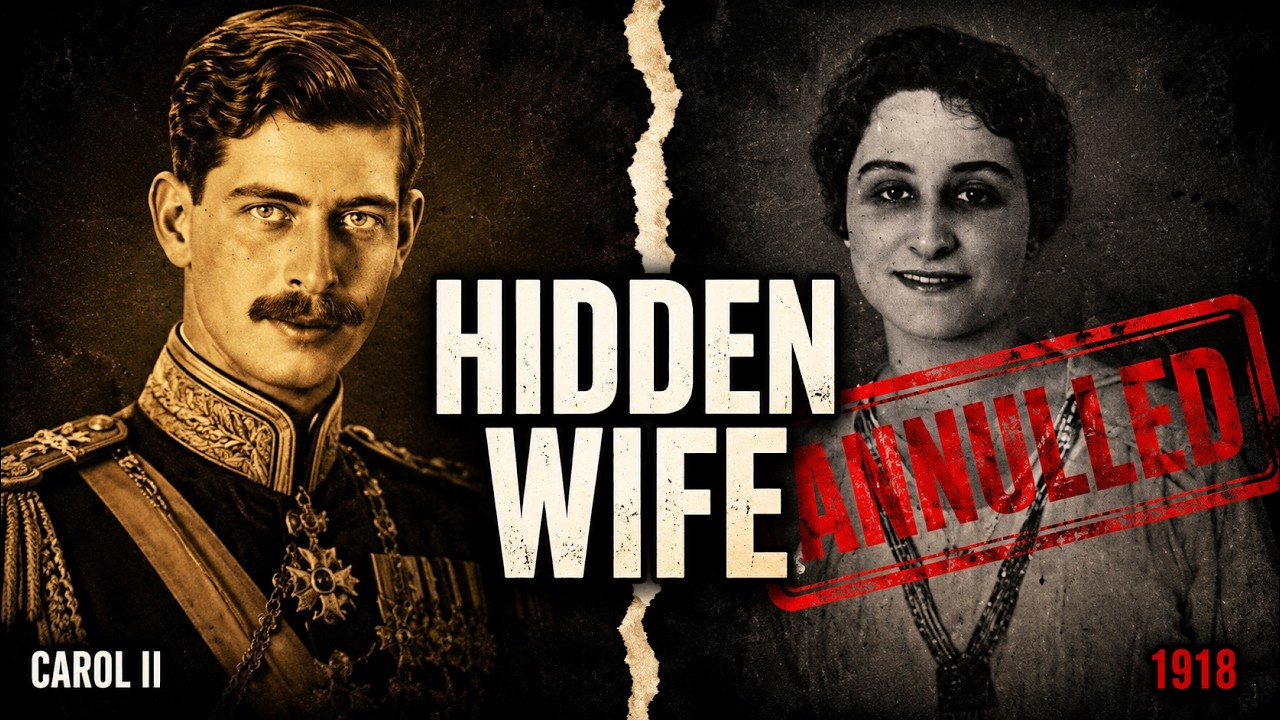
The Romanian royal house said nothing. Twenty-four days later, the man who had once crossed a wartime border in disguise to marry her died in exile in Estoril, Portugal. He was 59. His name was Carol II, and he had been king of Romania for a decade.
His death was documented and debated by historians. Hers was not. Zizi was the first woman Crown Prince Carol chose over the weight of a dynasty. She was also the first person that royal house systematically tried to erase.
The legal consequences of their marriage would still be argued in Romanian courts 78 years later. In the summer of 1918, Carol abandoned his military post in the middle of World War I. He dressed in civilian clothes, crossed the border into enemy-held Ukraine, and married Zizi in an Orthodox cathedral in Odessa. After the fact, he sent a telegram to his father, King Ferdinand: “I married Zizi.
Can I come back? ”
Carol’s story with Zizi began five years earlier. In 1913, at a political gathering in Bucharest organized by the conservative politician Alexandru Marghiloman, the 20-year-old Crown Prince met Zizi, then 15. Her family was Romanian with Phanariot Greek origins and ties to the ancient Byzantine Rangabe imperial lineage.
Her father was an army officer who would later become a general. When Romania entered World War I in 1916 and the royal court fled to Iași, Carol and Zizi found each other again. Their attachment had been building for five years. Zizi’s brother Lulu was one of Carol’s closest friends, and photographs exist of Zizi at royal family residences during this period.
The journalist A. L. Easterman, who covered Romanian affairs for decades, described it this way: Carol fell violently in love, and he was at no pains to dissemble it. The House of Hohenzollern-Sigmaringen had a rule written into its statute: the heir to the Romanian throne could not marry a commoner.
It was constitutional, not optional. Any marriage contracted in violation of that statute would be null under Romanian law. Carol knew this and married Zizi anyway. By the summer of 1918, the Romanian court had been in Iași for nearly two years.
The formal rituals of royal life had collapsed under wartime pressure, making the relationship possible. Carol’s actions carried enormous personal cost. Prime Minister Brătianu would later describe his desertion as close to treason. Carol walked away from his regiment in Târgu Neamț without authorization.
A lieutenant from his own unit helped him secure civilian clothes. He traveled through territory controlled by opposing forces, crossed into Ukraine, and arranged witnesses for the ceremony. On August 31, 1918, he stood before a priest in the Orthodox Cathedral of Odessa and married Zizi. Then he sent the telegram: “I married Zizi Lambrino.
Can I come back with her or should we go to France? ” There was no apology and no request for forgiveness. Just the fact of what he had done. The response was confinement.
Carol spent 75 days in a monastery in Bistrița under his father’s orders. From there he wrote letters, threatened abdication, and refused to recant. The prime minister recommended that Carol be stripped of his succession rights entirely and that his younger brother Nikolai be elevated to heir. In early 1919, the High Court of Cassation ruled that the marriage between Carol and Zizi was unconstitutional, unlawful, and annulled.
Carol responded by signing documents renouncing his right to the throne—and continuing to live with Zizi anyway. For a brief period in early 1919, the Crown Prince of Romania had legally removed himself from the succession in deliberate defiance. Yet the palace did not release him. Through intermediaries, it quietly made clear that this was not permanent.
Carol was still a prince, and the door had not closed. Zizi became pregnant. On January 8, 1920, she gave birth to a son in Bucharest. The boy was named Mircea Gregor Carol, after Carol’s youngest brother, Prince Mircea, who had died in 1916 at age three.
The choice of name was an act of insistence: Carol was telling his family this child belonged to the lineage. The palace’s response was public silence and increased private pressure. There was no single moment when Carol stopped fighting. The pressure worked through persistence: whispers about the kind of king he could become, the offer to come back and make this chapter the rough edge of a young man’s biography.
The palace had already identified a dynastic solution. Princess Helen of Greece and Denmark, Carol’s second cousin, was the candidate. The match was a diplomatic alignment between Romania and Greece, and it carried weight that Carol’s private preferences did not. Carol agreed to meet Princess Helen.
Within months, he had ended his relationship with Zizi. On March 10, 1921, Crown Prince Carol married Princess Helen of Greece and Denmark in Athens. Their son, the future King Michael, was born on October 25, 1921. Carol had not formally ended his relationship with Zizi before the wedding.
He simply left. The palace’s solution for Zizi was a document. She was required to sign an agreement committing not to raise any claims and to refrain from any harassing or harmful acts against any member of the royal family. In exchange, she received an annual payment of 110,000 francs from the Romanian government.
She signed it. Then she and her son were forced to leave Romania. Because Carol and Zizi’s marriage had been annulled before Mircea’s birth, the boy was classified as illegitimate under Romanian law. He carried his mother’s surname, Lambrino, not Hohenzollern.
Carol never officially recognized him. The story did not close there. It moved into courtrooms for decades. In 1955, two years after both Carol and Zizi died, a Portuguese court ruled that Mircea was Carol II’s legitimate son and permitted him to adopt the Hohenzollern surname.
Two years later, a French court made a similar ruling regarding Carol’s French properties. King Mihai, Carol’s son by Princess Helen and Romania’s last reigning monarch, appealed several times unsuccessfully. In 1995, a Romanian court ruled that Carol Lambrino, the name Mircea had taken, was in fact Carol II’s legitimate son. King Mihai appealed again.
Then, in 1996, a Romanian court went further. It ruled that Zizi’s original marriage to Carol had been legally valid. If that ruling stands—and it has been contested repeatedly—then the annulment of 1919 was itself invalid, which would mean Carol’s marriage to Princess Helen took place while his marriage to Zizi may still have been legally intact. The palace had tried to make Zizi disappear.
What it had done instead was plant a legal dispute that would outlive everyone involved. Zizi preserved every piece of evidence from those years: her diaries, her letters, photographs of herself with Carol at royal residences, documents from Iași and Odessa and Bucharest. She donated them to the Hoover Institution archives at Stanford University in California. They are cataloged there today under the collection name Jeanne Marie Valentine Lambrino papers.
She chose deliberately to leave the evidence. Carol repeated the pattern twice more. After leaving Zizi and marrying Princess Helen, he carried on a long affair with a woman named Elena Lupescu. That relationship forced him out of the succession in 1925, and he was exiled to France.
Helen divorced him in 1928. In 1930, he returned to Romania and reclaimed the throne, ruling as an increasingly authoritarian king until 1940, when he was forced to abdicate and fled for good. He married Lupescu in 1947 and died in Estoril, Portugal, on April 4, 1953. Neither Carol nor Zizi ever returned to Romania.
She had been pushed out. He had fled. Both died in Western European exile within 24 days of each other. Zizi’s son, Carol Lambrino, was married three times and had two sons.
His elder son, Paul Philippe Hohenzollern, still claims today to be the rightful head of the Romanian royal house. No Romanian institution has accepted that claim, but no Romanian court has permanently dismissed it either. The legal thread that began when a crown prince walked away from his regiment to marry a general’s daughter was never fully cut. It was only filed.
What Zizi’s story leaves behind is not a dynasty or a title. It is the record: stubbornly, inconveniently intact, that a woman existed, was chosen, was married, gave birth, was discarded, and refused to cooperate with her own erasure. The Romanian court rulings in 1995 and 1996 came 40 years too late to be justice. But the documents in the Hoover Institution still carry her name.
Jeanne Marie Valentine Lambrino. No court in any country has managed to annul that.