When Emperor Charles of Austria died in exile in 1922, he left behind eight children who became heirs without a throne. Raised between Swiss villas, boarding schools, and borrowed palaces, they grew up in a world that had abolished their birthright. Some became statesmen, others worked quietly in exile, and their descendants now hold connections to Europe’s reigning royal families. From the crown prince who sat in the European Parliament to the daughter born two months after her father’s death, here is the story of Charles I’s children and how their blood still runs through Europe’s royal houses.
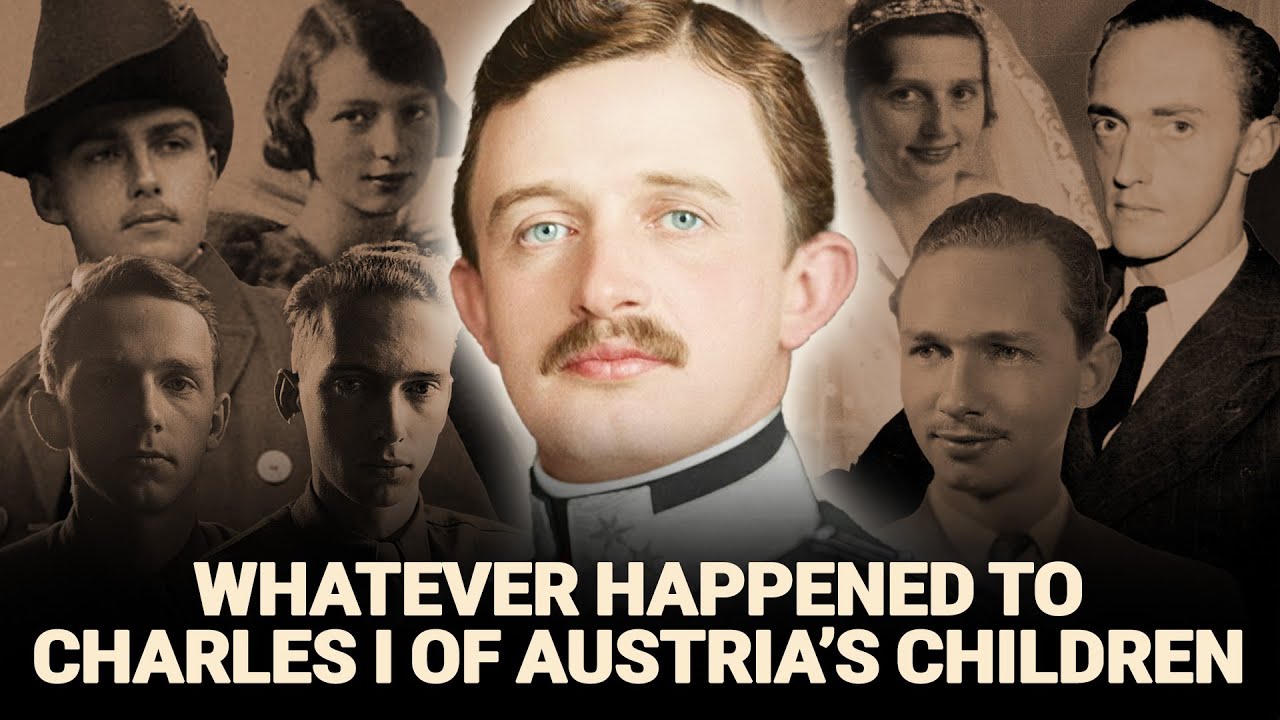
The Great War destroyed more than battlefields. It toppled dynasties that had ruled for centuries. In November 1918, Emperor Charles of Austria-Hungary, heir to a realm stretching from the Alps to the Carpathians, found himself emperor of nothing. He refused to formally abdicate, insisting he was merely stepping aside from affairs of state, but the distinction mattered little.
The Habsburg monarchy was dead, and Charles was a statesman without a state. With his wife, Empress Zita of Bourbon-Parma, Charles had eight children born between 1912 and 1922. The eldest, Otto, was just six when his father lost the throne. The youngest, Elizabeth, was born two months after Charles died in exile on the Portuguese island of Madeira.
The family’s exile began in Switzerland, where they lived in modest circumstances at Wartegg Castle. Charles’s two failed attempts to reclaim the Hungarian crown in 1921 led to his banishment to Madeira, where he died of pneumonia in April 1922 at age 34. Empress Zita was left to raise eight children alone, maintaining their imperial dignity while adapting to a world that had no place for emperors. What followed became a remarkable chapter in Habsburg history—not the story of how a dynasty fell, but how it learned to rise again.
Otto Franz Joseph Karl Ludwig Maria von Habsburg was born on November 20, 1912, at Reichenau Palace near Vienna. As the eldest son of the heir apparent, he was born into certainty that he would one day rule the vast Austro-Hungarian Empire. That certainty lasted exactly six years. When Emperor Franz Joseph died in 1916, Otto’s father became Charles I, and four-year-old Otto became Crown Prince.
By November 1918, there was no crown left to inherit. Otto’s childhood was defined by exile and education. In Switzerland, Zita ensured her children received instruction befitting their rank, even if that rank no longer officially existed. Otto learned German, Hungarian, Croatian, English, French, and Spanish—languages of the empire that was and the world that would be.
At age 14, he was sent to the Jesuit College of Stella Matutina in Austria, and later to the University of Louvain in Belgium. His education emphasized not just royal protocol, but practical skills, law, economics, and political science. Otto earned his doctorate in political and social sciences in 1935, writing his dissertation on agricultural reform in the Danube region. For decades, he maintained his claim to the Austrian and Hungarian thrones, styling himself Otto I of Austria and Otto IV of Hungary.
He established the Habsburg court in exile, first in Belgium, then in Bavaria after World War II. But Otto was no mere nostalgic pretender. He became a passionate advocate for European integration, seeing it as the peaceful successor to the multiethnic empire his family had once ruled. In 1961, he renounced all claims to the Austrian throne, finally accepting the republic that had replaced his inheritance.
In 1979, he was elected to the European Parliament as a representative of Bavaria, serving until 1999. Throughout his parliamentary career, he advocated for Central European integration and was instrumental in supporting the peaceful revolutions of 1989, particularly in Hungary and Czechoslovakia. In 1951, Otto married Princess Regina of Saxe-Meiningen in a ceremony that mixed Habsburg tradition with post-war pragmatism. The wedding took place in Nancy, France, attended by dethroned royalty from across Europe.
Otto and Regina had seven children. Their eldest son, Carl, was born in 1961 and maintains the family’s traditional claims, though more as a historical custodian than a political pretender. Otto lived to see the European Union expand to include much of the former Austro-Hungarian Empire. Hungary, the Czech Republic, Slovakia, and Slovenia all became EU members during his lifetime.
He died on July 4, 2011, aged 98, having transformed from crown prince of a fallen empire to elder statesman of a united Europe. His funeral in Vienna was attended by leaders from across the continent. His body was interred in the imperial crypt in Vienna, while his heart was separately buried in the Hungarian abbey of Pannonhalma, a symbol of his enduring connection to all the peoples his family had once governed. Archduchess Adelheid Maria Raineria Elisabeth Dominica was born on January 3, 1914, at the Hofburg Palace in Vienna.
She entered the world just months before the assassination in Sarajevo would trigger the war that ended her family’s reign. As the eldest daughter, Adelheid often served as a bridge between her brothers and younger sisters. Unlike Otto, who was groomed for leadership, Adelheid was drawn to intellectual pursuits, preferring books to social gatherings and academic discussions to court ceremonies. Adelheid received her early education from private tutors, but her true passion lay in historical research.
She spent years working in European archives, documenting not just Habsburg family history, but the complex web of relationships that had bound Europe’s aristocracy together for centuries. In an era when marriage was still considered the primary role for women of her background, Adelheid made an unusual choice—she remained single throughout her life. Several European princes showed interest in the intelligent Habsburg princess, but Adelheid chose independence. She dedicated herself to preserving family history and supporting charitable causes related to education and historical preservation.
Her most significant contribution was her systematic documentation of Habsburg genealogy and history, work that became invaluable to historians studying Central European nobility. She was consulted by universities, museums, and historical societies across Europe. Throughout the long decades of exile, Adelheid remained close to her mother, often serving as her companion and assistant. She helped manage the household and maintained correspondence with Habsburg supporters across Europe.
She also became the beloved aunt to her siblings’ children, introducing them to their family history. Adelheid died on October 3, 1971, at age 57. She was buried in the Habsburg family plot in Switzerland, and her papers and research were donated to academic institutions. Archduke Robert Karl Ludwig Salvator Franz Xaver was born on February 8, 1915, at the height of World War I.
Unlike his older siblings, Robert would become the dynastic bridge between the fallen Austrian Empire and the surviving monarchies of modern Europe. His early childhood in exile was marked by constant movement, and he learned adaptability from an early age. Robert showed particular aptitude for languages and diplomacy. During World War II, Robert served with distinction in the British Army, fighting against Nazi Germany, the regime that had incorporated his ancestral homeland into the Third Reich.
After the war, he established strong connections with Belgium, which had welcomed many Habsburg exiles. Robert became involved in various business and diplomatic ventures, often serving as an unofficial liaison between Austria and Belgium. In 1953, Robert married Princess Margherita of Savoy-Aosta, daughter of the Duke of Aosta, uniting two of Europe’s most prominent exiled dynasties. Robert and Margherita had five children.
Their eldest, Archduke Lorenz, married Princess Astrid of Belgium in 1984, bringing Habsburg blood directly into a reigning European royal house. Robert also became connected to the Austria-Este line, one of the cadet branches of the Habsburg family. Throughout his adult life, Robert balanced dynastic responsibilities with practical business activities. His diplomatic background and royal connections made him a valuable intermediary in international business during the period of European economic integration in the 1960s and 1970s.
Robert died on February 7, 1996, just one day before his 81st birthday. He had lived to see his children integrated into European society and his eldest son married into a reigning royal house. Archduke Felix Frederick August Maria Vom Vamzig Franz Joseph Peter Karl Anton Robert Otto Pius Michael Benedict Sebastian Ignatius Marcus was born on May 31, 1916, just as his grandfather Emperor Franz Joseph was dying. Felix would become the most geographically adventurous of Charles I’s children, eventually making his life across the Atlantic in a way no previous Habsburg had ever attempted.
Felix received a comprehensive European education, showing particular aptitude for modern languages and business studies. Empress Zita ensured her children could support themselves through professional skills rather than relying solely on traditional aristocratic income sources. When World War II began, Felix, like his brother Robert, was determined to fight against Nazi Germany. However, Felix chose to serve with American forces, reflecting his growing interest in the United States.
He fought to liberate territories his family had once ruled. After the war, Felix made a decision that shocked European royal circles—he immigrated to the United States, settling in New York City. He established himself in international business, using his European connections and multilingual abilities to facilitate trade between America and Europe. He deliberately kept a low profile, preferring to be known as a successful businessman rather than an exiled prince.
In 1952, Felix married Archduchess Anna-Eugénie of Arenberg. The wedding took place in New York, attended by both European royalty and American business associates. Felix and Anna-Eugénie had seven children, all raised as both Austrian aristocrats and American citizens. Throughout his career, Felix served as an unofficial cultural and business ambassador between America and Europe.
During the Cold War, his work became particularly valuable as Austria navigated neutrality between East and West. Felix died on September 6, 2011, at age 95. Archduke Carl Ludwig Maria Franz Joseph Michael Gabriel Antonius Robert Stefan Pius Gregor Ignatius Marcus was born on March 10, 1918, just as the Austro-Hungarian Empire was entering its final months. By the time he could walk, his father had lost his throne and the family was in Swiss exile.
From his earliest years, Carl Ludwig showed an inclination toward military life, embracing the military path younger Habsburg sons often pursued. His education emphasized military science, strategy, and the warrior traditions of his ancestors. When World War II erupted, Carl Ludwig chose to fight with American forces, serving in the European theater. His service record showed exemplary conduct and leadership under fire.
He had helped liberate Austria, but there was no role for a Habsburg prince in the democratic republic that emerged from Nazi occupation. The post-war period was perhaps the most difficult for Carl Ludwig. His military training and aristocratic background were poorly suited to the civilian careers his siblings pursued. He moved between different European countries, never quite settling anywhere permanently.
In 1950, Carl Ludwig married Yolande de Ligne, a member of an ancient Belgian noble family. The couple had four children, whom Carl Ludwig raised with strict discipline and clear expectations about duty and honor. As he aged, Carl Ludwig found his role as keeper of family traditions and military heritage. He became the family authority on Habsburg military history and protocol.
He also maintained connections with veterans organizations and military historical societies. Carl Ludwig died on December 11, 2007, aged 89. His funeral was conducted with full military honors, attended by representatives of various European armies and veterans organizations. Archduke Rudolf Karl Salvator Maria Antonius Dominicus was born on September 5, 1919, in the Swiss town of Prangins, making him the first of Charles I’s children born in exile.
His birth symbolized the new reality for the Habsburg family—they were no longer Austrian or Hungarian royalty, but European exiles dependent on the hospitality of neutral nations. Rudolf received the comprehensive education typical of Habsburg children, but his parents ensured he also learned practical skills. Unlike his older brothers who were groomed for leadership or military service, Rudolf was prepared for a more private existence. His education emphasized languages, business, and practical administration, and he showed particular aptitude for detail-oriented work.
In 1953, Rudolf married Xenia Chernichev-Besobrasov, a Russian noble who had also been born into exile. The couple had four children before the marriage ended in divorce in 1963, an event that caused some scandal in traditional Habsburg circles. His second marriage in 1971 to Anna Gabriela, Princess of Wrede, was more successful and lasted until his death. Rudolf pursued a deliberately low-profile professional life, working in various business capacities that utilized his linguistic skills and cultural knowledge.
Within the Habsburg family, he often served as a reliable organizer and coordinator for family events, helping to maintain family unity across geographic distances. Throughout his life, he maintained involvement with charitable organizations focused on helping displaced persons and refugees, a cause close to his heart given his own family’s experience of exile. Rudolf died on May 15, 2010, aged 90. Archduchess Charlotte Marie Adelaide Frederica was born on March 1, 1921, in Prangins, Switzerland.
The penultimate child of Charles I and Zita, she would become perhaps the most socially progressive of all the Habsburg children. Born into exile, Charlotte grew up with a keen awareness of social inequality and human suffering. Her childhood exposure to the struggles of displaced persons profoundly shaped her adult choices. Unlike her siblings who pursued traditional aristocratic careers, Charlotte trained specifically in social work and assistance to disadvantaged populations.
Her education included practical training in case work, community organization, and social advocacy. In the 1950s, Charlotte made a remarkable decision—she immigrated to the United States to work as a professional social worker in New York City. Charlotte deliberately adopted a low profile, often working under an assumed name to avoid complications that her royal background might create with clients and colleagues. Her work focused on assisting immigrants and refugees, populations she understood from personal experience.
In 1956, Charlotte married Duke Georg Alexander of Mecklenburg, a German noble who shared her commitment to social service. The couple had three children, raised with strong emphasis on social responsibility and public service. Charlotte’s professional work earned recognition from social service organizations and community groups. She was particularly noted for her innovative approaches to helping immigrant families integrate into American society.
After retirement, she continued community involvement through volunteer activities. Charlotte died on July 23, 1989, aged 68. Her funeral reflected her dual identity—Habsburg family traditions combined with recognition of her professional contributions to American social work. Archduchess Elisabeth Charlotte Aloysia Christina Theresia Antonia Josepha Roberta Ottonia Franziska Isabella Pia Marcus was born on May 31, 1922, in the Spanish town of El Escorial, two months after her father’s death in Madeira.
Elisabeth entered the world as an orphan, never knowing the father whose death had made European headlines just weeks before her birth. Her arrival brought both joy and sorrow to the grieving Habsburg family. Elisabeth’s childhood was unique among the Habsburg children. While her older siblings remembered the imperial court, the family’s fall, and their father’s presence, Elisabeth knew only exile and her mother’s stories of better times.
Raised largely by her mother and older siblings, she developed a close relationship with the entire family, making her childhood a collective family project. Elisabeth came of age in the 1930s and 1940s as Europe faced new totalitarian threats. During World War II, she participated in refugee assistance and war relief efforts. In 1949, Elisabeth married Prince Heinrich of Liechtenstein, bringing Habsburg blood into one of Europe’s few surviving sovereign principalities.
The marriage was both a love match and a strategic alliance between two prominent Catholic houses. Elisabeth and Heinrich had five children, continuing both Habsburg and Liechtenstein bloodlines. As a member of the Liechtenstein royal family, Elisabeth finally found the stable court life that had been denied to her as a child. She participated actively in the principality’s ceremonial and charitable functions.
Through her marriage and children, Elisabeth ensured that Habsburg blood continues to flow in one of Europe’s remaining sovereign monarchies. Her descendants are part of the Liechtenstein succession. Elisabeth died on January 6, 1993, aged 70. From the ruins of empire came not emperors but citizens.
Otto in the Parliament, Robert in Belgium, Charlotte in New York, Elisabeth in Liechtenstein—their paths trace a dynasty’s quiet rebirth. A century after Charles I’s death, his children’s descendants sit in modern parliaments and royal houses, living proof that Europe’s history never truly ends. It simply changes form.
The Habsburg line continues—no longer ruling empires, but serving democracy; no longer commanding subjects, but contributing as citizens to the Europe their ancestors helped shape.