In July 1939, a 13-year-old princess stood on a tennis lawn at the Royal Naval College at Dartmouth and watched an 18-year-old cadet leap over the nets. He was a prince of Greece and Denmark with no country that wanted him and no money to his name. His name was Philip.
Princess Elizabeth decided, quietly and completely, that she would marry him. She never once changed her mind.
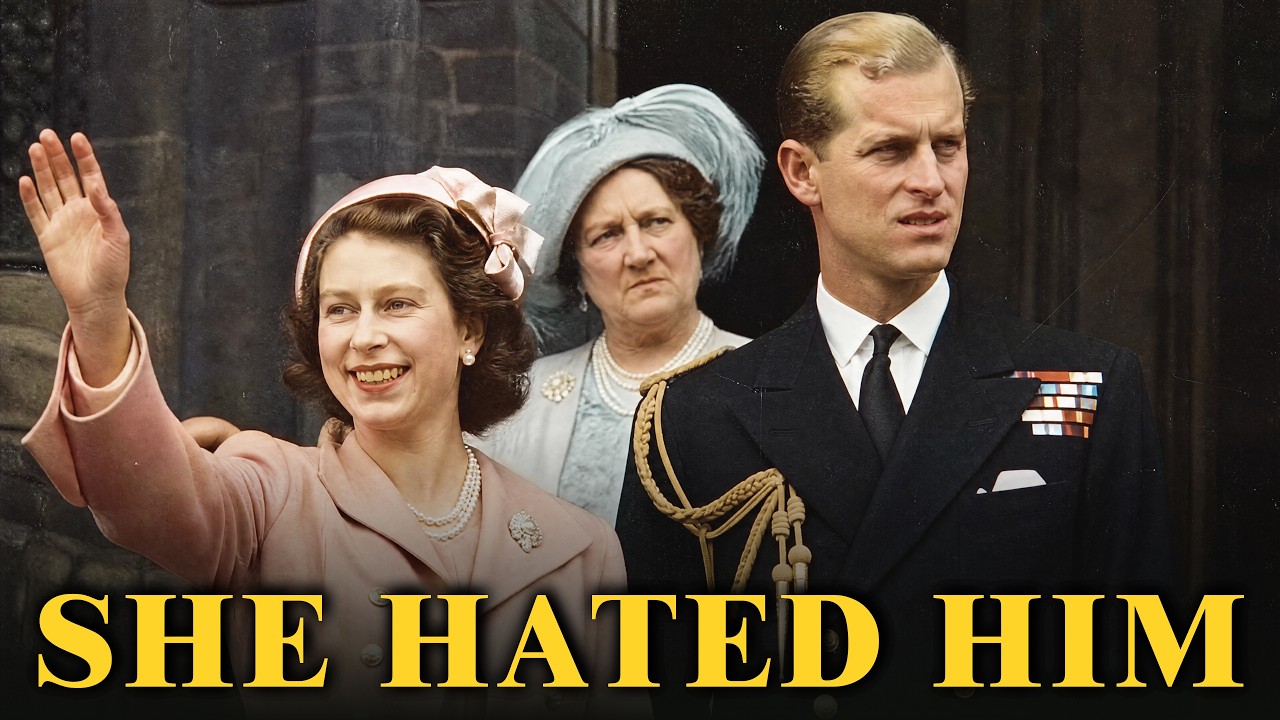
Her mother had other plans. Queen Elizabeth, wife of King George VI, was in those years the most admired woman in Britain. She wanted a Grenadier Guard for her daughter — an English gentleman of settled land and settled name. She already had a candidate in mind.
For eight years, the daughter waited. She said yes in secret and was not allowed to say it aloud. The question at the heart of the story is simple: which of the two women had read the man correctly?
Elizabeth was born in 1926, the elder daughter of the Duke and Duchess of York. For the first ten years of her life, she was not expected to be queen at all. Her uncle, the glamorous Prince of Wales, was the heir.
Then, in December 1936, her uncle gave up the throne to marry a divorced American woman the country and the church would not accept as queen. Her shy, stammering father became King George VI. The ten-year-old girl who had expected a quiet life became overnight the heir to the throne of the largest empire the world had ever known.
She carried that weight with a self-control that astonished everyone who watched her grow. She was tidy to the point of ritual. She did as she was told the first time without sulking. Those who knew the household described an almost unnerving sense of duty for a girl so young.
She was being shaped deliberately into a woman who would spend her life putting herself last. This is the child who at 13 looked at a penniless foreign cadet and decided without asking a soul that he was the one thing in her life she meant to keep for herself.
War came just two months after Dartmouth. Britain declared war on Germany in September 1939. Philip went to sea with the Royal Navy, and Elizabeth grew up behind the walls of Windsor Castle, where the two princesses were kept for safety through the bombing years.
The courtship happened across the length of the whole conflict, by letter and by rare, closely watched visits. He came to Windsor at Christmas of 1943 on leave, and the family staged a small pantomime in which the princess, by every account, glowed at the sight of him.
Philip was mostly at sea in the Mediterranean and later the Far East. The courtship advanced by letter across thousands of miles of dangerous water. She kept his photograph in her room and made no secret of her feelings to those close to her, though she made no display of them either.
She did not pine and she did not sulk. She simply held to it month after month, year after year, while the bombs fell and the war ground on. Her family said nothing at all to encourage her.
By the time the war ended in 1945, she was 19. The feeling that had settled in her at 13 had not shifted an inch. She was a young woman of 21 when the waiting ended, and in all those years she looked only at him.
What she could not yet see at 13 was the size of the thing standing between the wanting and the having. It was not the war and it was not the distance. It was her own mother, and her mother had already begun, quietly and with great skill, to find her daughter someone else entirely.
Queen Elizabeth had been born Elizabeth Bowes-Lyon in 1900, the ninth of ten children of a Scottish earl. She was raised at Glamis Castle in Angus and at St Paul's Walden Bury in Hertfordshire, in a world of settled land, old families and manners polished across centuries.
She had come into the royal family with great reluctance. By her own later telling, she refused the shy Prince Albert more than once before she finally accepted him, afraid of never again being free to think and speak and act as she felt she ought.
She had then watched the abdication tear the monarchy nearly in two, and she spent the war years rebuilding its standing, refusing to leave a bombed London and walking through the rubble of the East End.
Her whole world ran on a system of matches. The daughters of the great houses were brought out into society in their late teens, presented at court, and steered toward suitable husbands. Suitable meant land, an old name and a settled place in the order of the counties.
A Guards officer from a family with an estate behind it was close to the ideal. This was the machinery the Queen Mother had grown up inside and trusted without question, and it was the machinery she meant to run for her own daughter.
Philip fitted none of it. He had no land, no fortune, no English county, no fashionable regiment — only a foreign title he was about to surrender and an ambitious uncle nobody quite liked.
She did not rage or forbid or make a scene. That was never her way, and it was never how power was truly exercised at that level. She worked through charm and patience and the long slow game. The first move was simply to make sure her daughter had other men in front of her.
According to the royal historian Hugo Vickers, she was very keen that her daughter should marry a Grenadier Guard. She wanted exactly the kind of man Philip was not — landed, titled in the old English way, an officer of the senior regiments with an estate behind him and no foreign complications.
And she had a candidate ready. His name was Hugh, Earl of Euston, who would one day become the 11th Duke of Grafton. He was young, well-born and impeccably English, precisely the sort of match the Queen had in mind for the future sovereign.
He was taken seriously enough that the diarist Henry Channon, the society insider known as Chips, wrote of him in 1943 that he was reserved for a higher destiny, the very throne itself. In the private gossip of the court, this young earl was being spoken of as a future consort.
There was for a time a second name in the frame as well. Lord Porchester, known warmly to the family as Porche, who would later become the seventh Earl of Carnarvon, was a close and lifelong friend of the princess, and there were those who wondered whether the friendship might become something more.
By the fuller telling, that friendship was built on horses and racing, and it stayed there all their lives. He himself called her his lifelong best friend, and he was said to have been genuinely angry when the romantic rumours first began to fly. Euston was the true candidate, the one the Queen actively favoured.
Lay the board out plainly as it stood in the middle years of the war. On one side, a mother of enormous authority and even greater patience, with a clear preference, a real and titled candidate, and the whole weight of the court quietly inclined to agree with her. On the other side, a girl who wanted a foreign prince and had told almost no one just how much.
It was not a fair contest. The mother held every card that mattered. She had standing, the King's ear across the breakfast table, the customs of centuries on her side, and a suitable young earl in the best houses as a king in waiting.
What she did not have, and could not manufacture, was a daughter who could be moved. And so, since the girl would not turn her eyes away from Philip, the Queen and the court around her turned to the more practical business at hand.
If the daughter would not choose the earl, then the sensible thing was to remove the rival prince from the field, or at least to move him a very long way off. Remarkably, that is exactly what came to pass — but not in the way anyone expected.
The Earl of Euston, the Queen's preferred candidate, was suddenly handed a glittering posting abroad. According to Hugo Vickers, it was Lord Louis Mountbatten, Philip's own uncle, who was instrumental in getting Euston a fabulous job as aide-de-camp to the Viceroy of India.
An aide-de-camp is a senior officer attached to a great man's personal staff. The Viceroy of India was the most powerful British ruler anywhere on earth outside London itself, ruler in all but name of a subcontinent of hundreds of millions.
It was a magnificent appointment for a young earl. It was also very conveniently on the far side of the world, and it removed the Queen's favoured rival from the field at the exact moment he most needed to be present and pressing his suit.
The uncle of the man the Queen did not want had arranged for the man the Queen did want to be shipped off to another continent. It was a chess move of real cunning, made by a man famous for exactly that kind of cunning, and it worked.
With Euston gone to India, the absent suitor began to lose his shine. By the autumn of 1943, the family had cooled on the earl altogether. In the phrase Vickers records, he was written off at last as too inert.
But if the rival had faded, the objections to Philip most certainly had not. Removing Euston from the board did not mean the Queen had come round to the foreign prince. It only meant the argument shifted from who Elizabeth might marry instead to why she must not marry Philip at all.
He was, in the verdict that circulated among the King's household, too foreign, too rough-edged, too ambitious, and insufficiently English. Every word in that sentence was doing its work.
Too foreign, because he was a prince of Greece and Denmark with no drop of settled Englishness in his upbringing. Too rough-edged, because his manner was blunt and quick and utterly without the softening deference the court ran on. Too ambitious, because behind him stood his uncle Mountbatten, whose hunger for his family's advancement was famous and feared.
There were anxieties too about his money, of which he had almost none, and above all about his family. The earliest written testimony we have about the mood around the courtship comes from an unlikely place.
Marion Crawford, the princesses' governess, published a memoir of her years with the family in 1950, a book that scandalised the royal household and got her cast out of their lives forever. In it she recorded plainly that some of the King's advisers did not think Philip good enough for her. He was a prince without a home or kingdom.
Note carefully what that line says and what it does not say. Crawford lays the doubt squarely at the door of the King's advisers, the courtiers of the household. She does not put the words into the Queen's own mouth.
The most quoted verdict of all suffers from the same problem. The biographer Sarah Bradford records that Philip was described by an unnamed member of the household as rough, ill-mannered and uneducated. It is a cruel little phrase, repeated for decades as though it were the Queen Mother's own settled opinion. But it was not hers. It is Bradford quoting an anonymous courtier.
What can honestly be said is that the household around her held these views, that she moved through that household as its single most powerful figure, and that she plainly wanted her daughter to marry another man.
There is a deeper current running under all of it, and it points at the uncle far more than at the nephew. Much of what has been read ever since as the Queen's dislike of Philip himself may in truth have been her weariness of Lord Louis Mountbatten.
She distrusted his naked ambition for his family. She saw in him a genuine threat to the House of Windsor — a clever, restless man who would use a marriage to drive his own bloodline into the very heart of the crown.
Lord Louis Mountbatten was one of the most dazzling and most distrusted men of his age. He was a great-grandson of Queen Victoria, a naval officer of real ability, and a tireless promoter of himself and his family, whom the wider royal cousinage called, half in admiration and half in warning, the royal mob.
From Philip's boyhood he had taken the fatherless boy under his wing, guiding his schooling, his naturalisation and his entry into the Navy. There is little doubt among biographers that he steered his nephew toward Princess Elizabeth with the marriage firmly in mind.
To the Queen Mother, watching from inside the House of Windsor, this was precisely the danger. Here was a man who had already pushed his family from the fringes of European royalty toward its British centre, and who now stood to place his own great-nephew beside the throne itself.
Within a few years, Mountbatten would be the last Viceroy of India, the man who wound up the empire, a figure of the very first rank. His ambition was not a rumour or a slander. It was the visible engine of his whole life.
So when the Queen Mother looked at the penniless prince her daughter loved, part of what she saw and feared was the powerful uncle standing just behind his shoulder. And she was, as the coming years would prove, not at all wrong to worry about that.
Whatever the court believed and whatever the Queen feared, the foreign prince now did the one thing that forced the whole question out of the shadows. At Balmoral in the autumn of 1946, he asked the princess to marry him, and she said yes.
She gave her answer in the autumn of 1946, and then she was made to keep it silent for ten months. It happened at Balmoral, the royal family's Highland retreat in Scotland. Philip proposed, Elizabeth accepted at once, and she accepted privately before any permission had been sought or any consent given.
That order of events tells you almost everything about her. She did not go first to her father and ask whether she might be allowed to have him. She said yes to Philip and presented the wanting as a thing already settled in her own heart.
Her father, King George VI, did not refuse. But neither did he simply agree. He attached a condition, and the condition was delay. There would be no engagement announced, he ruled, until after his daughter had turned 21.
Her birthday fell in April 1947, which meant the better part of a year of silence stretched ahead of her. The girl who had finally, after seven long years, been told she could have the man she loved was now told in the same breath that she could not say so out loud.
In the early weeks of 1947, the King, the Queen and both princesses set off on a long royal tour of southern Africa, and Philip did not go with them. The tour was a matter of state and empire, not on its face a scheme to part two young people.
But look hard at what it functionally was. For months on end, from the start of 1947 into the spring, the princess was carried to the far side of the world without the man she had promised to marry, at the precise moment their engagement hung unspoken between them.
Whatever the intention behind it, the effect was a long separation with a deadline attached. If the feeling was ever going to cool, this was the arrangement most likely to cool it.
For the princess, the tour meant months of official smiles and long train journeys and the constant company of her parents, and none whatever of the man she had promised to marry. Back home, Britain was worn thin by rationing and the grey austerity of the postwar years.
On the 21st of April 1947, Princess Elizabeth turned 21. She marked the day not at home in England but in Cape Town, at the southern tip of the African continent. From there, over the wireless, she made the broadcast that would come to define her early life.
She dedicated herself, in that famous and much-loved address, to the service of the great imperial family to which she belonged, declaring that her whole life, whether it be long or short, would be given to that duty.
The country heard a grave young woman pledging her life to service. What the country did not hear, because she was not permitted to say it, was that this same young woman was already secretly promised in marriage to a man her mother had spent years trying to keep out of her reach.
The public vow and the private one were made in the same season, from the same far continent, by the same steadfast girl. Only one of the two was allowed to be spoken aloud.
The silence held all the way through to high summer. On the 9th of July 1947, the engagement was at last made public, and the newspapers carried it the very next morning to a country hungry for good news.
Britain, worn thin by six years of war and by the grey grinding austerity that had followed, fell gratefully upon a royal love story. But between the private yes at Balmoral and the public announcement in July lay the better part of ten months.
Ten months in which a future queen carried her own engagement folded up inside her as a secret, sailed to another hemisphere without the man she loved, and turned 21 on the far side of the earth. She bore all of it without a word of visible complaint.
It was the same steadiness she had shown at 13, worn now like armour. She had chosen, and she would wait, and she would not be turned.
This was a young woman with almost no experience of ever getting her own way, for the plain reason that she had almost never once asked for it. The single thing she had ever truly wanted for herself, she now had to hold in silence.
That none of it worked — that she came home from Africa exactly as promised to exactly the same man — is the truest measure of her that we have. The beautiful daughter had precisely one act of defiance in her whole nature, and she was spending it now slowly over long months, in the only currency she owned, which was patience without end.
There was a price on Philip's side too, a far steeper one than mere silence. For while the princess had only to wait, the prince had to be entirely remade. The court's oldest objection, that he was too foreign, was about to be answered in the most literal way imaginable.
To be allowed to marry her, the foreign prince would first have to stop, as far as law and paperwork and public ceremony could manage it, being foreign at all. He would have to give away his titles, his church and even his name.
Philip did not merely promise to become British. He was piece by piece formally unmade as a foreigner and remade as a subject of the crown. He renounced his royal titles of Greece and Denmark, the styles he had been born to and carried all his life.
He gave up the Church of his childhood, the Greek Orthodox faith in which he had been baptised, and was received formally into the Church of England in October 1947. He took a new surname, Mountbatten, drawn from his mother's English family, the anglicised form of the German Battenberg.
By the spring of that year, he had become on paper and in law a naturalised British subject. The prince of Greece and Denmark had walked into 1947 single and foreign, and he walked through it into a British commoner named Lieutenant Philip Mountbatten.
Only on the morning of the wedding itself did the titles come back to him, and now they came in the English key. The King created him Duke of Edinburgh, Earl of Merioneth and Baron Greenwich in the hours before he married the heir to the throne.
A dukedom is the highest rank of the peerage below the royal family itself, and to be handed one on your wedding morning was to be lifted in an afternoon from a stateless naval officer to one of the first noblemen of the land.
It was a careful and deliberate piece of theatre. The man who had been called too foreign had first been stripped of his foreignness and then handed an English dukedom to wear in its place, so that the bride at the altar would be marrying a British duke and not a stateless Greek prince.
The wedding took place on the 20th of November 1947 at Westminster Abbey, the ancient crowning church of English kings. Britain was still grey and rationed and bone tired, and the marriage of the young heir fell across the country like a shaft of sudden colour.
Even the bride's wedding dress had been bought in part with ration coupons, for austerity spared no one. The ceremony was broadcast by radio to an audience estimated at around 200 million people around the world.
For a few hours, the whole battered empire stopped to listen to a princess marry the man she had chosen for herself. And the story looked from the outside like a fairy tale with every difficulty smoothed away and resolved.
It had not been resolved. The objection that had gone the deepest, the one about his family, could not be dressed away with any dukedom, and it showed itself on the guest list in a way that wounded Philip for the rest of his life.
He had four elder sisters, and three of them were still living in 1947. All three had married German princes in the years before the war. And so, barely two years after a war against Germany had ended, they were not invited to their only brother's wedding.
The reasoning was put with cold simplicity by Lady Pamela Hicks, who knew the thinking of the day. So soon after the war, she said, you couldn't have the Hun.
The prince who had given away his titles, his church and his very name to be permitted into this family had to stand at the altar without his own sisters in the pews, kept away because of the country they had married into.
There is one object from that wedding day that holds the whole strange truth of it in a single glittering piece. The bride's engagement ring had been made by the London jeweller Philip Antrobus, and the diamonds set into it had not come from any shop.
They had been taken from a tiara that belonged to Philip's own mother, Princess Alice. That tiara carried the deepest kind of history, for it had been Alice's wedding gift from Emperor Nicholas II and Empress Alexandra of Russia, the last emperor and empress of Russia, murdered with their children in 1918.
So the ring on the finger of the future queen of England had been cut from a Russian imperial jewel given by a tsar who was later shot, to the mother of a prince who had no country of his own. Grandeur and exile, immense fortune and total ruin, set together in a single band of gold. She would wear it every day for the rest of her long life.
They married, and by every account they were happy. For a few years the arrangement kept its early shape. Philip returned to the Navy for a time and was posted to the island of Malta.
There, Elizabeth had a brief spell of something close to an ordinary life — a serving officer's wife in a Mediterranean garrison, driving her own car, living something nearer to the world other women lived in.
She shopped in the town. She went to the hairdresser like anyone else. She watched her husband command his own ship. Those who knew her spoke of it ever afterwards as the happiest and most carefree stretch of her whole life.
It could not last, and some part of her must have known it could not. Her father was already failing, worn thin by the strain of a crown he had never wanted and a war he had carried on a frail constitution. The ordinary years were borrowed time.
Two children came in those years, first Charles and then Anne. Then, in February 1952, while Philip and Elizabeth were away on tour in Kenya, the King died in his sleep at Sandringham, worn out at 56 by a role he had never wanted.
The young woman who had waited so long to marry her prince became, in a single morning under an African sky, queen of the United Kingdom and of a quarter of the world. And within weeks of that accession, the very first of her mother's specific fears about the man she had married came true.
The charge had been that he was too ambitious, and behind that charge stood the shadow the Queen Mother had watched most wearily of all, the figure of Lord Louis Mountbatten. Now, with Elizabeth suddenly on the throne, the shadow moved.
At Broadlands, the Mountbatten country house in Hampshire, Lord Louis was heard to declare with evident satisfaction that the House of Mountbatten now reigned over Britain. His family, through his nephew, had climbed at last to the very summit.
And the Queen's husband, taking his uncle's lead, proposed that the royal house should from now on carry his name. It should become the House of Edinburgh, he suggested, or the House of Mountbatten, so that his children would bear into history the family into which they had been born.
The reaction was immediate and ferocious. Queen Mary, the old queen, widow of George V and the living memory of the whole dynasty, was appalled when she learned of it. She understood at once what was being attempted and what it would mean.
The name of the royal house was not a small or a private matter. It had been made deliberately, at a moment of crisis in 1917 at the height of the First World War, when George V had swept away the family's German titles and christened the line anew as the House of Windsor.
A plain, solid English name for a dynasty that urgently needed to look English. To surrender that hard-won name now, barely a generation later, to a man of foreign birth and to the well-known ambitions of the Mountbatten family struck the old guard as a betrayal of the very thing the Windsor name had been created to defend.
There was a further insult buried inside the defeat, one that went well beyond the name. A queen's husband holds one of the strangest positions in the whole constitution. When a king marries, his wife becomes queen and shares his style. When a queen marries, her husband becomes nothing in particular.
No king, no partner in the sovereignty — a man who must walk a pace behind his own wife for the rest of his life and hold no formal power at all. Philip felt that asymmetry keenly, and the loss of the family name sharpened it to a point.
He had given up his career, his titles, his church and his country, and in return he was told that he could not even hand his own children his name, and that the dynasty they belonged to would be called by another. To a proud and able man in his early thirties, it was a bitter arithmetic.
Queen Mary did not fight it quietly or alone. She went to the prime minister, Winston Churchill, and Churchill and his cabinet came down on the question like a hammer on an anvil. The royal house, it was decided at the highest level of the state, would remain the House of Windsor now and in the future.
On the 9th of April 1952, only two months after the accession, the young queen formally declared it to be so. Her husband had proposed to give the dynasty his name, and the answer, delivered through the full machinery of government, was no.
It was one of the first great decisions of her new reign, and it was decided flatly against him. Philip took the defeat hard, and the words he is reported to have used about it have followed him down all the years since.
According to the biographer Gyles Brandreth, who set the remark down decades later, Philip said in private and in real bitterness that he was nothing but a bloody amoeba, the only man in the country not allowed to give his name to his own children.
An amoeba is the simplest and most powerless form of life, a thing that cannot even properly pass on what it is. The honesty of this account requires the hedge to stay on that quotation every time it is spoken, for it is a reported private outburst recorded long after the fact.
But reported or not, it plainly captures something true about the wound. The proud naval officer who had given away his titles, his church and his name in order to marry her discovered within weeks of her crowning that he could not even give his own name to his son.
Now weigh that first charge honestly against what had actually come to pass. The Queen Mother and the court around her had feared that Philip was too ambitious, that he and his scheming uncle would try, given the chance, to push the Mountbatten name into the very heart of the crown.
And within a matter of weeks of the accession, that is precisely and exactly what he tried to do. He reached for the name of the dynasty almost before the old king was cold in his grave. On this charge, the first of them, the mother had read the man and his uncle correctly.
But a single defeat is not the end of an ambition. It is only a check upon it, a door held shut for a while. The name had been kept Windsor by royal proclamation in 1952, and to all appearances the matter looked settled and closed.
In truth, it had merely gone underground to wait, and it would surface again eight years later, in a manoeuvre so quiet and so precisely timed that it can only be read now as a long game finally and patiently won.
The story of what happened in 1960 is a quiet masterclass in getting your own way slowly. Behind the scenes, away from the public eye, a lawyer named Edward Wynn had been pressing a persistent campaign for years, arguing that it was wrong, even a kind of insult, for the queen's own descendants to carry no trace whatever of their father's name.
The argument worked its way slowly upward through letters and memoranda until it reached the desk of the prime minister, by now Harold Macmillan. And the Queen, who had watched at close hand how much the loss of the name had cost her husband over the years, chose this particular moment to give something of it back to him.
On the 8th of February 1960, by an Order in Council, a formal decree of the sovereign acting with her privy counsellors, she declared that while the royal house itself would remain Windsor, her descendants who needed a surname — those not carrying the style of royal highness or the title of prince or princess — would from now on bear the name Mountbatten-Windsor.
It was a compromise and a partial one, but it was real and it was permanent. After eight years of waiting, the family name had been threaded quietly back into the royal line, joined now to Windsor, but present at last.
And the timing of it was extraordinary. The declaration came just 11 days before the Queen gave birth to her third child, Prince Andrew, on the 19th of February 1960. She had arranged, in the very last days before a new baby arrived, for that baby's line to carry its father's name.
Read that sequence of events as the Queen Mother would have read it. The man she had once judged too ambitious, checked so firmly in 1952, had come back eight years later and won a real share of the very thing he had been denied.
The Mountbatten name was in the dynasty now, exactly as she had feared from the very beginning that it might one day be, exactly as the patient uncle had always wanted it. It had simply taken a careful and determined man the better part of a decade to get it there.
The defeat of 1952 had been turned by patience into a partial victory, and the uncle's long reach did not stop at the matter of the name. Lord Louis Mountbatten, the ambitious figure the Queen Mother had distrusted from the very first, went on to make himself the guiding hand in the life of the future king.
He became mentor, teacher and confidant to the young Prince Charles, so central to the growing boy that Charles would later describe him in a phrase that has been widely reported as the grandfather I never had.
Sit for a moment with what that phrase means and with who was still living to overhear it. Charles had a grandmother who adored him, the Queen Mother herself, the warmest and most sheltering presence in his childhood.
And yet it was Mountbatten, the outsider's uncle, the very schemer she had feared, who became the old man at the centre of the heir's world, the one he turned to. The Queen Mother had worried that this family would push its way into the crown. Instead, it had pushed its way into the heart of the boy who would one day wear it.
That mentorship ended in sudden horror. On the 27th of August 1979, Lord Louis Mountbatten was murdered by the Irish Republican Army, killed by a bomb they had hidden aboard his fishing boat as it left a small harbour on the coast of the west of Ireland.
Members of his family were killed alongside him, including one of his young grandsons. The man who had helped steer the marriage into being, who had removed the rival to India, who had won back half the name and shaped the future king, was gone in a single instant of political violence.
The grief of it fell hard on Charles, who had lost the grandfather he never had, and hard on Philip, who had lost the uncle who had made his entire English life possible in the first place.
The murder was part of a single coordinated day of slaughter. On that same afternoon, the same organisation killed 18 British soldiers in a double bombing at Warrenpoint on the border in the north of Ireland. It was one of the bloodiest days of the whole long conflict.
There is a grim irony in it that the Queen Mother, had she been the vengeful sort, might quietly have noted. The ambitious uncle she had spent a lifetime distrusting, the schemer she had feared would use the family for his own ends, died in the end as a servant of the crown, murdered precisely because of what he represented.
Whatever he had wanted for his family, he paid for the family's position with his life. And the boy he had mentored, the future king, carried the wound of that loss for the rest of his own life.
So set the second charge down in the ledger beside the first. The Queen Mother had feared the Mountbatten agenda, the deep ambition of the uncle and the pull of that whole family upon the crown. And across the long decades she watched that specific fear come true, not once but twice over.
She lost the name, or half of it, in 1960. And she lost the heart of her own grandson to the very man she had spent a lifetime warning against. On this charge too, she had been proved right, and she had been quietly beaten.
But the charges of ambition and of the uncle were charges about power and manoeuvre, about names and influence. The next one was simpler, more human, and in its way more constant than either. It was the charge that the man was quite simply too rough.
And on that one, the passing years would prove her most right of all. The court had called him too rough-edged, blunt where the monarchy required softness, quick where it required patience, careless of the difference on which the whole delicate machine of the palace turned.
This was not a charge that waited for a single dramatic test to prove or disprove it. It was proved slowly over decades in a thousand small moments, because the roughness was never a phase that he passed through on his way to something smoother. It was simply and permanently who he was.
You could see the fault line early, and it ran directly between him and the whole world the Queen Mother guarded so carefully. In the run-up to the coronation of 1953, a great argument broke out over whether the sacred ceremony itself should be shown on television.
To the traditionalists, the idea came close to sacrilege. Churchill, now prime minister again, was firmly against it, calling it unfitting. The Queen Mother, by every account, disapproved of it deeply. The crowning of a monarch was an ancient and holy mystery, a solemn sacrament, not a show to be piped into the front rooms of ordinary people.
And on the other side of that argument, pushing hard and steadily for the cameras to be let in, stood Philip, who chaired the commission that organised the coronation, and who thought the old horror of publicity was so much dead weight from another age.
He won the argument. The coronation was televised, and something close to 27 million people in Britain alone watched it, many of them buying or renting their first television set to do so. The monarchy discovered, through the instincts of the very man the court had thought too rough, a powerful new way of speaking to its people.
But mark well the shape of that quarrel — the moderniser against the guardians, the blunt outsider against the old queen and the old prime minister. It was the same collision that had begun over a courtship, playing out now over a camera in the abbey.
The bluntness never softened with age. If anything, it hardened into legend. For the rest of his very long life, Philip said more or less exactly what came into his head, to anyone, anywhere, and the results filled the newspapers for half a century.
To take only one of hundreds: on a visit to the town of Oban in Scotland in 1995, he asked a local driving instructor how he managed to keep the local people off the drink long enough to get them through their test. It was precisely the kind of remark that made courtiers wince and made a certain sort of headline write itself overnight.
There were hundreds more like it strung across the decades of his public life in every corner of the world he ever visited. The manner the household had flagged as a serious flaw back in 1947 was, 50 years on, exactly the same manner, entirely unrepentant and wholly undimmed by time or by station.
And yet the very same quality that made him rough was also what made him useful, and any honest reckoning has to hold both halves of that truth at once. The bluntness that offended the old court was also a kind of restless energy, a flat refusal to sit still and merely unveil plaques and cut ribbons for the rest of his days.
A queen's husband, remember, has no constitutional role whatever. He is not made king. He has no state papers he is entitled to read, and no defined task set out for him to perform. Philip could very easily have faded into pure ceremony and drink and grievance. Instead, he built.

In 1956 he founded the Duke of Edinburgh's Award, a scheme of challenge and service for the young that has since carried millions of teenagers across more than a hundred countries through the same trials of endurance that had once rebuilt his own broken boyhood.
He took over the running of the great royal estates, and across his working life he carried out, before he finally retired, more than 22,000 solo public engagements. He became the first president of the British arm of the World Wildlife Fund in 1961 and later its international president, decades before such causes were fashionable anywhere.
He reorganised the running of the great royal estates and the palace household, cutting away what he judged to be dead weight. He gave the first television interview any member of the royal family had ever given. And through all of it he kept up a punishing schedule of duty.
The blunt, foreign, penniless outsider the household had wanted to keep out turned into one of the hardest-working figures the institution had ever contained. The roughness the Queen Mother deplored and the drive that built all of this were, in the end, the very same quality, wearing two different faces.
But usefulness was never the actual charge against him. The charge was manners, plain and simple. And on the manners, the Queen Mother had been simply and completely right from the first day of the marriage to the last.
She had thought him too rough for the family, and he was too rough for the family, and he stayed too rough for the family for 70 unbroken years. No amount of good and serious work ever sanded that roughness away. It is the one charge of them all that needed no verdict delivered at the end, because it delivered its own verdict cheerfully and without apology every time he opened his mouth in public.
Three of the charges tested now, and three of them had landed square. Too ambitious, proved within weeks. The Mountbatten agenda, proved across the decades. Too rough, proved beyond any possible argument. Again and again, the mother's case was holding point by point.
But the next charge reached back before the marriage even began, into the darkest ground in the whole story — into the question of the family Philip had come from and the war they had married straight into. It was the very charge that had kept his own sisters out of his wedding.
This is the darkest of all the charges, and it must be told soberly as plain dated fact, because the truth of it is grave enough without any colouring at all. The objection about Philip's family was never mere snobbery about foreign cousins. It was about the war, the recent and terrible war, and about which side of it his own blood had married into.
Philip had four elder sisters: Margarita, Theodora, Cecilia and Sophie. In a single short span between the end of 1930 and the late summer of 1931, while their mother was being committed to a sanatorium and their father was drifting away toward the south of France, all four of them married German princes.
Sophie, the youngest of the four, married first and married youngest of all, wed at the age of just 16 in December 1930. Within about eight months, all four sisters were married and gone into Germany, scattered from their brother across the princely houses of a country that would soon be the enemy.
What turned this from a matter of taste into a matter of state was what became of those German husbands in the decade that followed the weddings. Several of them were drawn into the Nazi regime, and some of them very deeply.
Sophie's husband, Christoph of Hesse, joined the party and then the SS, and rose to run a secret intelligence bureau of the Reich Air Ministry, a wiretapping and signals office under the direct patronage of Hermann Göring, one of the most powerful men in Hitler's Germany. Cecilia and her husband both joined the Nazi party on the very same day in May 1937.
The picture, in fairness, was not uniform across all four, and honesty requires the other half of it to be told as plainly as the first. Margarita's husband, a prince of the house of Hohenlohe-Langenburg, joined the party as well, and yet was later dismissed from the German army in the purge that followed the failed plot to kill Hitler in July 1944.
And Theodora's husband, the Margrave of Baden, never joined the party at all, and he and his wife kept their distance from the regime as far as they were able. The family Philip came from was neither wholly guilty nor cleanly innocent. It was tangled all the way through in the very worst events of the century.
There is a bitter symmetry running through it that the story should not pass over. While his sisters were marrying deeper into Germany, Philip himself was being carried in the opposite direction, schooled in Britain and bound for the Royal Navy. And when the war finally came, he fought against the very side some of his sisters' husbands served.
One brother, four sisters, and a line drawn straight through the middle of a single family by the politics of the age. The boy who walked in German uniform behind his sister's coffin in 1937 would, within four years, be holding enemy warships steady in his searchlight beams in the Mediterranean dark.
Into that tangle fell a private catastrophe of almost unbearable cruelty. In November 1937, his sister Cecilia, then heavily pregnant, boarded a small aircraft together with her husband, her mother-in-law and two of her young sons, flying to a family wedding in England.
The aircraft came down in thick fog near Ostend on the Belgian coast on the 16th of November, and every soul aboard was killed. Philip was just 16 years old, a schoolboy. He travelled to Darmstadt in Germany for the funeral.
The photographs that survive of that terrible day show a fair-haired boy walking in the funeral procession of his favourite sister, surrounded on every side by grieving relatives in German uniform. It is one of the most reproduced images of his entire early life, and its meaning is heavy.
So when the wedding came at last in 1947, only two years after that war had finally ended, the three surviving sisters — for Cecilia was dead — were not asked to come. We have already heard the reasoning in Lady Pamela Hicks's flat and terrible phrase, that so soon after the war you simply could not have the Hun.
The family Philip loved, the sisters who had been something close to mothers to him in his broken and scattered childhood, were kept away from his own wedding because of the country they had married into, and the regime that some of their husbands had served.
The charge about his family, at its hard root, was true. It was not going to be a passing embarrassment. It would remain a delicate and recurring problem around him and around the whole family for the rest of his long life.
And yet the honest verdict on this charge is the most complicated of all of them, because the very same family held its own bright opposite within it. Philip's mother, Princess Alice, the woman whose Romanov tiara had furnished the bride's engagement ring, spent the war in occupied Athens under German occupation.
There she sheltered a Jewish family in her own home, at genuine and daily risk of her own life, an act of quiet courage for which she is honoured to this day at Yad Vashem, the great memorial in Jerusalem, among the righteous among the nations. The same bloodline that ran into the SS ran also, in the very same generation, into that.
And the exclusion itself did not last. By the coronation of the new queen in 1953, only six years after the wedding that had shut them out, the surviving sisters were back inside the family, seated among the tiaras in the abbey. Their mother sat there too, remarkable in the plain grey habit of the Orthodox nursing order she had founded.
The Queen Mother had been right that the family would always be a difficulty and a shadow. What she could not have reckoned was that the same family also contained, in Alice, one of the bravest and most selfless people in the whole of this story.
Four of the charges tested now, and four of them in their different ways had held true. Too ambitious, too much under the uncle, too rough, and trailing a family that was a permanent complication. The mother's case was standing up point by careful point, almost exactly as she had first assembled it in the 1940s.
But there was a fifth charge still to come. It was the one that had hung over the marriage the longest of them all, whispered in drawing rooms and printed in hints for decade after decade, and never once in all that time actually proved.
It was the charge that the restless, magnetic, roving prince would not, in the end, be faithful to the wife who had chosen him. And here the honest historian has to move with the greatest care of all, because here there was the very most smoke and, in the end, by far the least fire.
Say the hard rule of this chapter first plainly, and then hold to it all the way through to the end. Alleged means alleged. Across 70 years of rumour about Prince Philip and other women, nothing whatever was ever proved. Not one single liaison was ever established as fact.
What there was instead, and what there has always been, was a reputation. And a reputation is a strange and terribly durable thing. It is built not out of evidence, but out of proximity, out of glamour, out of a handsome and restless man set down in the middle of a grey and watchful court.
It is built out of a handful of names repeated so often across so many years that the sheer repetition of them begins at last to feel like proof. The charge of unfaithfulness clung to Philip for an entire lifetime, and to see why it clung so hard, you have to see first how it was assembled.
It began harmlessly enough at a dinner table in Soho. In the years around his marriage, Philip belonged to a lunching society called the Thursday Club, which met at Wheeler's, a well-known fish restaurant in Soho in the raffish heart of London.
It had been got up by the society photographer Baron Nahum, and its members were a bright, clever, hard-drinking crowd of actors and wits and men about town. Mike Parker, Philip's own equerry and one of his closest friends, was a member.
So at various times were the film actor David Niven, the actor and humourist Peter Ustinov and the American harmonica virtuoso Larry Adler, a man who had himself been blacklisted in the United States. It was a loud club and a male one, fond of a long lunch and a broad joke.
It was exactly the kind of company a restless young naval officer would relish, and a stiff and anxious court would deeply distrust. Set against the club was the temper of the times, and the two did not mix at all well.
The court of the early 1950s still ran on an old and rigid idea of privacy, in which the press was kept firmly at arm's length and the private lives of the royal family were simply not discussed in print. The Queen's press secretary of those years, Commander Colville, was so obstructive with reporters that Fleet Street nicknamed him the abominable no-man.
But that old order was already beginning to crack. A hungrier, brasher press was rising, one that would chase exactly the kind of story a glamorous consort and a Soho dining club seemed to promise it. Philip stood on the fault line between the two worlds.
A modern, restless, informal man watched over by an institution still pretending the modern world did not exist. It was the perfect condition for rumour to breed in. A man seen at nightclubs, lunching with actors, absent for months at sea, and shielded by a palace that refused on principle to explain anything at all.
Once the imagining had started, no denial could ever quite catch up with it. That is how a reputation is built, and it is built out of almost nothing at all. Nothing improper has ever been shown to have taken place at the Thursday Club, but it did its lasting damage all the same.
It placed the Queen's husband week after week, year after year, in a bright social world of nightlife and gossip and glamorous acquaintance. In that kind of world, names attach themselves to a famous man the way iron filings leap to a magnet.
Over the long years the stories were told. A name would surface in a column. A rumour would circulate at a party. A newspaper would print a careful hint that stopped just short of a claim. And because the man was who he was, and because the setting was what it was, the hint would lodge and stay.
This is the machinery you have to see clearly before any single name is examined, because it explains the whole pattern of them at once. Every woman who was ever linked to Philip across those 70 years arrived in the story by the very same road.
Not through a letter in his hand, not through a photograph of anything more than a dance, not through a witness who had seen anything, nor through a confession from anyone at all. Each woman arrived through association, through having been seen in his company, through being exactly the kind of woman a rumour could conveniently be built around.
And once a name was on the list, it never once came off it again, no matter how firmly or how often it was denied, for the plain and unfair reason that a denial is always quiet and a rumour is always loud.
So the fifth charge, the Queen Mother's deepest fear that this man would not in the end be faithful to her daughter, has to be tested against a very peculiar kind of evidence — which is to say, against almost none at all.
There are names, and we will look at each of them honestly, at its real and modest weight, and no heavier. There are decades upon decades of whispers in the press and in the great houses. And there is, at the very bottom of all of it, a striking and stubborn and almost total absence of anything solid whatsoever.
Take the first name and the most famous. In October 1948, when the Queen, then still Princess Elizabeth, was heavily pregnant with Prince Charles, Philip was seen dining and dancing with the actress Pat Kirkwood, one of the great musical stage stars of her London generation, introduced to him that evening by the photographer Baron Nahum of the Thursday Club.
That single evening is the whole of what was ever actually established. They were in company together at a nightclub on one night, and from that one evening there grew a rumour that would outlive them both by years.
Philip denied it. Kirkwood denied it too, first with dignity and then, as the decades wore on and the story would not die, with a growing and understandable anger, calling it, in a weary phrase she must have grown sick of repeating, the mythology of the press.
She came to believe that the whispered link to the prince had quietly cost her the career and the public honours she was otherwise due — that a serious and gifted stage actress had been reduced in the public memory to a footnote in a rumour about a royal husband.
Take the second name. Hélène Cordet was a French woman Philip had known since his own childhood, a genuine and old friend from the scattered years of his boyhood. In adulthood, he stood as godfather to her children.
From that entirely ordinary kindness there grew one of the darker rumours of them all: the claim that he was not the godfather of her son at all, but secretly his father. It was an ugly and a wounding thing to say, and it too was denied at the source by the one person best placed to know.
Cordet's son, Max Boisot, stated publicly in 1996 that Philip was not his father, and no paternity claim has ever been made to stand up to any scrutiny at all. An act of simple friendship toward a childhood companion had been twisted over the passing years into one of the cruellest of all the stories told about him, and there was nothing whatever underneath it.
Take the third. The episode that came the closest of any of them to an open crisis. In the winter of 1956, Philip left England on a long solo tour aboard the newly commissioned Royal Yacht, opening the Melbourne Olympic Games in November of that year and then sailing on for months through the far and remote reaches of the southern world.
He was away from the Queen and from their two young children for something close to four months on end. During that long absence, his friend and equerry Mike Parker was served with divorce papers by his wife, and the whole machinery of scandal began at once to turn.
The sheer scale of that voyage is worth setting out, because it was the scale that made the absence feel so dangerous. Philip was gone from home for something close to four months, from the autumn of 1956 into the early months of 1957.
The royal yacht on that deployment logged something on the order of 70,000 miles, and the Duke's own travel across it ran to more than 40,000. He opened the Melbourne Games in November, crossed the Antarctic Circle, and called at some of the loneliest inhabited islands on the surface of the Earth.
Four months is a long time for any marriage, and it was a very long time indeed for a marriage already the object of the whole world's curiosity. When the divorce broke into the papers midway through the voyage, the coincidence of a long separation and a friend's marital collapse was all the fuel a rumour could ask for.
Parker resigned his post in 1957, taking the scandal away from the palace door with him as he went. And when the yacht at last came home, the Queen and the Duke were reunited without a single public word of the strain. The whole episode folded neatly back inside the united front.
An American newspaper, The Baltimore Sun, ran a story openly hinting at a rift in the royal marriage itself. And here the palace did a thing it almost never did, then or since. It answered the rumour directly and in public.
The Queen's press secretary, Commander Richard Colville, issued a flat and formal denial. It is quite untrue, he said, that there is any rift between the Queen and the Duke. That the palace felt itself driven to say even that much is the measure of how loud the whispering had by then become.
That it was only ever a denial, and that nothing was ever once shown to lie behind the story, is the measure of how very little the whispering could ever actually prove. Weigh the plain arithmetic of it.
One single nightclub evening in 1948. One innocent childhood friendship turned into a paternity slur and then flatly denied by the son himself in 1996. One long voyage of four months in 1956, and one newspaper story met by one rare and direct palace denial.
Across the whole of it, across 70 long years of the closest press attention any family on earth has ever endured, there was never a single letter, never a single compromising photograph, never a single credible witness who had seen anything at all.
The list of the names was long, and it grew longer with the decades. The list of the actual proofs stayed empty from beginning to end. That emptiness is the true and central finding of this chapter.
For across all those decades of rumour, with all those many names attached to him in the papers and the gossip, exactly one of the women involved ever chose of her own will to speak on the record about her friendship with Prince Philip. Only one in 70 years.
And when she finally did speak, what she actually said did not feed the rumour at all, as everyone expected it would. Instead, with great precision, it drew a line.
Her name was Alexandra, known to her friends and family as Sasha, the Duchess of Abercorn. She was, remarkably, a descendant of the great Russian poet Alexander Pushkin, a woman of unusual cultivation and inner life, and she had come to know Philip through the world of competitive carriage driving, the demanding sport he had taken up seriously in his later years.
Their friendship ran on close and largely private across many years, and it might well have stayed private forever, except that in 2004 it became the subject of a book by the writer and broadcaster Gyles Brandreth, extracted in a Sunday newspaper and then carried around the world by the wire agencies.
In that book, alone among all the women whose names had ever been joined to his across 70 years, Sasha Abercorn spoke for herself. What she said is worth quoting exactly, because every single word of it was plainly and carefully chosen.

It was a passionate friendship, she said, but the passion was in the ideas. And then she went further still and drew the line as plainly and as finally as a line can ever be drawn. It was certainly not a full relationship, she said. I did not go to bed with him.
That is the whole of it. It is the only first-hand account from any of the women in the entire history of the rumour. And notice with care what it actually does, this small and deliberate statement.
It concedes the intimacy, and concedes it in the strongest possible terms. It grants freely that the friendship was passionate, that the heart was fully in it, that the two of them had been close in a way that genuinely mattered to them both.
And then it stops with great precision at the one exact place the rumour had always most wanted it to go, and it refuses flatly and forever to go there. The passion was in the ideas. She did not go to bed with him.
She was not so much defending herself against a charge as correcting a record she felt had been got wrong, insisting on the reality of a kind of closeness the watching world kept no proper name for and could not seem to believe in.
Set beside her for a moment the woman who said nothing at all. In the last decades of his life, Philip's closest companion of all was Penny, the Countess Mountbatten of Burma, who shared his consuming passion for carriage driving and stood near him for the better part of 46 years.
She was at his side to the very end of his life, and she was one of only 30 mourners permitted at his funeral under the harsh restrictions of the pandemic in 2021. And in all of that time, across all those many years of the very closest friendship, she never once gave a single interview.
She never offered a single public tribute, never said one public word about him at all, before his death or after it. Where Sasha Abercorn drew her line with one careful sentence, this other woman drew hers with a total and unbroken silence, and she has kept it to this day.
Think about what those two responses have in common. The sentence and the silence. Neither woman fed the rumour. The one who spoke used her single public statement to draw a line against it. The other never spoke at all.
In 70 years of the loudest gossip about any man in Britain, the two women closest to the accusations gave the world one careful denial and one long silence, and nothing else besides. That is not the behaviour of people with something to hide. It is the behaviour of people protecting a friendship they considered real and private and none of the world's business.
And it fits everything else the record shows. The friendships were real. The intimacy, in the case of Sasha Abercorn, was real, and she said so plainly. What was never real, what was never once shown across a whole lifetime of the closest watching, was the thing the Queen Mother had feared.
And what of the man himself, the accused at the centre of it all? He answered the great charge directly only once, and memorably, to a journalist. And the answer has the unmistakable ring of exasperated truth about it.
Have you ever stopped to think, he said, that for the past 40 years I have never moved anywhere without a policeman accompanying me? So how the hell could I get away with anything like that?
It is reported as a remark he made in 1992, and the honest hedge stays firmly on it, but the plain logic inside it is very hard to shake off. The most closely watched man in Britain, trailed by armed protection officers every hour of every day and every night for decade after decade, asking the simple question of how on earth a secret life of the kind alleged was ever even supposed to have been physically possible.
And the people who had stood the very closest to him year in and year out said the same thing, and they had no earthly reason to protect a convenient lie. Mike Parker, who had been at his side through the worst of the rumours, insisted flatly that the Duke had been entirely faithful to the Queen throughout.
Lord Charteris, the Queen's own long-serving private secretary, a man who saw everything, said there was no evidence of any kind that he had ever strayed. Even Sarah Bradford, the biographer who had believed the worst of him back in the 1990s and had written as much, came round in the end years later and conceded openly that she might well have been mistaken all along.
No letter, no photograph, no witness, no confession, no proof at all across the whole span of 70 years, from a single person who was actually there to see it. This is the emotional centre of the entire case.
So let it be said now with the full weight it deserves. The Queen Mother had feared, above all the other things she feared, that this restless man would one day betray her steadfast daughter. It was the very deepest of all her charges against him. And it was the one she had been the surest of.
And it is the one charge out of every charge she ever laid that the long evidence of a lifetime simply and completely fails to support. He had been rough, yes, exactly as she said. He had been ambitious, yes, exactly as she feared. His family had been a lasting problem, yes, just as she had known it would be.
But unfaithful — the one thing above all others that she had dreaded — was never once shown to be true at all. On this charge, the greatest of them, the mother had been wrong, and her daughter, the girl who had chosen the man at 13 and never wavered from him since, had judged him more truly than anyone else alive.
There remained now only the very last charge of all, the first one she had ever made against him, all the way back at the beginning: that he was simply too foreign. And that one, of all of them, she had got the most flatly and completely wrong.
Go back at the very end to where the whole case began. The first objection, the founding one, the word from which all the others grew, was that Philip was too foreign, insufficiently English, a prince of Greece and Denmark with no country, no fortune and no settled English family behind him. A man who did not belong.
It was the charge the Queen Mother had been surest of from the very first, because it was the most obvious, the one you could see at a glance. And it is the charge that the long record of his life demolishes most completely of all.
Weigh what the word foreign was actually hiding. This foreign prince had fought for Britain, and fought well, in the darkest years of the war against the very country his sisters had married into.
He had entered the Royal Naval College at Dartmouth in 1939, the same visit at which the young princess first saw him, and he had passed out top of his term, winning the King's Dirk as the finest cadet of his intake. Then he had gone to sea and done something rather more than parade in a uniform.
At the Battle of Cape Matapan, fought in the Mediterranean in March 1941, the 19-year-old Philip served aboard the battleship Valiant. In the dark of the night action, he was given charge of the ship's searchlights.
He held two enemy cruisers steady in his beams so that the British guns could find them, and the guns did not miss. He was mentioned in dispatches for it, a formal recognition of gallantry, and his commanding officer credited his handling of the lights with the devastating result.
There was far more to the sailor than that one night action. He rose fast, and he rose on his own merit in a service that did not hand out rank for royal blood. By his mid-twenties he was one of the youngest first lieutenants in the fleet, the second in command of a warship.
He was later given a command of his own, the frigate Magpie. He was present in Tokyo Bay in the autumn of 1945 when the Japanese signed the surrender that ended the war, close enough to watch the greatest conflict in human history come to its formal close.
This was a professional fighting officer on a fast track to the very top of his profession. And when he married the heir, he gave that profession up, walking away from the sea he loved for a life of walking two paces behind his wife.
The court had called him foreign. The Royal Navy had called him one of its most promising young officers. Of the two judgments, the Navy had been looking at the man, and the court had been looking only at his passport.
This was not a decorative princeling. This was a young naval officer who had helped win a battle for the country that would later call him too foreign to marry into. The man the court thought insufficiently English had a better war than most of the Englishmen who looked down on him.
And what came after only drove the point deeper. The foreign prince did not remain foreign. He became, over the 70 years that followed, more thoroughly and more visibly a servant of the British crown than almost any native-born courtier who had ever doubted him.
He carried out more than 22,000 solo public engagements across his working life, opening, visiting, inspecting and speaking in every corner of the kingdom and across the world. He served longer as the consort of a British sovereign than anyone in the entire history of the monarchy.
He built British institutions that outlived him: the award scheme for the young that bears his old title, the conservation work, the endless committees and patronages. The boy from Corfu with no country to call his own ended his life as the single longest-serving and hardest-working figure the modern British monarchy has ever produced.
So the founding charge, the very first one, collapses entirely under the weight of the life that answered it. The Queen Mother had looked at a stateless young man in 1939 and seen a foreigner who did not belong in the family or the country.
What she had been looking at, without knowing it, was a decorated British naval officer in the making, a future pillar of the very institution she had given her own life to guarding. On the charge she had been surest of, she was the most completely wrong.
That is the strange shape the whole case finally takes when all the charges are laid out together. She had been right about so much, and yet she had built the entire case on the one foundation that would not hold.
Which leaves only the reckoning itself, the final accounting between the two women who had loved the same man and judged him so differently. And the most remarkable turn of all is who delivered the verdict, and when.
In the end, the woman who had built the case delivered the acquittal herself. The years, which prove so many things, slowly wore the hard edges of the old quarrel away. Whatever the Queen Mother had felt in the 1940s, the decades that followed brought something softer in its place.
The biographer Tim Heald recorded that the Queen Mother, late in her long life, came to describe Philip approvingly as an English gentleman. Turn that phrase over and hear everything in it.
An English gentleman. The very thing she had feared he could never be. The word English, the word that had been the whole foundation of the case against him, offered now freely as praise, and to a Greek-born prince at that. It was, in its quiet way, an acquittal delivered by the prosecutor herself.
And it was not only words. Those who watched the family closely across the last decades of the 20th century described a real and settled warmth between the two of them in old age, an ease that had not been there at the start.
The weariness that had once run between the guardian of the old ways and the impatient outsider had, by the end, worn down into something that looked a great deal like mutual respect and perhaps even affection.
The woman delivering that late verdict was by then a national institution in her own right, and her own long life had given her every reason to understand at last what her daughter had chosen. Widowed at 51, she had lived on for half a century as Queen Elizabeth the Queen Mother.
She had bought and restored a storm-battered castle on the far north coast of Scotland, the Castle of Mey, in the rawest months of her grief. She had become one of the great racing owners of the age, with hundreds of winners over the jumps, and she was famous fondly across the whole country for her flair, her gin and her celebrated overdraft with her bankers at Coutts.
She had guarded the dignity of the monarchy through five decades of change with a discipline that never once slipped in public view. And having spent her own youth learning that a royal marriage is a lifetime of concealed labour, she was perhaps better placed than anyone alive to recognise the real thing when she finally saw it in her daughter's.
She had feared the foreign prince would fail Elizabeth. Instead, she watched him hold, year after year after year, and the holding earned him at the very last the one word she had always wanted for a son-in-law. He had become, in her own telling, an English gentleman.
The Mountbatten shadow that had frightened her so badly had done its work and passed, the uncle himself long dead. What was left in the last years was an old woman and her daughter's husband who had shared a family and a lifetime of the same duty, and who had, against every early expectation, come to suit one another.
What is most striking of all, when you stand back from the whole 70 years of it, is the discipline the two of them kept the entire time. Through every phase of the long relationship, from the first cold resistance to the final warmth, the united front never once broke in public.
There was no leaked letter. There was no public quarrel, no scene at a wedding or a funeral, no briefing against each other in the press, nothing at all for the watching world to feed on. Whatever passed between them, they carried it privately for the sake of the one person who stood between them and loved them both.
Two of the strongest personalities in the modern monarchy conducted a decades-long difference of temperament without ever letting the public see so much as a crack in the surface. That too is a kind of achievement, and it was one they shared.
The Queen Mother lived a very long time, longer than almost anyone expected, longer than nearly everyone she had ever known. She saw the empire fold up and go. She saw her grandchildren marry, and some of them painfully divorce. She saw the monarchy shaken by scandal after scandal in the last decades of the century.
And through all of it, the one marriage she had tried hardest to prevent simply endured, quietly and completely, decade after decade — the steadiest thing in the whole storm-tossed family. The daughter who had chosen at 13 and never wavered had been proved, in the plainest possible way, to have chosen well.
At the very end, the deaths came close together. Her younger daughter, Princess Margaret, died on the 9th of February 2002. Just seven weeks later, on the 30th of March 2002, Queen Elizabeth the Queen Mother died at the Royal Lodge at Windsor at the extraordinary age of 101.
She had outlived her husband by half a century. She had outlived very nearly the whole of the century whose myths she had helped to write. And she died having watched the marriage she had fought so hard to stop pass its 50th year and keep going strong and unbroken, with the man she had once thought unworthy still faithfully at her daughter's side.
She had made her case and lost it, and lived long enough to be glad that she had lost. She had never once seen the marriage fail her daughter. She never would, for her daughter and the foreign prince had another 19 years still to go.
Elizabeth and Philip were married on the 20th of November 1947, and they remained married until his death on the 9th of April 2021, when he died at Windsor Castle at the age of 99, just short of his 100th birthday.
Seventy-three years is the longest marriage of any British sovereign in the whole thousand-year history of the crown. Philip was, when he died, the longest-serving royal consort the country had ever had, by a distance that will likely never be matched.
The union the most formidable woman in Britain had spent eight years trying to prevent turned out to be the most enduring royal marriage ever made. His funeral in April 2021 fell in the depths of the pandemic and was cut down under the restrictions of that grim year to just 30 mourners.
The image that came out of St George's Chapel that day — of the widowed queen sitting entirely alone, small and masked in a great empty choir stall — became the photograph of the whole pandemic year and something more than that. It was a picture of the end of the one great constant of her life.
She had chosen him at 13, married him at 21, and now at 94 she sat alone at his coffin, 73 years after the wedding her mother had not wanted. She herself would follow him within 18 months, dying at Balmoral on the 8th of September 2022, and she was laid to rest beside him at last, the two of them together in the chapel at Windsor, the argument long over.
So render the final verdict, charge by charge. Too ambitious: she was right, and she watched him reach for the dynasty's name within weeks. The Mountbatten agenda: she was right, and she lost that fight twice over, the name and the grandson both.
Too rough: she was right, gloriously and permanently right for 70 unrepentant years. The family: she was right that it would always be a shadow, though she lived to see the same family produce a heroine. And too foreign: there she was flatly, completely wrong, about a decorated sailor who became the most British man at court.
On four charges out of five, and more, the mother had read the man with a cold and painful accuracy. Almost everything she had feared about him had, in some measure, come true. And this is the strange heart of the whole story.
She had been right about the man, and it had not mattered in the slightest, because the case she built was a case about his suitability, about whether he was the right sort of person to be fixed into the machinery of the crown. And that was never the question her daughter was actually asking.
Elizabeth, at 13 on a summer afternoon at Dartmouth, had not been assessing a candidate for the role of consort. She had been choosing a husband. The mother was judging whether the man was good enough for the institution. The daughter was judging whether the man was hers, and whether he would last.
On that question, the only one she was actually asking, the daughter was right, and the marriage outran every single objection by decade after faithful decade. That is the deepest thing this long story has to teach.
There is what a parent can see about a person, standing outside, looking on with all the clear, cold sight of experience. And then there is what only the person marrying them can ever see, from the inside, up close, in the dark.
The Queen Mother, from the outside, saw the roughness and the ambition and the difficult family, and she saw them true. Her daughter, from the inside, saw the man himself, and she saw him truer. Both women were looking at the very same person across the very same 70 years, and both of them, in the end, were right about what they were each actually looking at.
Somewhere in the vaults, the engagement ring is still there — the one cut from the tiara a murdered tsar had given to a stateless prince's mother. The ring of diamonds carrying grandeur and exile in a single band, worn every day for a lifetime by a woman who chose against all advice and was proved right by time itself.
The Queen Mother had wanted a Grenadier Guard, an English gentleman of settled land and settled name. In the end, by her own late and generous verdict, that is more or less what her daughter's foreign prince became — an English gentleman, though he had to fight the whole establishment and win over the whole of a lifetime to be called it.
And the girl who stood on a tennis lawn at Dartmouth at the age of 13 and decided, quietly and completely, that she would have him and no one else, and who never once moved from that decision across the whole of her long life, turned out to have been, from the very first afternoon, the better judge of the two.