Lily Langtry died at dawn on February 12, 1929, in a villa perched on a cliff in Monaco. Her only companions were a paid nurse and two poodles barking in the next room. Her daughter refused to come. Her husband lived in another city.
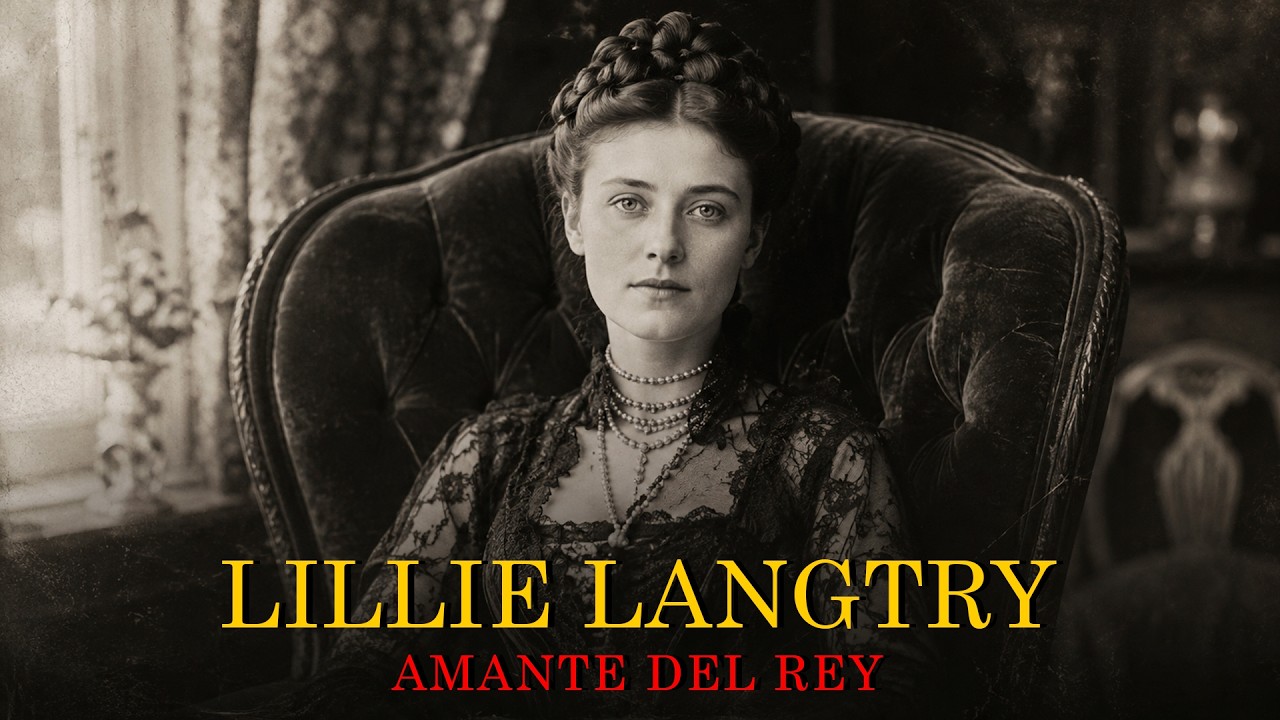
When the news reached London, newspapers devoted columns normally reserved for royalty to her death. She had once stopped traffic on Piccadilly simply by walking down the street. She had been the mistress of the future King of England, the first celebrity to endorse a commercial product, and the owner of a fortune equivalent to tens of millions of dollars today. She had earned every cent herself.
Born Emily Charlotte Le Breton on October 14, 1853, in the parish rectory of Saint Saviour on the island of Jersey, she was the only girl among six brothers. Her father, the Reverend William Corbet Le Breton, was the Dean of Jersey. Her mother was a woman of modest origins and firm convictions. She was raised alongside her brothers, climbing trees, jumping fences, and swimming in cold water.
Her brothers’ tutor taught her Latin, Greek, and mathematics. No one thought to stop it. By fourteen, men on the island were noticing her. By sixteen, she had discovered that the way people looked at her was a form of power.
But Jersey offered her nothing. The island was only about eleven miles long. Marriage seemed the only door out. She escaped in March 1874 when she married Edward Langtry, a wealthy Irish widower with a yacht.
She later admitted she was drawn to his boat, the Red Gauntlet, rather than to him. It offered her the open sea and a life beyond parish boundaries. The newlyweds moved to London, but society doors stayed closed to them. Then, in the spring of 1877, Langtry attended a reception wearing a simple black dress with no jewelry while other women wore silk and diamonds.
The effect was instant. Society artist Frank Miles crossed the room to ask if he could draw her. His sketches were reproduced on postcards sold across London. John Everett Millais, one of the most celebrated painters of the era, painted her portrait titled “A Jersey Lily,” which drew such crowds at the Royal Academy that a police officer had to stand beside it.
Her image appeared on more postcards than any other woman in England. Shops displayed her face in windows. Crowds gathered outside theaters where she was expected. On at least one occasion, traffic on Piccadilly stopped because word spread that Lily Langtry was walking down the street.
The Prince of Wales, the future King Edward VII, took notice. At a dinner on May 24, 1877, he arranged to have Langtry seated near him. Within weeks, they were inseparable. The affair was conducted according to the intricate protocol of Victorian court life.
The Prince’s wife, Princess Alexandra, received Langtry warmly, signaling that she was acceptable. At a court presentation in 1878, Langtry wore the Prince’s own emblem of three ostrich feathers in her hair. Queen Victoria received her without comment. Edward Langtry became a ghost in his own marriage, seated far from his wife at dinners.
He began drinking. The affair lasted about three years. When the Prince lost interest around 1880, the consequences were immediate. Gifts stopped, invitations dried up, and creditors began presenting their bills.
Langtry was deeply in debt. During this collapse, she discovered she was pregnant. The father was almost certainly not her husband. The likely candidate was Arthur Jones, a friend of the Prince, with whom she had begun a discreet relationship.
Lily disappeared to Paris, where she gave birth to a daughter on March 8, 1881. The baby was named Jeanne Marie and quickly handed over to Lily’s mother in Jersey. She was raised as the daughter of one of Lily’s brothers, who had conveniently died young. Lily would visit as her aunt.
The child never knew the truth. On December 15, 1881, Lily Langtry stepped onto the stage of the Haymarket Theatre to make her professional debut in “She Stoops to Conquer. ” She was the first woman of society to become a professional actress. Society women did not work for money; they certainly did not display themselves on a public stage.
Reviews were mixed, but the box office was excellent. Oscar Wilde encouraged her theatrical ambitions, recognizing that her talent lay not in acting but in being Lily Langtry in public. A theater was simply the most efficient place to convert that talent into money. In October 1882, she sailed to America aboard the Arizona.
Her premiere at the Wallack Theatre on October 23 was a phenomenon. The house was sold out, and the take was $7,800. Sarah Bernhardt, the most famous actress in the world, had earned $5,800 at her own New York premiere. Langtry had beaten her by $2,000 while being only half the actress.
Langtry understood what American audiences wanted: proximity to fame. She launched a coast-to-coast tour, performing in San Francisco, Chicago, St. Louis, and dozens of smaller cities. She invested thousands of dollars in Fifth Avenue real estate during her first American visit.
Property values in New York were soaring during the 1880s, and she understood appreciation. In 1882, Thomas J. Barrett, the general manager of Pears Soap, approached Langtry with an offer. He wanted her face and name for the product.
No woman of social position had ever endorsed a commercial product. She said yes. The advertisement appeared and was reproduced millions of times. It became the founding moment of modern celebrity endorsement.
Her financial empire drew from several sources: theatrical performances, London appearances, New York real estate, endorsement payments, gifts from wealthy admirers, horse race winnings, and rental income. By 1898, her personal fortune was roughly two to three million dollars, equivalent to between seventy and eighty million today. She commissioned a private Pullman railway car for her American tours. It was over forty feet long, upholstered in velvet, decorated with polished brass lilies on every fixture, and contained a salon, bedroom, kitchen, and staff quarters.
She traveled across America in this rolling palace, arriving like a head of state to crowds gathered since dawn. One persistent admirer was Frederick Gebhard, young, handsome, and heir to an enormous fortune. He lavished money on her, bought horses and jewels, accompanied her on tour, and even fought duels over her honor. Not all attention was welcome.
Robert Peel, known as Squire Abington, was possessive, violent, and rich. He beat her in hotel rooms and once hit her in the face hard enough to leave a black eye. She spent ten days recovering in hiding. Yet she kept returning.
Her explanation, recorded by contemporaries, was brutally calculating: “I detest him, but every time he does it he gives me a check for 5,000 pounds. ”
That sum in the 1880s was equivalent to roughly six hundred thousand dollars today. It was not masochism or love; it was the logical endpoint of a system that treated women’s bodies as commodities. The relationship with Gebhard ended after a train wreck near Shohola, Pennsylvania, in the summer of 1888.
His private train, carrying his string of racehorses, derailed catastrophically. Nearly all the horses died, including his champion runner, valued at tens of thousands of dollars. He accused Lily, saying she had already cost him a fortune. In 1892, Langtry discovered horse racing.
The Jockey Club assumed no woman could own a racehorse. She registered her horses under the name “Mr. Jersey. ” The alias was transparent; everyone knew Mr.
Jersey was Lily Langtry. Nobody objected. The fiction gave the Jockey Club plausible deniability. Her horse Merman became one of the most successful long-distance runners in English racing.
At the Cesarewitch of 1897, he won with odds of 100 to 7. Contemporary accounts place Langtry’s winnings at roughly 20,000 pounds, equivalent to more than two million dollars today. In 1900, she won the Ascot Gold Cup with a horse running at 20 to 1. Langtry was forty-six years old.
On July 27, 1899, the same day Merman won the Goodwood Cup, Lily married Hugo Gerald de Bathe. He was nineteen years younger, a young man without particular achievement but heir to a baronetcy. The marriage was a transaction: Hugo gained a famous wife; Lily gained the promise of a title. Hugo’s father was reportedly furious, wishing to die immediately so that his will could take effect and cut off his son.
He lived until 1907. The couple occupied separate residences for most of their marriage. The greatest reckoning awaited. At a party, Jeanne Marie Langtry discovered that the woman she called aunt was actually her mother.
Someone who assumed she already knew mentioned the truth in passing conversation. Jeanne Marie had been raised in Jersey believing her parents were dead. She withdrew from her mother in the following days and weeks. There was a confrontation, the details kept private.
She married Ian Malcolm, a Scottish politician who became a Member of Parliament. They had four children and lived in Scotland. The door between mother and daughter closed with a soft but irreversible click. Lily never publicly acknowledged her daughter or corrected the official story.
Langtry’s theatrical career reached its artistic peak in the 1890s and early 1900s. She played Rosalind in “As You Like It” at the St. James Theatre, selling out all performances for four months. As Cleopatra, she received ten curtain calls on opening night.
Critics who had dismissed her early work acknowledged genuine skill. In 1891, she returned to Jersey to extraordinary acclaim. Crowds lined the streets, the governor received her, and church bells rang. The daughter of the rector who had left on a yacht returned as the most famous woman in the British Empire.
By 1900, the world that had made Langtry possible was vanishing. Cinema arrived in London in the late 1890s. By 1910, large picture houses were opening across Britain. Radio was coming.
Mechanized, reproducible, cheap entertainment was replacing the live display of a beautiful woman. In 1913, Langtry made a single film, a silent short that has largely been lost. The camera did not love her as live audiences had. On screen she was just a woman; in person she had been a force of nature.
Edward Langtry, the man whose yacht had been her ticket off the island, was found wandering and confused at Chester railway station in October 1897. He was committed to the county asylum, where he died on October 15. The cause of death was recorded as general paralysis of the insane, a term that in the medical language of the time almost certainly indicated the final stage of syphilis. He was fifty-one.
The Prince of Wales became King Edward VII in 1901 and reigned for nine years. He died in 1910 at sixty-eight. Langtry continued acting into her sixties. She toured America in the 1900s, playing smaller theaters.
The Manchester Guardian captured the change: “A world with cinema and radio,” the critic wrote, “has more to do than crowd around a beautiful woman. ”
By 1920, Langtry had retired from the stage. She lived in Monaco, where she stayed in a villa on the cliffs above Monte Carlo. She kept her hair in the reddish-brown shade of her youth, an open vanity.
She danced at events with gigolos. Her poodles occupied a room adjacent to her bedroom. Somerset Maugham met her in Monaco and left a portrait of a woman who had aged without becoming sentimental. Actor Alfred Lunt remembered the bluest eyes he had ever seen.
“She looked at you,” he recalled, “as if deciding whether you were worth the effort. ”
In 1925, she published memoirs titled “The Days I Knew,” more notable for what they omitted. She never confirmed the affair with the Prince, never acknowledged her daughter, never spoke of the men who had beaten her or the money paid in compensation. She made her will.
Ten thousand pounds went to her sister. Nothing went to Jeanne Marie. Lily never explained. The winter of 1928 brought illness.
She weakened through January, and by February it was clear she was dying. She died at dawn on February 12, 1929, at seventy-five. She had asked to be buried in Jersey. February was cruel: blizzards swept the Channel, and the sea was violent.
The voyage that normally took hours became an ordeal of days. Her coffin traveled through bad weather to reach the island. The church of Saint Saviour, where her father had preached and where she had been baptized, was prepared for the funeral. Flowers arrived from London, Paris, and New York.
Hugo de Bathe attended, fulfilling his last duty as a husband. Jeanne Marie was not there. Among the mourners was an elderly man who attracted little attention: the old captain of the Red Gauntlet, the yacht that had brought Edward Langtry to Jersey more than fifty years before. He carried a bouquet of red Jersey lilies and placed it on her grave.
She was buried in the grave of her parents in the churchyard of Saint Saviour’s. At Goodwood racecourse, the Lily Langtry Stakes is run every year for fillies and mares. In Langtry, Texas, a saloon named the Jersey Lilly still stands as a tourist attraction. A self-appointed judge named Roy Bean was so infatuated with Langtry that he named his bar for her and wrote her letters she never answered.
He died in 1903, never having seen her in person. The saloon now draws one hundred thousand visitors a year. In California, a vine Langtry planted in 1888 still grows and produces grapes. A contemporary once said it would be hell to be married to her because she was too damned clever.
The observation was meant as a warning; it reads now as a tribute. She converted beauty into money, status into independence, and turned a system designed to consume women into one she used herself. The system was designed to consume women. She refused to be consumed, and the price of that refusal was a loneliness that money could soften but never cure.
Her daughter never forgave her. Her public eventually forgot her. But the architecture she created endures: each celebrity endorsement, each personal brand, each beautiful woman who looks in the mirror and sees not just a face but a business plan was built on the road she opened.