The crew behind one of the most influential horror films in American cinema had roughly three weeks, a handful of borrowed vehicles, and a budget that a midsize studio would have spent on a single sequence. The monster was a mask pulled from a costume shop shelf, and autumn leaves scattered across lawns were swept up after every take so they could be thrown down again for the next shot. There was no money for a composer, so the director wrote and performed the score himself. Audiences were so completely frightened that the industry spent the next decade trying to reverse-engineer the effect.
Almost none of it was planned, and the first major change arrived even before a word of the screenplay existed, when the story had nothing to do with the last night of October. It began under a different title. Producer Irwin Yablans had watched Assault on Precinct 13 and came away convinced that its director could do a great deal with very little. What he brought to John Carpenter was a premise rather than a story: teenagers looking after other people’s children in quiet houses, with someone outside watching them.
The working title was blunt about it—The Babysitter Murders—and no part of the concept tied it to any particular night of the year. Yablans was the one who suggested October 31st, arguing that setting the story on a single holiday evening would give the picture a built-in identity, a reason for audiences to remember it, and a distributor’s hook that came free. Moustapha Akkad put up the financing: $300,000, which was small even by the standards of independent horror at the time. The holiday setting solved practical problems as much as commercial ones.
A story confined to one night in one neighborhood allowed a small cast, a handful of locations, and no need to show the passage of time. Carpenter has described the arrangement without much romance: he was a young filmmaker being handed a commercial concept, a tight schedule, and enough freedom to shoot it his way. The mythology that grew around the character came later, built by sequels, imitators, and 40 years of Octobers. What existed at the start was a producer’s instinct about a date on the calendar and a writer who now had three weeks to turn it into a screenplay.
The script took just three weeks. Early in 1978, with a shooting date already fixed, Carpenter and Deborah Hill divided the writing between them along lines that matched what each actually knew. Hill took the teenagers. She had spent years babysitting, so she knew how girls that age talk to each other when no adult is listening.
The drifting half-bored conversations about boys, homework, and cigarettes fill the middle of the picture; they are the reason the neighborhood feels like a place instead of a set. Carpenter took Dr. Loomis. The doctor’s dialogue does something structurally different from everything around it, raising the stakes with language that belongs in an older kind of horror story: all warnings, doom, and a man who has already seen what everyone else is about to face.
The structural plan was simple enough to hold in your head: build the story so a scare beat arrived at regular intervals, keep the geography tight, and never write anything the budget could not deliver. No page of the screenplay required a set that did not already exist somewhere in a Los Angeles suburb. About three weeks after they started, they had a finished draft. The two worked fast and in close contact, which is part of why the finished pages read as one voice despite the split.
The shape of the story was so economical that the production almost never had to solve a structural problem on the day. Haddonfield hides real life in jokes. The Illinois town at the center of the story does not exist, but the name on its road signs belongs to a town in New Jersey. Deborah Hill grew up in Haddonfield and handed the name to the fictional suburb where the story unfolds.
Several street names came from the other side of the writing partnership, lifted from Carpenter’s years in Bowling Green, Kentucky. Laurie Strode carried the first name of a woman Carpenter had dated. Michael Myers was named for a British distributor who had helped push Assault on Precinct 13 in front of buyers at Cannes—a favor repaid in the least flattering way imaginable. Tommy Doyle came out of Rear Window, where a character of that name spends the picture refusing to believe what he is being told.
None of it was designed to be noticed: two writers filling in blanks reached for the places they had lived, the people they had known, and the movies they had watched too many times. The borrowing that went furthest sits at the center of the cast list. Dr. Sam Loomis takes his name from the boyfriend in Psycho, which means Janet Leigh’s daughter spent an entire picture being chased toward a man named after her mother’s co-star.
The Shape was built without a motive. Nick Castle’s name does not appear beside Michael Myers in the closing credits; he is billed as “The Shape,” and the billing was deliberate. Carpenter has said the adult Michael was never meant to work as a character in the usual sense. Two things fed into it.
One was a visit he made to a state mental hospital as a college student in Kentucky, part of a psychology class, where he was taken through the most serious ward and saw a boy of about 12 or 13 with a blank, unfocused stare that he later described as a schizophrenic look. The other was Westworld, specifically the Gunslinger Yul Brynner plays in it—a figure that keeps coming, does not negotiate, and cannot be reasoned with because there is nothing behind the face to reason with. What that produced was a film with no explanation in it. The 1978 picture never says why Michael goes back to that house, why those particular girls, or why that night.
Loomis offers a diagnosis of sorts, but he is also a frightened man using the only vocabulary available to him, and the screenplay gives no reason to treat his speeches as the answer. Everything that later arrived to fill the gap—the family connections, the cult, the runes, the ancient curse—was invented by sequels made years afterward by other people. Strip those away and the original leaves the question standing exactly where Carpenter left it. Carpenter gambled on creative control.
On paper, the terms looked poor for a filmmaker two pictures into his career. He agreed to write, direct, and compose the music for a fee of around $10,000, which was modest even in 1978. What he negotiated instead of money was authority. He kept the right to hire his own people, which put Deborah Hill in as producer, Dean Cundey on the camera, and Tommy Lee Wallace on production design.
The score stayed his, as did the final say on how the picture was cut and how it ended. For a director that young, working for an independent producer with no studio above him, that combination was unusual—and it is the reason the finished film has no committee fingerprints on it. Nobody made him add a chase, nobody made him explain the character, and nobody forced an alternate ending in which the threat was tidily resolved and the audience sent home settled. The other half of the deal was a percentage of the profits.
Because they were financing a cheap horror picture with no stars, profit points cost Yablans and Akkad little to hand over. Carpenter took them because there was little else on the table. Nobody expected the release to return more than a few times its cost. It went on to earn tens of millions of dollars against what it had cost to make, and that $10,000 fee turned into a payday most working directors of the era never saw.
The $300,000 budget forced guerrilla filmmaking across 21 days. That was the whole shooting schedule, start to finish, for a picture that now sits in the National Film Registry. A budget of $300,000 does not buy departments; it buys a small group of people who each do several jobs, and on this production almost everyone did. Crew members carried their own equipment between setups.
The company moved between locations in Pasadena and South Pasadena in a handful of vehicles. A single Winnebago covered the trailers, dressing rooms, and production office, plus whatever else a studio picture would have had built for it. There was no second unit waiting to pick up the next setup. Actors changed clothes where they could, and when something broke, whoever was standing nearest fixed it.
Tommy Lee Wallace is the clearest example of how far that stretched. His credits list production design and art direction, but he also scouted locations, cut film alongside Carpenter, dressed sets, and stood in for Michael in shots where Nick Castle was unavailable. A studio would have needed five people under contract to cover that list. The economy shows up on screen, though not as cheapness: the houses look like houses because they were houses, and those are real streets filmed at the hour they actually look like that.
What the production could not afford to fake, it simply pointed a camera at. Laurie Strode wasn’t the first choice. The role that made Jamie Lee Curtis famous was written and cast with somebody else in mind. Annie Lockhart, daughter of June Lockhart, was considered for Laurie before Curtis was ever brought in.
Curtis was 19. She had been working in television on Operation Petticoat and a run of guest parts, with no feature credit to her name. What the filmmakers saw in the reading was an ability to handle ordinary dialogue as though it were ordinary—which sounds like a low bar until you watch how much of the picture rests on it. Laurie spends long stretches doing very little that is dramatic: walking home, marking a book, sitting in a car.
The tension has to come from the audience believing she is a real girl on a real street rather than a character waiting for a plot to arrive. Deborah Hill saw the commercial angle immediately. Curtis was Janet Leigh’s daughter, so every piece of press about the film could reach back to Psycho without the publicity department having to invent a single line. It was a free connection between a cheap independent horror release and one of the most famous suspense films ever made.
Both instincts were right. The picture worked as a marketing story, it worked as a performance, and Curtis carried enough of it to build a career in a genre that had barely offered one before. California had to fake an Illinois fall. The sidewalks in South Pasadena were warm enough that spring for the crew to work in shirt sleeves while the cast sweated through sweaters and corduroy jackets.
On screen it was supposed to be the end of October in the Midwest, so every visual marker of autumn had to be manufactured. Pumpkins are a seasonal crop, and in a Southern California spring there were almost none to buy. The production tracked down what it could, then moved the same ones from porch to porch between setups. A pumpkin that sat on one porch in the morning was two streets away by the afternoon.
Leaves were the bigger problem. The trees on those streets were green, full, and entirely wrong, so the art department bought bags of dried leaves and scattered them across lawns, gutters, and pathways before each shot. The supply was finite, and the budget did not stretch to more, so crew members went out after every take, gathered the leaves back up, and laid them down again for the next angle. The same handful of leaves fell across Haddonfield for three weeks.
Camera placement did the rest. The neighborhood had been picked partly because its older two-story houses, deep porches, and mature front gardens read as Midwestern instead of Californian. Dean Cundey and Carpenter then composed shots to keep palm trees out of view, which in that part of Los Angeles takes constant attention. They favored overcast light and late-afternoon hours when the color temperature could pass for a colder climate.
Hedges, fences, and parked cars were used as blockers. The illusion holds well enough that most viewers have never questioned the geography—which is a strange thing to say about a movie whose entire premise depends on the season. It does not hold perfectly: palms are visible in a handful of shots if you know where to look, and the grass across the neighborhood is greener than any Illinois lawn has any business being on October 31st. Jamie Lee Curtis acted by a fear meter.
Nothing in the picture was filmed in the order the audience sees it. Laurie’s terror climbs steadily across the last 40 minutes, but the takes that built that climb were recorded weeks apart, out of sequence, often on days when the scenes on either side of them did not yet exist. That left Curtis with a problem no amount of preparation solves: she had no way of judging how frightened she was supposed to look in any given take because the shot before it and the shot after it had not been filmed. Carpenter’s solution was a scale.
He gave her a numbered range, 1 to 10, and before a take he would tell her where on that range the moment sat. A low number was unease, a glance over the shoulder, the kind of worry she would never say out loud. A high number was the far end of it, the closet, the screaming. Curtis then worked backward from the number—breathing rate, how tightly she held her shoulders, how much her voice broke, how wide the eyes went—all calibrated to a number called out seconds earlier.
What reads on screen as an unbroken slide into panic was assembled from fragments, each one set to a level by a director standing off camera. The performance that made her a horror lead for the next four decades was built to a set of numbers called out on the day. P. J.
Soles was cast because of Carrie. Carpenter had already seen her do most of the job before he ever met her. She had played Norma Watson in Carrie, the loud one in the baseball cap, and had turned up in The Boy in the Plastic Bubble the same year. What he wanted from Linda was energy that felt unforced.
Teenagers in horror pictures of that era tended to be written as types and played as types, but Soles had a loose, chatty quality that read as a real 17-year-old rather than an actress doing 17. Her line readings run over each other; she interrupts, repeats herself, and drifts off mid-sentence in a way that sounds unscripted. That quality is difficult to fake and close to impossible to direct into a performer who does not already have it. The casting also does structural work.
Linda is the counterweight to Laurie: one is out in the open, unbothered, treating the evening as an opportunity, while the other is careful, watchful, and half convinced something is wrong. That contrast carries a lot of the quiet work in the middle of the film, because Laurie’s caution only registers as caution when there is somebody beside her who has none. The part was small and the shoot was short, but Linda has outlasted almost everything else Soles did in the period—and the reason shows up in her first scene. She is the only person on that street behaving as though the day is entirely ordinary.
Dr. Loomis was rejected by horror legends. Two of the most recognizable faces in British genre cinema turned the part down before it reached the man who ended up defining it. Peter Cushing was offered the role first; his agent passed largely over the fee.
Christopher Lee was approached next, and the answer was the same. Donald Pleasence took it. His daughter had liked Assault on Precinct 13, particularly the music, and told him the young director was worth working with. That is the version Carpenter has told for years—and it means the entire tone of the film turned on a piece of family advice about a low-budget siege picture almost no one had seen.
Loomis is the only voice in the story that tells the audience how to be afraid. The whole character rests on Pleasence’s particular delivery: that clipped, slightly frayed urgency of a man who has run out of professional composure. Cushing would have brought gravity; Lee would have brought grandeur. Pleasence brings the sound of somebody who is badly frightened and cannot get anyone to listen.
He shot the entire role in about five days. Christopher Lee later called turning it down the biggest mistake of his career. A $1. 98 Kirk mask became Michael.
Bert Wheeler’s costume shop on Hollywood Boulevard kept its rubber faces racked along a wall near the back—rows of them, most intended for parties. Tommy Lee Wallace walked in with a tiny budget and a vague brief: find something for the killer to wear that would not look like a monster. He came out with two candidates. One was a clown face, which tied back to the 1963 sequence where the child wears a clown costume.
The other was a Captain Kirk mask, a William Shatner likeness sold as a novelty item priced at about $1. 98. Wallace tried both. The clown was too specific, too much of a joke, and it carried associations the story did not want.
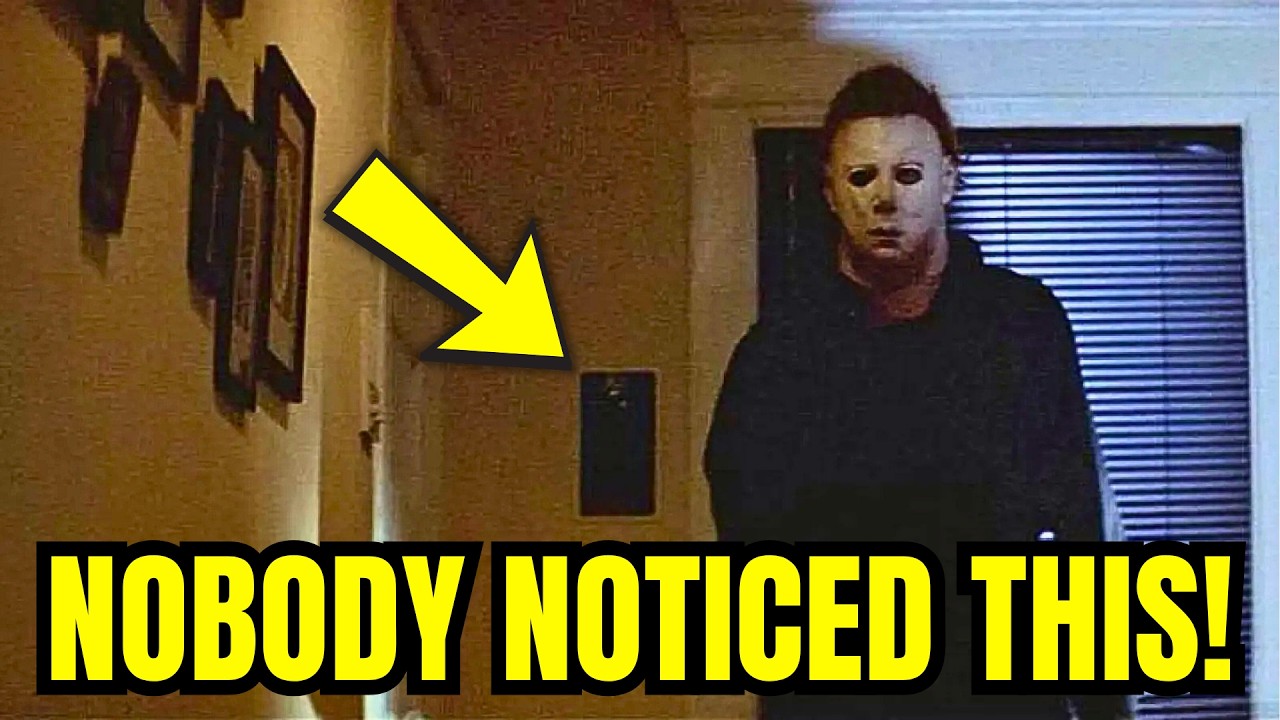
The Shatner face got taken apart. Wallace opened up the eyeholes so they read as empty sockets from a distance rather than as somebody looking out, teased and reshaped the hair, then sprayed the whole thing a flat, chalky off-white—killing the flesh tone that had made it recognizable. By the time he finished, there was nothing left of the actor underneath. What remained was a face with human proportions and no human information in it.
That was precisely what Carpenter and Hill had asked for: something an audience would read as a person, right up until the moment it failed to react like one. Two details matter more than they look. The blank white surface catches light in a way a detailed mask never can, which becomes important in the final act of the picture. And the mask was never intended to become an icon.
It was a prop solution costing less than $2, bought because there was no money to build one. A rubber novelty face priced at about the same as a sandwich is now one of the most valuable objects in horror cinema, with original pieces from the production changing hands for six-figure sums. Laurie’s wardrobe cost about $100. The costume budget was small enough that most of the cast turned up in their own clothes; Nancy Loomis has said she wore things out of her own closet.
For Laurie, the production went to a JCPenney and spent somewhere around $100 on the lot: the shirt, the skirt, the sweater, the shoes. That was the entire look for the character who carries the story. What the money bought by accident was characterization. Laurie dresses like a girl who is not thinking about how she looks.
The clothes are plain, slightly old-fashioned, and cut to disappear, which sets her apart from Linda’s brighter, tighter, more deliberate outfits without a single line of dialogue having to point it out. The same accident works on the town: Haddonfield reads as a real working suburb, partly because nobody in it looks styled. There are no fashion statements on those sidewalks, no costume department flourishes—just the sort of clothes people actually owned in 1978. The shoes came off the rack with everything else.
A production with money would almost certainly have spent it here, and the film would have been slightly worse for it. Seven people created Michael Myers. “Slow walk” is roughly how Nick Castle has summarized the direction Carpenter gave him for the part. Castle was not an actor; he was a USC film school friend of Carpenter’s who had come by the set because he wanted to watch a shoot, and he ended up wearing the mask for about $25 a day.
The lack of training turned out to be the point. Carpenter did not want a performance under that face; he wanted a body that moved without intention, at a steady pace, with none of the small physical signals a trained actor uses to communicate what a character is feeling. Castle’s walk has no urgency in it at all, which is why it works. He was not the only person under the mask.
Will Sandin played the child in the 1963 opening. Tony Moran shot the brief unmasked reveal near the end, on screen for a matter of seconds. Wallace stood in when Castle was not available, and other crew members and stunt performers covered specific inserts: hands reaching into frame, a body falling, a figure crossing a doorway at a distance. The presence the audience remembers as one relentless figure was pieced together from several different bodies, none of whom was primarily an actor—and the most recognizable of them was there because he wanted to hang around a film set.
The opening scene was shot last. By the time cameras rolled on the 1963 prologue, the rest of the picture already existed in an editing room. Those four minutes that introduced the audience to Michael Myers were the closing piece of production work on the schedule. Part of that was practical: the house standing in for the Myers home had sat empty for years, with peeling paint, damaged plaster, and rooms that looked abandoned rather than lived in.
Making it read as a normal family home in 1963 took cleaning, painting, and dressing, which the production did not have time for earlier in the schedule. The bigger challenge was the camera move itself. That long, unbroken point-of-view shot goes in through a window, across a kitchen, up a staircase, into a bedroom, and back out to the street. It was executed with a Panaglide, a stabilized rig that had only recently become available.
Every light had to be repositioned as the operator moved, and crew members cleared out of rooms seconds before the camera entered them, pressing themselves flat against walls just out of frame. A single mistake anywhere in the move meant resetting the house and starting over. One element was not achieved on the day at all. The dark border that closes in around the frame—the suggestion that the audience is watching through eyeholes—was added afterward as an optical effect rather than filmed through an actual mask.
The sequence that convinced audiences they were inside the character’s head was finished in a laboratory after everyone had gone home. Crew vehicles secretly became props. The caterer’s truck is in the movie. It appears on screen as the Phelps Auto Service vehicle, redressed with a sign and pointed at the camera, because renting a period-appropriate work truck would have cost more than the production could spare.
The pale Cadillac that turns up in Haddonfield belonged to Carpenter himself—an older model he was driving at the time. Station wagons parked along those streets were the ones people had arrived in that morning. The Winnebago that housed the production office and doubled as a changing space sat just out of frame for most of the shoot. None of this was hidden from anyone; there was simply no line in the budget separating what the company owned from what the fictional town needed.
The effect on screen is peculiar and useful. Haddonfield is populated by objects that look used, dented, and dusty in the way everyday suburban vehicles are, because that is exactly what they were. A production designer buying the same look would have had to age everything artificially. This company just parked its own cars where the camera could see them—which mattered more than it sounds, because the camera in this picture spends a great deal of its time looking at things in the distance.
Empty frames became the real scare. Dean Cundey shot the suburban material wide, keeping a hedge or a parked car close to the lens with much of the image given over to lawn, sidewalk, and open street. There is more space in those shots than a horror film normally allows, and that space is the mechanism. Once an audience has seen a figure appear at the edge of a composition, standing behind a hedge in the background or half-visible through a doorway, it starts checking the whole frame.
Every subsequent wide shot becomes an inspection. Viewers scan the shrubbery, the windows, the gap between houses—and the picture does not have to put anything there for the scanning to do its work. Some of those shots are occupied; many are not. The film never tells you which.
The Panaglide extends the same idea into movement. Rather than cut rapidly between angles to generate tension, the camera glides along sidewalks, into rooms, and around corners at a walking pace, leaving the audience an unbroken view and plenty of time to worry about what might enter it. No information is being withheld by editing; the threat, when it appears, appears in plain sight. Then there is the vanishing: Michael stands beside a hedge, Laurie looks away, and when the shot comes back he is gone.
There is no cut to explain it, no sound to mark it. Whether the audience is meant to read that as a man moving quickly or as something that does not obey ordinary rules is a question the original never settles. Crew families became Haddonfield extras. “We just got our own kids” is roughly how Carpenter has described solving one of the production’s more visible problems.
Halloween night in a suburban town means children out on the sidewalks in numbers, and there were a great many shots across several evenings of exterior work that needed them. Hiring background performers of that age involves agents, guardians, permits, and a per-day rate for every child in the frame. On a picture with this budget, none of that was available. So the company asked around.
People working on the film brought their own children in, and local families in Pasadena and South Pasadena lent theirs. Costumes were whatever the kids already owned or whatever could be assembled from a bed sheet. No child was blocked, choreographed, or given a direction beyond a general instruction to go trick-or-treating. The results are visible in the finished picture, and they are better than a hired background cast would have delivered.
The children move in loose, uneven clumps; some run ahead, some stop for no reason, and a few glance at the camera the way real children do when something unusual is happening on their street. There is none of the tidy, evenly spaced movement that professional background work produces, because none of them were thinking about the shot. Michael emerged from darkness. Laurie sits slumped in an upstairs hallway with her back to an open doorway, and behind her the room is simply black.
Then a pale shape begins to resolve out of that blackness, slow and low in the frame, until the mask is fully visible—and the audience realizes it has been staring at a face for several seconds. The effect was achieved with lighting alone. Dean Cundey lit the doorway so precisely that the only thing capable of catching light in that space was the chalky off-white surface Tommy Lee Wallace had sprayed onto a rubber novelty face months earlier. A detailed mask with flesh tones and shadowed contours would have been swallowed by the dark; the flat white one picks up the smallest amount of spill and returns it.
Cundey and Carpenter time the reveal so the face arrives before the body. The shot hands the viewer information Laurie does not have, and for a stretch of screen time the audience is watching her fail to notice. It costs nothing beyond patience with a lighting setup, and it has been imitated for decades by productions with budgets a hundred times larger—and the version that still works best costs nothing but time. Carpenter hid a voice cameo.
There is a performance in the picture that nobody sees: Annie’s boyfriend Paul exists entirely as a voice on the other end of a telephone, and that voice is the director’s. The role is uncredited and easy to miss on any number of viewings. Paul never appears; he has no scene, no reaction shot, nothing that marks him out as anything other than a plot function for getting Annie out of the house. The conversation plays as the sort of half-distracted teenage phone call that fills the middle of the film, which is exactly why the cameo goes unnoticed.
Nothing in the writing or the delivery draws attention to it. What that points to is the sheer number of jobs one person was doing on this production. Carpenter wrote the script with Hill, directed, composed the score, performed it himself, then stood at a microphone supplying a throwaway teenage boyfriend because nobody else was around to do it. That is what a 21-day schedule does to a director: every gap gets filled by whoever is already in the room.
He has never made much of it. In a filmography with several deliberate on-screen appearances, this one has stayed almost entirely in the background, which suits a part that was only ever a telephone. Carpenter chose tension over gore. “We wanted it to be like a jack in the box,” Deborah Hill said of the effect she and Carpenter were after.
The comparison is precise about the mechanism: a jack-in-the-box works on delay. The audience knows something is coming, does not know exactly when, and the waiting does most of the damage before the lid ever opens. Applied to a film, that meant building scares out of anticipation and timing instead of out of what the camera was willing to show. Count what is on screen: there is very little blood in the 1978 picture.
The killings are brief, mostly obscured, and several happen at the edge of the frame or behind an object. One of the most disturbing moments is a body pinned to a wall in a dim room, held in a wide shot with the camera never moving in for detail. The film shows aftermath and skips process. It trusts the audience to do the rest of the work, and audiences reliably do, filling in far more than they were given.
The reputation that followed does not match the content. The sequels, the imitators, and a decade of increasingly graphic slasher pictures attached themselves to this title and colored people’s memory of it. Viewers who return to the original after years away are often surprised by how restrained it is. That restraint is what allowed it to play widely, get reviewed seriously, and reach an audience far beyond horror regulars.
The entire score took three days. An early cut of the picture was shown to a young executive without any music on it, and she was not frightened at all. Carpenter has told the story many times since, usually as the moment he understood what was missing. Hiring a composer and an orchestra was never a possibility on this budget, so the job fell to the director, who had been writing music since childhood.
The recording took about three days in a Los Angeles studio, with Dan Wyman handling the technical side of the synthesizers—which in 1978 involved patching analog instruments by hand for every sound. The main theme is built on a piano figure in 5/4, an unusual time signature for popular music and the reason the theme feels slightly off-balance no matter how familiar it becomes. Carpenter has traced that rhythm back to his father, a music professor who taught him a pattern in five on bongos when he was a boy. The soundtrack credit reads “The Bowling Green Philharmonic,” which was a joke—there was no orchestra, only Carpenter, Wyman, and a small room full of keyboards.
Coupe de Ville, a band made up of Carpenter, Nick Castle, and Tommy Lee Wallace, also turns up on the record. Understanding why the music mattered so much means understanding what the film does without it. The picture is quiet. Long stretches carry no dialogue and no action, only a camera moving through ordinary spaces where nothing is happening.
In a conventional thriller, an orchestra would tell the audience how to feel about those spaces. What Carpenter wrote was a repeating figure that arrives before the threat does, so the sound becomes the warning system. By the second half, the audience is reacting to the piano before it has seen anything. Very few horror scores of the period work that way; most were written to underline what was already on screen.
Carpenter rescreened the cut with the music in place, and the executive was frightened this time. Three days of work at a synthesizer had done what three weeks of shooting could not do on its own—and the theme went on to become one of the few pieces of film music most people can hum without ever having seen the picture it came from. NBC created a strange extended cut. Anyone who watched the picture on American television in the early 1980s saw material that does not exist in the theatrical version, and for years viewers who remembered those scenes were told they had imagined them.
The explanation begins with a broadcast slot. NBC bought the television rights and scheduled the film for the end of October 1981, timed against the theatrical run of Halloween II. Television standards required cuts to several moments, and once those were removed, the running time no longer filled a two-hour slot with commercials. The network was short of screen time.
Carpenter was already shooting the sequel with much of the same cast available, so he filmed about 12 minutes of additional material during that production. Most of it is Loomis at Smith’s Grove arguing with hospital administrators about the danger the patient represents, which fleshes out the character’s frustration in the years before the escape. There is also an extra scene between Laurie and Linda. Jamie Lee Curtis had cut her hair short since 1978, so the sequence was staged with her hair wrapped in a towel to hide the difference.
None of this was part of the 1978 plan; the scenes were written and shot three years later for a network’s clock by people solving a scheduling problem. An entire generation of American viewers met the story for the first time in a version carrying 12 minutes the director had shot on a different movie’s schedule. The film became a preserved landmark. The trade press in 1978 treated the release as a modest independent horror picture with unusually good word of mouth.
Twenty-eight years later, the Library of Congress selected it for the National Film Registry, a list reserved for works judged culturally, historically, or aesthetically significant to the United States. The claim made for the picture is often overstated, so the specifics matter. The silent stalker had been in cinema since at least Peeping Tom and Psycho; subjective camera was not new either; the holiday-set killing spree had been done four years earlier by Black Christmas. What this production did was assemble a set of tools into a form that was cheap to copy, then prove to the industry that the form made money: an attacker with no face or dialogue, a camera that puts the viewer in an uncomfortable position, suspense sustained across everyday suburban streets rather than a gothic setting, a young woman who survives by fighting instead of being rescued, and a minimal musical signal that works as a warning.
Each of those existed somewhere before 1978. After 1978, they arrived as a package—and for the next decade a great many productions copied the package without understanding why any individual piece worked. The distance between those two facts is the interesting part. A production financed for around $300,000, shot in three weeks by people carrying their own equipment, is now a protected part of American film history, sitting on a list alongside Citizen Kane and Casablanca.
Preservation status carries no money with it and no plaque on a building. What it carries is the judgment of a national institution that this particular cheap independent thriller belongs in the permanent record. No part of the way this one was made suggested it would ever be considered in those terms—and the people who made it were, by their own accounts, hoping mainly that it would earn back what it cost. The TV movies hit a future clue.
A picture playing on the television set in the Doyle living room would not look significant to anyone until 1982. While Laurie sits with Tommy and Lindsay, waiting out an evening that is about to go badly wrong, the set behind them is running The Thing from Another World—the 1951 story of a research team trapped with something that should not exist. Four years after this film’s release, Carpenter directed his own version of it. Forbidden Planet turns up on the same set later in the evening, which points at the same place: a director raised on 1950s science fiction who put the movies that shaped him into the background of his own work.
The programming is doing practical work as well. Those old titles give the house a flickering light source and a low murmur of sound; they establish an ordinary evening in front of the television that the rest of the night will take apart. Whether Carpenter was consciously nodding toward a project he already wanted to make, or simply reaching for the films he loved to fill a screen, is not something the record settles. The likeliest answer is the plainest one, which does not make the coincidence any less strange to watch now.
Word of mouth built a box-office giant. The premiere was held in Kansas City on October 24, 1978. There was no coordinated national launch and no serious advertising campaign, because there was no money for either. What followed was a slow regional rollout, city by city, over a period of months, with prints moving from market to market as demand appeared.
In several places the film opened quietly, played to modest houses in its first week, then filled up in the second and third weeks as people who had seen it told other people to go. That pattern is unusual and difficult to manufacture. A studio release with a large advertising spend front-loads its audience, then declines week by week; this one climbed. Critical attention followed rather than preceded the success.
Gene Siskel and Roger Ebert both championed it on television; Ebert placed it among the year’s best pictures, comparing its command of suspense to Hitchcock. Reviews of that weight arriving for a cheap independent horror release gave exhibitors a reason to hold it and gave audiences outside the horror crowd permission to buy a ticket. The arithmetic ended up extraordinary: a picture financed for roughly $300,000 took in tens of millions worldwide, stood for years as one of the most profitable independent productions ever made, and did it without a single week of the marketing that normally produces those numbers. Pleasence helped rewrite the final scare.
A wet lawn at night, seen from a first-floor balcony, empty where a body ought to be: that is the image the screenplay asked Donald Pleasence to react to, and the direction on the page was “surprise. ” He suggested something else. Rather than shock, Loomis would look down and register something closer to confirmation—the expression of a man discovering that the thing he has been warning everyone about for 15 years is exactly as bad as he always said. Both versions were filmed.
Carpenter used the one Pleasence proposed, and it changes the whole ending. The face on screen belongs to a man who has just been proved right about something monstrous and takes no comfort in it. Then the picture stops telling you where to look. The last minute is a run of static shots of places the audience has already been: the staircase, the living room, the darkened bedroom, the house across the street, the empty sidewalk.
Nobody is in any of them. Over the top of it, the breathing continues. That is the whole argument of the film delivered without a line of dialogue. There is no body, no explanation, and no boundary drawn around the place where the threat could now be.
What Carpenter withheld at the beginning—a reason—he withholds again at the end. The last thing the audience is left holding is the sound of something still out there, still unexplained. Almost everything that makes this film work started as a limitation: a mask off a costume shop shelf because there was no money for a creature effect; the same bag of leaves thrown down and swept up for three weeks because Southern California had no autumn to offer; clothes from a department store; cars out of the crew’s own driveways; children borrowed from the neighborhood; a score written in three days by the director. Every one of those was a workaround, and together they produced a picture with no fat on it at all.
The other half of the reason it endures has nothing to do with money. Carpenter and Hill declined to explain their villain, and every attempt made since to fill that gap has made him smaller. What survives is a shape on a suburban street on an ordinary evening, in a town that looks like the one a lot of viewers grew up in—which is a much harder thing to shake off than any amount of backstory.