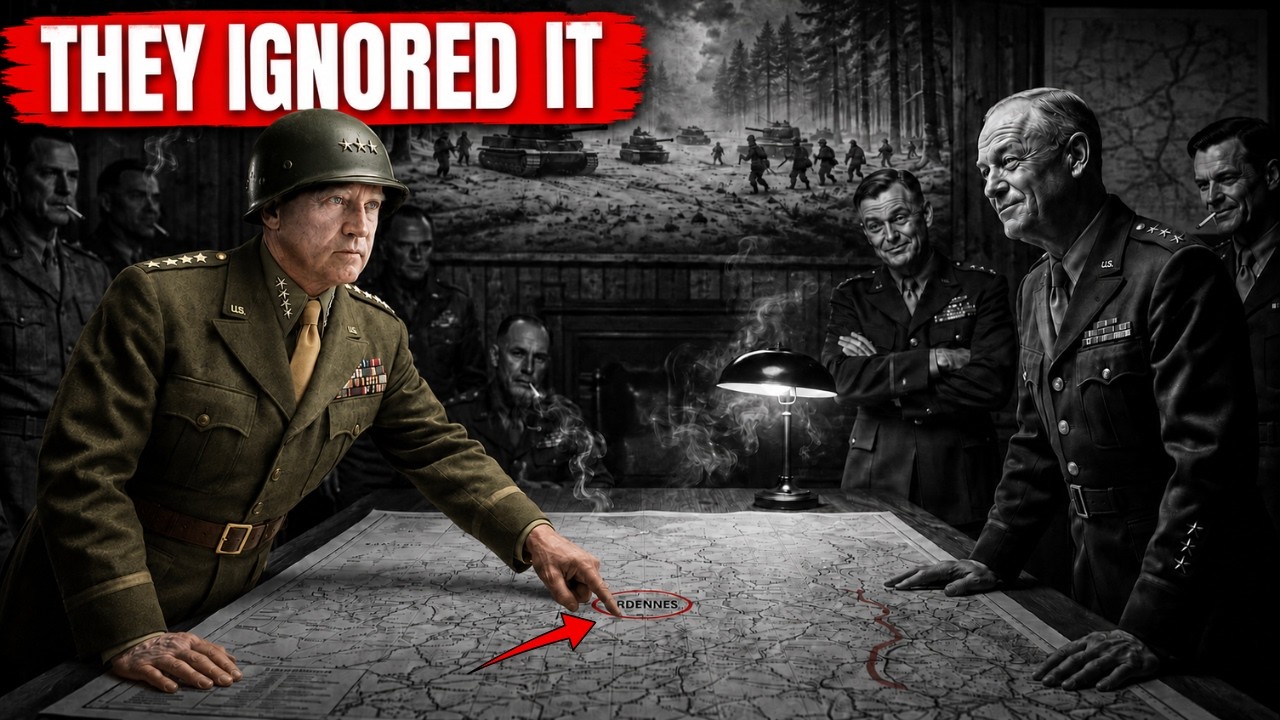
Allied commanders were still writing home to promise their families they would be back by Christmas when General George S. Patton stood over a map of the Western Front and concluded that tens of thousands of American soldiers were about to be massacred.
It was November 1944, and across the Allied lines snaking through France and Belgium, a quiet and far more dangerous poison had spread through headquarters: complacency. Paris had been liberated. German prisoners shuffled into holding pens by the thousands, many of them old men pulled from factories and boys barely old enough to shave, drowning in uniforms cut for soldiers twice their age.
Intelligence summaries week after week described a German war machine that was exhausted, disintegrating, and capable of nothing but a slow, painful collapse. Inside Patton’s Third Army headquarters, there was no champagne. There was a map on a wooden table, and a man pacing in front of it with his hands clasped behind his back, listening to the same reports as everyone else and believing none of them.
Patton was not looking at what the reports said. He was looking at what they did not say. To understand why a man surrounded by evidence of victory felt mounting horror, you have to understand who George S.
Patton actually was, because the version the public knew and the version that led Third Army were in many ways two different men.
The public image was of a reckless cavalry officer, a man who won through sheer audacity rather than intellect, a blunt instrument and little more. That image was largely a deliberate performance. Behind it was a man who had spent his entire life studying the history and theory of war with an obsession few officers could match.
Patton suffered from what is today recognized as dyslexia, and reading was never easy for him. He fought that difficulty for decades to build one of the broadest private military libraries of any American officer. He did not skim history.
He devoured it cover to cover, often more than once. He studied Hannibal’s campaigns. He studied Roman military writings closely.
He filled notebooks with observations on ancient tactics that seemed to have no bearing on tanks or aircraft.
But it was his study of his contemporaries that mattered most in the winter of 1944. Long before the United States entered the war, Patton had already turned his attention to the officers rebuilding the German army after its defeat in the First World War. He read translated German field manuals.
He studied the doctrine of fast, concentrated armored warfare, a body of ideas tied closely to the German officer Heinz Guderian, whose prewar writings on tank warfare helped shape the tactics that shattered France in the spring of 1940.
Patton did not merely learn what the Germans did on the battlefield. He learned how German commanders were trained to think. He understood their doctrine of relentless movement, a philosophy that treated static defense as close to a moral failure.
The German military tradition, generations deep, distrusted the idea of digging in and accepting slow defeat. When German forces found themselves forced onto the defensive, doctrine called for something far more aggressive than withdrawal. It called for concentrating scattered strength into a single, overwhelming point, a spearhead aimed at the enemy’s weakest seam, punching through to encircle and destroy everything caught in the trap beyond.
So while junior officers across the Allied lines looked at their maps in November 1944 and saw a beaten army preparing to surrender, Patton looked at the same terrain and saw the ghost of everything he had spent twenty years studying. He saw an army, however exhausted, still built on a doctrine that demanded exactly this kind of concentrated counteroffensive.
He was not alone in his doubts. Beside him, bent over the same maps night after night, was Colonel Oscar Koch, the quiet and meticulous chief of intelligence for Third Army. While the Allied intelligence network was suffering by early December from a dangerous kind of tunnel vision, cherry-picking scattered reports to support the comfortable belief that the war was nearly over, Koch and Patton were doing the opposite.
They were hunting for anything that contradicted the comforting story.
Koch found it in the strangest of places. He noticed that several of the most experienced German panzer divisions, units that had been fighting continuously for months, simply stopped appearing in Allied reports. The prevailing assumption among other intelligence officers was that these divisions had been destroyed outright, merged into other units, or effectively annihilated as fighting forces.
Patton was not convinced. Entire armored divisions, with all their tanks, fuel, and trained crews, do not simply evaporate. They go somewhere.
They go quiet for a reason.
Then came the radio traffic, or rather its absence. Along certain sectors of the front, German communications went almost entirely silent, day after day. Other Allied officers interpreted this as further evidence of collapse, a broken army with nothing left to coordinate.
Patton read it in a completely different way. Strict radio discipline and enforced silence across an entire sector was not the sound of an army falling apart. It was the sound of an army trying desperately not to be heard before it moved.
Standing over his map, tracing the front line with his finger, Patton began asking himself a question no one else at Allied high command appeared to be asking. If he were commanding the German side in this war, exhausted, outnumbered, and running out of time, where would he strike? His finger kept returning to the same place: a dense, hilly stretch of forest running across the border between Belgium and Luxembourg, terrain so heavily wooded and difficult to move through that Allied planners considered it nearly impossible for a major armored offensive.
They had given it a nickname that would later seem like a dark joke. They called it the Ghost Front, a quiet sector where exhausted divisions were sent to rest and green units were sent to gain experience away from real combat. For Patton, that quiet was the loudest warning sign on the entire map.
He had seen this before, in a sense. Four years earlier, French and British commanders had looked at the same tangled forest and reached the same confident conclusion that no modern army could push serious armored strength through it. Four years earlier, they had been catastrophically wrong.
German divisions had poured through those same hills and woods in the spring of 1940, bypassing France’s strongest defenses entirely, and within six weeks one of the most powerful nations in Europe had collapsed.
Patton had studied that campaign in exhaustive detail. He knew the terrain, the roads, and the speed at which German columns had moved through ground everyone had called impassable. Now, standing over a map that told a story of German collapse, he found himself staring at the same quiet forest, wondering whether history was about to repeat itself in front of an army that refused to see it coming.
There was another detail nagging at him, one that had nothing to do with tanks or radios. The weather. Forecasts from meteorologists predicted a wave of dense winter cloud cover crawling over the region within days, thick enough to keep Allied aircraft on the ground for an extended period.
For months, Allied air superiority had been one of the few advantages no German commander could counter on the battlefield. Fighters and bombers roamed the skies almost unopposed, tearing apart German columns whenever they tried to move in daylight.
A German commander desperate to launch a major offensive would need exactly this kind of weather, days of blindness for the Allied air force, to have any real chance of success. For Patton, every piece was lining up into a single, uncomfortable pattern. Missing divisions, silent radios, a quiet and lightly defended forest that history had already proven was not as impassable as everyone assumed, and weather coming that would cancel the one advantage the Allies could not afford to lose.
Separately, an intelligence officer could explain away any one of these details. Together, they looked like a plan. Patton kept these suspicions mostly to himself within the Allied high command, aware that voicing them aloud without proof would only reinforce his reputation as a loose cannon, a general who saw enemies and opportunities everywhere because sitting still made him anxious.
His fellow generals considered him reckless and difficult, a man who needed to be managed rather than trusted. If he sounded the alarm and nothing happened, it would confirm what his critics already believed. But inside his headquarters, with Koch beside him and the map spread between them, he was no longer wondering whether the Germans were planning something.
He was wondering how much time was left before they moved, and whether anyone outside this room would listen before it was too late.
 Somewhere out there along that quiet, wooded stretch of the Ghost Front, tired young soldiers were resting in the snow, unaware that their commander had already begun to suspect they were standing in exactly the wrong place at exactly the wrong time.
By the second week of December, Patton had stopped treating his suspicions as a theory. He treated them as a confirmed fact he simply could not yet prove to anyone outside his own headquarters. He summoned his operations officer, Colonel Halley Maddox, one of the steadiest planners on his staff, and gave him an order that seemed, on its face, entirely illogical.
Third Army was in the middle of its own offensive, driving east toward the Saar region, advancing through German defenses with the same momentum Patton had spent months building. Yet he asked Maddox to quietly begin drafting contingency plans, not to continue that offensive, but for something almost unthinkable: a sudden halt, and a full pivot of the army away from the east and toward the north, straight into the sector everyone considered the quietest and safest stretch of the entire front.
Maddox did not fully understand why, and he did not ask twice. Patton did not fully explain himself. He simply said that if the Germans struck through the Ardennes, he wanted Third Army ready to move within hours, not weeks, and he wanted the plan finished before anyone asked him to justify it.
It was, by any normal standard of military planning, an extraordinary and strange use of limited staff time. Armies simply did not draw up detailed contingency plans for large-scale attacks that intelligence summaries insisted would never happen. Diverting planning resources away from an active, ongoing offensive based on little more than a hunch born of missing divisions and silent radios was the kind of decision that could quietly end a promising career if it proved wrong.
Patton issued his order anyway, without hesitation and without asking permission from anyone above him. Three separate plans were quietly drawn up, each built around the same core idea: pulling several Third Army divisions from their current positions and driving them north to hit the flank of any German force that broke through the Ardennes.
Then came the waiting, the hardest part of any prediction no one else believes. December 9 passed. December 12 passed.
Daily intelligence summaries kept describing a defeated, retreating German army. Patton’s own diary entries in those days read less like the journal of a confident commander and more like the record of a man watching a fuse burn without knowing exactly when it would reach the charge.
He was certain something was coming. He simply did not know whether it would arrive in time for his preparations to matter, or whether he was about to embarrass himself in front of every general who already considered him reckless. At night, alone with his notebooks, Patton returned again and again to the same few details, turning them over in his mind like a man rechecking a lock he was sure he had left open.
The missing panzer divisions. The silence across the radios. The quiet gap in the forest that history had already proven was not as impassable as everyone insisted.
He was a religious man in his own unconventional way, inclined to write about fate and destiny in the same breath as troop movements and fuel allocations. In those December entries, there is a recurring sense that he believed he alone had been granted the ability to see what was coming.
Whether that conviction came from genuine insight or simply from a lifetime of trusting his own instincts over the consensus of others, even Patton himself could not have said for certain. All he could do was keep the contingency plans updated, keep his divisions ready to move, and wait for the rest of the Allied command to prove him right or make him look like a fool.
On the German side of the line, the plan Patton could only partially see carried a name and a sense of desperation few Allied officers understood at the time. Adolf Hitler, watching Germany’s position collapse on every front, personally pushed his generals toward one enormous final gamble in the West.
The objective was audacious to the point of fantasy: a rapid armored drive through the Ardennes, across the Meuse River, and on to the port city of Antwerp, splitting the American and British armies apart. Hitler hoped to force the Western Allies into a negotiated peace that would free Germany to focus its full strength against the Soviet advance in the East.
Many of Hitler’s senior commanders considered the plan reckless, undersupplied, and dependent on too many things going right in sequence. Their objections were overruled. The attack would go forward, and it would go forward soon, while the weather still provided cover from Allied aircraft.
Then, in the pre-dawn darkness of December 16, 1944, the silence broke. Along eighty miles of the Ardennes front, the ground itself seemed to shudder. German artillery, more than a thousand guns strong, opened fire almost simultaneously.
A wall of high explosives fell out of the dark onto American positions that had been, moments earlier, among the quietest in the entire war.
Soldiers who had been told this sector was a rest area, a place to recover from earlier battles or gain light experience before real combat, suddenly found themselves buried under bombardment heavier than most had ever seen. Trenches collapsed under the weight of the explosions. Telephone lines linking command posts were cut in the first minutes, isolating entire companies from any information about what was happening outside their small patch of frozen forest.
Behind that artillery curtain came the force Patton had spent weeks warning about. Nearly 200,000 German soldiers, organized into two full panzer armies alongside supporting infantry, surged out of the fog and snow. General Hasso von Manteuffel pushed the Fifth Panzer Army through the center.
To the north, the Sixth Panzer Army under Sepp Dietrich, built around some of the most heavily armed units Germany still possessed, drove toward the Meuse.
Overall command of the offensive nominally rested with Field Marshal Gerd von Rundstedt, though the plan itself had been drafted and pushed by Hitler and his military staff, determined to risk everything on one last blow in the West before the war was lost on every front at once.
The weather Patton had feared arrived exactly as predicted. Dense, low clouds gathered over the region, grounding the fighter-bombers that had spent months destroying German movement in daylight. For the first time in months, German columns could move on open roads without scanning the sky in dread.
It was the single condition every German planner needed, and it had arrived on schedule.
For the young American soldiers holding this sector, many of them fresh off transport ships and fighting for the first time, the attack came as overwhelming chaos. Entire companies of the inexperienced 106th Infantry Division found themselves surrounded within hours, their communications cut, their commanders unable to reach headquarters or even neighboring units. Men who had been told repeatedly that the war was nearly over now found themselves fighting for their lives in frozen forest terrain, with no one certain which direction was safe and which led straight into the advancing German spearhead.
Whole regiments were forced to surrender within the first two days of the attack after their supply routes were cut and their ammunition ran out, one of the largest mass surrenders of American troops in the entire European campaign. Reports reaching Allied headquarters were fragmentary and contradictory, and some senior officers initially dismissed them as local skirmishes rather than the opening of a sweeping offensive. It took hours, and in some cases a full day, for the true scale of the attack to sink in.
By then, the German advance had punched deep into Allied lines, creating a bulge in the map that would give the battle its name. The northern tip of Dietrich’s attack was led by a heavily armed spearhead commanded by a young and ruthless Waffen-SS colonel named Joachim Peiper, tasked with advancing as fast as possible toward the Meuse before the Americans could organize their defenses.
Peiper’s column tore through the American rear with terrifying speed in the first two days, brushing aside scattered resistance and capturing fuel depots intact, since the entire German plan depended on seizing American fuel to keep moving. Then came news that turned fear into something closer to cold fury.
Near a small crossroads town called Malmedy, a column of American prisoners, soldiers from an artillery observation battalion who had already surrendered and laid down their weapons, was marched into a snow-covered field by troops from Peiper’s advancing column. Without warning, machine guns opened fire on the unarmed men. Dozens were killed where they stood, or as they tried to run across open ground.
 Some were shot where they lay in the snow, still alive. A few survived by pretending to be dead for hours in freezing temperatures before crawling toward safety after the German column moved on.
Word of what happened at Malmedy spread through American ranks within days, carried by the few survivors and confirmed by investigators who reached the site after the area was retaken. For soldiers along the lines, many of them exhausted, frozen, and stunned by the suddenness of the German attack, that news landed like a physical blow. This was no longer simply a battle to hold ground.
For the men who fought in the Ardennes that winter, the war became personal in a way combat rarely allows, a reminder that the enemy in front of them was capable of atrocities no map, no intelligence report, and no confident prediction of German collapse had prepared them to imagine.
Fear was a double-edged weapon, and it soon curdled into a different kind of paranoia that spread through American ranks behind the actual fighting. Reports reached command of a secret operation led by the German commando officer Otto Skorzeny, who had assembled a small battalion of English-speaking soldiers wearing captured American uniforms, riding American jeeps, with orders to slip behind Allied lines, spread false directions, cut communication lines, and seize key bridges over the Meuse before they could be destroyed.
Only a handful of these infiltrators were ever actually caught. But the psychological effect of their mission far outstripped their actual numbers. Suddenly, no uniform in the theater could be fully trusted.
Military police at rear checkpoints began quizzing soldiers, including officers, with questions only a genuine American could answer without hesitation: the capital of their home state, the name of a baseball manager, the lyrics of a popular song.
Even senior officers were briefly detained and questioned at gunpoint by nervous young guards who were unwilling to take anyone’s identity on faith. The offensive had not just torn a hole in the map. It had planted the fear that the enemy could be anywhere, in any uniform, at any checkpoint.
In the first week alone, American casualties, killed, wounded, captured, and missing, surpassed tens of thousands, a toll that would ultimately make this engagement the costliest single battle in U. S. Army history for the entire war.
For an Allied command that had spent the previous month planning victory parades rather than emergency defenses, the sheer scale of the losses was almost impossible to absorb.
A kind of disciplined but very real panic swept through senior Allied commanders. Officers who days earlier had been chilling champagne and writing Christmas leave requests now stared at situation maps showing German spearheads driving toward the Meuse, threatening to split the American and British armies apart entirely, exactly as German military doctrine had always intended.
General Dwight D. Eisenhower, the Supreme Allied Commander, moved quickly once the scale of the crisis became clear, ordering two of the few reserve forces available in the entire theater, the 82nd and 101st Airborne Divisions, then resting and refitting near Reims in France, to move immediately toward the collapsing front.
At the heart of that chaos sat a small, unremarkable Belgian town at a crossroads called Bastogne. On any ordinary map, it would barely draw attention, a quiet market town surrounded by farmland and forest. But seven separate roads met there, passing through terrain that offered few other reliable routes for heavy vehicles.
Any army that controlled those roads controlled the ability to move large numbers of tanks and trucks quickly through the region.
Both sides recognized this within hours of the attack beginning. The 101st Airborne reached Bastogne by truck, many of its paratroopers lacking winter clothing, adequate ammunition, and medical supplies, and were thrown into positions alongside scattered survivors from other units caught in the retreat, including tank destroyer crews and combat engineers who had been fighting desperate defensive actions for days.
There was no time to dig proper defensive lines. There was barely time to determine who was in command of which sector before German armor began probing the perimeter. Within days, German forces had bypassed Bastogne and surrounded it from multiple sides, completing the encirclement of the town.
Inside that ring, roughly 18,000 American soldiers found themselves cut off from supply, surrounded by German armor, and facing brutal winter conditions with steadily dwindling ammunition, food, and medical supplies.
Temperatures dropped well below freezing. Wounded men froze where they fell before medics could reach them. Soldiers wrapped their feet in whatever cloth they could find, a desperate attempt to avoid frostbite in boots never designed for such prolonged exposure.
Artillery crews were ordered to ration their remaining shells, firing only on confirmed targets rather than responding to every German probe.
The medical situation inside the perimeter grew particularly desperate. A German air raid struck the building being used as the main aid station, wounding and killing patients and staff alike and destroying most of the division’s remaining medical supplies. Surgeons kept operating with whatever little equipment remained, working by lantern light in freezing rooms, as the number of wounded needing care grew by the hour and no ground evacuation route existed to move them to safety.
Belgian civilians trapped inside the encircled town took in wounded soldiers and shared what little food they had left, fully aware that the town around them might be reduced to rubble before any relief arrived. Correspondents filing stories to newspapers in the United States began describing the shape of the German advance on their maps as a “bulge” pressing into the Allied line, a description that stuck in the public memory so powerfully that the entire battle carried that name for the rest of history.
For families reading those reports over breakfast in December 1944, the confident predictions of imminent victory in the war had transformed, within a few short weeks, into a very different kind of fear: the fear that an army everyone had been told was finished had just launched the largest and bloodiest surprise attack American soldiers had faced in the entire war.
Even among the Germans, the attack was not going as smoothly as Hitler had promised his generals. In the north, Dietrich’s Sixth Panzer Army, meant to deliver the decisive blow toward the Meuse, found itself stalled for days in front of stubborn American defenses along a modest ridge near the town of Elsenborn, unable to break through despite repeated attempts. Field Marshal von Rundstedt, who had never believed the plan could reach Antwerp in the first place, watched the timetable slip day after day, aware that the entire gamble depended on speed and that the offensive was already failing to achieve its objectives.
No one inside that frozen perimeter needed to be told they were surrounded. Without supplies, without reinforcements, and without any relief force breaking through from outside, the men defending Bastogne waited for the unknown. Their limited artillery ammunition was rationed shell by shell.
Medical supplies for the wounded ran out entirely, forcing surgeons to work with whatever few resources remained in a makeshift aid station set up inside the town itself.
The only hope inside that shrinking perimeter was that someone in Allied high command, far behind German lines, would recognize the danger closing in on them and actually move to save them. By December 18, just two days after the attack began, Eisenhower understood the situation had grown too large and too dangerous for any single army group to handle alone. Entire divisions were fighting for survival rather than advancing.
The gap torn in Allied lines was widening by the hour. And if German armor reached the Meuse before being stopped, the entire Allied position in northwest Europe risked being split in two, with British forces isolated from the bulk of the American army behind them.
Eisenhower made the decision to summon his senior commanders to a single meeting away from the front to agree on a coordinated response before the crisis spiraled out of control. He chose a French city with a grim historical weight, Verdun, whose name still carried the memory of one of the costliest battles of the First World War, and set the meeting for December 19.
Hundreds of miles away, in the freezing headquarters of the U. S. Third Army, someone had already been moving for days.
While panic spread through Allied high command, and while the officers who had mocked Patton’s paranoia scrambled to understand a catastrophe they had not anticipated, Patton himself was calm in a way that unsettled those around him. He was not surprised. He had already ordered his staff to prepare for this exact moment.
The three contingency plans quietly drawn up over the preceding weeks were no longer theoretical exercises locked in drawers. They were about to become the most important and consequential orders of his entire career. And the fate of tens of thousands of frozen, trapped soldiers now hung on whether Allied command would trust a general most of them considered reckless, arrogant, and impossible to control.
The map that had once shown a retreat now showed something resembling a gaping wound, a deep bulge torn into the Allied line, with thousands of American soldiers trapped inside it and thousands more scrambling to hold what remained of their thin positions. Patton had expected this while almost no one else had. The only question left was whether he and the army he commanded could move fast enough to turn an impending massacre into something else entirely, and whether the rest of Allied high command, gathering at Verdun within hours, would give him the chance to try.

The room at Verdun on December 19 was heavy with cold and cigarette smoke. A handful of the most powerful men in the Allied armies sat around a long table beneath a map that looked less like a battle plan than a wound spreading across paper. General Dwight D.
Eisenhower stood at the head of the table, and the mood in the room, according to those present, was closer to shock than confidence. No one in that room, neither the British commanders nor the American army group commanders, had expected a blow of this magnitude from an enemy they had spent weeks describing as finished.
Eisenhower opened the meeting with a line meant to steady the room. He told the assembled generals that the situation should be treated as an opportunity rather than a catastrophe, a chance to catch the German army in the open, away from its fortified defenses, and destroy it once and for all. Few in the room found much comfort in that framing, not with tens of thousands of American soldiers surrounded, freezing, and running out of ammunition at that very moment.
The most urgent question on the table was simple to state and, by every normal standard of military logistics, nearly impossible to answer. Someone had to attack the southern flank of the German penetration to relieve the growing pressure around Bastogne and begin cutting off the spearhead before it reached the Meuse. But every army capable of launching that attack was already committed elsewhere, absorbed in its own offensives, hundreds of miles of icy roads away from the battle that mattered most.
Eisenhower turned to Patton and asked how long it would take Third Army to disengage from its current fight, reposition, and strike north into the German flank. Every general in that room expected an answer measured in weeks. Repositioning an army of that size, hundreds of thousands of soldiers and tens of thousands of vehicles, was not something done quickly, not in the middle of winter, not over narrow roads already choked with retreating refugees and broken convoys.
Moving a force that size was often compared, only half-jokingly, to trying to turn a battleship around inside a harbor built for rowboats. Patton stood up. He told Eisenhower that Third Army could attack with three full divisions within 48 hours.
The room did not take the answer well. Several officers openly scoffed, certain Patton was indulging his usual taste for theatrical bravado rather than offering a serious military assessment. One British officer present later admitted he assumed Patton was simply showing off for the room.
No one in that room, except a small circle inside Patton’s own headquarters, understood that the number he gave was not bravado at all. It was already happening. There was one more problem Patton addressed before the meeting ended, one no general in that room could solve with tanks or artillery.
The same low cloud cover that had kept Allied aircraft grounded and given the German offensive its opening days was now threatening to keep the planes Patton needed for his counterattack out of the sky.
Patton asked the Third Army chaplain to draft a short prayer for clear weather, an unusual request from a general more associated with profanity than piety, and had it printed and distributed to his men along with a Christmas greeting. Whether by faith, coincidence, or simple meteorological luck, the skies over the Ardennes cleared within days, allowing Allied fighter-bombers to return to the fight at the moment Third Army needed them most.
Before Patton left for the meeting at Verdun, he made a single phone call to his own headquarters and spoke a prearranged code word to his staff. The moment that call ended, without waiting for permission from Eisenhower, without waiting for the outcome of any meeting, Third Army began to move. The three contingency plans, quietly prepared and refined over the preceding weeks while every intelligence report insisted the Germans were beaten, were no longer locked in drawers.
They were already being executed in the field, hours before Patton stood in that freezing room and calmly told a group of skeptical generals what his army could do.
What followed over the next several days has been described by military historians as one of the most remarkable logistical achievements of the entire war. In brutal winter conditions, through blinding snow and roads turned to ice, the U. S.
Third Army executed a full 90-degree turn, swinging its axis of advance away from the east and driving north toward the 𝓮𝔁𝓹𝓸𝓼𝓮𝓭 flank of the German offensive.
Hundreds of thousands of soldiers, along with the vehicles, fuel, and supplies needed to keep them fighting, were redirected within days rather than the weeks conventional military planning would have required. The German high command, whose entire offensive was built on the assumption that a surprised and reeling enemy would take time to respond, was left stunned as an entire American army appeared on their southern flank far faster than any of their plans had accounted for. The doctrine Patton had spent twenty years studying, built on speed, concentration, and catching the enemy before he regained his balance, had been turned against the army that invented it.
The logistics behind that turn were staggering in scale. Military police were pulled from other duties to stand at intersections around the clock, directing an endless flow of trucks, tanks, and fuel tankers onto a handful of usable roads, many of them narrow, icy, and never designed for that volume of traffic in the depths of winter. Convoys drove through the night with headlights taped down to thin slits, engines groaning in the cold, drivers fighting exhaustion as much as the weather.
Fuel depots had to be shifted and resupplied along the new axis of advance before the leading divisions ran dry, a task that normally took weeks of careful coordination and was compressed into a few frantic days and nights.
Patton’s forces drove north with the same aggressive momentum that had built his reputation, tearing into the German flank, cutting supply routes, and shattering the momentum of an offensive that depended entirely on staying ahead of any coordinated response. Inside Bastogne, the men Third Army was racing to reach had no way of knowing that help was already on its way.
On December 22, three days after the meeting at Verdun, a small group of German officers approached the American lines under a white flag, carrying a written ultimatum. The message warned that the town was completely surrounded, that further resistance was futile, and that the only way to avoid annihilation of the trapped American force was immediate surrender. With a two-hour window to consider the terms, the American commander inside the perimeter, Brigadier General Anthony McAuliffe, read the demand, considered it briefly, and sent back a written reply consisting of a single word: “Nuts.”
The German officers, confused by the American slang, had to consult their escorts to interpret the response before realizing it was as blunt a refusal as intended. The next day, December 23, the German offensive lost its most dangerous spearhead. Joachim Peiper’s armored column, at one point the fastest-moving threat of the entire attack, ran out of fuel.
The American depots his advance depended on never materialized in the quantities the plan required. With his tanks abandoned for lack of fuel and no open road to the Meuse, the survivors of his unit were forced to destroy their remaining vehicles and escape on foot toward German lines. The fastest and most dangerous thrust of the entire operation had stalled less than a week after it began, undone by the same logistical gamble Hitler’s own generals had warned him about from the start.
On December 26, leading elements of the 4th Armored Division broke through the German ring around Bastogne, opening a narrow corridor into the town to relieve the exhausted, frozen defenders who had held out for more than a week against everything the German army threw at them. Trucks loaded with ammunition, medical supplies, and food poured through the corridor within hours, and the wounded, treated for days in freezing, overcrowded aid stations, were finally evacuated to proper hospitals behind the lines.
For the soldiers who had spent a week rationing bullets and wondering whether relief would ever come, the sight of American tanks advancing from the south was a moment few of them would forget for the rest of their lives. The fighting did not end there. It would take weeks more of brutal winter combat to fully eliminate the bulge torn into the Allied line and push the German forces back to their starting positions.
But the moment of maximum danger, the window in which the German offensive had any realistic chance of reaching the Meuse and splitting the Allied armies apart, had closed. The last major German offensive in the West had been broken, and Germany would never again be capable of launching an attack of comparable scale for the remainder of the war.
The cost was enormous on both sides. Tens of thousands of American soldiers were killed, wounded, captured, or missing in the weeks of fighting that followed December 16, making it the costliest single battle fought by the U. S.
Army in the entire war. German losses in men and equipment, though difficult to calculate precisely, were severe enough that Hitler’s army effectively exhausted its last meaningful reserves of manpower and armor in the West, reserves that would be desperately needed but entirely absent when the final Allied drive into Germany began just months later.
Most people today remember General George S. Patton for his ivory-handled pistols, his theatrical profanity, and the pugnacious aggression that made him a favorite subject for newsreel cameras. But the story of December 1944 reveals a very different weapon, one far less visible and far more decisive.
While junior officers across the Allied lines looked at the map and saw a beaten enemy staggering toward surrender, Patton looked at the same map and saw the doctrine of an army he had spent twenty years studying, preparing to strike exactly where history had already shown it would strike.
He had not simply reacted faster than anyone else once the German attack began. He had already positioned his army to respond before the attack started, based on nothing more than missing divisions, silent radios, and a stubborn refusal to accept the comfortable version of events everyone around him wanted to believe. It was not recklessness that saved tens of thousands of soldiers trapped inside a collapsing perimeter that winter.
It was a lifetime spent reading the enemy’s doctrine closely enough to know what it would demand of them, and a willingness to act on that knowledge before anyone else was prepared to believe it.
The map that had once told a story of German collapse came dangerously close, for several terrifying weeks, to telling a far darker story, one written in the choked roads around Bastogne, in the frozen fields outside Malmedy, and in the tens of thousands of casualties on both sides before the bulge in the line was finally erased. That darker story never came to pass, not because the danger was imaginary, but because one general refused to look away from it. Where his peers saw a defeated enemy fading into the winter fog, George S.
Patton saw the outline of a massacre about to happen, and he moved an entire army through ice and darkness to make sure it never did.