For much of the 20th century, Barbara “Babe” Paley was considered the most elegant woman in America, a figure whose taste, composure, and social authority made her an icon long before the term was widely used. She appeared on international best-dressed lists for so many consecutive years that she was eventually inducted into the list’s Hall of Fame. But behind the meticulously curated image lay two marriages, one that has largely been forgotten and one that defined her public life while exacting a private cost that only those closest to her fully understood. Babe was born Barbara Cushing on July 5, 1915, in Boston, the third daughter of Harvey Cushing, one of the most celebrated neurosurgeons in American history and a Pulitzer Prize winner.
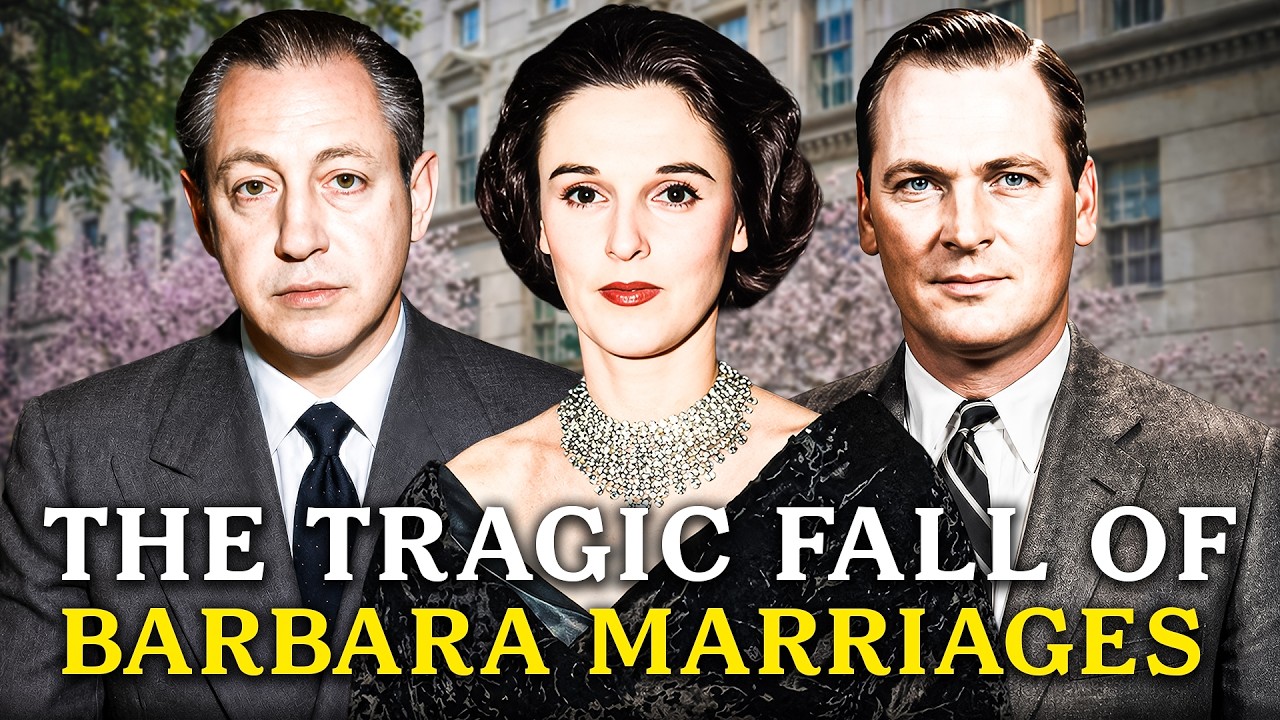
The Cushing household demanded excellence, and the three daughters—Betsy, Minnie, and Babe—grew up understanding they would need to navigate the world with intelligence and precision. Babe, the youngest, was strikingly beautiful and possessed a natural instinct for clothes and presentation that seemed innate rather than learned. The Cushing sisters became something of a social phenomenon in mid-20th-century America, each marrying men of extraordinary wealth and power. Betsy married James Roosevelt, son of Franklin Delano Roosevelt, and later John Hay Whitney.
Minnie married Vincent Astor, heir to one of the great American fortunes. Babe would eventually become Babe Paley, wife of William S. Paley, the man who built CBS into a broadcasting empire. But before that, there was a quieter first marriage that most people never knew about.
In the late 1930s, Babe arrived in New York and began working at Vogue in the fashion department. She was exceptionally good at it, understanding instinctively how clothing functioned not just as fabric but as language. Editor Diana Vreeland recognized in her an authority that went beyond prettiness; Babe wore things with a certainty that made the clothes look as if they had been invented for her body and posture. She was photographed constantly, appearing in the magazine not only as a staff member but as a living example of what it was trying to convey.
In 1940, at age 24, Babe married Stanley Grafton Mortimer Junior, a man from an old and enormously wealthy New York family. He was handsome, charming, and moved in the same social circles as the Cushings, having attended the right schools and belonged to the right clubs. The wedding was the kind of social event New York society paid attention to, and everything indicated the marriage would be a success by the standards that world used to define success. Stanley served in the Second World War, and when he returned, he was not quite the same man who had left.
He began drinking heavily, at first in the normalized way common to many well-to-do households of that era, but it progressed until it became the defining feature of the marriage. Babe, who had two children with Stanley—a daughter, Amanda, born in 1941, and a son, Stanley III, born in 1944—found herself managing a household increasingly shaped by her husband’s dependency. From the outside, the Mortimer marriage looked exactly as it was supposed to look. They had the right house, the right address, the right social calendar, and Babe continued to be photographed and admired.
But inside, Stanley’s drinking created an unpredictability that made ordinary life genuinely difficult, requiring Babe to manage not just her own behavior but her husband’s, quietly and without drawing attention, in the way wives of that world were expected to absorb and smooth over disruptions. Babe never aired her difficulties publicly. She maintained the surface with a professionalism that, given the circumstances, amounted to its own kind of achievement. By the mid-1940s, she had two young children and a marriage that had become a burden rather than a functioning partnership.
Divorce carried real and lasting social consequences in that era, and women in her position were looked at and spoken about differently. Yet continuing to organize her life around a husband whose condition was worsening was not a viable long-term arrangement. The divorce from Stanley Mortimer was finalized in 1947, when Babe was 31. She had been married for seven years, had two children, and was starting over.
What she could not have anticipated was that William S. Paley had been paying attention. William Samuel Paley was born in 1901 in Chicago, the son of Jewish immigrants from Ukraine. In 1928, at age 27, he persuaded his father and uncle to invest in the struggling Columbia Broadcasting System, bought a controlling interest, and began reshaping it.
What Paley brought to CBS was an instinct for what audiences wanted and a ruthlessness about acquiring the talent that would give them it. In the late 1940s, he raided NBC’s roster, signing Jack Benny and Bing Crosby with financial structures NBC had not considered, and built a news division that would become legendary. By the time Babe came into his life, Paley was one of the most powerful men in American media. He had also been married before, to Dorothy Hart Hearst, from 1932 until their divorce in 1947, the same year Babe’s divorce from Stanley was finalized.
Paley pursued Babe with the same focused determination he brought to business acquisitions. What he was after was Babe specifically, not just a beautiful woman; he valued her social authority, her taste, her composure, and her ability to navigate any room in the world. Babe, for her part, was drawn to Paley’s intelligence, energy, and the scale of the world he inhabited. He was not handsome in the conventional sense, but he was compelling in the way that people who are certain of their own importance can be compelling.
He offered her something her first marriage had failed to provide: financial stability and a platform equal to her own considerable abilities. They married on July 28, 1947. Babe was 32; Bill, as she called him, was 45. By any external measure, the Paley marriage was a triumph.
They lived at the highest levels of American social and cultural life. Their apartment at 820 Fifth Avenue was one of the most celebrated private interiors in New York, decorated and refined by Babe with a precision that made it a kind of ongoing work of art. They had a country house in Manhasset called Kiluna Farm, and later a property in Southampton. During the 1950s and 1960s, their place in New York society was genuinely without rival.
Babe’s reputation during these decades is difficult to overstate. She was studied and copied; young women who cared about style watched what she wore the way a later generation would watch fashion weeks. Her way of tying a scarf around the handle of her handbag became iconic and was imitated by women around the world. It was the kind of small gesture that only certain people could execute consistently, across decades, without ever appearing to try.
But William Paley was, throughout the marriage, serially unfaithful. This was not a secret within the world they inhabited; it was understood as a feature of the landscape. The women he pursued were often beautiful, often younger, and sometimes drawn from the same social world he and Babe occupied together, creating situations of considerable awkwardness that she was expected to absorb and manage with the same composure she brought to everything else. She did manage it, maintaining the marriage, the household, the social position, and a public face of impeccable serenity.
One of the most significant relationships of Babe’s adult life was not her marriage but her friendship with the writer Truman Capote. By the 1950s, Capote was becoming one of the most celebrated literary figures in America, moving through the upper reaches of New York society with unusual freedom. For Babe, Capote offered genuine intimacy without the complications of the marriage bed. He listened to her, talked to her honestly, and saw her not as a social asset but as a person with an interior life, real feelings, and real suffering.
For Capote, Babe represented something close to an ideal, and he reportedly called her the most beautiful woman he had ever seen. The trust she placed in him would become one of the most painful chapters of her life. In 1975, Esquire magazine published a short story by Capote titled “La Côte Basque, 1965,” part of a novel he had been promising for years called Answered Prayers. The story was thinly fictionalized and drew directly on the private confidences Capote’s friends had shared with him over years of close friendship.
The women who had trusted him found their most private moments and painful experiences placed before the reading public in a national magazine. Babe was not the only woman who felt betrayed, but she was perhaps the most deeply affected. The things Capote had written were things he could only have known because she had told him. She never spoke to him again.
He reportedly tried to reach her and was devastated by the rupture, but Babe did not give him the opportunity to explain himself. The friendship, one of the most sustaining things in her adult life, was simply over and never recovered. In 1973, Babe was diagnosed with lung cancer. She had been a smoker, as many women of her generation were.
The diagnosis began a five-year period during which she continued, with characteristic composure, to live her life as fully as she could while the illness progressed. She did not withdraw from social life immediately but continued to appear and host, maintaining the performance even as the cancer advanced. William Paley’s behavior during his wife’s illness is a subject people who knew the couple discuss with considerable care. He continued his social life and continued seeing other women.
He was not, by the accounts of people who observed them during those years, a devoted bedside presence. Babe Paley died on July 6, 1978, at age 63, after 31 years of marriage to William Paley. What those years actually contained, what they cost her, and whether the exchange was something she would have agreed to again, she never said publicly. The public version of Babe Paley was a curated one, not dishonestly exactly, but selective.
She genuinely had extraordinary taste, genuinely was a brilliant hostess, and genuinely moved through social life with an authority very few people in any era achieved. But that version omitted a great deal: the first marriage and what Stanley’s drinking had meant, the daily reality of being married to a man whose needs consistently took precedence over anyone else’s, the friendship with Capote and what its destruction had cost, and the loneliness. By all accounts, Babe Paley in her later years was genuinely lonely, surrounded by people and conversation yet fundamentally isolated in a way that photographs and fashion coverage never captured. Women who knew her social world understood what the marriage actually looked like from close range.
Slim Keith, one of Babe’s closest friends and herself a woman Capote betrayed in the Esquire story, was direct in her memoir, published after Babe’s death. She described Babe’s life with Bill as one lived largely on his terms, in service of his needs, his image, and his social comfort. She described a woman of tremendous capability who channeled nearly all of it into creating an environment that served her husband and who received in return financial security and social prominence that were real but not, Slim felt, an equal exchange. Babe Paley was not a passive figure.
She left Stanley Mortimer when the marriage stopped working. She chose William Paley with open eyes, knowing something of what he was. She built a life that, for all its compromises, was a genuine achievement on her own terms. The apartment on Fifth Avenue, the reputation, the friendships, the influence—these were not things that simply happened to her; they were things she constructed with considerable skill and effort over many decades.
That both things can be true, that she was constrained and that she was capable, is part of what makes her story resist simple readings. William Paley survived his wife by nearly 16 years, dying in 1990 at age 89. The years after Babe’s death were, by many accounts, not happy ones for him. The social world that had revolved around their partnership did not function the same way without her at its center.
Babe had been the organizing intelligence behind the life they shared, and making it work had required a constant, largely invisible effort that Bill had benefited from without fully understanding what it cost to produce. He attempted to replicate it, but people who observed him described a man who seemed genuinely adrift. He spoke about her after her death as irreplaceable and described their marriage as the central relationship of his life, words that people who had watched how he treated her during her lifetime found difficult to reconcile with the record. Babe brought two children into the Paley marriage from her first marriage, Amanda and Stanley Mortimer III, and had two children with William Paley, a son William Cushing Paley and a daughter Kate Paley.
Amanda Mortimer became in later years one of the people who spoke most honestly about who her mother actually was: not the icon, but the person behind the performance. She described a mother of genuine warmth and capability who was also shaped by a world that offered her a narrow set of options and who navigated those options with as much skill as anyone could have managed. Truman Capote never fully recovered from the fallout. The women he had betrayed withdrew from his life, removing the social scaffolding that had supported him.
The novel he had promised was never finished; the chapters that existed were published posthumously. His last years were marked by an escalating dependency on alcohol and other substances. He died in August 1984 at the home of his friend Joanna Carson in Los Angeles, at age 59. Babe had been dead for six years, and she had never taken his calls.
The story of their friendship and its destruction is in some ways the most genuinely tragic element of her later years, not because she was wrong to end it, but because it had been real. It had given her something the marriage never quite managed to provide, and she lost it, and then she lost her health. Babe Paley died at 63, a short life by any measure. She spent those years, in broad terms, in the company of two men who were each, in different ways, not fully equal to what she brought to the relationship.
She navigated that reality without public complaint, without recrimination, and without ever allowing the surface to crack enough for outsiders to see what was happening underneath. There is something to admire in that, and there is also something to mourn.