In 1895, Anna Gould was worth $2,000 a day. Not earned, but inherited. Her father’s trust paid out roughly $50,000 every month, and at 20 years old, standing just five feet tall, she was considered by those who met her to be unremarkable in appearance. None of that mattered.
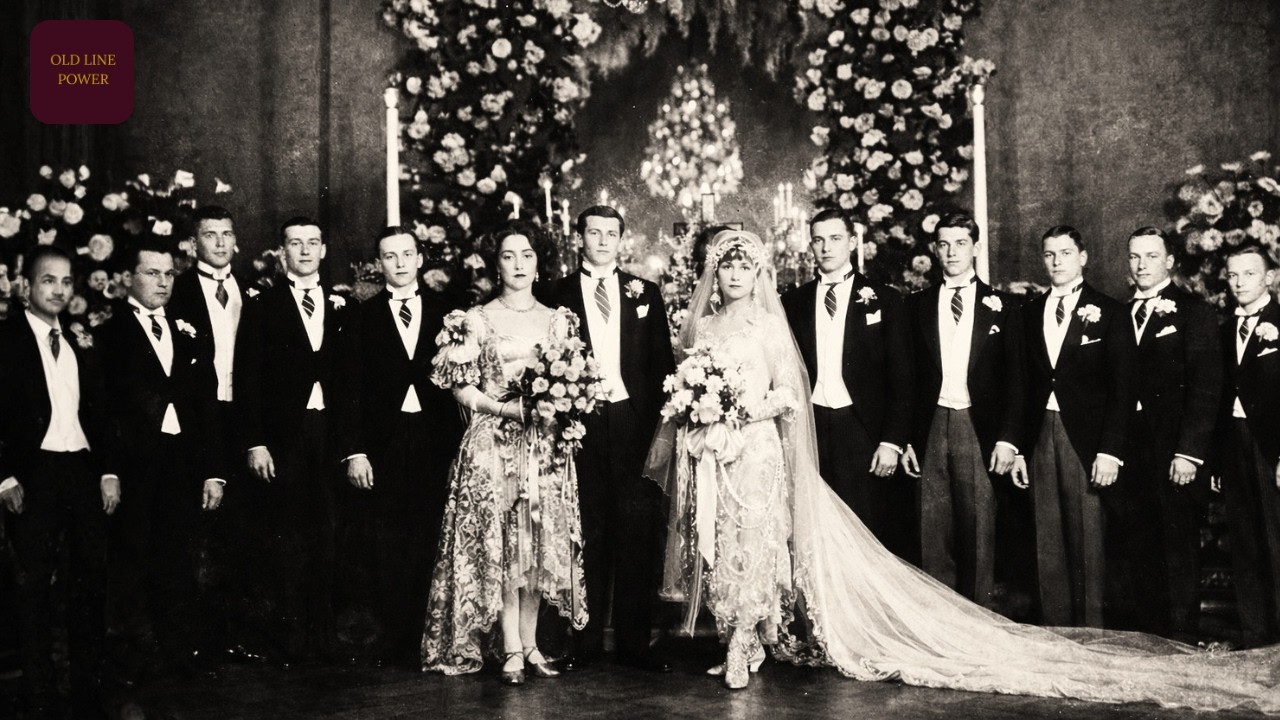
In the marriage market of the Gilded Age, Anna Gould carried the largest price tag in America. The familiar story of that era saw rich American daughters trade fortunes for European titles, only to watch the money drain away and the marriage crumble. Anna’s story did not follow that pattern. She married a man who treated her fortune like a personal bonfire, and in 11 years, he burned through the equivalent of $300 million on palaces, yachts, and parties that made front pages on two continents.
When Anna decided she had seen enough, she did not write a letter or consult a lawyer first. She emptied the house while he was at work, took the furniture, and cut the telephone line. He came home to a dark building and a set of legal papers. What happened afterward was stranger than the marriage itself.
Anna Gould was born on June 5, 1875, the daughter of Jay Gould, the railroad magnate known as the most hated man in America. He died in December 1892, leaving an estate officially valued at $77 million, with estimates from family closer to $125 million, approaching $3 billion in today’s terms. He left every cent to his children, not a dollar to charity. Anna inherited approximately $10 million, locked in trust, receiving income of roughly $500,000 a year.
She had grown up at Lyndhurst, the Gothic Revival estate overlooking the Hudson River, adored at home but shut out of New York’s high society because of her father’s reputation. After his death, she was an orphaned 17-year-old, socially isolated by her family name. Boni de Castellane arrived in New York in 1894 with excellent manners, no money, and a clear objective. He came from one of the oldest aristocratic families in France, but the family was broke.
When the time came for his parents to attend his wedding in New York, Anna’s brother George had to pay for their passage across the Atlantic. George refused to pay their return fare, prompting the old Marquis to call Americans a stingy race. Boni was 27, blond, blue-eyed, and immaculately dressed. He had fought three duels before age 25.
The expatriate social circuit had identified him as a professional charm merchant who understood that a French title could be exchanged for American capital with very little friction. He told the press he had come to America to discover the country and, as an experienced sportsman, to hunt, neglecting to specify what kind of game. His search ended in Lakewood, New Jersey, at a party hosted by George Gould. Anna was there.
She had spent two years fending off gossip columns that paired her with an actor, a society clubman, and at least one European prince. Marriage was her exit from a world that had decided her father’s sins disqualified her from belonging, and a titled marriage doubly so. Boni proposed after a handful of meetings. The wedding took place on March 4, 1895, at George Gould’s mansion on Fifth Avenue, with Archbishop Corrigan officiating.
Reporters cataloged the dress in exhaustive detail but reserved their real attention for the jewelry. Anna’s brother had given her a coronet of emeralds and diamonds valued at $40,000. Boni’s gift was a brooch holding 250 large diamonds and two enormous emeralds. Not everyone was charmed.
A reporter in Omaha wrote that the whole affair looked like a simple case of cash for a coronet, imagining Jay Gould in his coffin, skeleton hands beating against the glass at the thought of his millions falling into the hands of, as he put it, a French ninny who could not tell a bull market from a bear plunge. Two days after the ceremony, the newlyweds boarded a ship for France. They had been married less than a year when Boni rented the entire Bois de Boulogne for a party. Not a corner of it, but the entire park, roughly two and a half times the size of Central Park.
On July 2, 1896, for Anna’s 21st birthday, he staged a recreation of the fifth day of festivities from the wedding of Louis XIV and Maria Theresa of Spain. Over a thousand performers and servants worked through the night, 3,000 guests arrived by carriage, fireworks broke across a lake, and orchestras played from boats. The cost was reported at $300,000, which reaches past $9 million today. For a birthday party in a public park.
Within their first year, Boni bought a yacht called the Valhalla, a three-masted steel vessel over 230 feet long requiring a crew of roughly 100 men. The purchase price was $200,000, with refitting costing another quarter of a million. The same year, Anna fell in love with the Château du Marais, a sprawling estate built in 1770 about 30 miles southwest of Paris. Boni saw potential in it, so they bought it.
He then added the Château de Grignon in southern France. In the spring of 1896, Boni purchased 2. 5 acres on the corner of Avenue Foch and Avenue Malakoff, one of the most fashionable addresses in Paris. He hired the architect Ernest Sanson and gave him a single instruction: build a replica of the Grand Trianon at Versailles, twice the height, in pink marble.
They sourced marble from the same quarries Louis XIV had used to construct the original Versailles. When the first version of the exterior did not satisfy him, he had it refaced. When the second version still fell short, he ordered a trompe l’oeil painted over the marble to make it look more like what he had imagined. The palace took nearly seven years to complete.
Parisians called it the Palais Rose, the pink palace. When the doors finally opened around 1902, Boni filled it with Gobelin tapestries, portraits attributed to Rembrandt and Reynolds and Van Dyck, a 13th-century carpet pulled from Lisbon Cathedral, and a clock that Louis XIV had once given to the Pope. The cost of the palace alone was reported at $3 million. Within the first year of the marriage, Boni had complained he was hard up and unleashed lawyers on the trust to access the capital itself.
They succeeded. Over the course of 11 years, Boni consumed an estimated $10 million of Anna’s inheritance, landing near $300 million today. Anna’s family watched from across the Atlantic with growing alarm, and George Gould eventually had himself appointed trustee of his sister’s money by the French government. Boni kept mistresses openly, and his affairs were not discreet.
He circulated jokes about his own marriage the way other men distributed business cards. He referred to the conjugal bedroom as the expiatory chapel and described Anna as beautiful seen from the dowry side. One biographer noted that Marcel Proust, a close friend, based the aristocrat Robert de Saint-Loup in his novel on Boni. Anna endured this for a decade.
Then she stopped waiting. On January 20, 1906, while Boni was away at the Chambre des Députés, where he held a seat as a conservative royalist, Anna moved. She had planned it in advance. By the time Boni returned to Avenue Foch that evening, the Palais Rose was dark.
The furnishings had been removed. The telephone line was dead. The servants were gone. Waiting for him was a legal filing for separation.
The divorce proceedings became an international spectacle. The satirical magazine Puck published a full-page illustration depicting the case as a circus. The court granted the divorce on November 14, 1906. Anna received full custody of the three surviving children.
Boni received nothing, no settlement, no continued access to the trust, no share of the properties Anna had financed. For Boni, however, there remained a theological problem. Catholic canon law did not recognize civil divorce, and without an annulment, he could not remarry within the church. By 1908, Anna had married his own cousin, making the situation considerably more personal.
He filed his first petition for annulment around 1910, arguing the original ceremony had been defective. The case landed before the Roman Rota, the Vatican’s highest matrimonial tribunal. Anna opposed it with everything she had, hiring canon lawyers and fighting the petition through every procedural stage. If Boni succeeded, the legitimacy of her second marriage and the status of any children from it could be thrown into question.
The case consumed years. Lower tribunals sided with Boni, higher tribunals reversed them. Time magazine, reporting in 1925, noted that not since Henry VIII tried to annul his marriage with Catherine of Aragon had a matrimonial case spent so long before the courts of the Roman Catholic Church. In 1924, nine cardinals ruled.
The marriage was valid. The annulment was denied. Boni had spent 14 years fighting for a verdict that would never come. He reinvented himself as a dealer in fine objects and wrote a memoir titled The Art of Being Poor.
He died in Paris on October 20, 1932, at 65, leaving behind debts and three sons he had barely been permitted to see since the divorce. The Palais Rose was demolished in 1969 to make way for an apartment development. Anna’s family had watched her first marriage collapse while a significant portion of the Gould inheritance vanished. So when she informed them, barely two years after the divorce, that she intended to marry yet another titled Frenchman, the reaction was not subtle.
The man she had chosen was Hélie de Talleyrand-Périgord, Prince of Sagan. He was 48. Anna was 33. He carried one of the oldest titles in France, a name that traced directly back to Charles Maurice de Talleyrand, the diplomat who had navigated Napoleon’s rise and fall.
Hélie was also Boni’s first cousin. His father had been one of the most famous dandies in France, and Hélie himself had been briefly imprisoned earlier in his life over forged promissory notes. The wedding took place on July 7, 1908, in London, in a nearly empty church in Soho. One newspaper described it as the empty church where a prince and a millionairess wed.
It was the opposite of everything her first wedding had been. American accounts of the marriage describe it as quiet and dignified, a genuine partnership. The couple settled at the Château de Marais outside Paris and lived what appeared to be a comfortable, private life. But French sources tell a different story, claiming the marriage proved just as unhappy as the first, with Anna reportedly considering divorce early on but choosing to remain in order to keep the title of Duchesse de Talleyrand.
What is clear is that Anna stayed for nearly 30 years. Hélie died of a heart attack in Paris on October 25, 1937, at 78. Time magazine noted his passing briefly, identifying him primarily as the husband of the railway heiress Anna Gould. Howard de Talleyrand-Périgord was born on September 16, 1909, the first child of Anna’s second marriage.
His full name was Charles Maurice Pierre Jason Howard de Talleyrand-Périgord, stitching together the most storied diplomatic dynasty in France with the name of a boy from a dairy farm in the Catskills. Almost nothing survives about his childhood. He held the courtesy title of Duke of Sagan after his father renounced it in his favor. In the spring of 1929, he was 19.
He had met a young woman and wanted to marry her. His parents refused their permission, not objecting to the girl herself but insisting he was too young. On May 17, 1929, Howard shot himself in his parents’ home in Paris. He did not die immediately.
He was taken to a hospital and held on for 11 days. When reporters arrived, Anna released a statement acknowledging that her son had harmed himself after being denied permission to marry, stressing that their objection was solely to his age, not to the young woman involved. Howard died on May 28, 1929. He was 19 years old.
The New York Times ran the story on its front page. In the spring of 1939, Anna Gould boarded a ship and crossed the Atlantic in the opposite direction from the one she had taken 44 years earlier. She was 63. She had left New York as a 19-year-old bride with a French title and a fortune.
She returned as a widow, a duchess, and a woman who had outlived almost every version of herself the newspapers had tried to pin down. Her sister Helen, who had managed Lyndhurst for decades, had died the year before. The estate had passed to Anna. The grounds that once stretched across more than 500 acres had been reduced to 67.
The mansion itself was unchanged, with more than 50 pieces of the original furniture still sitting where the architect had placed them. Anna moved in and, like her father before her, made no alterations to the exterior. She continued her father’s other legacy. Jay had filled the greenhouse with orchids.
Anna expanded the collection until, by the mid-1940s, it held over 5,000 plants maintained by nine gardeners. In 1945, she auctioned everything for the benefit of the Red Cross. During the war, she opened the bowling alley her sister had built and turned it into a recreation space for wounded soldiers and returning sailors. Anna divided her later years between Lyndhurst and the Plaza Hotel in Manhattan.
She did not entertain on any grand scale. She died on November 30, 1961, in Paris. She was 86. She was laid to rest beside her second husband at Passy Cemetery in the same ground where her son Howard had been buried 32 years before.
Before her death, she arranged for Lyndhurst to be donated to the National Trust for Historic Preservation. She said she had loved the estate, as had her sister, and that the days of her childhood spent there were among the happiest of her long life. Jay had been called the most hated man in America. His daughter gave his home to the country.
The property is open to the public today.