You know the photograph. The Silver Jubilee of 1935. The balcony of Buckingham Palace. Queen Mary standing beside the King.
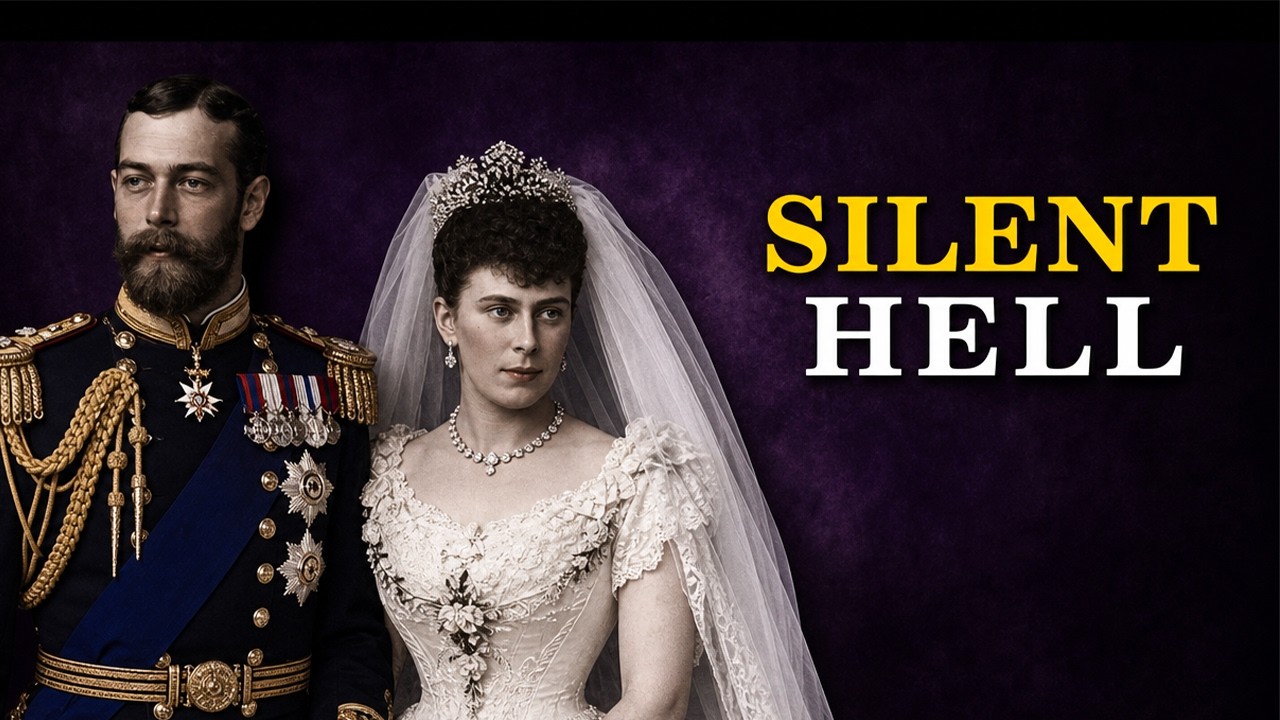
The marriage that Britain still describes as model. She was not chosen for it. She had been engaged to his older brother, and inherited the position six weeks after his funeral. For 42 years, the couple could express their feelings only on paper, apologizing to each other in writing for their shyness.
For 33 years, she was barred from the main house at Sandringham. She outlived him by seventeen years, and decided what documents could be published. The story begins in that house in January 1892. Sandringham in January was simply a shooting lodge out of control, a vast red-brick building in Norfolk where Queen Victoria’s eldest son set his clocks half an hour early so no one would be late for the pheasants.
That winter, an influenza epidemic swept England and crept inside the house. Prince Albert Victor, Duke of Clarence and Avondale, second in line to the throne, took to his bed with the illness days after his twenty-eighth birthday. It developed into pneumonia. He died on January 14.
His fiancée was in the house. Princess Victoria, Mary of Teck, or “May” as those close to her called her, had been engaged to him for six weeks. The wedding date had been set for late February, and work had already begun on her trousseau. When they buried him at Windsor, she placed her orange-blossom wedding wreath on the coffin.
What happened next explains the rest of her life. The family grieved, the country grieved, elegies were written, and black crepe hung from shop fronts. Within months, quietly, the same people who had chosen her for the dead brother began steering her toward the living one. This is not rumor — it is the clear shape of the historical record.
Queen Victoria spent two years examining Europe’s princesses, searching for a bride capable of strengthening a young man whose family had secretly lost hope in him. She found “May. ” She approved “May. ” “May” passed the test.
When the position’s occupant changed, the qualifications did not expire. So who was this woman the monarchy could treat as a transferable piece? Born at Kensington Palace in May 1867, she got her nickname from the month. Her mother, Princess Mary Adelaide of Cambridge, a granddaughter of George III and a cousin of Queen Victoria, was enormous, famous for it, adored by the London crowds who turned out to see her, and utterly incapable of living within any sum of money given to her.
Her father was Francis, Duke of Teck, and that was the part that shaped everything. Their marriage was a mésalliance. Her mother was a Hungarian countess, and in the calculations of Europe’s royal families, that made him and his children not quite royal. The practical impact was humiliating and constant: German courts considered the Tecks too un-royal to marry into, and the British aristocracy considered them too royal to marry at all.
May grew up in a palace apartment in a family with status and no money. She watched her father lose his temper over protocol and her mother ask for things they could not pay for. In 1883, the finances caught up with them. The debts reached the point where the family left the country — not for a trip, but to escape their creditors.
They went to Florence. May was sixteen. They stayed abroad for nearly two years. Most accounts treat that exile as an awkward footnote, but it was arguably the most important thing that ever happened to her.
In Florence, she went to galleries again and again and began doing what she would do for the next seventy years: identifying pieces, tracing their provenance, learning what was original and what was fake. A teenager whose family had been driven out of England by tradesmen’s bills taught herself the one form of wealth that does not evaporate in a bank panic: knowing exactly what a thing is and who owned it before you. She also learned the other lesson, the one no one wrote down but everyone could see. In her family, feelings were expensive.
Her mother’s warmth was vast and public, and it had cost them a home. May returned from Italy composed, disciplined, and very hard to read. Contemporaries called her “shy. ” It was closer to armored.
Then, in 1891, Queen Victoria went looking for a wife for her grandson. Prince Eddy was a problem. Charming and kind, he could not be made to concentrate by his tutors. The family’s solution was a wife who could compensate.
Victoria decided, against much German advice, that the Teck girl from the mésalliance had more character than any princess on her list. She summoned May to Balmoral, observed her, gave her approval. The courtship, such as it was, took place under supervision at a house party in Bedfordshire in December. Eddy proposed.
May accepted. Britain was pleased. There are warning signs. The summer before the proposal, Eddy had been infatuated with Princess Hélène d’Orléans, and they went together to Victoria about it.
The obstacle was religion — Hélène was Catholic, and the throne was not open to a man who married one. That relationship collapsed around the same period, according to his surviving letters. He was also writing to Lady Sybil Sinclair Erskine in non-brotherly terms. Then, that December, he proposed to May.
No one has produced evidence that May was in love with him, nor that she objected. She was twenty-four, her family’s finances were a joke in London society, and she had just been handed the future of the British monarchy. She said yes for reasons any adult can infer. Six weeks later, she was standing at Sandringham with a wreath she would never wear.
What she did in the following year is where her real character begins to show. She traveled abroad with her parents to the south of France to recover, wrote to Queen Victoria, maintained her place in the family instead of drifting away, and was helped by the one man who had the strongest possible reason to pursue her. Prince George had lost his brother and, with him, his status as the spare heir. Now he was the heir: a naval officer of twenty-six, pulled from his ships and given a dukedom and a destiny he had never expected and did not particularly want.
They grieved together. That part was real. Two reserved, unemotional people who had both lost the same person spent a year in each other’s company, mourning in a way they could not mourn with anyone else. But no one in that family left anything to chance.
Victoria wanted this marriage. Alexandra, Eddy’s mother, was possessive of George in ways that worried those around her and had her own opinions. And there was the matter of George’s other option. He was fond of his cousin, Princess Mary of Edinburgh, and by surviving accounts her mother steered her away from him, toward Romania instead.
By 1893, the path was cleared from both sides. George proposed on May 3 in the garden of Sheen Lodge in Richmond, at the home of his sister Louise. She accepted. Here is the detail the official narrative could not use, because the woman who recorded it made sure no one read it for fifty years.
When James Pope-Hennessy was researching his authorized biography of the Queen in the late 1950s, one of her old ladies-in-waiting, Margaret Wyndham, told him that May had confided something. Before everything — before Eddy, before the Duke of York — she had been in love with a man named Arthur Grenfell, later Viscount Hood. It was mutual, according to Wyndham, and May knew she could never marry him and would not have thought it right to try. It is one woman’s memory, told decades later, so it belongs in the questionable-information category.
But Pope-Hennessy placed a fifty-year embargo on his notes, and that line stayed sealed until 2018. Someone thought it mattered. So she entered that marriage knowing exactly what she was trading, which is entirely different from entering it blindly. They married on July 6, 1893, in the Chapel Royal at St.
James’s Palace. It was hot. The crowds along the route were huge and genuinely enthusiastic. She was very popular — the country had watched her lose one prince and decided to love her for it.
Victoria was present. Half of Europe’s royals were there. The bride wore silver and white with quantities of Irish lace, and the press coverage made the wedding look like a national reconciliation. But look at that day from the other side.
She chose neither the church, the date, the guest list, the dress code, nor even the groom. Every element had been arranged by a family that had already demonstrated it regarded her more as furniture than as a person. The wedding was not the start of her own life; it was public ratification of a decision others had made about her twice. There was also something else circulating that summer, in cheap republican papers: a story claiming the groom was already married to another woman, an admiral’s daughter in Malta, and that the whole affair was a hoax.
It was a lie. It took eighteen years, a criminal trial, and the parish marriage records of an entire island to kill that rumor. It was also, as far as anyone knows, the only false thing ever said about that marriage. The house they were given was a wedding gift from the groom’s father, and it tells you more about the next three decades than any letter.
York Cottage stood a few hundred yards from Sandringham House at the edge of the pond, previously used as overflow accommodation for bachelor guests. It was small, its rooms dark, the nurseries directly under the roof. There was no proper space for a woman who had spent her adolescence learning the difference between original and reproduction Chippendale, and her opinion had not been sought. George furnished the place before the wedding via Maples of Tottenham Court Road, and Maples supplied what Maples supplied.
Harold Nicolson, walking through decades later while writing the official biography of the King, could not get over its horror; he described it as a villa for servants. The furniture was still in place. She lived in that cottage, on and off, for 33 years. Six of her children were born there.
She lived in it as Duchess of York, then Princess of Wales, then Queen of the United Kingdom and Empress of India, because the big house was not available. Her mother-in-law occupied it. Queen Alexandra was beautiful, hard of hearing, generous, beloved, and not one to give up her property. When Edward VII died in 1910 and George became King, the widow simply stayed at Sandringham House.
She stayed for another fifteen years. The reigning Queen of England had to walk past her main country residence to reach a cottage with a cramped dining room, because the previous occupant had not left and no one dared force her out. Alexandra had an ally in this. Her unmarried daughter, Princess Victoria — known as “Toria” — lived with her and, by every account we have, disliked May and made it audible.
The most repeated phrase is that she called her sister-in-law “the German governess. ” It comes through recollections gathered long afterward, so take it as court memory rather than documented text. What is beyond dispute is the telephone. Toria called her brother almost every morning throughout his adult life, and the King took the call.
That was how the family system worked: his mother owned the house, his sister owned the morning, his father had chosen the furniture, and the woman he married had a sitting room roughly the size of a first-class railway compartment. Now the part that makes this stranger. In their own, different way, they were devoted to each other. This is what people misunderstand when they hear the word “arranged.
” George never took a mistress. Not in a family that produced Edward VII, and not in a century that treated that as routine behavior for any prince. No one has produced credible evidence to the contrary. He wanted her beside him and was visibly anxious when she was not.
They simply could not say it out loud. Their letters are extraordinary, and not for the reasons you might expect. There is no passion. There is something more unsettling: two married adults, sleeping in the same house, writing to each other about the fact that they cannot talk to each other.
He apologizes for being shy with her. She apologizes for being shy with him. Each explains in ink that the feeling is real and the tongue cannot deliver it. He told her his affection was there even when he could not show it.
She told him she was afraid he would think her cold. They kept this up for forty years. Read a hundred pages of that correspondence and you understand the story. The hell was not a mistress, nor cruelty in the usual sense.
It was two people locked inside a shared silence in a house they did not control, conducting a national marriage they could only manage properly by post. When they were not writing, they had another routine of language. Sandringham in January, London in spring, the cows in August, Balmoral in autumn, back to Norfolk for the shooting. He shot, worked on his stamp albums, and built one of the world’s great collections, seriously.
She did the cataloguing. Nicolson, in a private letter, compressed seventeen years of it into “killing animals and sticking in stamps. ” He did not put that in the book. The children came quickly: David in 1894, Bertie in 1895, Mary in 1897, Harry in 1900, George in 1902, and John in 1905.
The nursery is where sympathy becomes complicated, because both parents look bad and the evidence is unbalanced. The story that has hardened into fact is this. The first nanny was unstable, favored David to the point of madness, and pinched him just before presenting him to his parents so that he would cry and be returned to her immediately. The same woman is said to have neglected Bertie severely while feeding him, causing the stomach problems that plagued him for life.
She was finally dismissed after about three years, when the assistant nanny, Charlotte “Lalla” Bill, who stayed with the family for decades, spoke up. To be honest about its source, this comes through Lalla Bill’s memories and through the Duke of Windsor’s memoirs published half a century later by a man with strong opinions about his upbringing. It is not a contemporary document. Nearly all serious biographers believe it, because the parental side of the story is confirmed.
For three years, the Duke and Duchess of York did not notice that the woman in the attic was hurting their children. She was not an absent mother in the sense of being elsewhere. She was in the small house, sitting with them, reading to them, teaching them history and how to look at things. But she made an early decision and never wavered: her husband came first — before the children, before herself, before anything.
She stated this to Mabell, Countess of Airlie, her lady-in-waiting and closest friend, who published it in her memoirs in 1962. That book is full of affection and protectiveness, and it is the closest thing we have to hearing May justify her position. Her husband at the head of the table tended to shout. He bullied the boys about their clothes, their build, their handwriting.
In that room, Bertie’s stammer began. When George lost his temper — and he lost it often — she did not intervene. This leads to the most quoted sentence ever written about George V. He is said to have declared that his father had been frightened of his mother, he had been frightened of his father, and he was damn well going to make sure his children were frightened of him.
It is a perfect sentence. It is also almost certainly untrue. It first appeared in print in 1959, in a book by Randolph Churchill, relayed from a secondary source decades after the King’s death. Kenneth Rose, who wrote the great modern biography with access to the archives, treated it with explicit skepticism.
The most famous line about the private life of this marriage is merely a rumor that entered the record after everyone involved was dead. That matters not to acquit the man, but because the invented quote is kinder than the documented facts. Nobody needed to invent anything. The evidence is in the house arrangements, in the stammer, and in the eldest son who spent his whole life trying to escape that shadow.
Meanwhile, the fictional story that actually reached a courtroom was about none of this. In November 1910, a few months after George took the throne, a small republican paper printed in Paris and smuggled into England published an article titled “The Sanctity of Wedlock. ” It was written by a man named Edward Mylius. It claimed that George, as a young naval officer, had secretly married Admiral Sir Michael Culme-Seymour’s daughter in Malta, had children with her, and abandoned her — making his 1893 marriage bigamy and the Church of England the blesser of a crime.
The rumor was already twenty years old, having circulated since the engagement itself. Kings do not sue, because suing repeats the lie. This King sued. Mylius was arrested that December.
The trial lasted a single day, February 1, 1911, in the King’s Bench before the Lord Chief Justice of England. The Attorney General prosecuted. The Admiral testified. His daughter, then married to a naval captain, gave evidence that she had met the King once at a dance and had never met him in Malta.
Her sister had died unmarried. The Crown’s lawyer in Malta brought to London the island’s marriage records for every year from 1886 through the summer of 1893, and they were presented publicly in court. The defendant called no witnesses. He was convicted before the day was out and sentenced to twelve months in prison.
The King did not appear. Whether the sovereign could be compelled to appear as a witness in his own courts remains a matter legal historians still debate. He wrote in his diary that the story was a damned lie and he hoped that was the end of it. It was the end, but it left a strange residue.
The monarchy had now proven in the public record — with records and sworn testimony — that this marriage was exactly what it appeared to be. The private truth, the cottage, the silence, the stammering boy at the head of the table, none of that appeared in evidence and never would. The trial made the myth a legally supported fact. Then, a few months later, the couple sailed to India for the greatest display either of them ever had a share in: the Delhi Durbar of December 1911.
A hundred thousand people on the plain, the couple in new crowns beneath a golden dome, receiving the homage of India’s princes. She was magnificent at it. She always was. Public duty was the only place where the armor she had built in Florence became an advantage rather than a barrier.
They returned to the cottage, and to the youngest child, who had begun having seizures and was about to disappear. Prince John was four when his first seizure came in 1909. By 1917, his epilepsy had worsened to the point the household could not cope, and he was moved permanently to Wood Farm, a simple country house at the other end of the Sandringham estate, with Lalla and a small staff. His tutors were dismissed.
His education stopped. His mother arranged for local children to come and play with him. You can read that two ways, and the honest answer is that both are true. It was the prevailing medical advice of the time, and it was also an erasure.
The youngest son of the King of England was kept far from photographers’ eyes. His mother’s diary from the time of the move records the thing that broke her spirit: a huge, strong boy with the mind of a little child, and it made her unhappy. He died at Wood Farm on January 18, 1919, after a seizure in his sleep. He was thirteen.
What she wrote that day is the most quoted thing she ever wrote, and people use it to condemn her. “The shock was great,” she wrote, “although the death came as a great relief to that poor suffering little boy’s troubled soul. ” She told George. They traveled there together.
She found Lalla resigned and heartbroken. The next day she wrote to her friend Lady Mary Trefusis, saying the same thing — that it was a relief, because the illness was getting worse and he had been spared suffering. Judge if you like, but understand what you are looking at. That is not a woman without feelings.
That is a woman trained since Florence to turn anything painful into something manageable and recorded, and she was now doing it about her own child, in her own hand, at the end of a war in which she had spent four years visiting hospitals full of other people’s sons. She did not take off her emotional armor for this. She never took it off for anything. The public received a two-line announcement and learned for the first time that the boy had even been ill.
Here the story turns, quietly, over fifteen years of objects. She had never had a home of her own. She had had no authority over even a curtain. So she acquired the one territory no one in that family wanted, and conquered it completely: the Royal Collection itself.
She went through the palaces room by room. She read the old inventories. She tracked down royal property that had been donated, sold, or leaked into private hands through a century of Hanoverian housekeeping neglect, and recovered it by purchase, exchange, or requests that were famously difficult to refuse. She catalogued and labeled things.
She wrote ownership records on the backs of miniature paintings. She knew what belonged to whom and when. There is a circulating story that hosts learned to hide their best pieces before her visits because her sustained royal admiration functioned as a covert request. It is repeated everywhere and is merely anecdote, not evidence.
What is documented is the scale of what she recovered, and the fact that the modern Royal Collection is organized on the system she devised. She also crafted her own image. Look at her photographs from 1913 and 1950: she wears almost exactly the same look — small hat, long skirt, umbrella, pearls. Fashion changed twice in that period, and she refused to move with it.
It was deliberate. A monarchy that had just watched its counterparts fall in Russia and Germany needed to look immovable. She made herself a visual proof: a woman who did not change, standing beside a king who did not change, in a country that was changing violently. In 1924, she commissioned Edwin Lutyens to build a doll’s house with working plumbing and a library of miniature books written by contemporary authors, and put it on public display.
People treated it as a charming whim. It was also the first home she had ever furnished entirely to her own taste, at a scale she could control, for two million paying visitors. Alexandra died in November 1925. In 1926, after 33 years, the Queen moved into Sandringham House.
She was fifty-eight. The last decade of her life gave her what the marriage could never say. George nearly died in 1928 of blood poisoning. She nursed him through months of illness and convalescence at Bognor.
His temper softened with everyone except his eldest son. In May 1935, at the Silver Jubilee, the crowds came out in numbers that genuinely astonished him. He had spent his life assuming people tolerated rather than loved him, and afterward he said he had begun to think they must really love him for himself. That is the balcony.
That is the photograph. Him, bewildered by the flood of affection. Her beside him, upright, unchanged, the symbol of a stable marriage eight months before its end. He died at Sandringham on January 20, 1936.
For fifty years, the country believed he had passed peacefully while the family kept vigil, under a statement that entered history: “The King’s life is moving peacefully to its close. ” Lord Dawson of Penn wrote that sentence himself on a menu card beside the bed. In 1986, historian Francis Watson published what Dawson’s private diary contained. Dawson had hastened the end with an injection, and gave his reason: he wanted the death announced in the morning papers, in The Times, rather than the evening press, which he considered unseemly.
His wife phoned London to stop the presses. The diary recorded that the family made clear it did not want the King’s life prolonged. That is this marriage in its final moments: 42 years of silence, and the last chapter a piece of timing decided for the sake of the right newspaper. Eleven months later, her eldest son abdicated the throne to marry Wallis Simpson.
She never accepted it. In a letter she wrote to him in the summer of 1938, she told him plainly that he had preferred a woman to his country, and that it was a blow she had never gotten over. She refused to receive his wife at all. In May 1937, she did something no queen dowager had ever done in British history: she attended her second son’s coronation and sat in Westminster Abbey in full view, publicly affirming that the throne was untarnished.
She had never been given authority over her home, her furniture, her children’s custody, or even her own words. She had complete authority over only that. She lived seventeen years after her husband’s death, and in those years she performed her final work. Harold Nicolson wrote the official biography of George V, published in 1952 under family supervision, while privately calling the task impossible.
He was writing about a man he found boring, for a family that would not allow anything scandalous. The book was a memorial statement and also carefully sanitized. After her death, James Pope-Hennessy was commissioned to write her biography. He traveled around Europe interviewing everyone still alive who had known her, and recorded everything — the resentments, the absurdities, the secrets.
His 1959 biography was admiring and discreet. His raw notes were sealed for fifty years. They came to light in 2018. There appears the man she loved before any of it happened.
There, the household finally speaks in its own voice. She died on March 24, 1953, ten weeks before her granddaughter’s coronation. She made it explicit that mourning for her must not delay the coronation. The abbey service went ahead on schedule.
She had timed that too. Now look at the balcony photograph again. The woman standing beside the King is not merely a consort playing a decorative, faithful role. She is the only person in the frame who chose to be there.
Everything else in her life had been imposed on her: the first fiancé, the second fiancé, the cottage, the furniture, the seat beneath her mother-in-law’s seat, the son at Wood Farm, the silence. That posture was the only thing she made herself, and she wore it for forty years until the country believed it was her nature. The marriage was not a love story and it was never a fraud. It was a treaty between two people who could not speak, and both kept it to the letter.
She could only tell her husband she loved him with a pen in her hand. So she spent her final seventeen years deciding what others would be allowed to say about him.