The American Civil War is often remembered through images of massive infantry lines and roaring cannon fire, but the conflict could not have been fought without millions of animals. Historians estimate that more than one million horses and mules served during the war, making animal power nearly as central to the conflict as the soldiers themselves. With no tanks, trucks, or helicopters in the 1860s, armies relied entirely on horses once they moved away from vulnerable rail lines. Artillery pieces weighing over a ton required teams of horses to pull them, supply wagons carrying food and ammunition rolled behind marching columns, and ambulances used horses to evacuate the wounded.
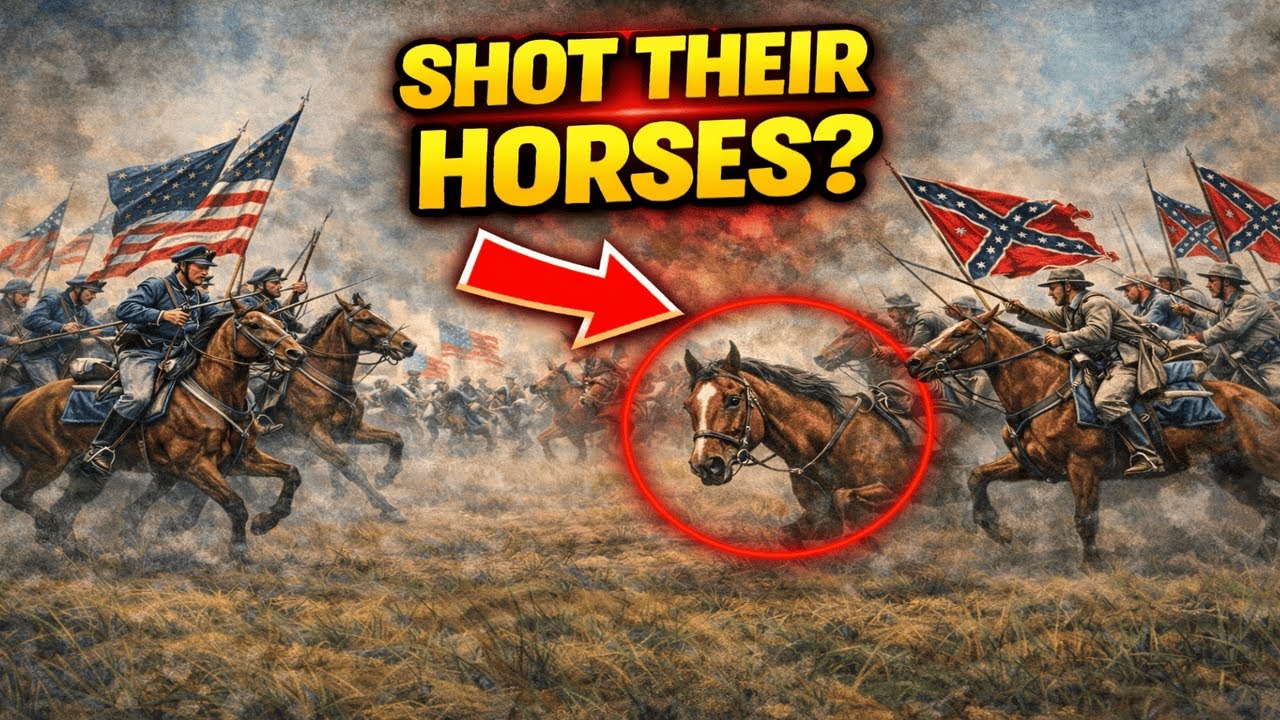
Cavalry forces, the fast-moving strike arm of both armies, depended completely on horseback mobility. Cavalry soldiers served as the eyes and ears of their armies, scouting miles ahead to locate enemy forces, carrying messages across territory where telegraphs could not reach, and charging directly into battle when the moment came. A cavalry charge was one of the most dramatic sights of the war, with hundreds of riders forming tight lines, sabers raised, and hooves pounding the ground as the formation surged forward. But these charges were incredibly dangerous for the horses.
A Civil War battlefield was one of the loudest places imaginable, with rifles cracking, cannons firing explosive shells, and wounded men crying out. Horses, though powerful, are easily frightened by loud noises, sudden movement, and the smell of blood. Many had been trained for months to endure these conditions, but training only went so far. Sometimes a horse would bolt, sometimes it would rear violently and throw its rider, and sometimes it would be hit.
Infantry soldiers quickly discovered that horses made much easier targets than riders. A man on foot presented a small target, but a horse and rider together were enormous. If the horse was shot, the rider was finished, either crushed beneath the animal’s weight or stranded on foot in the middle of a battlefield designed for mounted combat. Many soldiers deliberately aimed low when cavalry charged.
The results were devastating. At battles like Gettysburg, Antietam, and Brandy Station, entire fields were littered with horse bodies after the fighting ended. Some animals died instantly, but many were left horribly wounded. One sound appeared again and again in soldiers’ diaries and letters home: the screams of injured horses.
Veterans wrote that a wounded horse did not cry out quietly but screamed in a high pitch that some said was worse than the cries of wounded men, because the animals did not understand what was happening. Horses were incredibly valuable, and soldiers did everything they could to save those with minor injuries. Field farriers, blacksmiths who specialized in horseshoes, often treated wounded animals, and a horse with enough rest might return to service weeks later. But serious injuries, a shattered leg, a bullet through the chest, or a cannon fragment tearing through muscle, could not be treated on a battlefield.
A horse weighing nearly half a ton with broken legs could not move and became extremely dangerous, kicking wildly and injuring nearby soldiers or causing riders behind it to crash and pile up in chaos. Sometimes a wounded horse trapped its own rider beneath the saddle, leaving the soldier pinned under a dying animal while bullets flew overhead. Some were crushed, some suffocated, while others managed to crawl free but still faced the suffering animal that had just saved their life. A mortally wounded horse could suffer for hours, sometimes an entire day.
The army could not stop to care for every injured animal, and there were no veterinary hospitals capable of treating large numbers of wounded horses. So soldiers often carried pistols for a grim but necessary task: ending the animal’s suffering quickly with one shot, usually to the head. It was considered an act of mercy, but not an easy one. Many cavalrymen refused to let anyone else shoot their horse, believing the responsibility belonged to them.
Some removed the saddle first, some stroked the animal’s neck, and a few spoke to their horses in quiet voices before pulling the trigger. For soldiers who spent months or years riding the same animal, the bond became incredibly strong. A steady horse could remain calm under gunfire, a fast horse could outrun danger, and a loyal horse might carry its wounded rider away from battle. Soldiers named their horses, brushed them, fed them, and talked to them during lonely night watches.
One Union cavalryman described his horse as the best companion a man could have in this terrible war, while another wrote that his horse understood him better than most people did. When battles ended, the scale of devastation became clear. Soldiers walked across fields covered with bodies, broken cannons, burned wagons, and sometimes thousands of dead horses. Animals swelled quickly in summer heat, and the smell carried for miles.
Burial crews worked for days digging trenches to dispose of the carcasses, but not every horse had died. Some were still alive hours later, too badly wounded to move, still breathing, still suffering. Someone had to walk the field with a pistol and finish what the battle had started. Another battle was happening at the same time as the infantry exchanges, fought by the animals.
Every cannon required a team of horses, usually six, sometimes eight, to move it. These animals dragged artillery pieces weighing thousands of pounds along with heavy caissons filled with ammunition. When a battle began, drivers shouted commands and cracked whips as horses leaned into their harnesses and surged forward across uneven ground. But once the cannons opened fire, the horses had nowhere to hide.
They stood in long lines just behind the artillery crews, perfect targets. Gunners on both sides knew exactly where to aim to disable an enemy battery: not at the cannon, but at the horses pulling it. During artillery duels, cannonballs often tore through teams of horses before reaching the guns. A single solid shot could rip through multiple animals at once.
The surviving horses panicked instantly, rearing and kicking in their harnesses, while wounded animals collapsed beneath the weight of the artillery equipment. Sometimes the entire team went down together, tipping the cannon sideways. Drivers scrambled to cut the harness straps before the terrified animals strangled themselves trying to escape, but often there wasn’t time. More shells screamed through the air, and men had to abandon the dying horses to keep the guns firing.
With six powerful horses chained together by leather straps and metal fittings, the collapse of one threw the entire team into chaos. Panicked horses kicked wildly, sometimes breaking their own legs against the artillery carriage. If the horses couldn’t be freed quickly, the entire team might be shot by enemy infantry before they could move again. A wounded horse tangled in artillery harnesses could trap the entire battery, and on a battlefield seconds mattered.
Sometimes the only way to free the others was to kill the injured animal immediately. Nowhere did horses suffer more than during cavalry battles, and the largest of these was Brandy Station on June 9, 1863. Union cavalry under General Alfred Pleasonton crossed the Rappahannock River at dawn, hoping to surprise Confederate cavalry commanded by General J. E.
B. Stuart. What followed became the largest cavalry battle ever fought on American soil, with nearly 20,000 mounted soldiers clashing across open farmland. Lines of riders thundered toward each other, sabers flashed in sunlight, pistols cracked, and horses slammed together in violent collisions.
When cavalry units collided, the fighting was chaotic and close. Bullets flew in every direction, and the horses, being enormous targets, took the worst of it. Many went down instantly, while others staggered forward with wounds that would soon prove fatal. When a horse fell during a charge, it often created a chain reaction, with riders behind slamming into the fallen animal and tumbling from their saddles.
Within seconds, the ground could become a tangled mass of men, horses, and weapons. By the time the battle ended, hundreds of horses lay scattered across the fields. Surviving cavalrymen moved slowly through the wreckage, searching for wounded comrades and for their own horses, many of which they had fought with for years. They faced the same terrible decisions seen across every Civil War battlefield.
In modern wars, wounded animals might be transported to veterinary hospitals, but that was impossible during the Civil War. Armies were constantly moving, supply wagons were already overloaded, and transporting a half-ton animal across rough terrain was nearly impossible. Few trained veterinarians served with the armies, and most soldiers knew only basic methods of treating injuries. When a horse suffered catastrophic injuries such as shattered bones or massive internal bleeding, there was nothing anyone could do.
Leaving the animal alive meant condemning it to hours or days of suffering. For the Confederate Army, the loss of horses created an even greater crisis. The South had far fewer resources than the Union. Northern factories produced large quantities of equipment and supplies, and the Union Army could purchase horses from across the country and ship them by rail to the front lines.
The Confederacy did not have that luxury. As the war dragged on, good horses became incredibly difficult for Southern armies to replace. Confederate cavalry often rode animals that were exhausted, underfed, and worn down by constant campaigning, sometimes riding the same horse until it collapsed from fatigue. When a horse was mortally wounded, Confederate soldiers sometimes faced another painful decision.
If they could not take the horse with them, they could not leave it behind, because the enemy might capture it and put it into service within days. In desperate situations, soldiers killed their own horses to prevent them from being taken. Despite the terrible losses, many horses performed acts of incredible loyalty. Some carried wounded soldiers miles back to safety after battles, while others continued running even after being hit by bullets.
One Confederate cavalryman wrote about his horse carrying him away from a battlefield after he had been shot in the leg, running nearly two miles before finally collapsing from its own wounds. The soldier survived; the horse did not. Historians estimate that the Civil War consumed horses at an astonishing rate. Some cavalry units lost nearly half their horses during major campaigns.
Artillery teams were constantly replaced as animals died from wounds, exhaustion, or disease. By the final years of the war, the Union Army was purchasing thousands of new horses every month just to keep its forces moving. The Confederacy simply could not keep up, and in many Southern units soldiers rode animals barely strong enough to carry them. At Gettysburg, Robert E.
Lee launched one of the most famous assaults in American history, Pickett’s Charge, with nearly 13,000 Confederate soldiers advancing across open ground toward the Union line. Behind the advancing infantry stood Confederate artillery, and behind the artillery waited thousands of horses harnessed to cannons and supply wagons. Union artillery responded with devastating fire, and some shells that overshot their targets landed among the waiting horse teams. Drivers tried desperately to control the panicking animals, but several broke loose entirely, galloping wildly across the battlefield.
Others were killed instantly by exploding shells. Even far behind the front line, the horses were not safe. When the fighting finally ended on July 3, 1863, Gettysburg had become one of the most devastating battlefields of the entire war. More than 50,000 soldiers were killed, wounded, or missing, but the human casualties were only part of the story.
Thousands of horses also lay dead across the countryside. Farmers who returned to their land described fields filled with bloated animal carcasses, with some areas so thick with dead horses that wagons could barely pass. Union burial crews spent weeks digging enormous pits and pushing the animals inside before covering them with dirt, but many were simply left where they fell. Years later, farmers still uncovered horse bones while plowing their fields.
When soldiers returned home after the war, many spoke about battles, marches, hunger, and fear, but in letters and memoirs written years later, another memory often surfaced: their horses. Cavalrymen had depended entirely on a living creature beneath them, a horse that carried them into battle, carried them away from danger, and sometimes saved their life. When that animal died, or when the soldier had to end its life himself, the emotional impact lingered. Some veterans said they remembered their horses more clearly than the battles themselves.
Historians calculating the cost of the Civil War usually focus on human losses, with more than 600,000 soldiers dead. But the number of animal casualties was even greater, with historians estimating that over one million horses and mules died during the conflict.