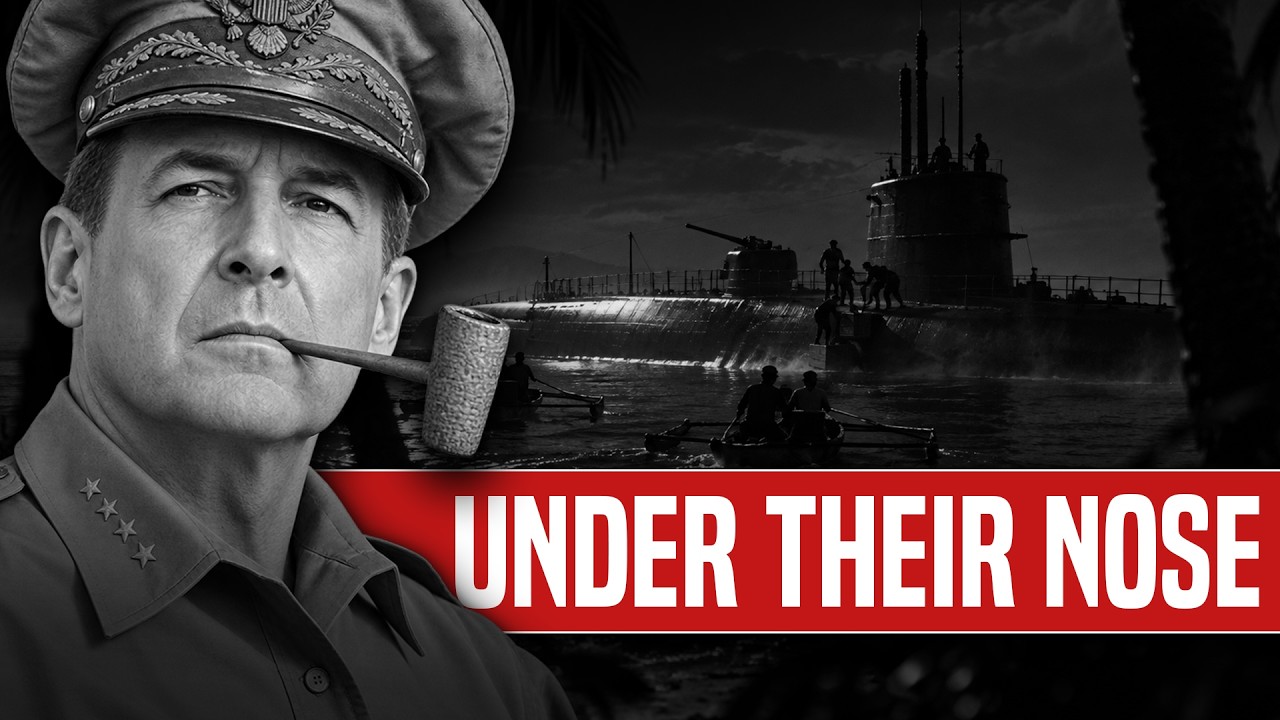
On October 23, 1943, the submarine Narwhal departed from Cape Morton in Queensland carrying 92 tons of ammunition, stores, and ten passengers. The orders came from the headquarters of General Douglas MacArthur, and the destination was the Philippines. Months before any American army could be sent ashore, MacArthur was quietly using submarines to deliver supplies to the Filipino guerrilla forces fighting the Japanese occupation. The fullest record of these secret missions is a memorandum from the Seventh Fleet’s intelligence center, now filed at the National Archives.
It lists every submarine run to the guerrillas, mission by mission, with the boat, the tonnage, the passengers, and whatever went wrong. The entries begin in January 1943 and extend just beyond October 20, 1944, when American troops finally went ashore at Leyte Gulf. The first entry is from 21 months before the landing. The submarine Gudgeon sailed from Australia with orders to put a radio party onto the south coast of Mindanao and carry ammunition and medicine to Panay.
The plan changed at sea. On January 14, 1943, she landed six men and about a ton of equipment on Negros instead, and the memo notes that no ammunition and no medicine reached the shore. The party belonged to Captain Jesus Villamor, a Filipino fighter pilot MacArthur had already decorated. His job was to find out who was really fighting in the islands and how to get supplies to them.
By the end of January, Villamor had a working radio link to Australia. Even this first date is not certain. The Army’s history of special operations in the Pacific places his landing in December 1942, while MacArthur’s reports have him leaving Australia on December 27. About 19 months out, the submarine Tambor left Fremantle.
Her orders were short: deliver $10,000, about two tons of supplies, and a party under Lieutenant Commander Charles Parsons to a point at Labangan in Pagadian Bay on Mindanao. She arrived on March 5, 1943. MacArthur’s reports add that the party carried cipher material so the guerrillas could communicate with Australia in a code the Japanese could not break. Parsons was a Navy reserve officer who had run a stevedoring company in Manila before the war.
When the Japanese took the city, he stayed out of the internment camp on the strength of his post as Panama’s honorary consul, and he got his family out on a diplomatic exchange ship in 1942. On Mindanao, he met Wendell Fertig, an American mining engineer who had refused to surrender and had become the accepted guerrilla commander on the island. Parsons carried MacArthur’s terms with him: organize, report, and stay out of open fights until the time comes. Afterward, he wrote to President Quezon in exile that the effect on the guerrillas had been miraculous.
After that mission, the loads grew, one boat at a time and about two tons at a time. The Army’s history lists what went into the crates: carbines, ammunition, radios, and medical supplies. Then there was a second category it calls “propaganda items”—chocolate, cigarettes, chewing gum, pencils, and newspapers, each one printed with MacArthur’s pledge from 1942: “I shall return. ” On a later run, according to an account built from Parsons’ own reports, the cargo included millions in counterfeit Japanese occupation pesos for the guerrillas to buy supplies and unsettle the occupiers’ economy.
Some of what went ashore was never on any order. The memo notes that submarine crews gave away their own gear, food, cigarettes, and toilet articles to the people waiting on the beaches. The pledge on the cigarette packets had been argued over before any of the supplies were made. Washington had asked MacArthur to change “I” to “we,” and he never did.
The reason traces back to a Filipino newspaperman on Corregidor. The memo keeps a running total, though it cannot agree with itself. Its opening pages say 18 submarines made 39 missions and took out 466 people; the summary table a page later says 19 submarines and 41 missions, with a slightly higher passenger count. Both versions agree on the cargo: 1,325 tons delivered.
The text adds that less than 50 tons went astray and that none is believed to have reached the enemy. About 11 months before the invasion, the Navy stopped treating the Philippine runs as errands for boats already on patrol. In October 1943, it set up a special supply unit of four submarines—Narwhal, Nautilus, Seawolf, and Stingray—with delivery as their main duty. Narwhal’s first cargo run is the one from the opening, and Parsons was aboard again.
Near the islands, she fired four torpedoes at a Japanese convoy, and all four missed. The convoy’s warships came after her with depth charges. When she surfaced to get away and ran at full speed into narrow water that looked like a dead end, one of her officers asked Parsons whether he knew the mountains ahead. He did.
“Keep going straight,” he told them. On the night of November 13, she put half her cargo and a party of radio men ashore in Paloan Bay. Then she went to Butuan Bay on the north coast of Mindanao, where a launch came out flying the agreed security signal, and Fertig himself came aboard. Heading into Nasipit, she ran aground in the channel.
She backed off in less than an hour. When Narwhal tied up at the town dock, a Filipino band on the pier was playing “Anchors Aweigh. ” Forty-six tons came off that night. The memo dates the delivery as November 14, while the published patrol report says November 15.
Thirty-two people went south with her: eight women, two children, and one baby. Radio transmitters came off that dock along with the ammunition, and they raise a question the paperwork can partly answer: did anything those radios sent back ever put an American ship where it needed to be? By mid-December 1943, MacArthur’s staff could draw a map of guerrilla radio stations covering most of the southern Philippines. By the time of the landing, the Army history counts 134 stations set up by the Philippine section of MacArthur’s intelligence staff, while the Seventh Fleet memo counts 120.
Some were coast watchers on the straits. Others watched for aircraft. Some were weather posts sending readings from every major island, morning, afternoon, and night. The Navy manned two control stations of its own on Mindanao, whose sole job was to sift guerrilla traffic and pass anything useful to the fleet.
The memo puts the number of organized guerrillas at 65,000 south of the 12th parallel by landing day, and headquarters had spent a year and a half telling them to watch rather than fight. The Army’s historians later judged the guerrilla reports, exaggerated as many of them were, the single most important source of intelligence American forces had in the islands. MacArthur answered the radio question himself in a statement his headquarters issued after the Leyte landing. He said the submarines had carried in “driblets at first arms, ammunition, and medical supplies” and that four boats had ended up committed to nothing else.
He then claimed that the guerrilla network had helped sink enemy shipping of enormous tonnage and that the warning of an enemy fleet gathering west of the Philippines during the Marianas operation had come through that same network. Parts of the claim hold up. The Seventh Fleet memo says its control stations passed guerrilla items of operational importance directly to its ships. In May 1944, the submarine Crevalle picked up a packet of captured papers from the south coast of Negros, papers the memo rates as of the highest value.
MacArthur’s statement says guerrillas had taken defensive plans along with the strength and positions of the enemy fleet. The Marianas claim is shakier. The Navy’s own accounts credit its submarines with reporting Admiral Ozawa’s carriers leaving Tawi-Tawi, and no Navy account found for this story names a guerrilla report as the first warning. Of everything in those crates, the radios were the only cargo that could talk back.
In 1944, the entries get longer. In March, Narwhal was unloading at Tawi-Tawi when Japanese warships came into view. She pushed the rest of her deck cargo over the side and left, and afterward found two passengers aboard whom nobody had authorized. In August, Stingray was depth-charged off northern Luzon and got her men ashore with only 60 percent of their supplies before two dozen armed Japanese coastal boats came past the landing spot.
Around 25 days out, Nautilus unloaded cargo and drums of gasoline on the coast of Cebu and then ran onto a shoal. The memo says the crew lightened the ship, burned the secret papers, and made ready to blow her up and take to the boats. On the last try, she came off the next day. Four days later, she was at Panay taking on 47 passengers, more than half of them children.
The unit’s remaining boat had been doing well. In August, the task force commander in Australia sent her a signal. The memo copies it out word for word: “Well done, Seawolf, for snappy work on first two jobs. ” She sailed from Brisbane on September 21 with 17 Army men and cargo for Samar.
At 7:56 on the morning of October 3, she and Narwhal traded radar recognition signals at sea. Later that day, a Japanese submarine sank the destroyer escort Shelton in the same waters, and every friendly submarine nearby was told to report its position. Seawolf did not answer either call. The destroyer escort Richard M.
Rowell, working with an aircraft, attacked a contact in that area, and her report says the boat below sent long dashes and dots that bore no resemblance to the existing recognition signals. The Navy’s Book of Losses, published in 1949, says only that friendly fire was possible, while Rowell’s own ship history says she sank the boat by mistake. About a hundred men were aboard, the 17 soldiers among them. Narwhal sailed with her next load eight days later.
As for the printed pledge, the answer comes from William Manchester’s biography of MacArthur. On Corregidor, Chief of Staff Richard Sutherland had told Filipino journalist Carlos Romulo that the slogan for the islands ought to be “We shall return. ” Romulo disagreed. His words, as Manchester gives them, were: “America has let us down and won’t be trusted.
” His point was that Filipinos still trusted MacArthur himself, so the promise had to carry his name. Who later asked for the change is disputed. Manchester says the Office of War Information suggested it. The Roosevelt Library says the White House asked.
A historian writing for the anniversary in 2029 names the president and the Joint Chiefs. All of them agree the proposal was made, and all agree MacArthur said no. A promise from a government that had just lost the islands would have been one more piece of paper. A promise from one man was something people could hold him to.
Eight days before the Leyte landing, on October 12, 1944, a Navy flying boat set down in Leyte Gulf about 40 miles south of Dulag, and Parsons and an Army intelligence officer paddled ashore in a rubber raft. His Navy Cross citation dates the action at the 13th and says he went through the Japanese lines alone at night to reach the guerrillas. He stayed with the Leyte commander, Colonel Ruperto Kangleon, telling people to pull back from the shore without saying why. Parsons came through the war.
Afterward, he went back to his stevedoring business, and the Philippines made him a citizen. His mother-in-law, who had stayed behind in the capital, had been arrested and killed by the occupation’s military police in 1944. In an oral history he gave in 1981, he said, “I think I’ve been lucky. ” He died in Manila in May 1988 during his afternoon nap, aged 86 or 88 depending on which birth year is correct.
Fertig stayed on Mindanao until the Americans came in 1945, then went home to Colorado to run a mining company and died there in 1975. Villamor returned to Australia in October 1943, served in the war, and died in 1971. The Philippine Air Force’s main base in Manila now carries his name. Frank Ladda, the first captain on those Narwhal runs, took the new submarine Lagarto to the Gulf of Siam, where she was lost with all hands.
In May 1945, Narwhal’s own last run came under a third captain. Two days after sailing, a Navy patrol plane came in to attack her, recognized her as American at the last moment, signaled good luck, and flew off, having very nearly supplied the bad luck itself. She landed ten tons at Tawi-Tawi on the 17th. Then, one night out on the 19th, she put 50 tons of cargo and a small party ashore on the southwest coast of Negros—21 months after Gudgeon’s six men had landed on the same island with no ammunition at all.
The next morning was October 20, 1944. The first troops went ashore near Dulag and Tacloban at about 10 a. m. , and MacArthur came in with a later wave.
As the landing craft went in, Kangleon’s guerrillas went to work on the bridges inland, blowing them to keep enemy reinforcements away from the beaches, and Parsons was with them. Narwhal was already well to the south, heading for Brisbane. The memo lists who she was carrying: 20 women and children, a mess boy for Nautilus, and five prospective mess boys.