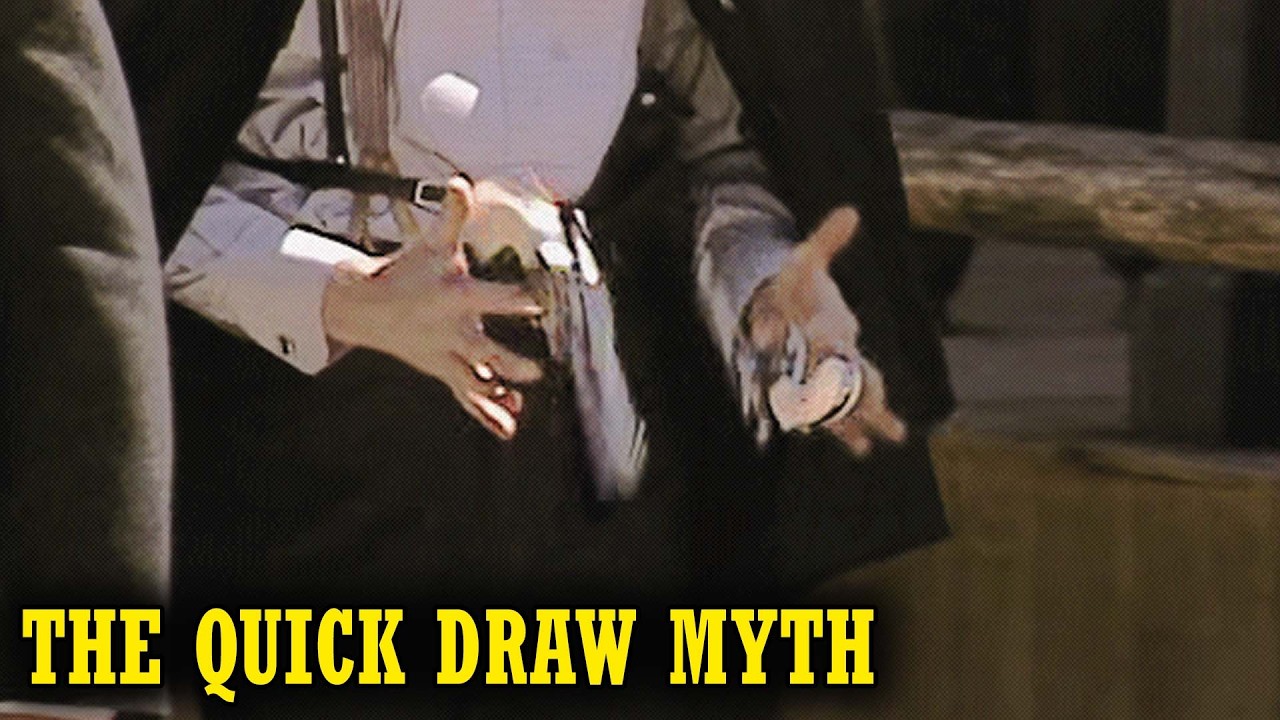
Hollywood taught generations to picture Old West gunfights as tense noon showdowns, with two gunmen facing off in an empty street and reaching for their revolvers at the same instant. Real frontier violence was usually far faster, messier, and less honorable than what appears on screen. Many encounters began without warning, happened at extremely close range, and involved ambushes, shotguns, or several armed men firing through smoke and confusion. Statistical records from the era paint a surprisingly peaceful picture.
Historian Robert Dykstra examined original police records, court dockets, and newspaper archives from the five major Kansas cattle towns: Dodge City, Abilene, Wichita, Ellsworth, and Caldwell. Combined across all five towns between 1870 and 1885, there were only 45 documented deaths from violence over that entire 15-year period. Dodge City’s most violent year, 1878, saw just five killings, according to the Dodge City Times and local coroner records. Some measures suggest a frontier resident faced lower risks than residents of many modern American cities.
One reason the towns stayed calm was economic self-interest. Business leaders, town councils, and saloon owners had no interest in chaos. A town with a dangerous reputation would lose cattle drives to a competing railroad stop, and investors avoided unstable communities. So local leaders hired competent marshals and supported ordinances that kept trade and residents safe.
The classic face-to-face duel is largely a fiction. Real gunmen preferred surprise and ambush. Billy the Kid’s most famous confrontation was pre-planned; on April 1, 1878, he and allies hid behind an adobe wall in Lincoln, New Mexico, and ambushed Sheriff William Brady before he could respond. John Wesley Hardin often attacked people while they were asleep or drunk.
Even Wild Bill Hickok’s death in 1876 was not a duel; he was shot from behind by Jack McCall while playing poker in Deadwood, South Dakota. The famous 1865 Hickok-Tutt shootout in Springfield, Missouri, is often cited as the model for Hollywood duels, but eyewitness accounts describe something very different. The two men were roughly 75 yards apart, and Hickok took deliberate aim with his Colt 1851 Navy revolver rather than firing from the hip. It was a rare event that dime novelists and filmmakers later compressed into a routine street confrontation with dramatically shortened distance.
Ballistics also mattered. Nearly all frontier firearms used black powder, which produced thick, heavy smoke. Inside poorly ventilated saloons and gambling halls, a few shots could obscure vision almost completely, turning encounters into confused, close-range struggles rather than clean, visible standoffs. The noise in an enclosed wooden space was also intense, adding to the confusion.
Accuracy was far worse than movies suggest. The standard single-action Colt revolver was heavy, with a stiff trigger pull and minimal sights. Under adrenaline, precise aiming was nearly impossible. Documented cases like the 1887 Luke Short and Jim Courtright gunfight in Fort Worth, Texas, show experienced gunmen missing at close range.
Courtright’s gun caught on his watch chain, and Short’s first shot missed entirely, hitting the sidewalk instead. Contrary to popular belief, many frontier towns had strict local gun control ordinances. Wichita, Kansas, and Cheyenne, Wyoming, established boundaries where carrying firearms was prohibited. Dodge City’s 1876 ordinance required cowboys to surrender their firearms at the marshal’s office in exchange for a receipt.
Some historians note that these regulations could be more restrictive than those in the same cities today. The famous 1881 Gunfight at the O. K. Corral in Tombstone, Arizona, was directly linked to such a law.
The primary cause was enforcement of Tombstone Ordinance Number Nine, which restricted carrying firearms within town limits. The actual fight did not occur inside the O. K. Corral but in a narrow, approximately 15-foot-wide empty lot behind a lodge on Fremont Street.
The participants were only a few feet apart when the shooting began. The fight lasted roughly 30 seconds, with about 30 shots fired. Billy Clanton and both McLaury brothers died, while Virgil and Morgan Earp were wounded. Doc Holliday’s belongings were grazed by bullets, and Wyatt Earp was reportedly unharmed.
Ike Clanton, who had threatened the Earps the previous day, reportedly fled through the back door of the photography studio once the shooting started, claiming he was unarmed. Medical realities differed greatly from Hollywood portrayals. Soft lead bullets of the era deformed significantly upon impact, causing severe tissue damage. Infection was the greatest threat, as frontier doctors often lacked knowledge of germ theory and basic sterilization practices.
Recovery from serious injuries could take days or weeks, if it came at all. Morgan Earp, shot in March 1882 in Tombstone, had time with his family before his wounds proved fatal. The line between lawman and outlaw was often blurred. Town marshals frequently earned their income through fees per arrest and portions of fines, creating incentives to regulate vice rather than eliminate it.
Wyatt Earp’s early career included involvement in brothel operations in Peoria, Illinois, in 1872, and his duties in Wichita and Dodge City often focused on fee collection. Wild Bill Hickok’s tenure as marshal of Abilene ended in December 1871 after he accidentally shot his deputy, leading the town council to dismiss him. A more extreme example was Frank Canton, presented publicly as a respectable sheriff in Johnson County, Wyoming. Historical research identified Canton as an alias for Joe Horner, who had a prior record involving bank robbery and had escaped custody in Texas.
Canton reportedly worked for the Wyoming Stock Growers Association and played a central role in the violent Johnson County War of 1892, where large cattle interests used hired gunmen against small independent ranchers. The transformation from documented history to myth began while participants were still alive. Dime novels of the 1870s and 1880s, written by authors like Ned Buntline, turned figures like Buffalo Bill Cody into heroic legends, inventing dramatic confrontations that never occurred. Buffalo Bill’s Wild West show, which toured from 1883 to 1913, presented theatrical recreations of stagecoach robberies and shootouts to millions of Americans, shaping popular visual expectations of the West.
Early filmmakers drew inspiration from Buffalo Bill’s shows and dime novels rather than historical records. Wyatt Earp, in his old age in 1920s Los Angeles, informally advised early directors like John Ford and Raoul Walsh. Yet the filmmakers often ignored historical details, substituting wide open streets for the narrow Tombstone lot and promoting low-slung holster styles that looked good on camera. The Hollywood version of the Old West was built for drama, not accuracy.
The real frontier involved strict local laws, chaos in tight spaces, and lawmen far more human than legend allows. Understanding how these myths evolved does not diminish the films, but it gives proper appreciation to the complex, sometimes more remarkable history of the communities that actually built the American West.