A man in a dark coat walked the banks of the Delaware River in New Jersey, watching gardeners set young trees in the ground. His neighbors knew him as the Count de Survillier, a wealthy Frenchman with one of the finest art collections in the state. A few years earlier, he had been King of Spain. His name was Joseph Bonaparte, the eldest brother of Napoleon, and he was the first of the fallen imperial family to land on his feet in America.
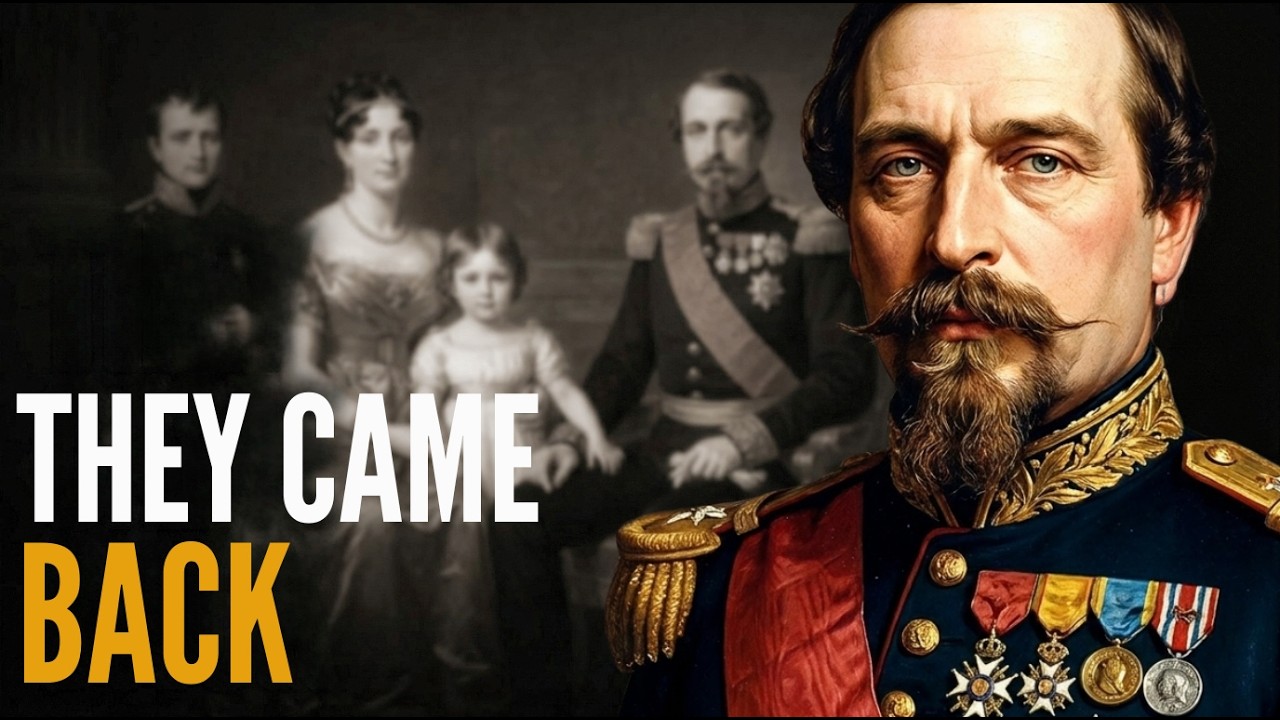
On April 20, 1814, Napoleon said farewell to his soldiers in the courtyard of the palace at Fontainebleau and climbed into a carriage for the coast, bound for the Mediterranean island of Elba. He left behind a wife, a son, his mother, four brothers, three sisters, and the wreckage of the largest European empire since Charlemagne. The empire was finished, but the family was not, and what would become of them had no obvious answer. For most of two decades, Napoleon had governed Europe largely through his relatives.
He made Joseph a king twice, first in Naples and then in Spain. He placed one brother on the throne of Holland and a third on a new throne carved out of Germany. His sisters were given duchies and a kingdom, his brothers-in-law became princes, and his stepson was made viceroy of Italy. It was government by household, and when the head of the household fell, every arrangement fell with him.
In a single spring, eight people who had been royalty woke up as fugitives. The powers gathering at the Congress of Vienna to redraw the map of Europe treated the scattering of the Bonapartes as routine housekeeping. The family was not to be allowed to settle together anywhere it might become a center of intrigue. The Austrian Chancellor who shaped that peace wanted them watched, separated, and slowly forgotten.
For the most part, he got what he wanted. That the family woke up wealthy was not an accident. Before leaving Fontainebleau, Napoleon arranged payments for his brothers, sisters, and mother, a final handout of imperial money before the treasury passed into other hands. The Bonapartes lost their thrones in 1814 and again for good the following year.
The victors could bar the family from thrones, but they could not touch the things that actually carry a dynasty: its money, its marriages, and its lesser-known branches. Where the Bonapartes went said everything about their place in the new Europe. The brothers scattered, one to Rome under the protection of the Pope, one drifting through Switzerland and Italy, the youngest sheltering inside the Austrian Empire. The sisters and their mother went south toward Rome and Trieste.
France itself was closed to them. The restored Bourbon kings had no wish to share the country with the dynasty that had replaced them. When Napoleon returned from Elba in 1815 for the brief campaign that ended at Waterloo, he hardened every fear the victors held. Within a year of his final fall, a new law banished the entire Bonaparte family from France in perpetuity.
No member could own property there or set foot on French soil, and the ban reached down to descendants not yet born. Napoleon himself was sent to the Atlantic island of St. Helena, where he died in 1821. For a family whose claim rested on having ruled France, being written out of the country cut deeper than the loss of any throne.
In a tall house near the center of Rome, an old woman in black received reports on her scattered children the way other people read the morning papers. Letizia Bonaparte had borne 13 children and buried five of them young. The eight who lived had given her a son who ruled a continent and daughters who wore crowns. Romans called her Madame Mère, Madame Mother.
She had grown up poor on Corsica and had never quite believed the grandeur would last, so when it went, she did the practical thing. She guarded the money and kept her scattered children in one another’s letters, holding together by correspondence a family that no longer had a country to meet in. Rome took the exiled Bonapartes in when the kings of Europe would not. The Pope had been Napoleon’s prisoner for years, dragged across the Alps and held in France against his will, and he answered that treatment by opening his city to the family that had ordered it.
Letizia’s half-brother, a cardinal, gave her a household there. Her brothers and daughters sheltered nearby at different times. The city the emperor had once stripped of its lands became the safest address his relations could find. They were safe here, but never quite free.
The first generation thinned quickly, and it thinned in comfort. The eldest sister, who had governed Tuscany for her brother, died near Trieste in 1820. Within five years, the great beauty of the family was gone too, not yet 45. She had been the only sibling to stand by Napoleon to the end, selling her jewels to fund his exile.
The buyer of her Paris townhouse was the Duke of Wellington, the man who would soon defeat her brother at Waterloo. The others faded more slowly. A widowed sister lived out her years under an assumed name. One brother kept a small court in Rome.
Another wrote poetry in Italy. One by one, the people who had worn crowns settled into a long, comfortable, powerless obscurity. That safety came with eyes on it. Austrian and French agents read the family’s letters, counted their visitors, and reported every rumor of a plot to capitals that had not stopped fearing the name.
The brother who managed it best was the one who had gone furthest away. Joseph Bonaparte, once King of Spain, crossed the Atlantic and built a country estate on the New Jersey bank of the Delaware. He called it Point Breeze. He filled it with paintings by Rubens and Rembrandt, laid out gardens and an artificial lake, and kept a table that drew the Marquis de Lafayette and the most powerful men of the young republic.
Within a few years, a startling proposal crossed the Atlantic to find him. There was talk, never firmly pinned down, of crowning a Bonaparte king of an independent Mexico, and the men behind it had come to the brother who had already lost two thrones. He turned them down. He had been a king twice, and twice it had ended in flight.
What he held now was different. The pictures, the river, and the money working quietly in banks in London and Holland, none of it could be taken from him by a change of government in Europe. Back in Rome, the matriarch outlived most of what she had built. Letizia learned of her son the emperor’s death on his Atlantic rock in 1821, news that took two months to reach her.
She buried two of her daughters before her own end. She lost her sight, kept to her house, and when she died in 1836 at the age of 85, she was the last great presence of the imperial generation. By then, the family had done something the victors of 1815 had never planned for. It had not been destroyed.
It had only been put away, scattered across Italy and America, living on money the powers had failed to seize. In a palace on the edge of Vienna, a fair-haired boy was being raised to forget who his father was. He spoke German, not French. The court that surrounded him called him Franz, an Austrian Archduke’s name, and gave him an Austrian title, Duke of Reichstadt.
The grand rooms of Schönbrunn were his home, and in a quieter sense, his cage. At his birth in 1811, he had been hailed across an empire as the King of Rome, the long-awaited heir who would carry his father’s work into another century. He was the son of Napoleon, and his grandfather, the Emperor of Austria, intended that he should never be allowed to remember it. His mother had made that easier than it should have been.
Marie Louise was a Habsburg Archduchess, married to Napoleon in 1810 to seal a peace and to give him the son his first wife never had. When the empire fell, she did not follow her husband into exile. Her father took her home and gave her the small Italian Duchy of Parma to rule. With her, he sent an Austrian general, the one-eyed Count Neipperg, to keep her company and steer her away from any thought of joining Napoleon.
The plan worked completely. She bore Neipperg children while Napoleon still lived, married him after the emperor died, and married a third time after that. She died in 1847, still ruling her small Italian duchy, and was laid to rest in Vienna among the Habsburg emperors. The boy left behind in Vienna grew up clever, restless, and increasingly aware of exactly who he was.
He read about his father in secret, kept his portrait, and asked old soldiers what the conqueror had really been like. He trained as a soldier and longed for a command, but the Austrian court had no use for a living symbol of Bonapartism. He fell ill with tuberculosis, and on July 22, 1832, he died in the Palace of Schönbrunn at the age of 21, leaving no child. With him, the direct line of descent from Napoleon simply stopped.
For a watching world, that should have been the end of the Napoleonic story. The emperor was 11 years in his grave. His only legitimate son was now in his at 21. The brothers were aging exiles scattered across Italy and America, and the sisters were nearly all dead.
The Allied powers who had crushed the empire in 1815 had every reason to believe the file was closed. They were wrong. The family was not finished. It had only been waiting in the wrong branch.
What they had not counted on was the daughter’s line and the younger nephews. Louis, the former king of Holland, had married Hortense de Beauharnais, the daughter Josephine had brought to her marriage with Napoleon. Their third son, born in Paris in 1808, carried both bloodlines. His name was Louis Napoleon.
He had grown up in exile in Switzerland and Germany, watching his uncle’s legend swell in the years after Waterloo. From the death of the Duke of Reichstadt, he drew a conclusion that nobody in Vienna or Paris took seriously: if the direct heir was gone, then the claim was his. He was, at first, easy to dismiss. He tried to raise a garrison against the French king at Strasbourg in 1836 and was bundled out of the country.
He tried again at Boulogne in 1840, landing with a few dozen followers and a tame eagle meant to evoke his uncle. He was arrested and locked in a fortress for what was meant to be life. He escaped after six years by walking out dressed as a laborer. To the governments of Europe, he was a comic figure, a pretender with a famous surname and no army.
On the night of December 2, 1851, soldiers moved through Paris arresting the men who might have stopped what was coming. At the center of it was the once comic pretender, now president of the French Republic. After the revolution of 1848 swept away France’s last king, Louis Napoleon was allowed home. He stood for the presidency and won by millions on the strength of his name.
Now barred by the constitution from standing again, he took the rest by force. On December 2, 1852, the anniversary of his uncle’s victory at Austerlitz and of his own coup the year before, he proclaimed the empire restored and took the throne as Napoleon III. A national vote gave him overwhelming approval. Thirty-seven years after the family had been barred from France by law, a Bonaparte ruled the country again.
The Second Empire lasted 18 years. Napoleon III rebuilt Paris into the city of boulevards the world still visits and married a Spanish countess named Eugenie. In 1856, he produced what his uncle’s line had lacked: a healthy son and heir, known to France as the Prince Imperial. For the first time in two generations, the Bonapartes had a throne and a clear successor at the same time.
Then, in 1870, the emperor let himself be drawn into a war against Prussia that France was not ready to fight. At Sedan that September, he was surrounded and taken prisoner with his army. The empire fell in an afternoon. The family went into exile once more, this time to England, and Napoleon III died there in 1873.
That left the boy. The Prince Imperial grew up in Kent and trained at the British Military Academy near Woolwich. He ached to prove himself worthy of his name in the only way his family had ever truly respected: under fire. When Britain went to war against the Zulu Kingdom in Southern Africa in 1879, he begged to go.
The British government refused, then gave way under pressure from the Queen herself. He sailed to Africa as an observer attached to the British army. On June 1, 1879, the heir to Napoleon’s empire died in a British uniform in the grasslands of Southern Africa, thousands of miles from the France he was meant to rule. He had been out on a small scouting patrol in Zululand when his party was ambushed.
He was 23. His body was brought back not to Paris, but to England, and buried in an abbey in Hampshire that his mother built to hold him. The dream of putting another Napoleon on the French throne ended for good on a scouting patrol in the African veldt. His death took more than a life.
The Bonapartist movement in France had rested everything on him, a young, able, popular heir who might one day have been called home. With him gone, there was no figure left to gather behind. The idea of a third Napoleon ruling France faded out quietly in the years after 1879 until it belonged to history rather than to politics. His mother outlived all of it.
Eugenie, the last empress of the French, lived on in England for more than 40 years after her son’s death. For most of those years, she was the dynasty itself, its memory and its dignity. Pretenders, politicians, and crowned heads called on her to pay respects to a cause that no longer had a throne. She died in 1920 at the age of 94, having seen the family rise, rule, fall, and lose its heir.
The imperial claim passed sideways to the descendants of Jerome, the youngest brother. Through that line, the family has continued to this day. In October 2019, the current head of the House of Bonaparte was married in Paris in the Church of Les Invalides, beneath whose great dome Napoleon himself lies. He is Jean-Christophe Napoleon, born in 1986.
His bride was an Austrian countess, a descendant of the Habsburg house Napoleon had married into in 1810. Two centuries after the empire fell, a Bonaparte and a Habsburg were joined again, only a few steps from the tomb of the man who had begun it all.