For 16 years, Italy’s exiled king used every remaining shred of his authority to prevent his only son from marrying the woman he loved. He never relented, not even on his deathbed. The woman at the center of that long refusal was Marina Ricolfi Doria, a world champion water skier from Geneva who spent nearly two decades waiting to marry Vittorio Emanuele di Savoia, the heir to a throne that no longer existed. Umberto II, the last king of Italy, reigned for just 34 days in the spring of 1946 before a national referendum abolished the monarchy.
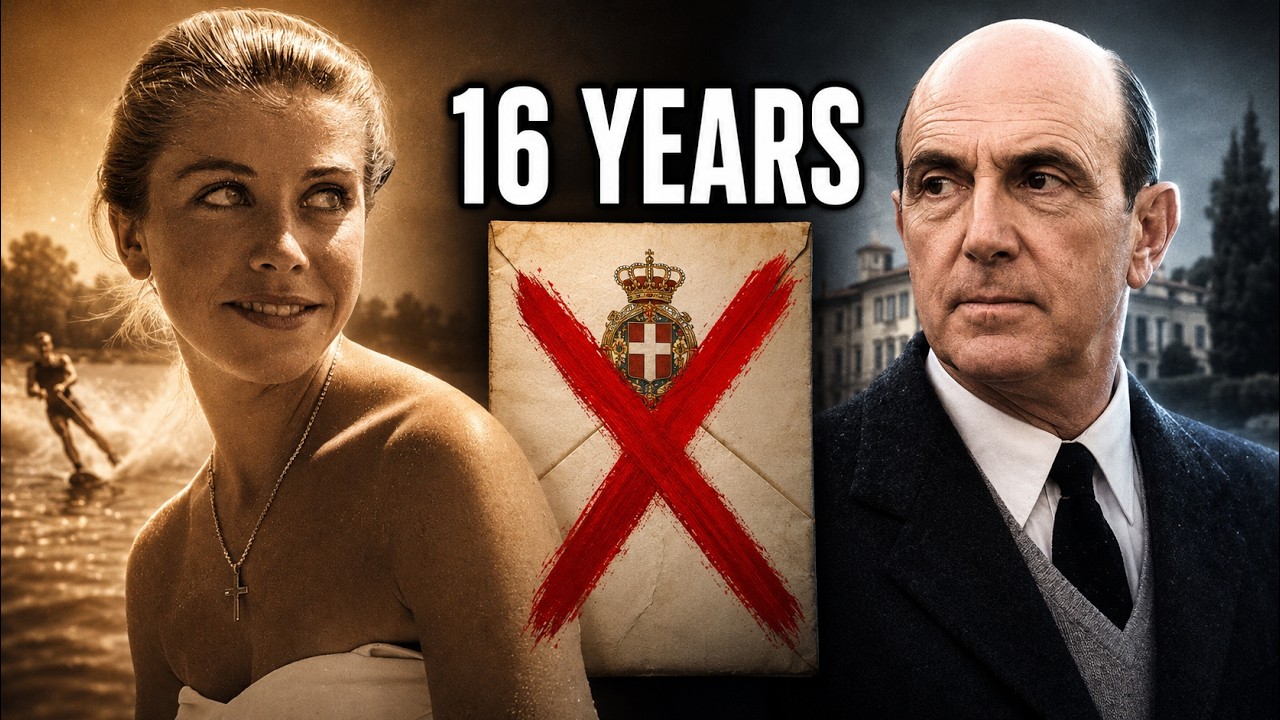
He went into exile that summer and settled in Cascais, Portugal, where for the next 37 years he maintained the careful rituals of a royal court that had no country. He died on March 18, 1983, at a private clinic in Geneva, at the age of 78, without ever officially recognizing his son’s marriage. Vittorio Emanuele and Marina met in 1954 on a lake in Switzerland. Both were born on February 12, exactly two years apart, she in 1935, he in 1937.
Marina came from a comfortable Geneva family but had no aristocratic title or royal bloodline. What she had instead was an extraordinary athletic career. She won gold at the water ski world championships in 1955 and again in 1957, accumulating 23 Swiss national titles and 12 European medals before retiring at 25. Vittorio had been nine years old when his family lost the throne.
He grew up in exile, educated in several languages, raised with material comfort but no clear future. He was a royal heir organized entirely around something taken from his family before he was old enough to deserve it or lose it. Marina offered him something the dynastic world could not provide, a direct, unmediated choice that had nothing to do with title or obligation. Umberto’s objection was never framed as personal disapproval.
It was institutional. Under the traditions he maintained, a marriage without royal consent would be considered morganatic, outside the recognized line of succession, and the dynastic rights of any children could be challenged by other branches of the family. With no country left to govern, the marriage rules of the House of Savoy were the mechanism through which Umberto exercised what little power remained. In 1963, Vittorio and Marina gave an interview to the Italian magazine Oggi discussing their intention to marry.
Umberto responded with a letter to his son, saying he was motivated only by affection and a desire to assure the best for the future, but that the proposed union could not proceed because it would contrast with the way the family had always done things. The letter offered love as justification for refusal. Vittorio did not accept it. Four years later, Umberto escalated.
In June 1967, Italian newspapers reported that Vittorio was engaged to Maria Antonietta of Württemberg, whose lineage fit the dynastic framework without complication. Eleven days later, the same newspaper announced a proposed match with Princess Isabella of Savoy-Genoa. Both arrangements collapsed. Neither woman married Vittorio, and he returned again to Marina.
The pattern was clear by then. Letters had not moved him. Alternative marriages had not moved him. The accumulated weight of royal tradition and a father’s sustained disapproval had not moved him.
What Umberto could not grant was permission. What he could not take away was the relationship itself. On January 11, 1970, after 16 years together, Vittorio Emanuele and Marina Ricolfi Doria were married in a civil ceremony in Las Vegas, Nevada. No representative of the House of Savoy was present.
No blessing came from Cascais. The choice of Las Vegas was not incidental; it was a deliberate step outside the system that had required a permission it would never give. Later that year, in October, the couple held a Catholic ceremony in Tehran, Iran, where Vittorio had built a professional life in banking and trade and was a close acquaintance of the Shah. But Las Vegas came first.
That was the moment of choice. Umberto did not change his position. He issued no acknowledgement of the marriage, no congratulations, no modification of his stance under the dynastic rules he still considered binding. His refusal carried consequences within that framework.
Because the marriage had occurred without royal sanction, Vittorio’s dynastic rights were open to challenge. Decades later, that dispute became formal. In 2006, Vittorio’s cousin Amedeo, the fifth Duke of Aosta, publicly declared himself the rightful head of the dynasty, citing the unsanctioned marriage as his legal basis. Vittorio’s own sister, Maria Gabriella, sided with their cousin.
In February 2010, a court ruled in Vittorio’s favor, ordering the Duke of Aosta and his son to pay damages and stop using the unqualified family surname. That resolution came 40 years after the Las Vegas ceremony. Their son, Emanuele Filiberto, was born on June 22, 1972, in Geneva, the first child of a marriage his grandfather never recognized. Umberto died in Geneva on March 18, 1983, in the same city where Marina and Vittorio had built their life and where their grandson was growing up.
He died 11 years after his grandson was born and 13 years after the Las Vegas wedding, having never said yes and, in the end, never saying anything at all. His refusal was carried into death without softening. What the refusal cost Marina is hard to calculate from the outside. She spent 16 years in a committed, defining relationship that the formal world declined to recognize.
She occupied a position with no official name, the partner of an exiled prince in social circles organized entirely around titles and precedents. After Las Vegas, she was legally married and held the title of Duchess of Santana di Valdieri, conferred by Vittorio before the wedding, but that status was contested depending on whether one accepted Umberto’s interpretation of the rules. Observers noted her composure across decades, the way she attended required engagements, maintained the Geneva household, raised her son, and stood beside Vittorio through legal disputes and public controversies. She never documented what any of it cost her personally.
What is clear from the record is that Marina did not need Vittorio for a life of substance. She had built one entirely on her own terms before he was part of it. She brought something real into the relationship, not just youth or romantic feeling, but a demonstrated capacity to do difficult things without requiring an audience for the doing. Umberto spent 16 years looking for a replacement for her.
He never appeared to consider that the woman he was trying to replace might simply not be replaceable. On February 3, 2024, Vittorio Emanuele di Savoia died at the Geneva Cantonal Hospital. He was 86. Nine days later, on the shared birthday of February 12, Marina turned 89, marking the date for the first time in 70 years without him.
His funeral took place on July 1, 2024, at the Basilica of Superga above Turin. For the first time since the monarchy was abolished in 1946, a Savoy heir was laid to rest in the royal crypt, his ashes placed among the kings and queens of his dynasty, in the country he had spent most of his life being kept from. He and Marina had been married for 53 years and together for nearly seven decades. The man who spent 16 years refusing to recognize that marriage died in 1983.
The marriage he refused outlasted him by 41 years. Emanuele Filiberto, born of the union Umberto never sanctioned, has two daughters of his own, Vittoria and Luisa. In June 2023, he announced his intention to eventually pass his dynastic claim to Vittoria, making her the first woman in the family’s history to be formally positioned as a potential head of the house, something Umberto’s framework had never made room for. The 53 years proved duration, and in a story like this, duration is the only evidence that cannot be manufactured.
Marina stayed beside Vittorio through every version of their life together, the 16 years of waiting, the Las Vegas ceremony that defied everything Umberto stood for, the Tehran church that blessed what the exile court refused to acknowledge, the legal disputes, the decades of building a life in a city that was neutral enough for everyone but home to no one. She was beside him at the end.