Jacqueline de Ribes died on December 30, 2025, in a hospital in Switzerland at the age of 96. The French aristocrat had spent roughly five decades as a muse, collaborator, and quiet co-creator to the greatest couturiers of her era, and the obituaries that followed her death were unanimous in mourning an irreplaceable figure. The New York Times called her a symbol of a dwindling era. Others called her the last queen of Paris.
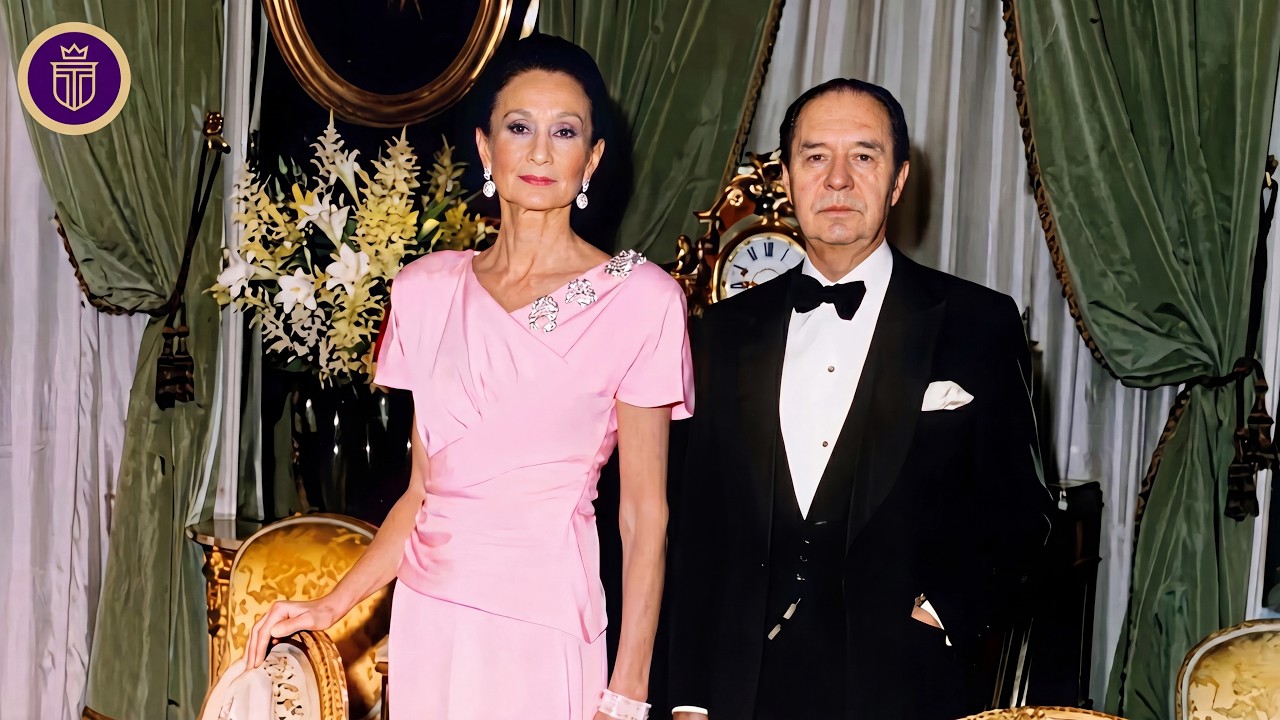
She cut patterns on her attic floor, employed a young Valentino as her sketch artist before he had his own label, co-designed evening dresses for Emilio Pucci, and anonymously wrote a fashion column for Marie Claire under a pseudonym because it was considered unseemly for an aristocrat to work. At 53, after the death of her conservative father-in-law removed the final constraint, she launched her own fashion label. Her debut collection was presented in the Paris home of Yves Saint Laurent, and she soon signed an exclusive contract with Saks Fifth Avenue and dressed clients including Joan Collins, Nancy Reagan, Cher, and Raquel Welch. Jacqueline Bonnin de la Bonninière de Beaumont was born on July 14, 1929, in Paris.
Her father, Comte Jean de Beaumont, was a fighter pilot, a crusader descendant, and longtime vice president of the International Olympic Committee. Her mother, Paule de Réveaud de la Raffinière, was a socialite and literary translator who rendered Hemingway and Tennessee Williams into French. Jacqueline’s childhood was marked by her mother’s coldness, which she would later describe with painful clarity. Her mother mocked her long nose and kissed her only once during Jacqueline’s whole childhood.
When the Nazis occupied France, Jacqueline and her siblings were sent to Hendaye, near the Spanish border, while the family’s residence was requisitioned by the Gestapo. Their Scottish nanny was seized and sent to a forced labor camp as a British national. Jacqueline later recounted hearing the sounds of torture from the occupied mansion. By 1943, the family had moved to a chateau occupied by German officers until American soldiers liberated it in 1945.
A pivotal moment came when her uncle, avant-garde art patron Count Etienne de Beaumont, took his teenage niece to meet Christian Dior, who had just opened his couture salon in 1947. The visit planted a seed: style was not ornamentation but a language, a form of authority. Jacqueline understood that maintaining elegance in the face of brutality was itself a form of resistance, a lesson shaped by the wartime horrors she had witnessed. In 1947, she met Edouard de Ribes at a luncheon in Saint-Jean-de-Luz.
He described seeing a gazelle and immediately falling in love. They married on January 30, 1948, when Jacqueline was 19. Her father-in-law, the conservative Comte Jean de Ribes, described her as a cross between a Russian princess and a girl of the Folies Bergère, a backhanded tribute that captured the tension at the heart of her life. The family lived in a wing of the Grand Hôtel de la Bienfaisance, a mansion built in 1865 and filled with six generations of paintings and decorative arts.
The marriage imposed a strict constraint that would define the next 35 years. Working on anything but philanthropic pursuits was frowned upon. Edouard was genuinely upset by many of her professional initiatives. The specific rule was that she could dress beautifully, entertain magnificently, and support charities generously, but any creative ambition beyond those three activities violated the social contract of her marriage and class.
“Throughout my life I was told that I could not pursue a career,” she told Architectural Digest. “Yet I always worked. I sought an outlet for my creative expression. ”
The prohibition was not against creativity but against commerce.
Jacqueline could create as long as she did not appear to be doing it for money. She found outlets through the anonymous fashion column, attic pattern cutting, and disguised collaborations with couturiers. The decisive turning point came in the early 1950s during a visit to New York. Diana Vreeland, then fashion editor of Harper’s Bazaar, spotted her across a room and arranged a photo shoot with Richard Avedon.
Vreeland stripped away Jacqueline’s attempts at conventional glamour and insisted on raw authenticity. The photograph, featuring her elongated neck, almond-shaped eyes, and a single thick braid, was published in Life magazine and became one of the most iconic fashion photographs of the century. The photograph transformed her into a public icon. By 1956 she was named to the International Best Dressed List, and in 1962 she was inducted into its Hall of Fame.
Yves Saint Laurent called her an ivory unicorn. Valentino compared her to Nefertiti. She was photographed by Irving Penn, Slim Aarons, Cecil Beaton, and Avedon. The recognition made her more visible than ever, but it did not come with permission to work, deepening the paradox of her position.
The 50 years she spent as someone else’s muse were not 50 years of passive beauty but active creation conducted under the constraint of anonymity. In 1955, she employed Oleg Cassini to produce custom gowns, but the designs were her own, cut on the attic floor of her Paris home. Because she could not draw, she hired a young Italian artist from the Jean Dessès studio to sketch the designs. His name was Valentino.
The future fashion emperor worked as her draftsman, often adding his own touches, and de Ribes encouraged him to stay and build his career. Three years later Valentino opened his own couture house, and Jacqueline became one of his most celebrated clients. Emilio Pucci spotted her skiing in Saint Anton, dressed entirely in pink, which led to a collaboration in which Jacqueline designed evening dresses for Pucci. Pucci called her Giraffina, meaning baby giraffe, and predicted she could fill Christian Dior’s shoes if she chose.
She also began anonymously writing a fashion column for French Marie Claire on how to be chic on almost nothing, under a pseudonym. Her relationships with the great couture houses were never those of a passive client. Designers placed their drapers, cutters, and fitters at her disposal out of genuine respect. She routinely commissioned alterations so extensive that when Marc Bohan of Dior finally asked, “Is it mine?
” the answer captured her entire dynamic. She was a creative director without portfolio, shaping the output of the greatest fashion houses without credit or compensation. When fashion alone could not contain her creative energy, Jacqueline channeled it into other arts. In 1958 she produced the first play at the new Récamier theater, Federico García Lorca’s When Five Years Pass.
After the Marquis de Cuevas died in 1961, she took over management of his celebrated International Ballet, working 15-hour days until she dissolved it three years later for lack of resources. In the early 1970s she co-produced television programs based on Luigi Barzini’s The Italians and co-produced Eurovision variety shows benefiting UNICEF. Italian director Luchino Visconti considered casting her in his planned Proust adaptation before the project collapsed when he fell ill. Jacqueline radically refused to wear any look straight off the runway.
She mixed pieces from different designers, pairing a jacket from one house with trousers from another, and mixing couture with market finds at a time when head-to-toe loyalty to a single couturier was expected. She would cut up and cannibalize her own haute couture gowns to create elaborate fancy dress ball costumes, treating a Balenciaga or Saint Laurent as raw material for further creation. Late in life she laughed at being compared to a disc jockey: whatever she picked up, she could turn into something else. The death of her conservative father-in-law in 1982 was the decisive catalyst.
With the final major family constraint removed, she announced her intention to launch a fashion label to close friends including Pierre Bergé and Yves Saint Laurent. The announcement was met with skepticism from family but support from the fashion world. Her first collection debuted in 1983, presented in the Paris home of Yves Saint Laurent, a powerful endorsement. Saint Laurent attended alongside Valentino and Emanuel Ungaro, all applauding.
The collection was ready-to-wear but infused with couture sensibility, glamorous evening gowns, floor-length silhouettes, structured jackets trimmed in velvet, bold patterns balanced by restraint. The garments were not the amateur productions of a socialite playing at design but the work of someone who understood fabric, proportion, and garment engineering at the level of a trained couturier. After the debut she signed an exclusive three-year contract with Saks Fifth Avenue, and by 1985 the label was grossing $3 million annually and carried in over 40 stores across the United States. Her clientele included Joan Collins, who wore de Ribes for her 1985 wedding, Nancy Reagan, Cher, Raquel Welch, Barbara Walters, Danielle Steel, and Marie-Hélène de Rothschild.
Her style influenced the costume design of Dynasty, and Collins was reportedly encouraged to channel de Ribes for her role as Alexis Carrington. In 1984 she traveled across the United States on a promotional tour, staging charity fashion shows and managing every detail personally. Her signature was a distinctive elongated, column-like silhouette suited to her tall frame, with dramatic details such as cascading backs and exquisite twists at the shoulder. Silk georgette was a favored material chosen for its ethereal lightness.
She favored asymmetry, draping, and the controlled deployment of volume. “Style is what makes you different,” she said. “It is your own stamp, a message about yourself. ”
In 1986 the Japanese cosmetics conglomerate Kanebo acquired a minority stake in her company.
The relationship quickly soured when Kanebo began requesting changes to proportions and designs for the Japanese market. Jacqueline resisted, and the partnership deteriorated. Then came her health crisis. She developed debilitating back pain and underwent a hemilaminectomy in 1994, surgery to remove part of a vertebra that left her unable to walk for three years.
She also received a diagnosis of celiac disease. Unable to manage a fashion house from a hospital bed, she dissolved the company in 1995. The label had run for 12 years and dressed some of the most visible women of the era. Its closure was not a failure but a forced ending imposed by illness.
The Saks contract expired, the celebrity clients moved on, and the business she had fought three decades to create faded. The specific injustice of the timing defined her biography: she was prohibited from working for 35 years by social convention, permitted to work for 12 years by the death of her father-in-law, and prevented from continuing by a medical condition that removed her ability to walk. In 2015, the Costume Institute at the Metropolitan Museum of Art mounted “Jacqueline de Ribes: The Art of Style,” running from November through February 2016. The show drew nearly 195,000 visitors and featured approximately 60 ensembles of haute couture and ready-to-wear from her personal archive, along with her fancy dress ball creations, photographs, video, and personal ephemera.
Curator Harold Koda wrote that her approach to dress as a statement of individuality could be seen as a kind of performance art. The exhibition argued that her approach to personal style over 60 years constituted an artistic practice as culturally significant as the work of any couturier. In 1999, Jean Paul Gaultier dedicated his spring-summer couture collection to her, naming it Divine Jacqueline as a tribute to Parisian elegance. On July 14, 2010, her 81st birthday, President Nicolas Sarkozy decorated her as a Chevalier of the Legion of Honor at the Élysée Palace.
Valentino, present at the ceremony, offered his tribute: “Jacqueline is the last queen of Paris. ”
De Ribes was serious about ecological and humanitarian causes. As early as 1974 she advocated for the preservation of natural beauty in the Balearic Islands, and she orchestrated an international campaign to save the Mediterranean island of Espalmador, successfully campaigning for its classification as a nature reserve. She was deeply committed to UNICEF, co-producing fundraising television events.
In the 1980s she received a women of achievement award alongside Bette Davis and Anne Getty. Her husband Edouard predeceased her in 2013 at 90, after more than 60 years of marriage. He lived to see her Met retrospective announced. The marriage was simultaneously the institution that constrained her creative expression and the institution that provided the social position, financial security, and access to haute couture that made her creative expression possible.
Jacqueline de Ribes died on December 30, 2025, at 96. “Elegance is not a question of money,” she once said. “It is a question of education. ” The woman whose mother kissed her once in her childhood and mocked her nose spent 80 years proving, through personal style and then through professional design, that the creative intelligence behind both was as significant as anything produced by the couturiers she had spent 50 years collaborating with.
The Met confirmed it. Gaultier confirmed it. Valentino, who had been her sketch artist before he was Valentino, confirmed it.
The woman who had been told throughout her life that she could not pursue a career died having pursued one of the most varied creative careers of the 20th century.