The Reagan family gathered around a hospital bed in Los Angeles in January 2026 to say goodbye to an 80-year-old man who spent his adult life defending the legacy of a father he was not biologically related to. Michael Reagan’s death marked the loss of Ronald Reagan’s most consistent public defender—but his journey to that role was anything but straightforward. Ronald Reagan fathered five children across two marriages, though only four survived infancy. His first wife, actress Jane Wyman, gave birth to daughter Maureen in January 1941.
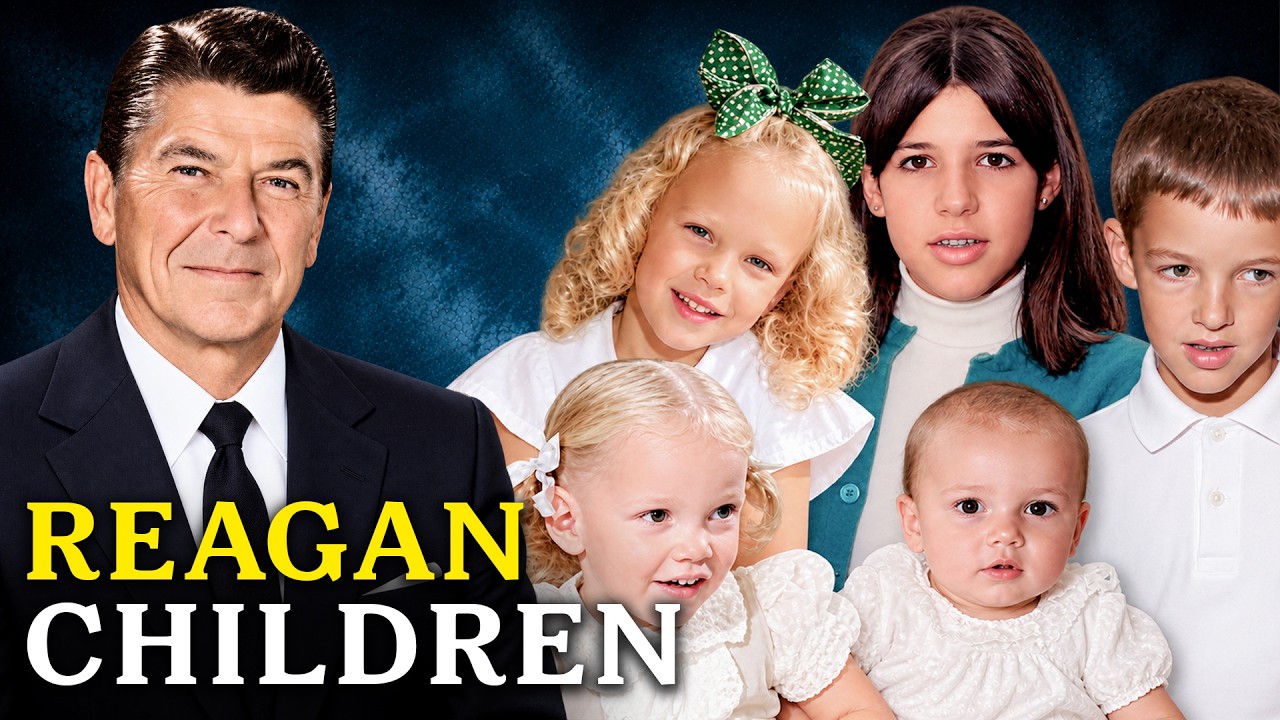
Four years later, in March 1945, the couple adopted a newborn boy just hours after his birth. The child, born to an unmarried woman named Irene Flouger and originally named John Charles Flouger, was renamed Michael Edward Reagan. Two years after Michael’s adoption, in June 1947, the couple welcomed daughter Christine, born prematurely. She lived only hours.
Christine’s death placed enormous strain on an already troubled marriage, and biographers cite it as a significant factor in Ronald and Jane’s 1949 divorce. Reagan married Nancy Davis in March 1952. Their daughter Patti was born in October of that year, and son Ron followed in May 1958. The family was thus split between two households and two very different chapters of Reagan’s life—before his rise from actor to governor of California to president of the United States.
Michael Reagan grew up knowing he was adopted, but the knowledge shaped his identity in complicated ways. Like his sister Maureen, he was sent to boarding schools, and friends and biographers later suggested this deepened his sense of displacement. In his 1988 memoir, “On the Outside Looking In,” he disclosed that he had been sexually abused as a young boy by a camp counselor—an experience he carried in near silence for decades and said shaped his struggles with shame, trust, and self-worth. Michael’s professional life was eclectic.
He raced powerboats competitively, winning a national championship, appeared on television programs including “Falcon Crest,” and hosted the game show “Lingo” during its first season in 1987. His early adult years included a brief controversy shortly after his father’s 1980 presidential election victory, when business letters he sent referenced his father’s new position in a manner critics said improperly traded on the family name. He eventually found his professional home in conservative talk radio. “The Michael Reagan Show” ran in national syndication for roughly three decades, establishing him as a recognizable conservative commentator.
In his later years, he was a regular contributor on Newsmax. He published three books: “On the Outside Looking In,” “Twice Adopted” in 2004, and “Lessons My Father Taught Me” in 2016, collectively tracing his long journey toward reconciliation with both his adoption and his complicated relationship with his adoptive father. Michael married Pamela Gail Putnam briefly in 1971, then Colleen Sterns in 1975. The marriage lasted over five decades and produced two children, Cameron and Ashley.
He also served as board chair of the John Douglas French Alzheimer’s Foundation, working directly on the disease that claimed his father in 2004, and later led the Reagan Legacy Foundation. Michael died on January 4, 2026, after a battle with cancer, surrounded by his family. The date held a poignant coincidence: it would have been his older sister Maureen’s 85th birthday. Maureen Reagan was the eldest of Ronald Reagan’s five children and the one who most directly followed her father into Republican politics.
Before entering politics, she worked in radio, television, and briefly attempted acting. She rose to co-chair of the Republican National Committee and was known for advocating women’s political participation, including support for the Equal Rights Amendment—a position that sometimes put her at odds with the more conservative wing of her party. She also served as a U. S.
representative to the United Nations Commission on the Status of Women. In 1982, Maureen ran for the U. S. Senate seat representing California.
Reports from the period said her father notably declined to publicly endorse her candidacy, a decision observers suggested created genuine tension between them. She published her memoir “First Father, First Daughter” in 1989. Following her father’s 1994 disclosure that he had Alzheimer’s disease, Maureen threw herself into advocacy work. She testified before Congress, worked with research organizations, and served on the National Alzheimer’s Association, becoming one of the most visible public advocates for Alzheimer’s awareness and research funding in the country.
Colleagues said her work shifted federal funding priorities during a critical period. Maureen’s relationship with her stepmother Nancy, complicated for decades, warmed considerably during this period as the two women drew closer in caring for Ronald. Maureen died on August 8, 2001, at age 60, following a lengthy battle with malignant melanoma. She passed nearly three years before her father’s death.
Patti Davis, born Patricia Ann Reagan in October 1952, took a path that placed her in direct public opposition to nearly everything her father’s political career represented. From a young age, she gravitated toward liberal causes, placing her at odds with her increasingly conservative parents. In 1974, she deliberately dropped her father’s surname, adopting her mother’s maiden name, Davis. During her father’s presidency in the 1980s, Patti spoke publicly and repeatedly against his administration’s nuclear weapons policies, participated in anti-nuclear demonstrations, and gave interviews placing her in direct conflict with the White House her parents occupied.
Her 1992 memoir, “The Way I See It,” offered an unflattering portrait of her upbringing and caused considerable additional pain within the family. Patti later expressed genuine regret about the book’s timing and tone, describing it as written while she was still processing unresolved anger. The estrangement between Patti and her parents lasted roughly two decades. Reconciliation began following her father’s 1994 Alzheimer’s diagnosis, a process friends described as slow and halting but ultimately meaningful.
It produced some of Patti’s most praised writing: her 2004 memoir “The Long Goodbye” chronicled her father’s decade-long decline and earned genuine critical praise. In 2011, she founded a support group called Beyond Alzheimer’s for caregivers. In 2018, Patti publicly disclosed that she had been sexually assaulted decades earlier by a music industry executive, joining other women sharing similar experiences during the national conversation. She married yoga instructor Paul Grilley in 1984; the couple later divorced.
She published another memoir, “Dear Mom and Dad,” in 2024. Ron Reagan, born May 1958, took yet another distinct path. He enrolled at Yale but left after one semester to pursue professional ballet, eventually joining the Joffrey Ballet in New York. Press coverage treated his career choice as a national curiosity during the early 1980s, but Ron described it simply as following a genuine artistic passion.
His dance career gave way to a longer career in journalism and political commentary as a broadcast host and analyst across various platforms. Politically, Ron has positioned himself well to the left of his father, identifying as an independent and speaking openly about his atheism. He married Doria Palmieri in 1980; the marriage lasted until her death in 2014. He remarried in 2018 to Federica Basagni.
He has no children, meaning only Michael and Maureen produced descendants carrying the Reagan line forward. Christine Reagan, born prematurely in June 1947, lived only hours. The loss placed enormous strain on a marriage already showing significant difficulty. Neither Ronald nor Jane spoke about the loss publicly with any frequency.
A year after Christine’s death, Jane Wyman won an Academy Award—an achievement that arrived amid one of the most painful periods of her personal life. Christine’s siblings mentioned her in their memoirs decades later, but the wider public long remained unaware Reagan had been father to five children. The various estrangements, political disagreements, and private wounds across the Reagan family began genuinely shifting in November 1994, when Ronald Reagan disclosed in a handwritten letter to the American people that he had been diagnosed with Alzheimer’s disease. The letter, in which Reagan reflected on beginning what he described as the journey toward the sunset of his own life, reshaped the family’s dynamics almost immediately.
The disclosure also brought enormous new public attention to Alzheimer’s. Maureen threw herself into advocacy while growing closer to Nancy. Patti gradually reentered her family’s life, spending time with both parents during her father’s decade-long decline. Michael dedicated significant time to Alzheimer’s causes, working in close contact with his stepmother and siblings.
Ronald Reagan died on June 5, 2004, at age 93. His funeral drew world leaders and enormous public crowds, with all four surviving children present—a rare public gathering of a family that had spent so many years divided. Nancy Reagan, who had spent the decade caring for her husband, survived him by nearly 12 years. During that period, she became a prominent advocate for stem cell research due to its potential for Alzheimer’s treatment, a position that put her at odds with many in her late husband’s party.
Nancy died on March 6, 2016, at age 94 from congestive heart failure. She was laid to rest beside her husband at the Ronald Reagan Presidential Library in Simi Valley, California. As of 2026, only two of Ronald Reagan’s five children remain living. Patti Davis continues writing and speaking publicly on subjects ranging from Alzheimer’s caregiving to her family’s history.
Ron Reagan remains an active political commentator, speaking candidly about both his beliefs and his family’s legacy. Michael Reagan’s death on January 4, 2026, marked the loss of the family’s most consistently visible defender of his father’s political legacy. The Ronald Reagan Presidential Foundation and Institute described him as a steadfast guardian of his father’s legacy, shaped by conviction, purpose, and devotion. His family’s statement described him as a beloved husband, father, and grandfather, surrounded by family in Los Angeles.
He was survived by his wife Colleen, his children Cameron and Ashley, and half-siblings Patti and Ron. Looking back across the full arc of Ronald Reagan’s family history, what emerges is a portrait considerably more complicated than the polished public image surrounding the family during the White House years. Two children followed their father into conservative politics. Two moved decisively away from it.
One never lived long enough to have any path at all. The shared tragedy of Alzheimer’s ultimately brought several family members back into genuine contact after decades of accumulated distance. More than two decades after Ronald Reagan’s death, with three of his five children now gone, his legacy continues to be carried forward by the two who remain, each processing publicly in their own ways what it meant to grow up inside one of the most closely watched and extraordinarily complicated American families of the 20th century.