In the spring of 2011, a probate judge in Saginaw County, Michigan, signed an order distributing an estate. The man whose estate it was had died in 1919. Ninety-two years had passed while a Michigan trust sat untouched, growing, waiting for a single condition to be satisfied. The condition had been written into the will of Wellington R.
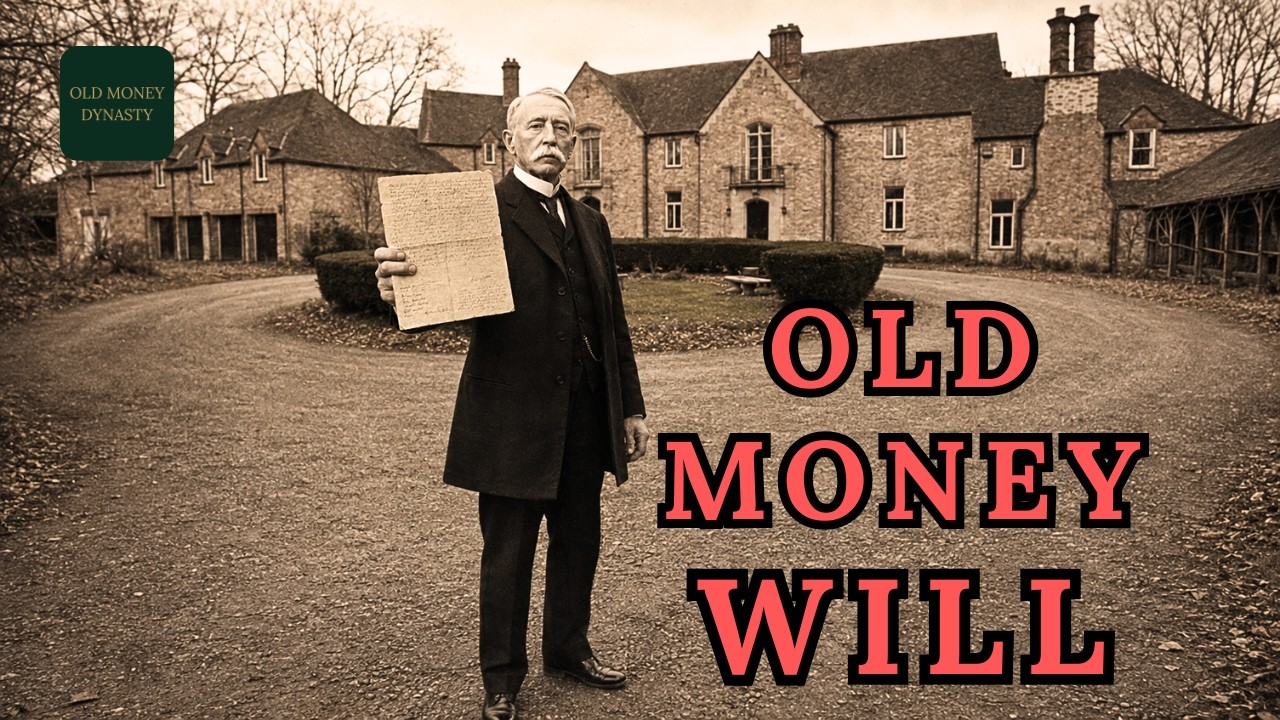
Burt, a lumber baron who died in March 1919 at age 87. Estimates of what he left range between $40 million and $90 million, which in present-day terms equates to anywhere from $740 million to $1. 6 billion. For a stretch in the early 1900s, he was counted among the eight wealthiest men in the United States.
His money came from the Saginaw Valley white pine trade and, later, from iron leases on Minnesota timberland he had bought cheap, which turned out to be sitting on ore. When the will was read in Saginaw in March 1919, his children and grandchildren learned they would each receive an annuity of $1,000 a year—roughly $18,000 in today’s money. The cook, the housekeeper, the coachman, and the chauffeur were left the same amount. His secretary received $4,000.
One son was treated differently, receiving $30,000 a year, though the record does not explain why. One daughter received nothing. Her $5,000 annuity had been in an earlier version of the document, but Burt struck it out after a disagreement about her divorce. Then came the clause that defined the estate.
The bulk of the fortune was to remain in trust, running for 21 years after the death of his last surviving grandchild who was living when he died. That meant his children could not have the money. Neither could his grandchildren. Nobody could until 21 years after the last of those grandchildren had died.
Every person in the room was permanently excluded—not delayed, but excluded. Burt had used his will as a weapon before. A few years earlier, he lost a fight with the Saginaw city assessor, who raised the valuation on his personal property. Burt’s response was to strike out a set of bequests he had planned for the city.
By the end of his life, he was living alone on Genessee Avenue, his eyesight failing and his hearing mostly gone. The servants he later named in the will looked after him. Saginaw called him the “lone pine of Michigan. ” No letter or deposition survives explaining why he excluded his family.
He put nothing in the document beyond the instruction itself. The more interesting question is how a dead man was allowed to have that instruction at all. English and American courts had built a rule for exactly this problem: the rule against perpetuities. It exists to stop the dead from governing the living forever.
No interest is good unless it must vest, if at all, no later than 21 years after some life in being. In other words, a man may reach forward from the grave through the lifetime of somebody already alive when he died, and then for 21 years more. The older name for the thing the rule guards against is “mortmain”—the dead hand. Burt took the rule out of the law books and turned it into a command.
He broke nothing. He located the outer edge of what the law allowed a dead man and stood on it. Not every rich man got it right. Samuel Jones Tilden, a corporate lawyer and former governor of New York who won the popular vote for the presidency in 1876 but lost the office, died in 1886 with an estate of roughly $6 million.
His will directed that the bulk of it establish a free library and reading room in New York. His nephew sued, and other relatives joined. Their argument was that the clause had been badly drafted. In 1891, the Court of Appeals held the clause invalid.
Half of what Tilden had meant for a public library went to his relatives instead. What survived was $2. 25 million—not enough to build anything. In 1895, the remains of the Tilden Trust were folded together with the Astor Library and the Lenox Library.
The combined body became the New York Public Library. The building opened in 1911, 20 years after a court took his clause apart. His name is carved into the front of it. The lesson the men who followed drew from this was not that dead-hand control was wrong.
It was that the drafting had to be better. John Gottlieb Wendel found his own method. His father, John D. Wendel, died in 1859, leaving about $3 million.
The will gave a single son a power of appointment—a legal instrument that lets the holder decide later who receives what. A father had placed the division of his daughters’ inheritance into the hands of their brother. The Wendel money started in fur in Manhattan and moved into real estate. By 1914, the holdings were valued at $80 million, something near $2.
5 billion today. John Gottlieb Wendel had one governing fear: if his sisters married, the property would be divided among husbands and children, and the holdings would come apart. So he made certain they did not marry. He told them every man who called was after the money.
He informed suitors personally that they need not return. His sisters were required to stay out of society and to dress in the styles of their girlhood. Two of them resisted. Georgiana ran, but her brother had her committed to the psychiatric ward at Bellevue.
A sheriff’s jury afterward pronounced her insane. Augusta was declared incompetent. One sister got out by waiting until her brother was dead. Rebecca married the Reverend Luther Albert Swope when she was 60 years old.
The house they all grew up in stood at 442 Fifth Avenue on the corner of 39th Street. It never changed—gas light, no telephone, no electricity. Neighbors called it the “house of mystery. ”
John Gottlieb Wendel died on November 30, 1914.
Eighteen hundred people came forward claiming to be his heirs. He had none. That had been the entire point. Rebecca managed the family holdings after her brother died, and when she died in 1930, everything went to her sister, Ella Virginia von E.
Wendel, the last of them. She had never married and never held a job, and newspapers noted she had never owned jewelry. She died in March 1931 after a stroke. The real estate accumulated under the Wendel name was worth more than $100 million.
The only living creature close to the last holder of it was a French poodle named Toby. Reporters who got inside afterward described gas fixtures that had never been converted to electricity, and rooms that had been locked when a sister died and never opened again. Then the claimants arrived. Two hundred thirty-three claims were filed against the estate.
The litigation ran three years. People turned up with family Bibles, letters, and photographs. One claimant went to prison for forging a marriage certificate and a will. Ella had left a will, and most of what she owned went to charitable and educational institutions.
The largest single share—a fifth of everything—went to Drew University in New Jersey, along with the building on Fifth Avenue. Drew leased the property briefly and then had it taken down. The ground was cleared in 1934, and a department store went up on the corner. John Gottlieb Wendel had kept his sisters single to prevent husbands and children from breaking the property apart.
The property was broken apart in a courtroom by 233 strangers, not one of whom he had ever met. Jay Gould’s estate took a different shape. He died on December 2, 1892, of pneumonia, at age 56, leaving $77 million—near $2. 7 billion in modern money—and six children.
The will named four of the six children as executors and trustees of the residuary estate. The two youngest, still minors, received income and no control. The design had a logic. Gould’s fortune was control of railroads, and control depends on holding blocks of stock together.
Split the inheritance six ways, and the blocks fragment. But somebody has to run the machine, and that somebody was his son George. George ran the railroads and the trust. For 23 years, nobody in the family asked to see the arithmetic.
Then in 1916, Frank and Anna sued, demanding a complete accounting of every transaction since 1893 and alleging mismanagement and self-dealing. In 1919, the court removed George as chief executive and trustee, finding he had mixed his own money with money belonging to the estate. The case ran another eight years. Contemporary accounts called it the most expensive lawsuit of its time over an inheritance.
George J. Gould died in May 1923, and his obituary noted that his death was holding up the litigation with his family over his father’s estate. The settlement came three years after he was buried. The surviving brothers and sisters agreed to repay the trust, with the figure most often cited at more than $20 million.
It concluded in 1927, 35 years after Jay Gould died. The lawsuit outlived the defendant. Cornelius Vanderbilt died on January 4, 1877, at age 82, the richest American who had ever died. The estate was put at around $100 million.
Almost all of it went to William Henry, the eldest surviving son. Cornelius Jeremiah, known in the family as Corneel, received not the bonds themselves but the income from them. The principal would revert to William when Corneel died, and the money was to be spent on his maintenance on condition that his behavior was exemplary. Corneel had epilepsy from childhood.
In 1849, his father had him committed to the Bloomingdale Asylum, where the record gave the disorder as dementia. Five years later, the Commodore had him committed a second time. He filed for personal bankruptcy in 1867. The will went to probate in February 1877.
Corneel objected, joined by two of his sisters. Their case was that the Commodore had lacked testamentary capacity, pointing to his age, physical decline, undue influence by his eldest son, and his belief in spiritualism. The trial ran more than a year and became the largest public entertainment in the city. Then, in June 1877, Corneel’s counsel received a letter from a man named Franklin A.
Redburn, a former head detective. He wrote that in the autumn of 1874, a well-dressed stranger had approached him with a proposition. The stranger said a singular change had come over the Commodore—the old man had begun to believe his disgraced son had returned to virtue. The accusation was that somebody had arranged what a father felt about his own child.
The lawyers called it the great conspiracy. The will contest ended in 1879 without a verdict. William settled, paying $200,000 in cash and a trust fund of $400,000—about $20 million in modern terms. Against the $95 million William inherited, the settlement came to roughly six-tenths of one percent.
Corneel took the money and went back to Connecticut. In 1879, he bought the West Hartford property again, the same ground his father had sold out from under him, and started building a 24-room house. He died in 1882, aged 51. The house was never finished.
No Vanderbilt ever lived in it. For about 40 years, it stood on the hill carrying the family name with nobody of that name inside. In the 1920s, it came down to make room for a housing subdivision. William Henry took what his father left him and nearly doubled it in eight years, then died himself in 1885.
The money did not last. Accounts of a family gathering at Vanderbilt University in 1973 give the number present as 120. Not one of them was a millionaire. Charles Tyson Yerkes promised a hospital and a public art museum in his own house, both to be paid for out of what he left behind.
He died in New York on December 29, 1905, aged 68, of kidney disease. The money had come out of Chicago street cars. His methods were not in dispute even at the time. He bribed people.
He blackmailed people. By 1899, Chicago had finished with him, and he sold his holdings and came back to New York with $15 million in cash. He moved into the house he had built at Fifth Avenue and 68th Street, a mansion with two picture galleries holding what he had spent 20 years buying in Europe: four Rembrandts, four works by Frans Hals, canvases by Hals, Raphael, Rubens, and Watteau, and two marbles by Rodin. New York society did not visit.
So he willed the galleries to the public instead. The collection and the galleries were to become a public museum. A hospital was to be founded and endowed. His wife was to receive a third of whatever remained.
That fraction is the hinge of everything that followed. By 1908, the Times was reporting that the library and gallery attached to the mansion, willed to the city for public use, were being lost to foreclosure instead. Creditors came at the estate from London and Chicago. Obligations of his underground electric railways company had to be met first.
When the accounting was finished, one contemporary summary put the estate at $4 million. There was a further complication. In October 1905, while her husband was in London, Mary Adelaide Yerkes had the safe in his study drilled open. Inside she found a bill of sale dated 1896 that assigned to her all the furniture, household goods, and every painting in the house.
Before he sailed, Yerkes had pressed her for a divorce and threatened to leave her out of the will. Yerkes died at the Waldorf-Astoria four days after Christmas. Five weeks later, his wife married a man named Wilson Mizner in the drawing room at 864 Fifth Avenue. Then the will was contested, and the bill of sale went in front of a court.
The probate courts of Cook County declined to uphold the assignment. She lost the mansion and the collection. The collection went to auction in February 1910 and brought about $2 million. The mansion was offered two months later.
The court had set a minimum price of $1. 4 million. Fewer than 100 people came. Not one bid was offered.
The sale was adjourned for a week. Newspapers noted that no Fifth Avenue property of comparable value had ever gone under the hammer before. Back in Saginaw, the money in Wellington Burt’s estate had been in the hands of trustees for seven decades. It had gone through the Depression, two wars, and every panic in between.
Nobody had spent it. Nobody had been able to. In 1920, two Saginaw lawyers found a crack in the will. The estate included iron leases in Minnesota, and Minnesota had a law forbidding trusts that ran as long as Burt had specified.
On that ground, roughly $5 million came loose and was distributed. Nothing else moved. Over the following decades, the heirs went back repeatedly, spending hundreds of thousands of dollars in legal fees attacking a document drafted to survive exactly that. A settlement in 1961 produced another $720,000.
After that, everybody waited. The condition ran on the life of one person. Marion Lansill was the last of Burt’s grandchildren who had been alive when he died. She died on November 21, 1989.
The clock started that day, 70 years after it was set. Twenty-one years later, plus a few months for the legal work, the Saginaw County Probate Court signed the order. Patrick McGraw had come to that courthouse in 1999, and he has said he never imagined he would be the one who finally handed the estate out. It had grown to somewhere between $100 million and $110 million.
Twelve people received it in shares determined by seniority. The youngest was 19. The oldest was 94. Not one of them lived in Saginaw.
Not one of them had any memory of Wellington Burt. Thirty of his descendants received nothing, either because they were ineligible under the terms or because they died before the condition was satisfied. Christina Cameron was 19 years old and living in Lexington, Kentucky. Marion Lansill had been her great-grandmother, making her the descendant three generations further down of a man who died a lifetime before she was born.
Her share was put at between $2. 6 million and $2. 9 million. Reporters asked her about him in 2011, and she said the thing everybody who has ever read the will has thought: it seemed pretty clear he had not had much use for his family.
Five men, five documents, one number. The rule against perpetuities still exists, but it is not what it was. Several American states have abolished it outright. Texas replaced its version with a limit of 300 years.
Trusts are now routinely written to run for centuries, called dynasty trusts. Not one of these five documents trusted a single living person. Burt named no descendant he was willing to rely on. Wendel gave one son the power and gave his daughters none of it.
The Commodore chose a single son out of the whole family. Gould appointed four of his children as a committee. Yerkes put his faith in an institution that did not exist yet and never would. A will is a set of instructions written by somebody who will not be present for the situation it applies to.
These were men with an unusual gift for anticipating markets and competitors and legislatures. Every one of them was beaten by the same thing: people are not property, and they cannot be administered. What these families received instead was litigation. Between them, the cases ran for well over a century of combined time, and the fees consumed a great deal of what was being argued over.
The buildings went the way the families went, and in every case the paperwork got there first. Burt’s house was demolished in 1959. The site is now a parking lot.