In December 1867, a postal carrier named Thomas Weston sought shelter from a heavy snowstorm at a remote cabin in the Missouri Ozarks, roughly 17 miles northeast of Springfield in Webster County. The modest home, known locally as the Stillwell place, had a reputation for offering travelers water and rest. But when Weston arrived on December 12th, he found the cabin dark and silent, with no smoke rising from the chimney and no lantern burning in the window. Weston entered to find a half-eaten meal on the table, hardened with frost, and cold ashes in the fireplace.
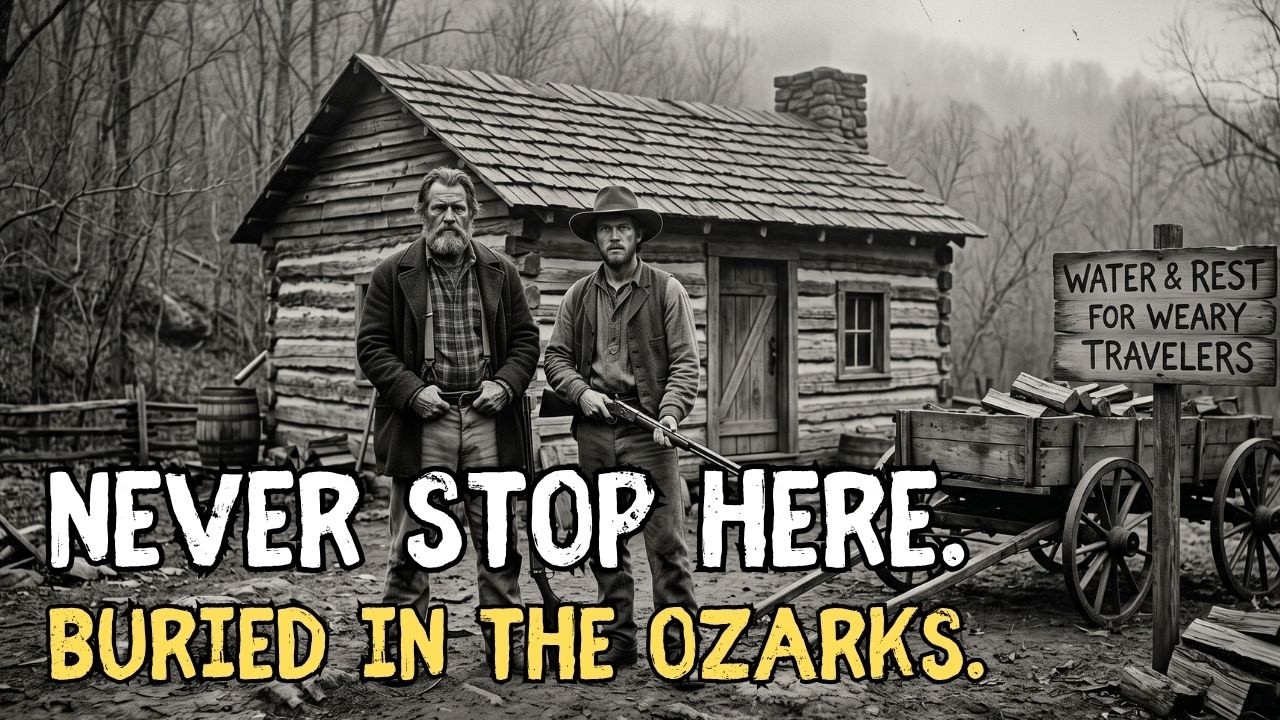
The brothers who lived there, Elias, 37, and Jeremiah Stillwell, 34, were gone. Their coats still hung by the door, and their rifles remained mounted above the fireplace. It appeared they had vanished in the middle of a meal. Weston pressed on to Marshfield despite the worsening weather to report his discovery to Sheriff James Harrington.
The following day, a search party of six men, including the sheriff, arrived at the property. They found no signs of a struggle, but beneath a floorboard under Elias Stillwell’s bed, they discovered a ledger book containing 37 entries dating from October 1863 to November 1867. Each entry listed a name, a date, and notations about items of value: watches, coins, a fine coat. Some entries were marked with a simple X.
The search extended to the outbuildings, where a root cellar behind the cabin revealed a narrow tunnel leading to a hidden chamber. Inside, investigators found numerous personal effects, watches, rings, clothing, papers, and 32 pairs of boots and shoes of varying sizes. None matched the known possessions of the Stillwell brothers, strongly suggesting they had been taken from travelers who had stopped at the cabin. No bodies were found.
The Springfield, Missouri Weekly Patriot ran a front-page story on December 17th, 1867, under the headline “Strange disappearance in Webster County. Foul play suspected. ” As word spread, residents began recalling troubling details about the brothers, who had arrived in the area in 1863 during the chaos of the Civil War and claimed to be from Kentucky. They kept to themselves but were known for offering clean water and occasional meals to travelers.
Sheriff Harrington cross-referenced the ledger names against reports of missing persons and found several matches. Joseph Hammond, a Springfield merchant, had been reported missing after failing to return from a business trip in late November 1867. William Cooper, listed in an entry from July 1867, had disappeared while traveling to visit relatives. The list of travelers reported missing along routes near the Stillwell property eventually contained 23 names dating back to late 1863.
In February 1868, deputies discovered a shallow grave about half a mile from the cabin containing the remains of a man wearing tattered clerical clothing. It was Reverend Michael Donovan, a circuit preacher who had disappeared in April 1866 while journeying from Springfield to Lebanon. His name appeared in the ledger with the notation, “Man of cloth, silver cross, few coins, books of no value. ” The silver cross mentioned in the ledger was absent from the grave.
Examination of the remains revealed deeply troubling findings. According to the county physician, Dr. William Hayes, the body showed evidence of extensive post-mortem processing, with flesh removed from most bones with precision suggesting anatomical knowledge, and long bones broken at the ends in a manner consistent with marrow extraction. In March 1868, after the ground thawed, a systematic search of the property uncovered human remains in three separate locations: a deep pit behind the barn, a wooded area about 200 yards northwest of the cabin, and, most disturbingly, sealed within the walls of the smokehouse.
Dr. Hayes estimated the remains belonged to at least seven different individuals. Some bones showed evidence of having been processed with tools similar to those used in butchering animals. Among the hanging meats in the smokehouse, cuts that had initially been assumed to be venison or pork were identified as unmistakably human in origin.
In April 1868, a trapper named Theodore Palmer came forward with information. He claimed to have encountered Jeremiah Stillwell on December 11th, 1867, the day before the brothers’ disappearance was discovered, riding north with a bundle tied to a second horse. Palmer said Jeremiah seemed in a hurry and did not stop to talk as he normally would. Investigators also discovered a journal belonging to Jeremiah Stillwell wedged behind a loose stone in the hidden chamber.
Most entries were mundane, but several were deeply disturbing. An entry from August 1864 read, “E says the stew needs more salt. Travelers don’t notice any difference. Sometimes I wonder if they suspect.
The well keeps our secret. ” Another, dated April 1865, stated, “Three men today, army deserters. E said too risky, but they had good boots and a fine rifle. No one will look for them.
Used the special herbs in their coffee. ”
The references to the well prompted Sheriff Harrington to order it drained. At the bottom, workers found a layer of silt containing numerous small bones, later identified as finger and toe bones, several teeth, buttons, a gold wedding band inscribed with the initials MH to JH 1858, and a leather pouch containing human hair of various colors tied into neat bundles. Efforts to trace the brothers’ claimed Kentucky origins proved entirely fruitless.
No records of Elias or Jeremiah Stillwell could be found in Kentucky or any surrounding states, raising the possibility that Stillwell was an assumed name. By August 1868, with no new leads and the brothers still missing, the active investigation wound down. The case remained officially unsolved for nearly a century. It was reopened in significance in 1952 during a renovation of the Webster County courthouse, when workers discovered a sealed compartment in the basement containing documents long believed lost in a fire in 1892.
These included detailed inventories of items found in the hidden chamber and several photographs taken at the scene, among the earliest examples of crime scene photography in Missouri history. The recovered documents also included correspondence between Sheriff Harrington and authorities in other states. A letter from the Sheriff of Daviess County, Kentucky, dated June 3rd, 1868, stated that no record of the Stillwell brothers existed, but described a strikingly similar case from 1861 involving brothers named Ezekiel and Joshua Hartley, who had disappeared following accusations of grave robbing and customer poisoning at their roadside tavern. The descriptions matched, with Ezekiel now approximately 37 and Joshua 34.
Both were known for unusual interest in anatomy and preservation methods, and Joshua had briefly worked as an assistant to a local doctor before being dismissed. The Hartley brothers had operated a tavern called Hartley’s Rest on a road between Owensboro and Hartford from 1858 to 1861, earning a reputation for unusually flavorful stews and meat pies. In early 1861, suspicions arose when the local cemetery reported evidence of grave tampering, and several travelers who had stopped at the tavern were reported missing. Before authorities could question the brothers, they vanished overnight.
A history professor named Clarence Thornton published his findings in the Journal of Ozark Studies in 1953, drawing renewed attention to the case. Following his publication, an elderly woman named Sarah Wilkes shared a story passed down through her family. Her grandfather, James Wilkes, had been a member of the 1868 search party. According to family lore, the search had uncovered a hidden room beneath the cabin floor containing what he called instruments of torture and a chair with restraints.
Wilkes said Sheriff Harrington ordered the men not to include this in the reports to spare the families of the missing. Thornton’s research also uncovered a curious detail about the brothers’ disappearance. The abandoned meal on their table had included two plates, yet evidence suggested a third person had been present. A third chair was pulled out, and a partial footprint in spilled stew was of a different size than either brother’s known footwear.
In 1955, construction workers clearing land for a new highway approximately 12 miles north of the former Stillwell property unearthed human remains in a shallow grave. The remains were determined to belong to a male in his 30s who had died approximately 80 to 90 years earlier, with a single gunshot wound to the back of the skull. Found alongside the remains was a pocket watch with the initials ES engraved inside. Investigators concluded they had found Elias Stillwell, murdered and buried far from the cabin.
The victim’s right hand was missing entirely, removed post-mortem with a sharp instrument. In 1958, a retired sheriff from Pike County, Illinois, reported that in 1869 a man matching Jeremiah’s description had been briefly detained in Pittsfield, Illinois, for questioning regarding a suspicious death at a boarding house. The man, who gave his name as Jeremy Stillson, was released after witnesses provided an alibi and left town immediately afterward. In 1967, exactly 100 years after the brothers’ disappearance, the Webster County Historical Society erected a small marker near where the cabin once stood, reading, “To the Stillwell cabin, 1863-1868, scene of unsolved disappearances that haunted the Ozark frontier.
” The same year, the Springfield News-Leader ran a week-long series on the case. A significant development came when the descendants of Dr. William Hayes provided a journal he had kept with far more detailed observations than appeared in official reports. Hayes had written that the preparation of the human remains showed evidence of specialized knowledge, and that certain parts were clearly preferred over others, suggesting a ritualistic or preferential aspect to the brothers’ consumption patterns.
The meat had been processed using techniques one might expect from a trained butcher or medical professional, with certain organs carefully removed and preserved separately. In 1968, Harold Weston, great-grandson of Thomas Weston, donated a box of his ancestor’s personal papers to the Webster County Historical Society. Among these was a journal containing a startling confession. An entry dated April 17th, 1882, read, “What I told the sheriff about discovering the Stillwell place abandoned was not the whole truth.
I had stopped there many times before, always alone, always careful. That final day, I arrived to find Elias dead at the table, his face in his stew. Jeremiah held a gun, shaking like a leaf. He said he was going to tell, said he couldn’t live with it anymore.
He made me help him load Elias onto a horse. We rode north together until we found a suitable place to bury him. Jeremiah gave me a gold watch and 50 dollars to keep quiet, then said he was heading for Oregon Territory. I have not seen him since.
May God forgive me for my silence and complicity. ”
Weston also wrote of accepting meals from the brothers, stating, “I never suspected the true nature of their stew. God help me. I consumed it with relish, complementing them on its rich flavor.
How many poor souls passed my lips in those meals? The thought torments me nightly. ” He described Jeremiah speaking openly about their history during their ride north, revealing that they had begun their crimes in Kentucky after their parents died and left them destitute. What had started as grave robbing had evolved into something far darker when they realized they could profit from both the possessions and the remains of their victims.
Weston wrote that Jeremiah spoke of their methods matter-of-factly, including using herbs that would make travelers drowsy without affecting the taste of the food. In 1969, a team from the anthropology department at the University of Missouri examined the photographs and descriptions of the remains. Their analysis concluded that the processing methods showed remarkable consistency and anatomical knowledge, with selective removal of certain body parts, particularly muscle groups from the thighs, shoulders, and back, cuts that would be considered prime in traditional butchery. The Missouri State Police officially closed the Stillwell case in 1969, classifying it as solved despite the absence of a trial or definitive proof of what became of Jeremiah Stillwell.
The official conclusion was that the brothers had killed at least 21 travelers between 1863 and 1867. In 1972, a historical researcher discovered that a man named Jerome Stillman had purchased land near Portland, Oregon in 1869, establishing a way station for travelers. The physical description matched Jeremiah Stillwell, and during the three years he operated the property, at least two travelers were reported missing after being seen heading toward it. Stillman sold the property in 1872 and vanished from records.
In 1975, renovations to a historical building in Sacramento, California, uncovered a journal belonging to a man who identified himself only as JS, with entries dating from 1873 to 1878. The journal described the author’s life as a cook in a mining camp in the Sierra Nevada foothills, with passages about special techniques for preparing meat and secret ingredients that made his stews particularly flavorful. An entry from 1877 stated, “Sometimes I miss E in our cabin in the hills. He was weak at the end, but for years we perfected our craft together.
The guests never suspected what nourishment they received at our table. ” The journal ended abruptly in October 1878. In 1980, an archaeological survey of the Stillwell property found that soil samples from around the well showed unusually high concentrations of human bone fragments. The team also discovered a previously unknown pit behind the smokehouse containing a layer of ash and charred bone fragments, indicating some remains had been burned.
A small tin box buried beneath the cabin’s hearth contained a daguerreotype photograph of two young men standing beside an older couple. On the back was written, “Ezequiel and Joshua Hartley with mother and father, 1848,” confirming the brothers’ original identities. A historian researching Missouri Civil War records discovered that a Union patrol had stopped at a cabin matching the Stillwell property’s description in October 1863, shortly after the brothers established themselves. The patrol leader’s report mentioned accepting a meal from two Kentucky men and noted that three of his men fell ill afterward, though all recovered.
The patrol leader described the brothers as oddly hospitable and noted that they seemed visibly disappointed when the patrol announced their intention to continue rather than camp for the night. In 1992, a true crime author published “The Stillwell Brothers, America’s Forgotten Predators,” which became a regional bestseller. Following publication, a woman from northern California shared a family story about a great-grandfather who ran a boarding house in Sacramento in the late 1870s. Among his tenants was a middle-aged man who worked as a cook and called himself John Smith.
According to family lore, Smith died suddenly in 1879 of an apparent stroke. When the boarding house owner cleaned out his room, he discovered a locked trunk containing watches, rings, and other valuables inconsistent with his modest lifestyle, along with a journal containing entries that disturbed the owner so deeply he burned it after reading a few pages. The known victims represent only those who could be connected to the brothers through evidence found at their Missouri cabin, likely a fraction of their total victims across multiple states and identities. The final whereabouts of Jeremiah Stillwell remain a mystery.
The land where the cabin once stood has long since returned to wilderness, and the well was filled in during the 1970s after several animals were found dead nearby.