Historians have long debated the quality of leadership on both sides of the American Civil War, a conflict that claimed more than 600,000 battlefield deaths. Among the commanders who shaped the war’s course, a handful stand out for their military genius, while others are remembered primarily for their failures. Ulysses S. Grant is widely considered the North’s most effective commander.
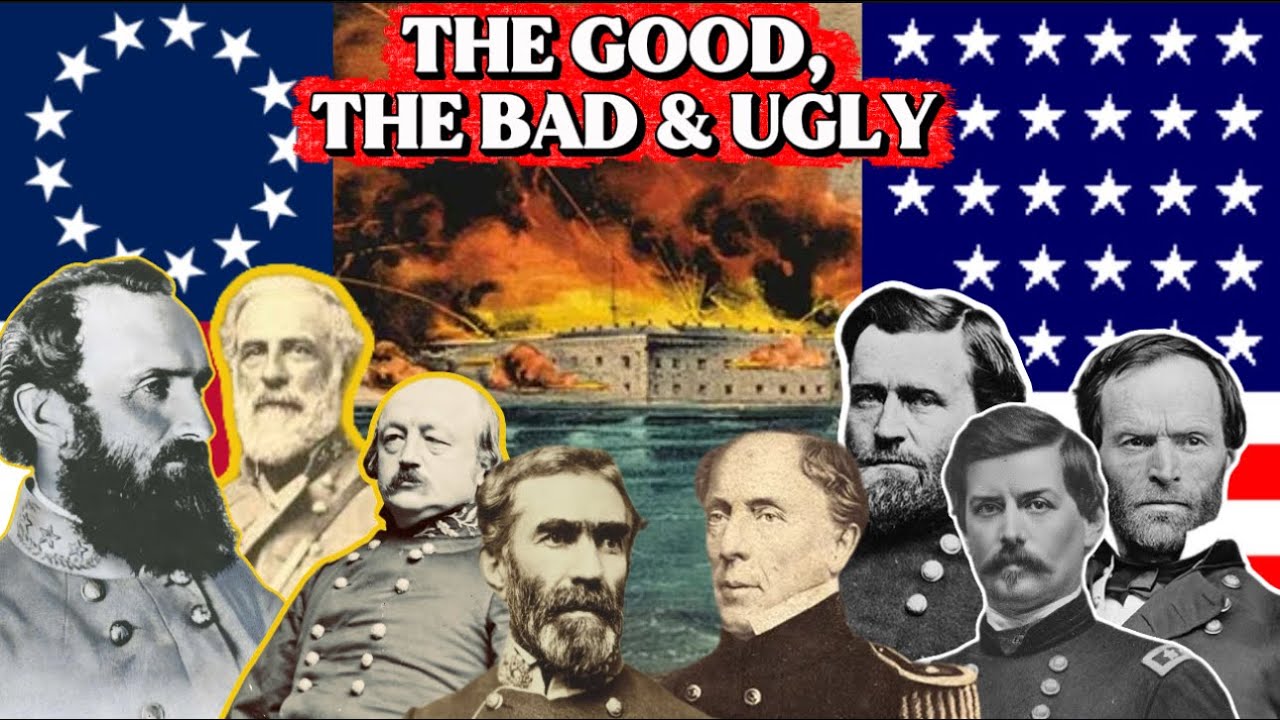
Despite early career disappointments and a personal struggle with alcoholism, Grant displayed remarkable resilience and strategic vision. President Lincoln valued his tenacity, famously saying, “I cannot spare this man. He fights. ”
Grant’s leadership style contrasted sharply with his predecessors.
Earlier Union commanders under Lincoln had been timid, politically ambitious, or insubordinate. Grant understood the war as a conflict of attrition, recognizing that the North’s superior manpower and resources made victory inevitable. He pressed forward relentlessly without making excuses. His innovative approach included coordinating infantry, cavalry, and artillery in combined operations, and he became a master of military logistics.
Beyond his battlefield success, Grant broke the Union Army’s color barrier by creating the Bureau of Colored Troops. As president, he used federal power forcefully to combat the first iteration of the Ku Klux Klan. Later in life, Grant lost his fortune in a fraudulent investment scheme. Knowing he was dying, he raced against time to write his memoirs to provide for his family.
Published by Mark Twain, “The Personal Memoirs of U. S. Grant” became a literary masterpiece and one of the best-selling books of its era, earning his family over $12 million in today’s dollars. William Tecumseh Sherman, Grant’s loyal subordinate, is remembered for bringing the war directly to the Southern civilian population.
His famous March to the Sea through Georgia and the Carolinas destroyed Confederate infrastructure and morale. Before the war, Sherman experienced repeated failures, including in banking and law, and suffered a public nervous breakdown in 1861 that newspapers labeled insanity. His affection for the South made his later role in its devastation personally painful. His policy of targeting the economic and psychological backbone of the Confederacy is considered foundational to modern psychological warfare.
Ironically, after the war he became a leading voice for reconciliation with the South, yet as commanding general of the army he directed brutal campaigns against Native American tribes. He never actually said “war is hell” in a public speech, though he told military graduates that “war is all hell. ”
On the Confederate side, Robert E. Lee remains a figure of profound contradictions.
A career U. S. Army officer who served with distinction in the Mexican-American War, Lee was offered command of the Union armies by Lincoln. He refused, choosing instead to defend his native Virginia.
Lee called secession “a revolution and a calamity” and disliked slavery, which he termed “a moral and political evil. ” His loyalty was to his state rather than to the Confederate cause or the institution of slavery. Despite his tactical brilliance, his aggressive offensive strategy at Antietam and Gettysburg caused catastrophic casualties the South could not afford. His defeat at Gettysburg, where he lost about 15,000 men in a failed assault known as Pickett’s Charge, marked a turning point.
He was forced into a defensive campaign that prolonged the war for two more years though the Confederacy was already doomed. After the war, he urged Southerners to accept the outcome and unite in restoring harmony, reportedly declining invitations to build monuments on battlefields. Thomas “Stonewall” Jackson earned his famous nickname at the First Battle of Bull Run, where his men stood “like a stone wall” against Union assault. A devout Presbyterian, Jackson’s Calvinist faith gave him unshakable confidence in battle, though it manifested in strict, even legalistic ways.
While teaching at VMI in Lexington, Virginia, Jackson started a Sunday school for enslaved and free Black children, teaching them to read so they could study the Bible. Yet he fully supported slavery as ordained by God and fought to preserve the institution. Jackson was accidentally shot by his own men at Chancellorsville. Surgeons amputated his left arm, but he died eight days later from pneumonia, likely caused by an infection that doctors failed to properly drain.
The Confederacy lost its most aggressive tactical commander, a loss widely linked to the subsequent failure at Gettysburg. Among the war’s less successful commanders, George B. McClellan earned the nickname “the Young Napoleon” for his organizational brilliance. He rebuilt the demoralized Union Army into a professional fighting force, but consistently refused to commit it to decisive battle.
Even when Union soldiers discovered a copy of Lee’s battle plans, McClellan persisted in believing he was outnumbered, and he failed to exploit the advantage. His letters to his wife revealed grandiosity and paranoia, believing Lincoln and Stanton were actively working against him. Removed from command after Antietam, he later ran against Lincoln as the Democratic presidential candidate in 1864. Braxton Bragg is often considered the worst Confederate general.
Placed in high command of the western armies, he was responsible for several costly Southern defeats. His subordinates described him as vindictive and deceitful, and his command inspired near-mutiny. Paradoxically, Bragg was arguably the best administrative organizer in the Confederacy. After being relieved, he served as chief of staff to Jefferson Davis, functioning as the Confederacy’s de facto chief of the general staff.
While he freed his slaves in his will and argued slavery was a dying institution, his tactical incompetence overshadowed his administrative contributions. Benjamin Butler, a Massachusetts lawyer and politician, was politically useful to Lincoln. Early in the war, he invented the legal category of “contraband of war,” refusing to return escaped enslaved people to their owners. However, his military record was marked by repeated failures, and Grant called his campaigns “as helpless as a child on a battlefield.
”
His occupation of New Orleans was notorious. He issued an order stating that women who insulted Union soldiers would be treated “as women of the town plying their avocation,” earning him the epithet “Beast Butler. ” Rumors of corruption followed him throughout the war. John B.
Floyd, a Virginia politician who served as U. S. Secretary of War before the war, was widely suspected of transferring over 105,000 federal arms to Southern arsenals before secession. At Fort Donelson, he abandoned his command and escaped, leaving his troops to surrender to Grant.
His tenure as Secretary of War was marked by scandal, including accusations of issuing fraudulent bonds. His military career ended quietly after Fort Donelson, and he died in obscurity in August 1863. The Civil War’s generals were a study in contrasts.
Some demonstrated genuine strategic genius that shaped the nation’s future, while others failed so completely that their names became synonymous with military incompetence.