When Edward IV died in April 1483, his dynasty seemed secure, with two young sons to continue the York line. Within months, both boys had vanished inside the Tower of London, and his daughters had been declared illegitimate by an act of Parliament. In a single generation, the children of the handsome Yorkist king who won his crown through war and charm scattered into monasteries, marriage alliances, and obscurity. One daughter, Elizabeth of York, became the mother of the Tudor dynasty.
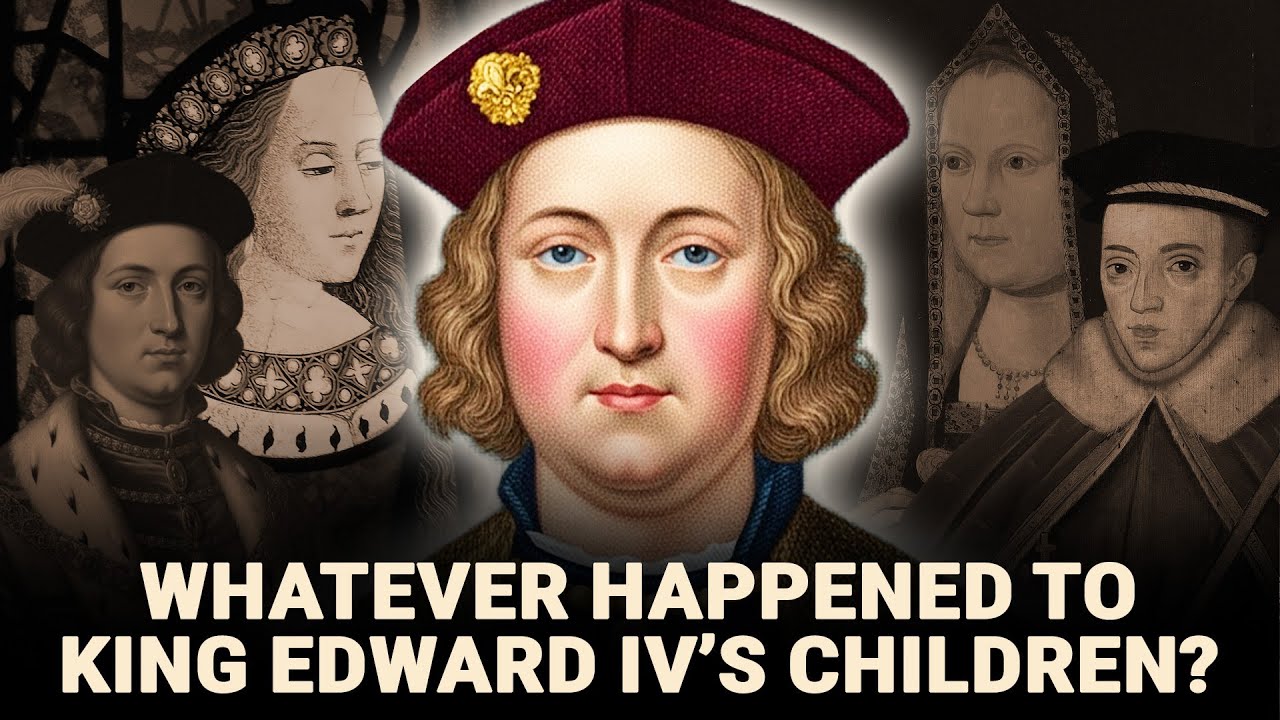
Two princes disappeared into one of England’s most enduring mysteries. The others found quiet lives far from the throne their father had fought for. Together, their stories show how a royal bloodline dissolves and transforms across generations, carrying York DNA into noble houses and humble gentry families alike. Elizabeth of York, born in February 1466, was her father’s most valuable diplomatic asset.
As a child, she was promised at various times to the Dauphin of France and the Duke of Burgundy’s heir, though each negotiation collapsed as European politics shifted. When her uncle Richard III seized the throne and declared her illegitimate, she fled to sanctuary at Westminster Abbey, her future uncertain. The Lancastrian claimant Henry Tudor changed everything. On Christmas Day 1483, he publicly vowed to marry Elizabeth if he won the crown, transforming her from political liability into the key that would unite the warring houses.
After Henry’s victory at Bosworth Field in August 1485, the couple married in January 1486, and Elizabeth became queen of England before her twentieth birthday. Their marriage was a calculated healing of national trauma. Elizabeth bore Henry eight children, though only four survived to adulthood. Her eldest son Arthur embodied their dynastic hopes, named for the legendary king to emphasize the Tudors’ ancient British heritage.
When Arthur died young, her second son Henry became heir, the future Henry VIII. Elizabeth walked a careful line between honoring her York heritage and supporting her Tudor husband, maintaining relationships with York loyalists while never challenging Henry’s authority. Her diplomatic skill proved vital during rebellions led by Lambert Simnel and Perkin Warbeck, both claiming to be her supposedly dead brothers. She died in February 1503, days after giving birth to a daughter who also died.
Through Elizabeth, Edward IV’s blood entered the Tudor line permanently. Her son Henry VIII, granddaughter Mary I, and great-granddaughter Elizabeth I all carried York genetics alongside Tudor ambition. The white rose of York lived on in the royal arms, symbolically united with the red rose of Lancaster. Mary of York, born in August 1467, enjoyed a relatively carefree childhood in the royal nursery.
Contemporary accounts describe her as lively and intelligent, with a particular talent for music. By 1481, she had been tentatively promised to Frederick, the future king of Denmark, and reportedly studied Danish phrases and maps of her future kingdom. In May 1482, at just 14 years old, Mary died suddenly at Greenwich Palace. Contemporary sources give no clear cause, suggesting either illness or possible complications from early pregnancy.
Her death shocked the court and devastated her parents, eliminating the possibility of a lasting York-Danish alliance. Cecily of York, born in March 1469, was named for her formidable grandmother Cecily Neville. She proved particularly adept at languages, eventually speaking French, Latin, and some German fluently, and composed several pieces of music that survive in manuscript form. After Henry Tudor claimed the throne, she married John Welles, Viscount Welles, in late 1487.
The marriage served Tudor interests perfectly, neutralising potential York claims while rewarding a loyal supporter. Contemporary letters between Cecily and John reveal warmth and mutual respect rare in political alliances. When Welles died in 1498, Cecily managed his estates competently as a wealthy widow for three years. In 1502, Cecily made a controversial second marriage to Thomas Kyme, a Lincolnshire gentleman of modest background.
The match angered Henry VII, who briefly confiscated her dower lands as punishment. But the marriage proved even happier than her first, and she bore two daughters who carried Edward IV’s bloodline into obscure but respectable gentry families. Cecily’s daughters ensured her genetic legacy continued through minor English nobility for generations. By choosing love over status, she ensured her father’s bloodline would survive in unexpected places, beyond the reach of Tudor persecution that targeted obvious York claimants.
Edward V was born on November 2, 1470, in sanctuary at Westminster Abbey, while his father fought to reclaim his throne. After Edward IV regained his crown in 1471, the young prince was established in his own household at Ludlow Castle on the Welsh border, trained by leading humanist scholars under the guidance of his uncle Anthony Woodville. Edward IV’s unexpected death in April 1483 thrust the 12-year-old prince into the center of England’s most enduring mystery. As he traveled from Ludlow toward London for his coronation, his uncle Richard, Duke of Gloucester, arrested his Woodville relatives at Stony Stratford and assumed control of the royal party.
The boy continued to London with dignity, lodged in the Tower’s royal apartments as traditional protocol dictated. Richard postponed the coronation indefinitely, then had Parliament declare Edward IV’s marriage invalid, making all his children illegitimate through the act known as Titulus Regius. The young king’s claim to the crown was legally destroyed. During the summer of 1483, sightings of both princes in the Tower gradually ceased, and by autumn rumors of their deaths were circulating widely.
No bodies were produced, and no official announcement was made. The mystery of what happened to the Princes in the Tower, as they became known, would captivate historians for centuries. Various theories emerged, blaming Richard III, suggesting the boys had been smuggled away for their safety, or pointing to Henry Tudor’s agents. Recent scholarship has refined understanding of Edward V’s situation without solving the central mystery.
The 1674 discovery of child skeletons in the Tower provided tantalizing but inconclusive evidence. What remains clear is that Edward V represented the last realistic hope for pure York succession, and his disappearance cleared the path for the Tudor dynasty. Margaret of York was born in April 1472, during the secure years of Edward’s second reign, and died just eight months later. Her death devastated her parents, particularly her mother, who had already endured the anxieties of bearing royal children during political upheaval.
The infant princess was buried at Westminster Abbey. Richard of Shrewsbury, Duke of York, was born in August 1473, securing the succession with a spare heir. In 1478, the 5-year-old was betrothed to Anne Mowbray, the 8-year-old heiress of the Norfolk dukedom, in a magnificent wedding ceremony. Anne died in 1481, leaving Richard a widower at a young age and creating inheritance disputes over the Norfolk estates.
When Richard III moved against the Woodville faction in 1483, young Richard initially remained in sanctuary with his mother. But Cardinal Bourchier convinced Elizabeth Woodville that her son would be safer with his brother in the Tower during coronation preparations. In June 1483, the 9-year-old left sanctuary forever, joining his brother in the Tower’s royal apartments. Contemporary witnesses noted his cheerful demeanor, as he seemed to view the reunion as an adventure rather than understanding the political trap closing around both brothers.
The boys played together in the Tower’s gardens, but their freedom gradually decreased as servants were reduced and access to visitors became restricted. The last reliable sighting of Richard occurred in summer 1483, after which both princes disappeared from public view. Pretenders later claimed to be Richard, most notably Perkin Warbeck, who insisted he had escaped the Tower and lived in exile. These claims reflected public desire to believe that at least one prince had survived, but their joint disappearance eliminated the strongest York male claims and enabled Tudor succession.
Anne of York was born in November 1475, the fourth surviving daughter. She showed an early inclination toward spiritual matters, excelling in religious studies and spending hours in the royal chapel. In February 1495, the 19-year-old married Thomas Howard, later Earl of Surrey and eventually Duke of Norfolk, in an alliance that served Henry VII’s strategic interests. Anne bore Thomas three children and managed the family’s numerous estates competently.
Her household became a center of learning and religious observance, and she founded several chantries and supported monastic houses. Her spiritual devotion intensified after the death of her infant daughter, and she began wearing a hair shirt beneath her court dress. After Thomas’s death in 1524, Anne deepened her religious commitments, effectively retiring from court life. Her traditional Catholic devotion put her at odds with Henry VIII’s emerging break from Rome, though she avoided direct political involvement.
She died in November 1511, and her tomb emphasized her piety and charitable works rather than her royal birth. George, Duke of Bedford, was born in March 1477, Edward IV’s third son. The infant duke carried significant political weight, but died in March 1479 at just 2 years old. His death left Edward V and Richard as the only surviving sons, a reduction that would prove catastrophic when political crisis struck the family just four years later.
Catherine of York was born in August 1479, the fifth surviving daughter. She was only 3 years old when her father died and her uncle seized power, transforming her from princess to bastard overnight. She remained with her mother in sanctuary during the tumultuous months of 1483, watching armed men guard the doors and sensing her mother’s terror. In 1495, Catherine married William Courtenay, Earl of Devon, in a marriage that proved harmonious and productive.
She bore three children and became an capable administrator of the Courtenay estates in the southwestern counties. Her household became a center of learning and culture, patronizing scholars and artists. After William’s death in 1511, Catherine chose not to remarry, instead focusing on managing the family inheritance and ensuring her children’s integration into Tudor society. She supported monastic reform movements and became known for her charitable works among Devon’s poor.
She died at Colcombe Castle in November 1527, surrounded by her children and grandchildren. Bridget of York, born in November 1480, was the last of Edward IV’s children. She was barely 2 when her father died, and the sanctuary months at Westminster profoundly shaped her worldview. She showed early signs of religious calling, preferring prayer to play and showing unusual interest in monastic routines.
In 1492, the 11-year-old entered Dartford Priory as a novice nun. Henry VII encouraged this choice, which demonstrated Tudor piety, removed a potential focus for York loyalist sentiment, and provided a respectable alternative to problematic marriages. The king’s generous endowments ensured she lived comfortably while pursuing her spiritual vocation. Bridget spent over 40 years at Dartford, becoming one of the community’s most respected members and serving in various administrative roles.
Her death in 1517 marked the end of Edward IV’s direct line, symbolically closing a chapter in English royal history that had begun with such promise in the 1460s. Among the legitimate heirs stood one acknowledged illegitimate son, Arthur Plantagenet, born around 1472 to an unknown mother. Edward IV provided him with education, status, and opportunities, reflecting the flexible approach to royal bastards that characterized medieval monarchy. His illegitimate status paradoxically protected him during the succession crises that destroyed his legitimate brothers.
Henry VII saw no threat in Edward IV’s bastard son, and Arthur’s marriage to Elizabeth Grey brought him the Lisle viscounty and substantial estates. His greatest opportunity came when Henry VIII appointed him Deputy of Calais, one of the most important positions in Tudor government. His tenure produced the Lisle letters, an extensive correspondence providing unparalleled insight into Tudor governance and society. Arthur’s career ended in 1540 when he was arrested on charges of treasonous correspondence with Cardinal Pole and other Catholic exiles, accusations probably fabricated during Henry VIII’s paranoia about Catholic plotting.
He died in the Tower of London in 1542, reportedly of shock upon learning of his reprieve, as the royal pardon arrived too late. In less than 50 years, the children of Edward IV shaped the turning of England from Plantagenet to Tudor. Some built new dynasties, others vanished into legend or cloister. Elizabeth’s womb united the roses and bore the Tudor line.
Mary’s early death eliminated Danish alliance possibilities. Cecily found love in Lincolnshire obscurity. Edward and Richard disappeared into mystery that still captivates historians. Edward IV’s genetics spread through noble families across England, from Howard palaces to Courtenay castles to unnamed gentry households where York descendants lived quietly for generations.
From the Tower of London to Westminster’s vaults, traces of his line remain half-hidden in brass, stone, and bloodlines that still touch Britain’s throne today. The white rose of York never truly died. It simply took root in unexpected soil, growing quietly through the centuries that followed.