In October 1925, one of the Soviet Union’s most respected military leaders entered a Moscow hospital for what was described as a routine operation. He never left the operating table alive. Officially, the death of Mikhail Frunze was ruled a medical tragedy. But the circumstances surrounding it, including the political pressure applied before the surgery and the warnings of his own doctors, gave rise to suspicions that have never fully faded.
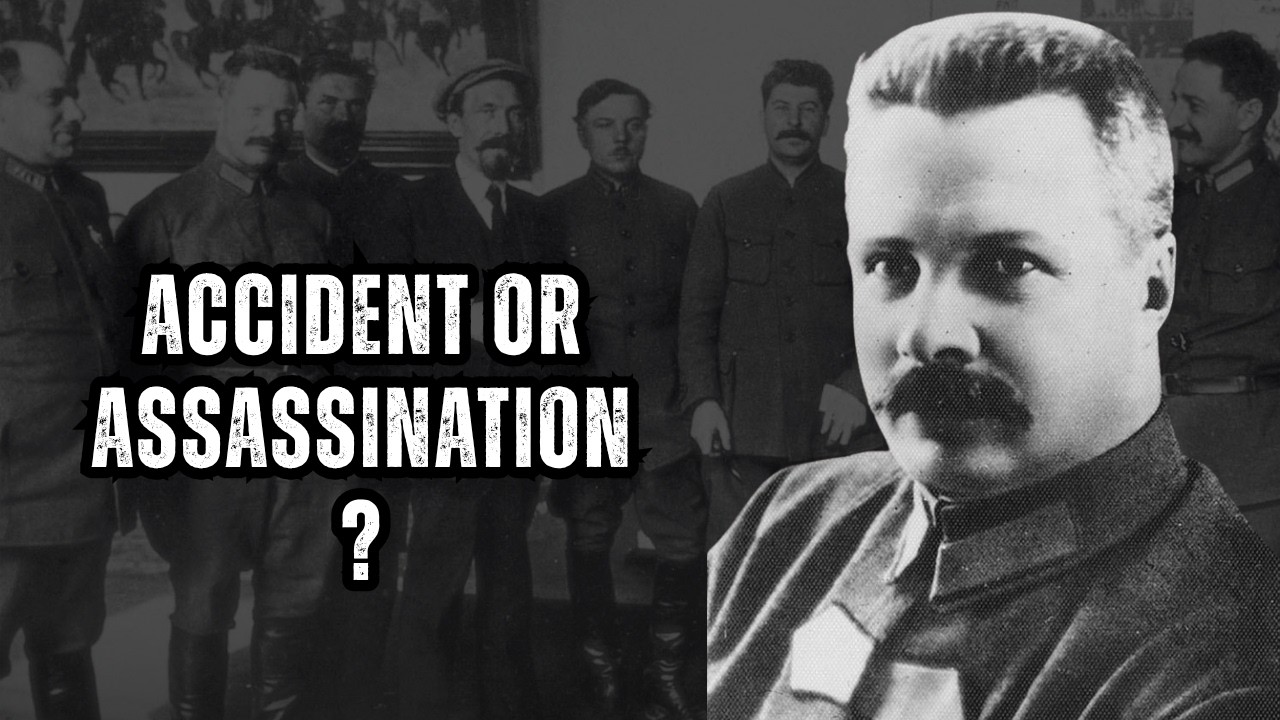
Mikhail Frunze was not just a senior Soviet official. He was one of the most accomplished figures to emerge from the Bolshevik Revolution. By 1925, he stood at the peak of his power. Born in February 1885 in Pishpek, now Bishkek, Kyrgyzstan, he graduated with a gold medal from his gymnasium and studied at the Saint Petersburg Polytechnic University.
In 1904, aged 18, he joined the Russian Social Democratic Labor Party and sided with Lenin’s Bolshevik faction. His revolutionary career included leading a major textile workers’ strike in Ivanovo during the 1905 revolution, for which he was sentenced to death twice. Both sentences were commuted to lifelong hard labor in Siberia. He escaped in 1916 and resumed revolutionary agitation among soldiers on the Western Front during World War I.
By the time of the October Revolution in 1917, he was leading an armed force of workers in Moscow. Frunze’s reputation was cemented during the Civil War. He commanded the Fourth Army on the Eastern Front and defeated Admiral Alexander Kolchak near Omsk. Leon Trotsky, then head of the Red Army, was so impressed that he gave Frunze command of the entire Eastern Front.
His most celebrated victory came in November 1920, when he ordered a night crossing of the Perekop Isthmus into Crimea, surprising the forces of General Pyotr Wrangel. Frunze later suppressed the anarchist movement of Nestor Makhno in Ukraine and drove Basmachi insurgents out of Turkestan. He also developed a unified military doctrine that standardized how the Red Army trained, organized, and commanded its forces. His writings on military doctrine remained influential inside the Soviet military until the 1980s.
His political rise was equally rapid. In 1921, he was elected to the Central Committee. In March 1924, he became Deputy Commissar for Military and Naval Affairs. By June 1924, he was a candidate member of the Politburo.
In January 1925, he replaced Trotsky himself as People’s Commissar for Military and Naval Affairs. He was 40 years old and at the top of the Soviet military establishment. In the unstable politics of 1925, that made him either very valuable or very dangerous. Frunze had suffered from chronic stomach ulcers for years.
Doctors had suggested surgery more than once, but he had repeatedly refused. Writing to his wife shortly before his death, he said he was feeling healthy and that undergoing an operation seemed ridiculous. After a severe episode, however, he was hospitalized. Two influential visitors came to see him: Joseph Stalin and Anastas Mikoyan.
According to multiple accounts, both men pressed Frunze to agree to surgery. His own physicians opposed the operation. They believed his weak heart could not withstand chloroform anesthesia. Their objections were overruled.
The Central Committee arranged its own panel of doctors, who recommended surgery, and the operation was scheduled. On 31 October 1925, Frunze was placed on the operating table. He never regained consciousness. Surviving documents give a precise account of the procedure.
Anesthesia was administered for 65 minutes, while the operation itself lasted only 35 minutes. Frunze had difficulty falling asleep and tolerated the anesthesia poorly. Initially, ether was used, but when Frunze experienced what the documents describe as sharp and prolonged excitement, the medical team switched to chloroform, the very substance his own doctors had warned could be fatal for him. During the operation, his pulse dropped sharply.
Cardiac stimulant injections were administered, but doctors could not stop his heart from failing. The political context of October 1925 is crucial. Lenin had been dead for less than two years, and Stalin was building influence carefully but methodically. His rivals were still active.
Frunze had recently replaced Trotsky as Commissar of War and was aligned with Grigory Zinoviev, another of Stalin’s opponents. That alignment made Frunze’s continued presence at the top of the military increasingly inconvenient for Stalin. It was Stalin, along with Mikoyan, who visited Frunze in hospital and pushed for the surgery. It was the Central Committee’s chosen doctors who overrode the medical objections.
And it was Stalin who held specific oversight responsibilities for the medical care of senior Soviet officials. Historian Roman Brackman was direct about it: Frunze had refused to support Stalin in his conflict with political opponents, and Stalin knew it. Trotskyist historian Vadim Rogovin went further, arguing that Stalin arranged for a panel of handpicked doctors to recommend surgery, knowing full well that Frunze’s own physicians had already declared the operation too dangerous. None of this has been confirmed by documentary evidence from Soviet archives.
Suspicion spread almost immediately. In May 1926, the writer Boris Pilnyak published a novella in the literary journal Novy Mir called The Tale of the Unextinguished Moon. It depicted a healthy, reluctant Red Army commander ordered by unnamed political figures to undergo a fatal surgery. Though the character’s name was different, the parallels were widely understood.
The issue of the journal was confiscated and recalled from circulation. A new issue was published without the story. Pilnyak was subjected to a nationwide campaign of vilification. In 1930, he was expelled as head of the Authors League in Moscow.
In 1937, he was arrested. In 1938, after a trial lasting 15 minutes, he was sentenced to death and executed. A man was killed for writing a story that suggested another man had been killed. That is not proof of anything, but it illustrates the system within which Frunze died.
Three explanations for Frunze’s death have been offered. The first is the most straightforward: in 1925, surgery carried risks that are difficult to fully appreciate today. Chloroform was widely used but known to cause cardiac complications in vulnerable patients, and Frunze had documented health problems. The second explanation is where most serious historians tend to land: even if no one intended for Frunze to die, the chain of decisions that led him to the operating table was political.
Stalin and Mikoyan pushed for the surgery. The Central Committee overrode the doctors’ objections. Whether or not anyone planned the outcome, the medical warnings were ignored. That is not proof of murder, but it is proof of recklessness.
The third explanation is the one Soviet authorities worked hardest to suppress: that Stalin identified Frunze as a political obstacle, independent, influential, and aligned with his opponents, and used his oversight of senior officials’ medical care to push Frunze into a dangerous operation, knowing his heart would not survive chloroform anesthesia. Multiple historians, including Brackman and Rogovin, have made versions of this argument. Supporters of this theory point to one detail. The surgeon who operated on Frunze, Dr.
V. N. Rozanov, had operated on Stalin himself four years earlier, in 1921, for appendicitis. Rozanov administered the same heavy doses of chloroform to Stalin during that procedure.
Stalin survived. Frunze did not. Others argue that one surgeon producing two different outcomes on two different patients proves nothing. No documentary evidence from Soviet archives, including those opened after 1991, has confirmed that Stalin ordered Frunze’s death.
The Soviet Union did not conduct transparent investigations into the deaths of its own senior officials. There was no independent inquiry into what happened to Frunze. The official version was stated, and that was that. The secrecy only deepened the suspicion.
Within days of Frunze’s death, Kliment Voroshilov was appointed as his replacement, formally on 6 November 1925. He was Stalin’s man and held the position for nearly 15 years. In the late 1930s, Stalin’s Great Purge tore through the Red Army. Approximately 35,000 officers were removed, thousands of them executed.
The military establishment that Frunze had built was systematically destroyed by the man who had taken power after him. Frunze’s death began to look less like an isolated incident and more like the opening chapter of something much longer. Behind the politics and the theories, there was a family. Frunze had asked visiting friends to carry a message to the Central Committee that he wanted to be buried in Shuya.
That request was not honored. He was buried in the Kremlin Wall Necropolis on Red Square. His wife Sophia died the following year, in 1926. Their two young children, a son named Timur and a daughter named Tatiana, were raised first by their grandmother.
When she died in 1931, they were adopted by Kliment Voroshilov, the man who had taken their father’s job. Timur Frunze grew up to become a fighter pilot. On 19 January 1942, he was killed in action near Staraya Russa. He was 18 years old.
A 40-year-old man who had survived two death sentences, escaped Siberia, and won a civil war entered a hospital for a surgery his own doctors opposed, under pressure from the man who stood to benefit most from his absence. The operation reportedly found no ulcers. He never came out alive.
Nearly a century later, the question of whether Mikhail Frunze was murdered remains officially unanswered.