In 1820, crowds were said to have gathered outside a courthouse in Salem, New Jersey, to watch a man die. Robert Gibbon Johnson was not being executed. He was reportedly eating tomatoes. Standing on the courthouse steps with a basket of red tomatoes, he declared he would eat them all, while doctors in the crowd warned that the fruit’s juice would turn his blood to acid and kill him before sunset.
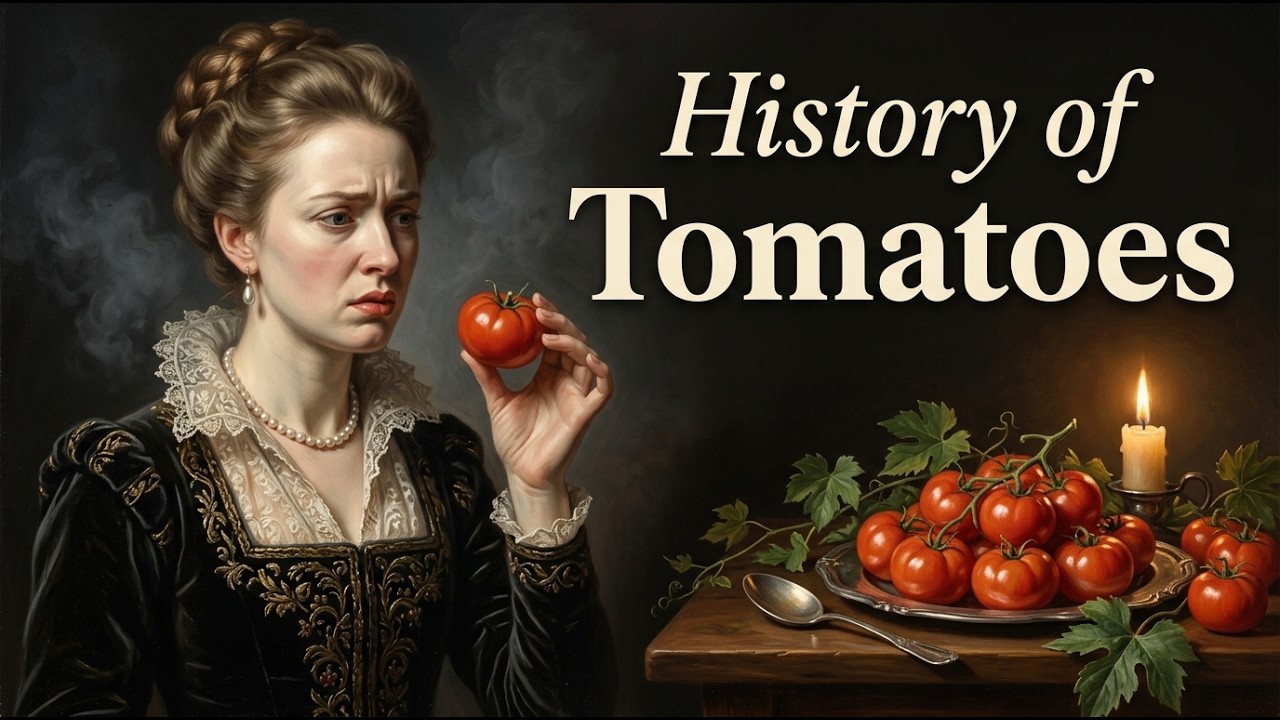
According to the legend, Johnson bit into a tomato, chewed, swallowed, and nothing happened. He took another bite and remained alive. The story has been repeated for more than 200 years, but whether it happened exactly as told is debated. Some historians believe the tale was exaggerated or invented decades after the supposed event.
What is not in dispute is why the story rings true: for centuries, Europeans and American colonists genuinely believed tomatoes could kill them. For roughly 300 years, one of the most versatile and flavorful fruits on Earth was treated as a decorative garden plant because people were too afraid to eat it. Strangely enough, they had some evidence. People really did die after eating tomatoes.
But the culprit was not the fruit. To understand how the tomato went from suspected poison to a staple of pizza, pasta, and ketchup worldwide, you have to return to its origins in the mountains of South America, thousands of years before any European laid eyes on it. Wild tomatoes originally grew in the Andes along the western range of South America, in what is now Peru and Ecuador. Those early fruits were small and bitter, roughly the size of blueberries, often yellow or green, growing in rocky high-altitude soil.
Birds and animals ate them, and eventually humans recognized they were edible, although it took time before anyone considered them worth deliberate cultivation. The civilizations that first turned the wild tomato into an actual crop were the peoples of Mesoamerica, in what is now Mexico and Central America. No one knows exactly when cultivation began, but the Aztecs were growing tomatoes by at least the 15th century and possibly earlier. They used them in a variety of dishes, often mashing them with chili peppers and ground pumpkin seeds to make sauces that were early ancestors of modern salsa.
Spanish historian Bernardino de Sahagún, who documented Aztec life in the mid-16th century, described bustling open-air markets in the Aztec capital Tenochtitlan, where vendors sold tomatoes of different sizes and colors, from small green ones to large red ones. The Aztec word for the fruit was “tomatl,” roughly translating to something like “the plump thing” or “swollen fruit,” which evolved through Spanish into the English word “tomato. ”
The Aztecs did not find tomatoes suspicious or dangerous. For them, it was simply food.
But the Aztecs were not the ones who introduced the fruit to the rest of the world. That task fell to the Spanish, who had a very different relationship with the plants and animals they found in the Americas. When Hernán Cortés and his soldiers arrived in Mexico in 1519, they encountered Aztec markets filled with products they had never seen. Along with corn, avocado, cacao, and chili peppers, they found tomatoes.
The Spanish took samples of everything back to Europe, partly out of curiosity and partly because they were looking for anything that could be profitable. Tomato seeds crossed the Atlantic to Spain sometime in the early 16th century, and from Spain, the plant slowly spread into the gardens of southern Europe. That is when things turned strange. When the tomato reached Europe, it landed in the middle of a botanical minefield.
Early European herbalists and botanists looked at the tomato plant and immediately recognized a family resemblance. Tomatoes belong to the nightshade family, which had a terrifying reputation in Europe. The most notorious member was Atropa belladonna, known as deadly nightshade, a plant whose berries can kill an adult within hours. Henbane and mandrake, both used in poisons and associated with witchcraft, were also nightshades.
When European herbalists studied the tomato and noticed the same leaf shapes, flower structures, and family traits as these known killers, they were not eager to add it to their salads. Italian physician and botanist Pietro Andrea Mattioli was among the first to formally classify the tomato in 1544, placing it alongside mandrake. He called it “pomodoro,” meaning golden apple, because the first tomatoes to reach Italy were a yellowish variety. Mattioli described the fruit as edible but was cautious, noting it belonged to a plant family used to make poisons.
Other botanists across Europe were less diplomatic. English herbalist John Gerard declared the entire plant poisonous in the 1590s, writing that it produced something cold and harmful. His widely read herbal remained influential in English-speaking countries for generations. But the real reason the tomato’s poisonous reputation took hold in northern Europe had nothing to do with botany.
It was about the plates. Specifically, pewter plates. In the 16th and 17th centuries, wealthy Europeans dined using pewter tableware. Pewter is an alloy made mostly of tin, but the pewter of that era also contained significant amounts of lead.
Tomatoes are highly acidic. When acidic tomato juice sat on a pewter plate, it leached lead from the metal into the food. The person eating was not poisoned by the tomato; they were poisoned by their dinnerware. But no one knew that at the time.
What they knew was that wealthy people who ate tomatoes from fine pewter plates became ill, sometimes severely, and occasionally died. Lead poisoning causes nausea, abdominal pain, confusion, and convulsions, and eventually death. Symptoms could take days or weeks to fully appear, making it almost impossible to identify the exact cause. A nobleman eats a tomato at dinner, three days later he is doubled over in pain, a week later he dies.
The only unusual thing he had eaten was that strange red fruit from the garden. The link seemed obvious, and no one was running controlled experiments to verify it. Meanwhile, poor people in southern Europe who ate tomatoes from wooden plates or clay bowls, or straight from the vine, were perfectly fine. They had been eating tomatoes for decades without problems.
But the wealthy were the ones with influence. They wrote books, consulted physicians, and published warnings in herbal guides. Their deaths were documented, and their doctors shaped medical opinion. The deaths of poor farmers rarely entered the historical record, let alone their eating habits.
So the conclusion spread through the upper classes of European society: the tomato is deadly. Do not eat it. The tomato earned its most famous English nickname, “poison apple,” and it stuck for an astonishingly long time. In Britain, tomatoes were grown as curiosities, displayed in gardens alongside flowers, admired for their bright colors and attractive vines, but never eaten.
For more than 200 years, that was the tomato’s entire identity. In parts of Germany and other northern European countries, there was another layer of fear linked to something darker. The tomato acquired the nickname “wolf peach. ” Folk tales connected nightshade plants to werewolves and witchcraft, and the tomato, as a nightshade relative, inherited that supernatural suspicion.
Herbalists used nightshade plants for ointments and potions associated with hallucinatory rituals and occult practices. The scientific name Linnaeus gave the tomato in 1753 was Solanum lycopersicum, which literally translates to “wolf peach of the nightshade family. ” Even taxonomists were wary. The French had their own view.
They called the tomato “pomme d’amour,” meaning love apple. Exactly why remains debated. Some historians think it was a corruption of the Italian “pomodoro,” golden apple, which sounded like “pomme d’amour” to French ears. Others believe the French associated tomatoes with aphrodisiac qualities, partly because they were exotic and forbidden, and partly because of their attractive red appearance.
Either way, the French were not rushing to eat it either. The love apple was treated as a curiosity and a conversation piece, something a wealthy person might grow in a garden to impress visitors, but it did not seriously enter French cooking until much later. That is what makes the Italian story so striking. While the rest of Europe treated the tomato as a time bomb, Italy was quietly falling in love with it.
Italian peasants in the southern regions, especially around Naples and Sicily, began cooking with tomatoes as early as the late 16th century. They were not wealthy people eating from pewter. They were farming communities using clay pots and wooden bowls. They quickly discovered that tomatoes taste amazing when cooked with olive oil, garlic, and a little salt.
The tomato’s fresh acidity complemented the rich, fatty flavors of Mediterranean cooking in a way nothing else could. By the mid-17th century, tomato-based sauces had become a staple in southern Italian kitchens. The first known Italian cookbook to include tomato recipes was published in 1692 by Antonio Latini, who worked as steward for the Spanish viceroy in Naples. Latini included a recipe for tomato sauce he described as being in the Spanish style, pointing to the link between Spain’s early familiarity with tomatoes and Italy’s later embrace.
Naples, under Spanish control at the time, had stronger cultural ties to Spain than to the rest of Italy, and that Spanish influence likely brought tomatoes into Neapolitan kitchens. From there, it spread. Pizza margherita, which would become one of the most famous foods on the planet, was born in Naples. According to the story, in 1889, pizzaiolo Raffaele Esposito created a pizza topped with tomatoes, mozzarella, and fresh basil in honor of Queen Margherita of Italy during her visit to Naples.
The red, white, and green ingredients echoed the colors of the Italian flag, and the queen is said to have loved it. Whether the origin story is entirely accurate or not, pizza margherita became a symbol of Neapolitan cooking and one of the most iconic dishes in human history. Pasta with tomato sauce evolved from food for the poor into a defining feature of Italian cuisine. What began as poor farmers cooking tomatoes in clay pots turned into a culinary tradition that would define an entire country.
The simplicity of the combination was its genius: a ripe tomato, a clove of garlic, good olive oil, and perhaps a little fresh basil. That was all it took. The tomato did not simply join Italian cooking; it came to dominate it. That happened because poor people tried it first, loved it, and never stopped eating it.
While the rest of Europe was still arguing over whether the fruit was deadly, Italian grandmothers had been making sauce from it for 200 years. The journey of tomato acceptance in America was its own saga and took longer than you might expect. Early American colonists carried their European suspicions across the Atlantic. Tomatoes were not eaten in the American colonies for most of the 18th century.
Farmers sometimes grew them as ornamental plants, exactly as the English did, but eating them was considered reckless. Thomas Jefferson was among the first prominent Americans to challenge this. He grew tomatoes at his Monticello estate in Virginia beginning in 1781. Jefferson had spent time in France, where attitudes toward tomatoes were beginning to soften, and he brought seeds back with him.
He served tomatoes at dinner parties and wrote about them in his garden journals, documenting different varieties and cultivation methods. But even Jefferson’s endorsement was not enough to change opinions overnight. He was already considered eccentric by his contemporaries, and the fact that he ate tomatoes may have reinforced that view for many people. That brings us back to the story of Robert Gibbon Johnson.
According to the legend, in 1820, Johnson stood on the steps of the Salem County courthouse in New Jersey and ate an entire basket of tomatoes before a horrified crowd to prove once and for all that the fruit was safe. His personal physician allegedly told him he was committing suicide. The story is dramatic, almost cinematic, and has been repeated in history books and food documentaries for decades. But modern historians have found no contemporary newspaper reports or records of the event.
The earliest version of the story appears to date from the early 20th century, about 100 years after the supposed event. Consensus among food historians today is that the Johnson story is likely a myth, or at least a heavily exaggerated version of a far less dramatic reality. What actually happened was more gradual and less theatrical. American cookbooks began including tomato recipes in the 1820s and 1830s.
A recipe for tomato ketchup appeared in a Philadelphia cookbook in 1812. Farmers in the southern states were growing and selling tomatoes in markets by the 1830s, and Creole cooking in New Orleans had already incorporated tomatoes into gumbos and stews with French and Caribbean influence. The shift was slow, not a single dramatic moment on courthouse steps, but a quiet transformation over decades as more and more people tried tomatoes, did not die, and began using them regularly. By the 1840s, tomatoes were being commercially canned for the first time.
The ability to preserve tomatoes in tin cans meant they could be shipped across the country and eaten year-round, which did more for the tomato’s reputation than any public stunt could have. When Union soldiers received canned tomatoes as part of their rations during the Civil War in the 1860s, many tasted the fruit for the first time and carried that taste home with them after the war. Suddenly, tomatoes were being grown in household gardens from Ohio to Illinois and beyond. Then came ketchup, which has one of the strangest origin stories in food history.
The word ketchup originally had nothing to do with tomatoes. It traces back to the Chinese Hokkien term “ketyap,” which referred to a fermented fish sauce used as a condiment in Southeast Asia. British traders encountered this sauce in the 18th century and brought the concept back to England, where cooks began making their own versions with mushrooms, walnuts, and anchovies. Early English ketchup was a dark, thin, salty liquid, nothing like the thick red sauce we put on french fries today.
The tomato-based version of ketchup appears to have been created in America around 1812, when a Philadelphia scientist named James Mease published what may be the first recipe for tomato ketchup. But early versions had problems. They spoiled quickly, and some manufacturers used questionable preservatives to extend shelf life, including coal tar and sodium benzoate in quantities that would alarm modern food safety inspectors. That is where Henry John Heinz entered the picture.
Heinz had already gone bankrupt once, after his horseradish business failed in 1875. He came back the very next year with a new product: his own ketchup recipe made from fresh ripe tomatoes and vinegar as a natural preservative, eliminating the need for the unsafe additives his competitors relied on. Heinz marketed his ketchup as pure. In an era when food adulteration scandals were making headlines, that message resonated with American families worried about what was actually in their food.
Heinz’s company grew quickly. By the turn of the century in the 1890s, bottled tomato ketchup had become one of the most popular condiments in America. Heinz was selling millions of bottles a year, and the company slogan “57 Varieties” became one of the most recognizable marketing phrases in the country. Heinz was so confident in his product that he became one of the strongest advocates for the Pure Food and Drug Act of 1906, pushing the federal government to crack down on the artificial preservatives his competitors used.
The tomato, which Americans had feared eating just 80 years earlier, was now being mass-produced in Pittsburgh factories and shipped across the country in bottles. The tomato still had one more strange chapter ahead. In 1886, an importer named John Nix filed a lawsuit against the Port of New York over customs duties. The Tariff Act of 1883 imposed a 10 percent tax on imported vegetables but not on imported fruits.
Nix was importing tomatoes from the Caribbean and did not want to pay the vegetable tariff. He argued that since tomatoes are botanically a fruit, the ovary of a flowering plant developing after pollination, they should be classified as fruit and therefore exempt from the tax. The case reached the United States Supreme Court. Both sides called witnesses, including language experts and produce merchants, to testify about the difference between fruits and vegetables.
By any logical measure, the case was somewhat absurd: adults in the highest court in the land arguing over whether the tomato is a fruit or a vegetable. But real money was at stake, and the court took it seriously. In 1893, Justice Horace Gray delivered the court’s unanimous opinion in Nix v. Hedden, ruling that although the tomato is technically a fruit botanically, it is used as a vegetable in common everyday language, served as part of the main course of a meal rather than as dessert, and therefore should be taxed as a vegetable.
The court acknowledged the botanical argument but said tariff and trade classifications must follow common usage, not scientific classification. Gray even cited cucumbers, squash, and peas as examples of botanical fruits everyone treats as vegetables without thinking. So to this day, the tomato lives with a kind of identity crisis: botanists call it a fruit, the law calls it a vegetable, and people arguing about it online will likely never stop. What happened after 1893 was nothing less than global dominance.
The tomato transformed from a controversial fruit with a complicated past into one of the most widely cultivated and consumed crops on the planet. The 20th century saw the tomato become the foundation of numerous national cuisines in ways that would have been unimaginable a hundred years earlier. Italian immigrants arriving at Ellis Island in the late 19th and early 20th centuries brought their tomato-based pasta sauce and pizza recipes with them to New York, Philadelphia, Boston, and Chicago. Those dishes became arguably even more popular in America than they were in Italy itself.
Pizza went from a Neapolitan street food to one of the most consumed foods in the United States by the mid-20th century. Pasta with red sauce became synonymous with family dinner. Italian-American cuisine was built on the tomato, and it reshaped the way an entire nation ate. Mexican cuisine, which had never given up the tomato since the Aztecs cooked with it centuries before Europeans arrived, brought salsa and pico de gallo to American tables.
By the 1990s, salsa had actually overtaken ketchup as the best-selling condiment in the United States, an astonishing fact when you consider how recently Americans had feared even looking at a tomato. Indian cuisine incorporated tomatoes into curries, lentils, and sauces to such an extent that dishes like chicken tikka masala or butter chicken are hard to imagine without them, even though tomatoes only reached India through the Portuguese in the 17th century. North African and Middle Eastern kitchens introduced tomatoes into dishes like shakshuka, harissa, and tagines. The global spread of the tomato was not a straight path.
It was messy, full of false starts and regional reluctance. But once it began, it could not be stopped. The mid-20th century industrial agriculture revolution turned the tomato into a commercial crop on a scale that would have seemed incomprehensible to frightened 17th-century Europeans. California alone now produces nearly a third of the world’s processed tomatoes.
The state’s Central Valley, with its hot, dry summers and irrigated farmland, hosts massive tomato-growing operations that harvest hundreds of thousands of tons every year to meet global demand for canned tomatoes, tomato paste, tomato sauce, and ketchup. Specialized harvesting machines comb the fields, picking and sorting tomatoes by the truckload. A single processing plant in California can handle more than 10,000 tons of raw tomatoes in a single day. China has become the world’s largest producer of raw tomatoes, growing more than 60 million metric tons annually by the early 2000s.
Italy remains a major player in the processed tomato market, with many cooks considering San Marzano tomatoes grown in the volcanic soil near Mount Vesuvius the best in the world for making sauce. These tomatoes are so highly regarded that certification labels exist to distinguish authentic San Marzano tomatoes grown in the specific region from imitations. The heirloom tomato movement, which began in the 1970s and accelerated in the 1990s, revived interest in the fruit’s remarkable diversity. There are more than 10,000 known varieties of tomatoes worldwide.
They come in colors ranging from deep purple and charcoal black to bright orange, yellow, green at ripeness, and even striped combinations. Some are the size of a grape. Others can weigh more than two pounds. Varieties like Brandywine, Cherokee Purple, Green Zebra, and Black Krim each have their own flavor, texture, and history.
The supermarket tomato, that pale, flavorless pink thing bred for shelf life and shipping durability, represents only a tiny fraction of what the species offers. Industrial agriculture chose tomato varieties that can survive being picked green, treated with ethylene gas to turn red during shipping, stacked in boxes without bruising, and staying on shelves for weeks without rotting. Flavor was almost entirely sacrificed. If you have ever bitten into a supermarket tomato in January and wondered why it tasted like crisp water, that is the trade-off.
The heirloom seed movement has since pushed back against this industrial homogenization, and farmers’ markets across the country now sell tomato varieties that would surprise anyone who thinks all tomatoes taste alike. The journey of the tomato from feared killer to beloved staple is one of the strangest paths in food history. A fruit that grew wild in the mountains of South America, was domesticated by the Aztecs, crossed the ocean with the Spanish, terrified Europe for 300 years because of bad tableware and a family connection to poisonous plants, then quietly conquered the world from the kitchens of poor Italian farmers. It is now the most consumed fruit on Earth, more than bananas, more than apples, more than any other fruit you can name.
The global tomato industry is worth more than 200 billion dollars a year. The fruit appears in some form in nearly every major cuisine on the planet. What may be strangest of all is this: the tomato spent more time being feared than it has spent being loved. Depending on how you count, Europeans suspected the tomato from roughly 1550 to about 1850.
That is 300 years of fear. The tomato has only been universally accepted for about 170 years. It spent nearly twice as long as a suspected poison as it has as a beloved food. Every time you put ketchup on a hot dog, eat a slice of pizza margherita, or dip tortilla chips into salsa, you are eating something your ancestors genuinely feared.
Something doctors warned could kill you. Something people literally refused to eat for longer than the United States has existed as a country. The tomato did not overcome its reputation because of a dramatic courthouse moment or a single brave individual. It did not need a marketing campaign, a celebrity endorsement, or a scientific study.
It overcame its reputation because poor people in southern Italy and rural America ate it anyway, noticed it tasted incredible, and kept cooking with it until fear looked ridiculous. The experts were wrong. The wealthy classes were wrong. The herbalists were wrong.
And a small, wrinkled wild berry from the Peruvian Andes turned out to be one of the greatest ingredients in the history of human food.