Inside the submarine construction hall at Kure in the autumn of 1945, American naval officers walked the length of a boat with enough range to cross the Pacific Ocean twice on a single load of fuel and found its patrol logs full of rice. The officers were part of the United States Naval Technical Mission to Japan, dispatched within two weeks of the surrender to catalog what the Imperial Japanese Navy had built and how it had used it. The boat was one of the Sentoku type, the I-400 class, the largest submarine built by any navy during the war. The logs they pulled from the surviving boats did not describe commerce raiding.
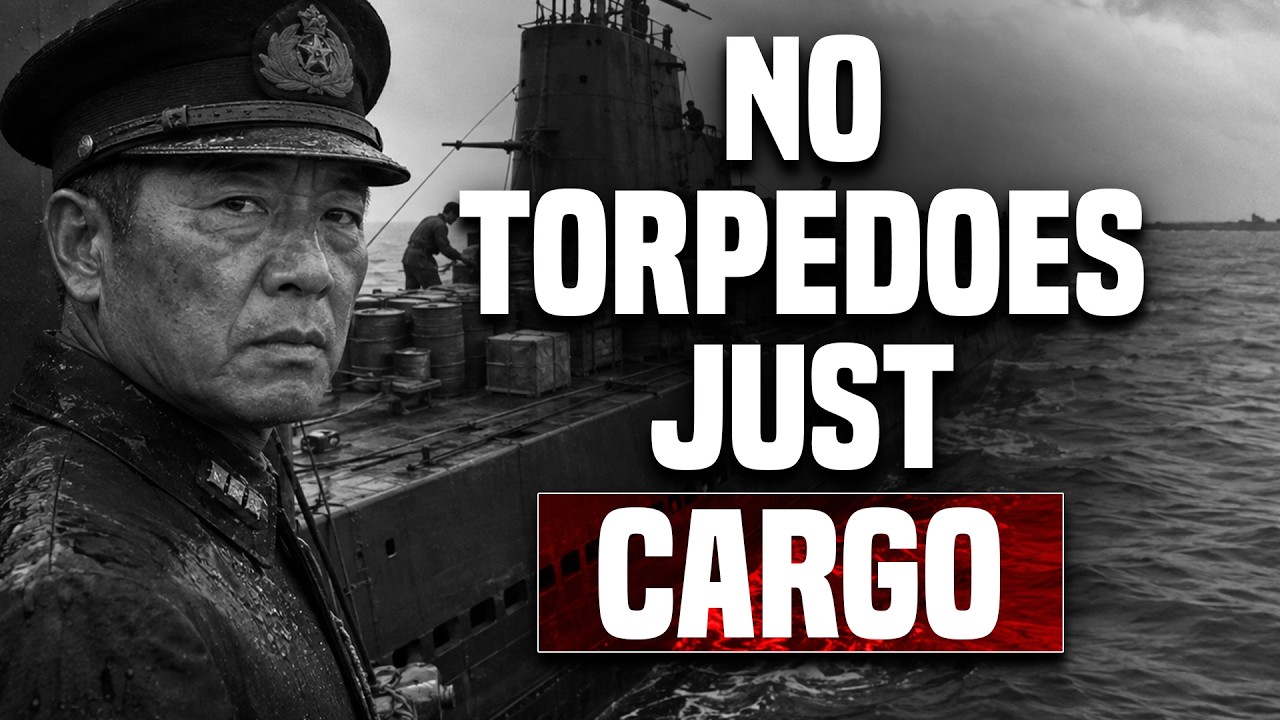
They described aviation gasoline, rice, sugar, rubber, tin, quinine, ammunition, and even drums of opium. Across the yards at Kure, Sasebo, and Yokosuka, the mission counted 174 ocean-going submarines taken into service during the war. Of those, 128 were gone, a figure that survives in the mission’s records and in the postwar casualty compilation kept by Japanese Navy historians. Three quarters of the force had been lost.
The longest-range submarines afloat had spent most of the war as freighters, and that is the puzzle the mission walked into. The answer traces to a single word: Tsushima. The Battle of Tsushima was fought on May 27 and 28, 1905, in the strait between Korea and southern Japan. It was the most complete naval victory of the modern age.
A Russian fleet had sailed 18,000 nautical miles from the Baltic to reach the Pacific, and a Japanese fleet under Admiral Togo Heihachiro destroyed it in a single afternoon. Of the 38 Russian ships that entered the strait, 21 went down, seven struck their flags, and six limped into neutral ports. Only three reached Vladivostok. Russian casualties exceeded 4,000 killed against 116 Japanese.
Togo flew the Z flag from his flagship Mikasa, the signal that, in the meaning the fleet understood, put the fate of the empire on the next few hours. The victory was total and immediate, and the officers who came of age on that deck carried its shape into every staff paper they wrote for the rest of their careers. That victory settled in the minds of the officers who fought it and the officers they trained that modern naval wars were decided by a single engagement between big ships and big guns, fought in open water on one day by a fleet that had arrived in fighting condition. The doctrine that came out of it was called Kantai Kessen, the decisive battle, and it shaped every keel the Imperial Japanese Navy laid afterward, including every submarine.
The submarines had a specific role in the plan. They were the outer screen drawn up across the Pacific in long patrol lines, hundreds and then thousands of miles from the home islands. They were to find the opposing fleet as it crossed the ocean, report its position, wear it down on the way, and hand the weakened remnants over to the gunline, the battleships and cruisers that would finish the work at heavy artillery range. A submarine built for this job needed to reach the Eastern Pacific, stand station for weeks, and report what it saw.
It did not need to sink merchant ships. Commerce raiding was seen as a secondary task, the business of a lesser navy. The boats that came off the ways at Kure and Sasebo for that job were unlike anything else afloat. The Type A, Type B, and Type C fleet submarines carried 14,000 to 20,000 nautical miles of range, more than any American or British boat of the period.
They carried scout float planes in hangars built into the front of the conning tower, launched by catapult or recovered by crane. They carried the heaviest torpedoes of the war, the Type 95, driven by oxygen and leaving almost no visible wake. At the top of the program sat the I-400 class, three boats finished too late to matter. Each was able to carry three floatplane bombers in a watertight cylinder built onto the front of the hull, designed to sail anywhere on the planet, surface, and put aircraft over a target the rest of the navy could not reach.
The men who drew those lines on the drawing tables at Kure were not fools. The range was real. The doctrine it served was not. The decisive engagement the plan had been built around had not yet come.
The United States Navy did not sortie across the Pacific in a single body to be met and destroyed off the home islands. It came in pieces, in amphibious landings, in carrier raids, and in a submarine campaign against Japanese merchant shipping that the plan had never considered. The outer scout lines drawn up where the enemy fleet was supposed to pass found nothing because there was no enemy fleet passing. The submarines sat on station for weeks at a time, burned fuel, and reported empty water.
The scout float planes they launched to extend the search came back with the same answer. The ocean the plan had assumed would be the anteroom to the decisive engagement was just the ocean. By the autumn of 1942, the Imperial Navy had a force of long-range submarines and no decisive engagement for them to scout. What it had instead was a garrison stranded on Guadalcanal, cut off by aircraft and cruisers from the American fleet and beginning to starve.
The solution was the submarines. The fleet boats built to find an enemy fleet crossing the Pacific went south to run rice and ammunition into the Solomon Islands after dark. I-2, I-3, I-4, and I-7 surfaced off the beaches, unloaded drums of rice by hand, and slipped away before dawn. Working parties of soldiers on the beach sometimes took the drums in silence and pointed the boat back out to sea before the dawn patrol found her.
The runs went on through the autumn and into the winter. The boats meant to fight a fleet action came to know the beaches of the Solomons better than they knew the patrol lines they had once held. I-3 was caught on the surface by a patrol torpedo boat on the night of December 9, 1942, hit by a torpedo, and sunk with her cargo. A fleet boat lost delivering rice.
The same mission reached every garrison the Americans had cut off in their island hop. Submarines ran rice and medicine to Wake, to Truk, to the bypassed detachments of the Marshalls, surfaced in the lagoons at night, unloaded soldiers who had not seen a supply ship in months, and slipped out before the morning air patrol found them. The same logic reached across two oceans. In June 1943, the submarine I-8 departed Kure on what the Navy called a Yanagi, or Willow, mission, bound for German-occupied France.
She sailed south, rounded Africa, crossed the Atlantic, and put into Brest in August, the second Japanese submarine to complete the passage to Europe. German officers came aboard at the dock and a band played on the quay. She came back carrying rubber, tin, quinine, raw opium, coffee, and a load of German technical drawings, machine parts, and engineers. The cargo manifest survives.
Among the strategic materials on a vessel that had just crossed two oceans and back, 50 cases of opium and a quantity of coffee sit listed alongside the rubber and tungsten. The reason they are there is not recorded. I-8 was one of the lucky ones, and she came home. The other Yanagi boats, for the most part, did not.
I-30 reached Europe and made Singapore on the way back, then struck a mine in the Singapore Strait and sank. A British submarine torpedoed I-34 on the way out before she left the Indian Ocean. I-29 made France and Singapore on the way home, then an American submarine sank her off the Philippines. I-52, the last of them, disappeared in the Atlantic in 1944 with her cargo and the gold to pay for it, and turned up 50 years later on the bottom, still loaded.
The extreme range of the fleet boat, the quality the doctrine had prized above all others, went into moving freight between continents, and the freight had cost the boats that carried it. By 1944, the cargo runs had stopped being an improvisation and become a program. The Navy built a class of boat for it. The Type D transport, the I-361 class, was a vessel of better than a thousand tons with her torpedo tubes left out, designed from the keel up to carry 85 tons of freight in her pressure hull and another 40 on her deck, surfaced at night beside a bypassed garrison and unload.
The Navy ordered 20 of them. The I-351 was something stranger, a submarine built to resupply flying boats at sea, carrying 365 tons of aviation gasoline in special tanks, 11 tons of fresh water, and aircraft bombs and torpedoes for the flying boats she was meant to support. When the flying boats stopped operating, the I-351 became a tanker and went to move fuel. She went down on July 14, 1945, to torpedoes from the submarine USS Bluefish on the return leg of her second voyage.
Survivors pulled from the water told their interrogators that one torpedo had struck the aviation gasoline tank. The explosion, in their words, knocked them unconscious and blew them overboard. The arithmetic of the loss became plain in postwar compilations. Of the boats the mission had counted, close to three quarters went down, a loss rate of roughly 73 percent.
The American submarine service, in the same ocean over the same years, lost 52 boats out of roughly 285 that conducted war patrols, about 18 percent. Those boats sank close to 5. 3 million tons of Japanese merchant shipping and over 1,300 warships. The Imperial boats, built with greater range and heavier torpedoes, sank about 1 million tons of merchant shipping between them.
One American boat, the USS Barb under Commander Eugene Fluckey, took credit for close to 97,000 tons of enemy shipping across her war patrols, a figure that stands against a meaningful fraction of the entire enemy submarine effort. On a single patrol in 1945, Barb put a shore party ashore on Sakhalin and blew up a train, the only ground combat Americans conducted on the Japanese home islands in the entire war. What the boats could do when allowed to do it was considerable. On September 15, 1942, the submarine I-19 fired a single spread of six torpedoes at the American carrier Wasp south of Guadalcanal.
Three hit and sank her. One of the others continued on, by chance, and struck the battleship North Carolina, damaging her. A fifth struck the destroyer O’Brien, which broke apart and sank weeks later. It is, by most accounting, the most destructive single torpedo spread of the war.
Three weeks earlier, on September 9, the submarine I-25 had surfaced off the Oregon coast, launched a small floatplane, and dropped incendiary bombs on the forest near Brookings, the only air attack ever made on the American mainland. The capability was real and demonstrated early. The doctrine simply had other plans for the boats that carried it. Then, at the end of 1944, the decisive battle scouts finally arrived in the form the plan had always imagined.
The I-400 class came into service. I-400 commissioned in December. I-401 followed in January 1945. I-402, the third, came out as a tanker, her aircraft cylinder left off and her hull fitted to carry fuel, because by the time she was ready, there were no aircraft to carry and no fuel to be had any other way.
The designers had meant the class to sail across the Pacific, surface off the Panama Canal, and put their floatplane bombers over the locks. Each Seran bomber folded its wings along the fuselage and rested on a rail inside the cylinder, assembled and launched off the front of the boat in minutes, and designed to fly one mission and ditch alongside on the way back. She measured 122 meters from stem to stern, better than 6,000 tons beneath the water, and the Navy studied the mission and trained the aircraft for it. The boats that could have done it were the finest submarines built by any navy in the war.
The Navy ordered the Panama Canal strike in the spring of 1945, then postponed it, then redirected the boats toward the American anchorage at Ulithi Atoll, then postponed again. On August 16, the day after the surrender, crews were ordered to destroy their aircraft. The crew of I-400 punched holes in the floats of her Seran bombers and pushed them overboard. The crew of I-401 catapulted theirs into the sea.
The boats themselves sailed to Tokyo Bay and gave themselves up. The exact accounting of how much of the force’s effort went into cargo and how much into combat patrols is, at this distance, not recoverable. The naval staff destroyed the bulk of their records in the days between the surrender and the occupation. What survives was reconstructed after the war from two sources: the interrogations of Japanese officers conducted in Tokyo between October and December 1945 by the naval analysis division, and the Senshi Sosho, the postwar defense history compiled decades later from surviving fragments and officer testimony.
The two sources agree on the shape of the story and on the loss figure. They do not agree in every case on which boat did what on which day. The casualty list totaled the cost accumulated off the page for three years: 128 submarines gone. The I-373, a Type D transport, left Sasebo on August 5, 1945, on a run to Takao on Formosa, carrying a cargo of aviation petrol, rice, and sugar.
She went down on August 14, the last Japanese submarine lost in the war, six days before the surrender document was signed on the deck of the American battleship Missouri. The cargo manifest of the last boat the Imperial Navy lost was aviation fuel, rice, and sugar. The war ended while her crew was still in the water. The American Navy towed the three surrendered I-400 boats off the coast of Oahu in 1946 and scuttled them.
The decision went unannounced. The Soviet Union had demanded inspection rights under the terms of the Allied agreement, and the United States declined to let Soviet officers examine the most advanced submarines in the world. The boats went down in deep water without ceremony, and no one recorded the position with any precision. In 2013, a research submersible from the Hawaii Undersea Research Laboratory found the I-400 in 2,300 feet of water off the southwest coast of Oahu, resolving a question that had sat open since the Cold War.
The wreck lies where the Navy put her, and no Japanese memorial has ever marked the spot. The Imperial Japanese Navy never formally repudiated the decisive battle doctrine and held no inquiry into the loss of three quarters of the submarine force. Surviving officers told the interrogators in Tokyo that they had held the submarines for fleet reconnaissance rather than releasing them against commerce, because the decisive battle they had waited for never came. The Navy published no official history of the submarine force.
The General Staff wrote no after-action review of the cargo runs. An entire submarine force was built to fight a battle the enemy refused to show up for, and it spent the war it got carrying rice until the war ran out of submarines.