On January 6, 1982, two young women vanished hours apart while hitchhiking along freezing mountain roads near Breckenridge, Colorado. Annette Schnee, 21, and Bobby Joe Oberholtzer, 29, did not know each other, but their disappearances on the same blizzard night would remain tangled together for nearly four decades. Annette grew up in Colorado’s high country and dreamed of becoming a flight attendant. She worked two jobs in the ski town of Frisco, cleaning rooms at a Holiday Inn during the day and waitressing at a bar in the evenings, saving money toward a future she pictured clearly.
Hitchhiking in that small mountain community was routine and unremarkable. Bobby Joe had recently moved to nearby Alma with her husband, Jeff. She worked as a receptionist, had children from an earlier marriage, and was remembered as a caring person who gave up her own comfort for others. Jeff worried enough about her traveling the dark mountain roads that he built her a heavy brass key ring, sturdy enough to use as a weapon if a ride went wrong.
On the evening of January 6, Bobby Joe was out celebrating a promotion. Around 6:21 p. m. , she called Jeff from a pub, telling him she had a ride lined up and would be home soon.
It was the last time he ever heard her voice. That afternoon, Annette had left her shift at the Holiday Inn, stopped at a doctor’s office, and picked up medication at a Breckenridge drugstore. The clerk remembered her as cheerful and unhurried. She was last seen just before 4:45 p.
m. , apparently planning to hitchhike the short distance home. A blizzard was moving into Summit County, with temperatures dropping toward 20 degrees below zero. Both women accepted rides from strangers that night, the way people in that town routinely did.
Jeff fell asleep waiting for Bobby Joe. When he woke around midnight and she was still gone, he drove into the storm searching for her. Police told him officers could not act for 24 hours. He went out again at 3 a.
m. and found nothing but empty road. Early the next morning, a local rancher found Bobby Joe’s driver’s license on his property. Jeff rushed toward the ranch and spotted her blue backpack on the highway, along with a glove and tissue stained with blood.
That same afternoon, friends on cross-country skis found her body in a snowbank near the summit of Hoosier Pass, at over 11,000 feet. She had been shot once in the chest at close range. There was no sign of sexual assault. Near her body, investigators found her house keys, the brass key ring Jeff had made her, and plastic zip ties, evidence she had been restrained.
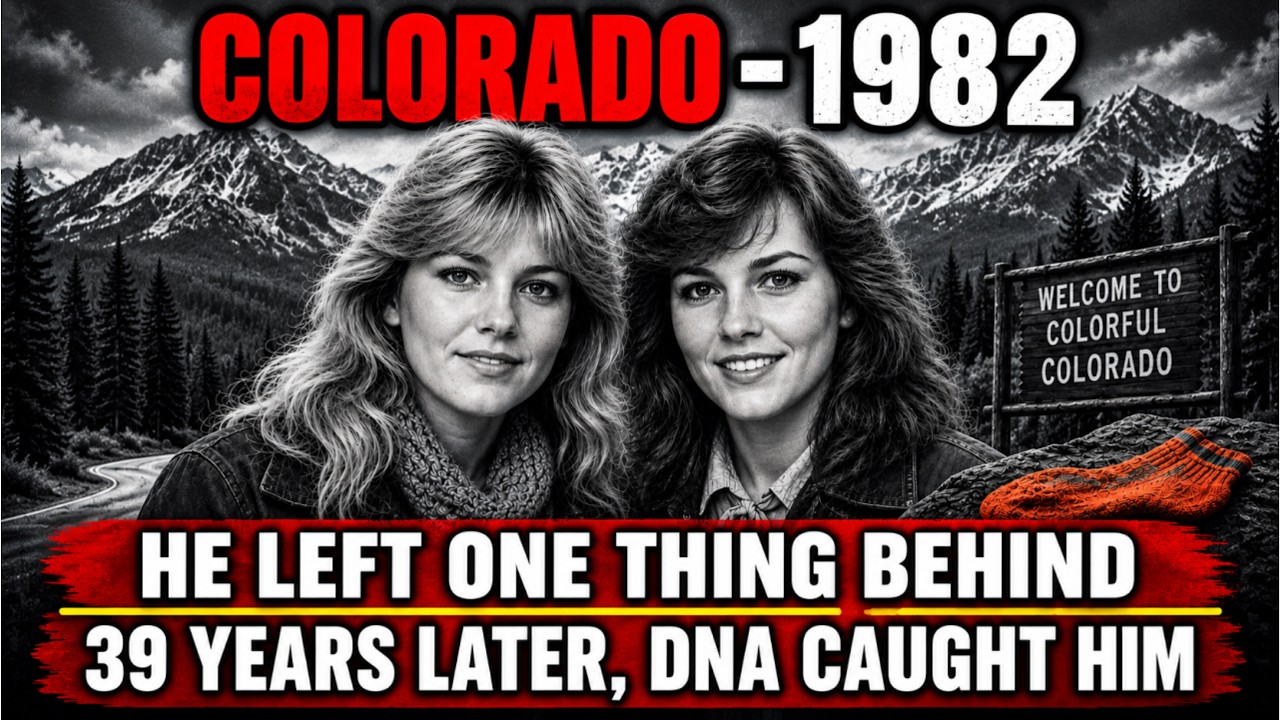
A short distance away sat a single orange bootie sock that belonged to no one at the scene. Nobody could explain it. It went into an evidence box as a stray detail. Two days later, a coworker reported Annette missing after she failed to show up for her shifts.
Detectives traced her last movements to the drugstore, then the trail went cold, just like Bobby Joe’s. The similarities were obvious, but without Annette’s body or forensic proof connecting the two cases, investigators could not officially treat them as one. DNA profiling did not exist as an investigative tool in 1982. With no way to turn the evidence into a name, suspicion fell on Jeff Oberholtzer.
Parts of his alibi were not airtight, and investigators found a business card for his repair shop tucked inside Annette’s recovered backpack. He explained he had given Annette a ride months earlier and handed her his card. He passed two polygraph tests and cooperated fully with searches, but lived under suspicion for years. DNA testing more than a decade later formally cleared him.
On July 3, 1982, nearly six months after she vanished, a boy fishing in a creek 23 miles from Breckenridge found Annette’s body face down in the water. She had been shot in the back, likely while running downhill trying to escape. On her left foot was an orange sock, an exact match to the one found near Bobby Joe. Investigators now knew one killer was responsible for both deaths, but they still had no way to name him.
The man who did it was Alan Lee Phillips. Born around 1951, he was 30 in January 1982, working as a mechanic and a miner in Clear Creek County. He was not a drifter. He was a neighbor, someone people trusted to fix their trucks.
In 1973, he had been arrested on burglary and assault charges, a documented early sign of violence, but in 1982 there was no national database to connect that old arrest to the murders. For nearly four decades, Phillips kept living. He worked the mines, opened his own mechanic shop, married, and raised children. He stayed rooted in the same corner of Colorado, close enough to Breckenridge that he almost certainly drove past the roads where both women had vanished.
His unremarkable ordinariness let him blend into the community, and nobody had reason to look at him twice. The breakthrough came through investigative genetic genealogy, a technique that was transforming cold cases. In 2020, Park County Detective Sergeant Wendy Kipple submitted the old blood evidence from Bobby Joe’s glove and tissue to United Data Connect, a Denver-based genealogy company. Instead of running the DNA through a criminal database, genealogists uploaded it to public ancestry databases and worked backward from distant relatives.
On January 9, 2021, the genealogist called Kipple with two names. They belonged to brothers: Bruce Phillips, who had never lived in Colorado, and Alan Phillips, who had lived in the area for decades and still ran his mechanic shop nearby. The blood Bobby Joe had drawn from her attacker had finally produced a name. Investigators re-examined the orange sock from 1982.
They now believe Phillips picked up Annette first, assaulted her inside his truck, and her sock came off in the struggle. Hours later, when he picked up Bobby Joe along a different stretch of road, that same loose sock fell out during her fight to escape him. Fresh DNA testing on Bobby Joe’s original clothing, still preserved in evidence storage, matched Phillips a second time. Investigators also re-examined a detail from the night of the murders.
Phillips had gotten his pickup truck stuck in the blizzard on nearby Guanella Pass and used his headlights to flash an SOS, spotted by a sheriff aboard a commercial flight overhead. Fire Chief Dave Montoya drove up through the storm and pulled him out of the snow, remembering a sizable bruise on Phillips’s face. Phillips said he got it stumbling in the snow while looking for his truck door. Investigators later came to believe the bruise had come from Bobby Joe, fighting for her life in the front seat of his truck.
On February 24, 2021, officers arrived at Phillips’s home in the small town of Dumont, just 20 miles from where he had been rescued off the same mountain pass. Confronted with the DNA evidence, he offered no explanation and gave police nothing. He was arrested on charges including first-degree murder, kidnapping, and assault with a deadly weapon. The trial opened on August 29, 2022, in the 11th Judicial District Court in Fairplay, Colorado, more than 40 years after the murders.
A jury of 15 Park County residents was seated after two days of selection. Deputy District Attorney Mark Hurlbert led the prosecution. The prosecution’s case rested on the DNA match, the orange sock linking both victims to a single killer, and the timeline placing Phillips near Breckenridge that night. The defense noted Phillips had lived a law-abiding life for four decades and that evidence stored for 40 years raised questions about handling and contamination.
Fire Chief Montoya told jurors, “We ended up picking up a guy straight out of hell,” recalling the night he rescued a stranded, bruised man with no idea what that man had just done. After closing arguments, the jury deliberated for just over four hours. On September 15, 2022, they returned a verdict of guilty on eight counts, including first-degree murder for both Annette Schnee and Bobby Joe Oberholtzer. On November 7, 2022, Phillips was sentenced to two consecutive life sentences without the possibility of parole, one for each woman he took, run back to back.
Before sentencing, the court heard from both families. Annette’s sister, Cindy French, had been only 11 when her sister disappeared. She said she still remembered watching her mother break down in tears over the six agonizing months the family spent not knowing what happened to Annette. She noted that while Annette never got to build a family, Phillips had spent those same decades free to have a wife and children of his own.
French later named her own eldest daughter after her sister. Bobby Joe’s daughter, Jackie Vukas Walker, described a childhood shaped by grief and anxiety. She said she cried so many nights into a horse-patterned pillow that her tears blurred together until she could not tell where one night ended and the next began. Phillips did not visibly react to either statement.
He never gave either family an explanation and expressed no remorse in open court. Retired detective Charlie McCormack, who had carried the case since 1989, was there for the verdict. Asked how it felt, he said, “It’s been a long haul. ” Annette’s mother, Eileen Franklin, had said something similar the day Phillips was first arrested: “You know, I thought there’d be no closure.
”
On February 27, 2023, less than four months after being sentenced, Alan Lee Phillips died by suicide in prison at age 71. He took whatever remained of his account of that January night with him. There would be no appeal, no parole hearing, no chance for either family to hear him explain himself. Annette never became a flight attendant.
Bobby Joe never got to watch her children grow up. What they got instead was one winter night that took everything, and 39 years of two families refusing to let the world forget their names. Bobby Joe fought, and that single fight outlived her killer by decades.