On April 17, 2021, inside St. George's Chapel at Windsor, 30 mourners sat spaced apart under pandemic rules. A widowed queen sat entirely alone. Every other face belonged to a Windsor, a Mountbatten, or a cousin carried down from some scattered German house.
And yet, listed 30th, neither born to the family nor married into it, sat a butcher's daughter from London named Penny Knatchbull. For 46 years, she had been part of Prince Philip's life, close enough that the royal household kept a private name for her. The world had watched that friendship for decades and never once been told what it was.
Now the man was gone. The seat among the family was hers. And nobody then or since has ever explained why.
The answer to that question is quieter and sadder than the newspapers ever wanted it to be.
A prince was carried out of his own country as a baby, asleep in a cot that had been built from a wooden fruit box. It was the winter of 1922, and the family of Prince Andrew of Greece was fleeing a country that no longer wanted them.
The infant on that boat had been born the previous June on the kitchen table of a villa on the island of Corfu, a house called Mon Repos, and he had been given the name Philip. He was a prince of Greece and Denmark by birth, and while he was still a baby, he was a refugee.
The orange box that held him is the first fact anyone needs to know about him, because it tells the whole truth of his beginning in a single image. He entered the world grand in title and stripped of everything that title was supposed to mean.
What followed was not the sheltered childhood the word prince suggests. It was a scattering.
His father, Prince Andrew, drifted away into a separate life on the French Riviera, a man broken by exile and disgrace, and the boy saw less and less of him as the years went on. His mother was Princess Alice of Battenberg, a woman born deaf, clever, devout, and fragile.
In 1930, when Philip was still a child, she suffered a breakdown and was placed in a sanatorium in Switzerland. She did not vanish from his life gently. She was taken, and for years there was almost no contact between them at all.
A boy of nine lost his mother not to death but to an institution, which is in some ways a crueler loss, because there is no grave to visit and no ending to mourn, only an absence that goes on and on.
His four sisters were older, and one by one they married into German noble houses, several of them into families that would later be entangled with the rise of Nazism. When Philip married the future queen in 1947, those same sisters were not invited, because Britain had so lately been at war with the country they had married into. Even the family he did have was, at the great moment of his life, kept from the room.
He grew up passed between relatives, an English uncle here, a grandmother there, a boarding school that became more of a home than any house his parents kept. He was schooled at a hard, cold place called Gordonstoun in the north of Scotland, a school built on the idea that character is forged through discomfort, cold showers, long runs, and self-reliance.
For a boy with no settled home, a philosophy that turned ruthlessness into a virtue must have felt less like education than like survival dressed up as principle.
There was a war to follow the wounded childhood, and it gave the young man the first thing that had ever been fully his own. Philip joined the Royal Navy and served through the Second World War at sea, a real officer in a real fleet, mentioned in dispatches for his conduct in action.
The Navy suited him as polo and carriage driving would later suit him. It was hard. It was disciplined. It judged a man on what he could do rather than on what he had been born as. And for a stateless prince with a foreign name, it offered a way to become at last unambiguously British.
When the time came to marry the heir to the throne, he gave up what remained of his foreign titles, renounced his claims to Greece and Denmark, and took instead the plain English surname of the uncle who had shaped him. He married Princess Elizabeth on November 20, 1947.
The homeless boy from the orange box had made himself into a naval officer and the husband of a future queen. And he had done it in large part by learning to give nothing of his inner life away.
There was one man who studied him. Lord Louis Mountbatten, his mother's brother, took the stateless boy in hand. Mountbatten was a naval officer of vast ambition and vaster charm, a man who collected relatives and causes with equal appetite, and he made Philip's future his personal project.
It was Mountbatten who guided the young man toward the Royal Navy, toward the British establishment, and in time toward the young princess he would marry. Philip owed the entire shape of his life to that uncle. The homeless prince was given a country to serve and a family to belong to, and the man who arranged both was the head of the Mountbatten family.
Hold that name close, because a young woman would one day marry into it. And the whole of this story turns on the fact that Mountbatten was the bridge between a lonely prince and a butcher's daughter who had not yet been born.
The man these losses produced was not soft. He was the opposite of soft. He became famous across seven decades of public life for a sharp tongue, a short temper, and a refusal to indulge sentiment in himself or in anyone near him.
He made remarks that landed him in the newspapers for all the wrong reasons. He was impatient with fuss, with flattery, with the slow ceremony of the role he had married into. He walked, by long tradition, two steps behind his wife, a consort with no constitutional job, no rank of his own for years, and no obvious outlet for a restless and formidable mind.
To a watching public, he was the gruff duke, the man who said the wrong thing, the shadow at the queen's shoulder. But the reserve was a shield built over a wound.
A boy who has lost a homeland, a mother, and the ordinary security every child is owed learns early that the people you love can be taken without warning and without explanation. Such a boy grows into a man who guards himself, who does not hand his inner life to anyone, who meets grief with work and irritation rather than tears.
That guardedness would become the central puzzle of his old age, because the man who confided in almost no one, who would not discuss the private matters of his own marriage with anyone at all, did in the end choose a single person outside that marriage to talk to, to trust, to be seen with, year after year, without apology and without explanation.
The reasons he chose her, and the reasons it was allowed, begin with the orange box and the sanatorium and the sisters kept from the wedding. He recognized loss when he met it. And one day he would meet a woman who had just been handed a loss as total as any he had known.
While a prince was learning to trust no one, a girl was being raised on a fortune built from 700,000 steaks a year. Her father was a man called Reginald Eastwood, and he had not been born to anything at all.
He began his working life at the age of 15 as an apprentice butcher, learning the trade with a knife in his hand, at an age when the sons of the families his daughter would one day sit among were still at school. He had a gift for the work and a greater gift for turning the work into money.
In the early 1960s, he built a chain of steakhouses across London, rooms of plate glass and red velvet where a rising middle class could eat like the wealthy for the price of a single evening out. In 1964, he floated the company on the stock market.
At its height, the business is reported to have turned over 20 million pounds in a single year and to have sold 700,000 steaks across the same 12 months. It was a fortune made one plate at a time, a fortune with the heat of the grill still on it, and it was very large indeed.
Reginald Eastwood had crossed inside his own lifetime from the man behind the counter to the man who owned the room. That kind of crossing was rare in the England of the day, and it left a particular mark on the children who inherited its comforts. They had everything money could buy, and none of the things money could not.
Into that new fortune, on April 16, 1953, a daughter was born in London. She was named Penelope Meredith Mary Eastwood, and she would be known all her life as Penny. Her mother was Marian, and a younger brother named Peter followed two years later.
The family had money in abundance, but it was the wrong kind of money for the world Penny would eventually enter. It was trade money, earned money, the money of a man who had cut meat for a living. In the rigid arithmetic of English class, how a family got its fortune counted for far more than how large that fortune was.
There were old families with a fraction of the Eastwood wealth who would never have thought of the Eastwoods as equals, for the simple reason that the Eastwoods had made their money rather than inherited it.
Penny was raised at a distance from all of that. She was schooled in Switzerland, in the clean and anonymous comfort of the continent, where an English girl with a new fortune behind her could be simply a well brought up young woman and nothing more complicated.
She was clever, and when her schooling was finished, she did not drift into the London season the way a titled girl might have done. She went to university instead. She studied at the London School of Economics, one of the most demanding institutions in the country, and she graduated in 1976.
That fact is worth holding on to, because it tells you who she was before the world decided what she was. She was numerate, disciplined, educated, foreign polished, and entirely self-possessed. She was not a decorative girl waiting to be married off to the highest name that offered. She was a woman with a mind, and it was that mind, in the end, as much as anything else, that would be trusted to hold the private thoughts of a prince.
That kind of woman was, in the England of the 1970s, a peculiar sort of outsider. She had the polish that money could buy and the education that ambition could win, and still the oldest doors in the country would not open to her on those merits alone.
A degree from a great university counted for a great deal in the professions and for almost nothing in the drawing rooms of the landed families, where what mattered was not what a person had achieved but whom they had descended from. She belonged, in the strictest sense, nowhere. She was too rich to be ordinary and too new to be grand.
What she had that no schooling gave her was a love of the outdoors and a love of horses. She rode. She liked open country and long days in the saddle and the plain physical pleasures that owe nothing to rank. A horse does not care whether the fortune behind its rider came from land or from a butcher's counter.
In the field, in the mud and the weather, the old distinctions that ruled the drawing rooms simply fell away. And it was horses, in the end, that carried Penny Eastwood toward the one world her father's money could never have bought her a place in.
The steakhouse fortune bought comfort, education, and a certain kind of freedom. It did not buy a seat at the table of the House of Windsor. Something else did that.
It began with a marriage, and before the marriage, with a meeting. She was 21 years old, and the year was around 1974 or 1975, when she first came into the orbit of the queen and the queen's husband. The sources differ a little on the exact year, and the difference matters only because it sets the clock on everything that followed.
Count from the earlier meeting to the day the Duke died, and the span comes to 46 years. She met them both at once, through the horses and the country pursuits the family shared, and the man who was 32 years her senior noticed the young woman his family's circle had drawn in.
There was nothing in that first meeting to suggest what it would become. What bound her to Philip from the very beginning was the plainest thing in the world. They liked the same things. They liked horses. They liked being outdoors. And they liked the honest tiredness that comes at the end of a day spent in the open air.
Friendships that last a lifetime rarely announce themselves at the start. They begin as something small, a shared interest, a familiar face at the same gatherings, and only later, under a weight neither party could have foreseen, do they reveal how deep the roots have gone.
To marry the man she loved, Penny had to step inside the most closely watched family in Britain and one of the most marked by sorrow. The man was called Norton Knatchbull, and he was of the royal world in his bones.
He was the grandson of Lord Louis Mountbatten, the last viceroy of India, the same man who had taken a stateless Greek prince in hand and steered him toward a queen. Norton was Prince Philip's godson. He was a second cousin to Prince Charles.
He carried in his person the whole tangled closeness of the extended royal family, the cousins and godsons and honorary uncles who make up the private world behind the public throne. When Penny fell in love with Norton, she was marrying into the very heart of the crown and into the household of the one man to whom Prince Philip owed everything.
That single fact is the hinge of the entire story. Philip's whole life had been shaped by Lord Mountbatten. The uncle had rescued the nephew from rootlessness and given him a country, a career, and a wife. And now a young woman was marrying Mountbatten's own grandson and would live in Mountbatten's own houses and would move through the same rooms and shooting parties and horse shows as the prince who thought of Mountbatten as the nearest thing he had ever had to a father.
Proximity was built into the marriage before the marriage even happened. Penny did not have to engineer her way toward Prince Philip. By becoming a Knatchbull, she was placed automatically and permanently within arm's reach of him. The family she was joining was the family that had made him.
The house at the center of that family was Broadlands in Hampshire. It was an 18th century mansion of some 60 rooms, a Grade I listed house set in its own great sweep of parkland, and it carried a weight of royal association that few private houses in England could match.
The Queen and Prince Philip had spent their honeymoon there in 1947. Years later, in 1981, Prince Charles and Lady Diana Spencer would spend the first three days of their own honeymoon under the same roof. To live at Broadlands was to live inside a place where the private life of the monarchy had repeatedly come to rest.
For Penny, a woman whose father had built his fortune selling steaks across London, Broadlands was the far end of a journey that almost defies measurement. At one end of her life, a man in an apron weighing meat behind a counter. At the other, the honeymoon house of two royal generations and her own name on the deeds of belonging.
To grasp what marrying a Mountbatten meant, one has to grasp who Lord Louis Mountbatten had been. He was not merely a grand relation. He was the last viceroy of India, the man who presided over the end of British rule there, and he had been, across his long life, cousin, uncle, and mentor to much of the royal circle of Europe.
Above all, he had been the maker of Prince Philip. It was Mountbatten who had taken the stateless boy in hand, steered him into the Royal Navy and the British establishment, and guided him toward the young princess he would marry. To carry his name was to stand at the junction where the monarchy, the empire, and the modern history of Britain all met.
Penny Eastwood, the daughter of a man who sold steaks in London, was marrying into that. The gap between the counter and the viceroy's bloodline was a gap of centuries as much as of money, and she crossed it in a single wedding.
The name she was marrying into was one of the grandest in the country and one of the most freshly grieved, though the full weight of that grief still lay a few weeks in the future at the time the wedding was arranged.
The Mountbatten line ran from Lord Louis the viceroy down through his elder daughter Patricia, who would in time become the second Countess Mountbatten of Burma, and then to her son Norton. Marrying Norton, Penny was stepping onto the last rung of one of the most storied ladders in the aristocracy.
It was a family woven through the history of empire, of the Royal Navy, of the partition of India, and of the modern monarchy itself. It was a family accustomed to standing at the sharp edge of history, where private feeling and public duty were forever colliding, where a marriage could be a matter of state and a death could be a matter of headlines.
Penny, stepping into that world as a young bride, could not have known how much of its darkness she would come to share. She saw the shooting parties and the horse shows and the great houses. She did not yet see the losses that ran beneath them, the griefs the family carried behind its composure, the way sorrow seemed to follow the name from one generation to the next.
What she brought to it was youth, intelligence, and a self-possession that had been forged in the odd loneliness of being too rich to be ordinary and too new to be grand. What the family offered her in return was belonging, of a kind her father's fortune could never have purchased at any price. Blood or marriage into blood was the only currency that bought a place at that table, and Penny had found the second.
The wedding was set for October 20, 1979, at Romsey Abbey, the great church near Broadlands, where the family's most solemn occasions were held. Prince Charles, the future king, would stand as best man to the groom.
It was to be one of the society events of the year, a gathering of the extended royal family and the aristocracy, a public sealing of Penny's entry into the innermost circle. She was 26 years old. She had crossed the whole distance from the steakhouse to the abbey in a single decision to marry a man she loved. And the man happened to be the grandson of the person who had shaped Prince Philip's entire life.
The titles that came with the marriage tell their own story of the family's standing. On her wedding day, Penny became Lady Romsey, the courtesy title Norton carried as the heir. In the years that followed, she would rise with him through the ranks of the family.
When his father died, she became Lady Brabourne. And in 2017, when Norton's mother, Patricia, the second Countess Mountbatten of Burma, died, Norton succeeded as the third Earl, and Penny became by courtesy the Countess Mountbatten of Burma.
The daughter of the steakhouse man now bore one of the great titles of the realm, the very title that Lord Louis, the murdered viceroy, had carried. She had also, in 2010, taken on the ancient civic office of High Steward of Romsey, succeeding Norton in the role.
Step by step, title by title, the outsider had become an insider of the deepest kind, until the name she carried was the name of the man whose death would one day shadow the whole of her marriage.
But between the setting of the wedding and the walking of the aisle, something happened that no one had planned for and no one could have imagined. In the late summer of 1979, on a bright morning off the west coast of Ireland, the family Penny was about to join was very nearly destroyed.
Eight weeks before Penny walked down the aisle, the family she was joining was blown apart on a boat off the Irish coast. It was August 27, 1979.
A fine late summer morning at Mullaghmore, a small harbor in County Sligo, where the Mountbatten family kept a holiday home and a wooden boat called Shadow V. Lord Mountbatten, then 79 years old, had gone out that morning to check the lobster pots, as he had done on countless mornings before.
With him were members of his family and a local boy who helped with the boat. The Irish Republican Army had hidden a bomb aboard the vessel, reported to have been around 50 lb of gelignite, and they detonated it by radio signal from the shore as the boat cleared the harbor.
The blast tore the boat to pieces. Lord Mountbatten, the man who had taken a homeless prince under his wing and steered the modern monarchy through some of its hardest passages, was killed.
So was Nicholas Knatchbull, who was 14 years old, one of a pair of twins, and the younger brother of the man Penny was about to marry. So was Paul Maxwell, a local boy of 15, who had been helping on the boat that morning.
Doreen, the Dowager Lady Brabourne, who was 83, was pulled from the water, gravely injured, and died the following day. Norton's parents, John and Patricia, were terribly hurt. The surviving twin, Timothy Knatchbull, was badly wounded but lived.
In the space of a single morning, one family lost four of its members and had several more maimed. A man named Thomas McMahon was arrested, convicted, and sentenced to life imprisonment in November of that same year.
The survivors carried the day with them for the rest of their lives. Timothy Knatchbull, the twin who lived, had been gravely wounded and had lost in a single instant his identical brother, his grandfather, and his grandmother.
Norton's parents, John and Patricia, both badly injured, survived to grieve their younger son and to carry on the Mountbatten line, Patricia in time becoming the second holder of the title her father had been murdered under.
For the family Penny was joining, the wound never fully closed. It could not. A boy of 14 does not come back, and a grandfather killed on a summer morning does not return. The bride of that October stepped into a household that would carry the 27th of August with it always, and she would prove over the years uncommonly able to sit with a grief that never healed, because she was about to learn at firsthand exactly what such a grief was.
For Prince Philip, the murder at Mullaghmore was a private catastrophe that he met, as he met everything, in silence. The uncle who had taken in a stateless boy, who had steered him into the Navy and toward his marriage, who had been the nearest thing to a father the exiled prince ever had, was gone in an instant, killed by a bomb while he checked his lobster pots on a summer morning.
Whatever Philip felt, he did not say. He carried the loss the way he carried all his losses, folded away out of sight, and he went on. It is one more entry in the long ledger of his griefs: the homeland, the mother, the scattered family, and now the mentor.
And it is the entry that connects him most directly to the young woman marrying into the wreckage that October. They had both now lost someone to that family's particular exposure to history. It was the first sorrow they held in common, though neither could have known then how many more would follow.
The cruelty of the day did not end at Mullaghmore. That same afternoon at Warrenpoint in County Down, the Irish Republican Army killed 18 British soldiers in a coordinated double ambush, the greatest single loss the British Army suffered in the entire conflict in Northern Ireland.
The 27th of August 1979 is one of the darkest days in the long violence of the Troubles, and the Mountbatten family stood at the center of it.
The killing at Mullaghmore was a national shock as much as a private tragedy, one of the defining atrocities of the long conflict in Northern Ireland that the British called the Troubles. Lord Mountbatten was among the most prominent men in the country, a war hero and a member of the royal family, and to strike him down on a summer morning while he checked his lobster pots was a deliberate statement of the reach of the violence.
That it came on the same afternoon as the killing of 18 soldiers at Warrenpoint only sharpened the horror for the royal family. It was proof, written in the blood of one of their own, that no rank and no love could hold the era's violence at bay.
Into that gathering of the wounded in October of 1979, with Prince Charles standing as best man, walked the bride, a young woman of 26 joining a family in the very rawest days of its grief.
For Penny, the timing was almost unbearable. She was eight weeks from her wedding to Norton when his grandfather, his younger brother, his grandmother, and a boy who worked for the family were killed, and his parents were left fighting for their lives.
She was not yet a member of the family by law, but she was already bound to it by love and by the imminent marriage, and she watched the people she was about to call her own be gathered up by history's violence in a single morning.
The wedding went ahead in October as planned, less than two months after the funerals. It could not have been the untroubled celebration it was meant to be. It was a marriage begun in the immediate shadow of an atrocity, in a family still bleeding from wounds that would never fully close, with Prince Charles standing as best man and Prince Philip somewhere in the gathering, mourning the uncle who had shaped him.
There is a particular weight to beginning a marriage in that shadow. Penny stepped into the Mountbatten family not at a moment of golden security, but at a moment of raw and recent grief.
From her very first days as a Knatchbull, she was a member of a household that knew in the most terrible way that the wealth and the titles and the royal connections offered no protection at all against sudden and violent loss.
She had married into sorrow, and in doing so she had, without knowing it yet, taken the first step onto the ground she would one day share most deeply with Prince Philip. Because the thing that would bind the guarded old prince and the butcher's daughter was loss itself, whatever the newspapers would later imagine.
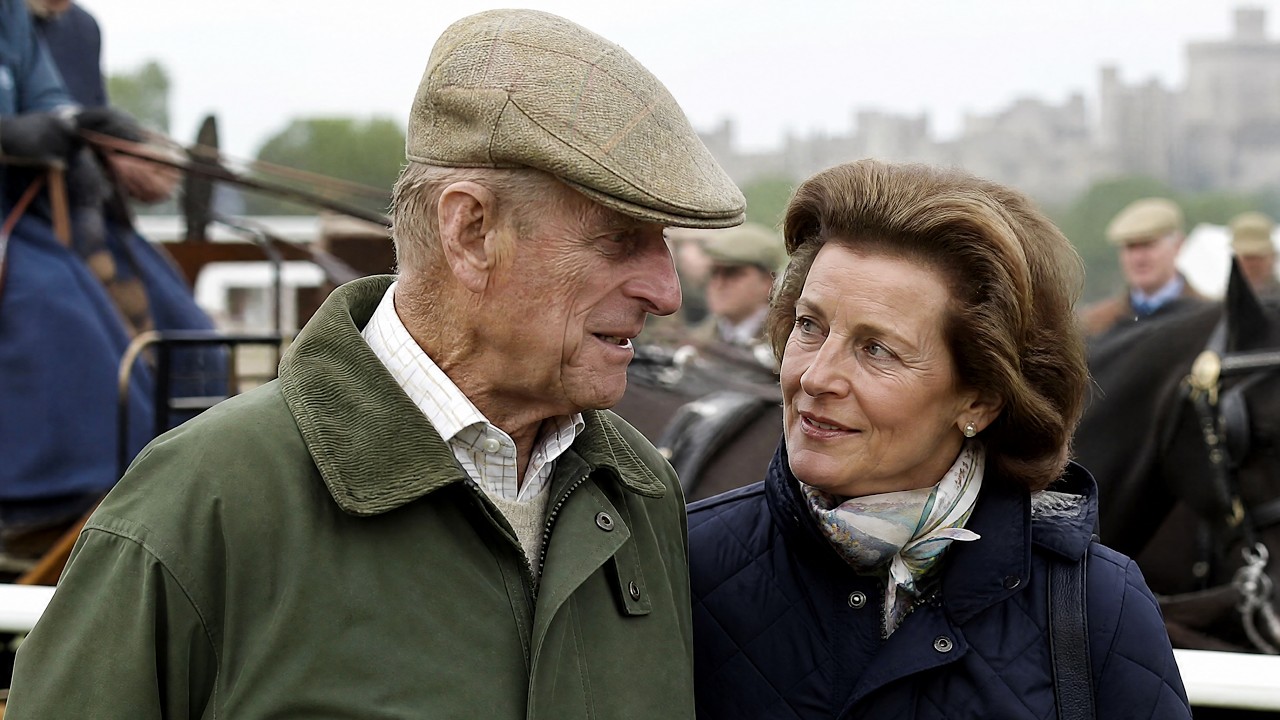
It was the particular wordless understanding that passes between people who have learned too early and too often that the ones they love can be taken from them between one bright morning and the next.
She could not have seen that yet. In October of 1979, she was a bride of 26, newly installed mistress-in-waiting of Broadlands, standing inside the innermost circle of the British monarchy at the precise moment that circle was at its most wounded.
The rise was complete. From the steakhouse to the abbey, from trade money to a viceroy's bloodline, she had crossed the whole distance in a single decision. What came next was not a further climb. What came next was the slow revelation of what it truly meant to belong to this family, and of the man, 32 years her senior, who would come to lean on her more than anyone would ever be told.
The friendship the whole country would one day watch had not yet begun in earnest. It was waiting, as such things wait, for a sorrow deep enough to call it into being.
At 49 years old, a prince walked away from the sport he loved and picked up a set of reins instead. For much of his adult life, Prince Philip had been a polo player, a fast and combative one, at home on a galloping horse with a mallet in his hand.
Polo suited him. It was hard. It was physical. It carried a controlled danger, and it demanded the kind of nerve and aggression that his ceremonial life gave him no other place to spend. But by the start of the 1970s, his body was beginning to argue with the game.
Arthritis had crept into his wrists and hands, and a man who did nothing by halves was not going to keep playing a sport he could no longer play at his own standard. In 1971, he gave up polo altogether.
He was not a man to sit still, and so the question was not whether he would find something to replace it, but what. What he found was carriage driving, and the choice would shape the rest of his life, and though no one could have guessed it then, the shape of the strangest friendship of his old age.
Carriage driving was at the time an obscure and demanding sport barely known to the wider public. A driver sits behind a team of horses, sometimes a pair, sometimes a four-in-hand, and guides them through three distinct tests.
There is a formal driven presentation, all polish and precision. There is a cross-country marathon, the wildest phase, in which the team is driven at speed through water, up banks, and around tight hazards that punish the smallest error. And there is a test of accuracy through a course of narrow gates.
It is a sport that rewards patience, planning, courage, and an almost mathematical control of large and powerful animals. It could have been designed for a man with Philip's temperament, a man who liked machinery and horses and rules and risk in equal measure.
He did not merely take the sport up, he seized it. Prince Philip became one of the leading figures in the whole world of competitive carriage driving, a driver who competed for Britain and a man who threw himself into the writing of the sport's modern rules, helping to shape the very structure of the competitions he entered.
He drove teams of horses and later, as age went on, teams of fell ponies well into his 80s. He was president of the international governing body of equestrian sport for years, and he used that position to give carriage driving the formal shape it had lacked.
For a consort with no constitutional role and a lifetime of standing two steps behind his wife, the sport offered something precious and rare. It was entirely his own. On the marathon course, in the mud and the water, he was not the queen's husband. He was a competitor judged on his own skill, answerable to nothing but the clock and the horses.
The scale of his commitment can be measured in plain terms. He came to the sport at 49 and was still driving competitively in his late 80s, which is to say he pursued it for the better part of 40 years.
He competed at the highest level at the Royal Windsor Horse Show and at events across Britain and the continent. He kept a stable of fell ponies for the purpose. He wrote and revised rule books. He arrived at competitions not as a spectator or a patron, but as an entrant, plainly dressed, focused, and impatient with anything that got in the way of the driving.
Few members of the royal family have ever devoted themselves to a single private discipline so completely and for so long, and with so little concern for whether the public understood or shared the enthusiasm.
His authority in the sport was not merely that of a keen amateur. From 1964 to 1986 he served as president of the International Equestrian Federation, the world governing body of the sport. And it was in that role that he helped to write the modern rules of competitive carriage driving itself. He did not just enter the competitions. He helped to invent the form they took.
There is something characteristic in that. A man who had been handed no settled place in the world made himself a place, and then made the rules of it. The sport he chose was young enough that he could shape it, obscure enough that he could own it, and demanding enough that it asked everything of him.
For the better part of 40 years, it gave the restless energy of a formidable man somewhere to go, and it gave the friendship that would grow up inside it an arena that belonged, in a real sense, to Philip himself. When Penny drove at Windsor, she drove on ground the old man had helped to design.
The Royal Windsor Horse Show became over those decades one of the fixed points of his year. It is held each spring in the private grounds of Windsor Castle, within sight of the walls, and it is as close as the royal family comes to a home fixture in the sporting sense. Generations of the family have ridden and driven and competed there.
For Philip, it was both a competition and a kind of sanctuary, a stretch of days when the horses and the course took precedence over the ceremony. And it was there, year after year, in the ordinary business of a shared sport, that a friendship could be conducted in the open without anyone being able to say there was anything untoward in it.
Two people who both loved carriage driving, standing together at a horse show, examining a team, watching a marathon run, were doing nothing that needed explaining. That is the crucial thing the sport gave, and it will matter enormously later. It gave the friendship a reason to exist in public that no one could sensibly object to, because Penny would come to the sport too, and not by accident and not alone.
Philip drew several people around him into carriage driving over the years. In time he would encourage his daughter-in-law Sophie, the Countess of Wessex, and later still his granddaughter, Lady Louise Windsor, who would take up his ponies and his carriage after his death. The sport ran in the family, quite literally passed from the old man to the young.
So when a grieving young woman was also drawn into it, she was one of a number moving in a world the whole family shared. There was nothing singular, nothing secret, in a member of the Mountbatten circle learning to drive a carriage under the eye of the man who had made the sport his own.
The very ordinariness of it was the point. It gave cover and it gave company, and it gave a shattered woman something to do with her hands and her days at the moment she needed it most.
For now, at the start of the 1970s, that grief still lay ahead. Philip was a man in his early 50s with a new obsession and 40 years of it still to run. He had found the thing that was his and his alone, the arena where he could be simply a driver among drivers.
He could not have known that the same sport would one day become the setting for the deepest friendship of his later life, or that the young woman his godson was about to marry would stand beside him in that arena for decades, or that the whole of Britain would watch them there and wonder and never be told.
The reins were in his hands. The stage was set. What it still lacked was the sorrow that would bring the two of them together in earnest. And that sorrow was coming in the form of a child's illness at the far end of the 1980s.
In October of 1991, a five-year-old girl was buried in the grounds of Broadlands, and her mother said she would never leave. The child's name was Leonora Knatchbull. She was the third child of Penny and Norton, born on June 25, 1986, a little sister to Nicholas and Alexandra.
She was by every account a bright and beloved little girl, and she fell ill with cancer while she was still a toddler. The disease was kidney cancer, and it did to her family what such a diagnosis does to any family. It turned the ordinary machinery of daily life into a long vigil of hospitals and hope and dread.
Leonora died on October 22, 1991. She was five years and four months old. There is no way to soften what the loss of a child does, and this account will not try. It is enough to record the plain facts and to let them carry their own weight.
Penny Eastwood had crossed the whole distance from a steakhouse fortune to the innermost circle of the monarchy. She had married into one of the grandest families in Britain. She lived at Broadlands in a house of 60 rooms, honeymoon house of two royal generations, and none of it, not the money, not the title, not the closeness to the crown, could do a single thing to save her daughter.
The great houses and the old names lived at the sharp edge of history, and they had learned before at Mullaghmore that wealth is no shield against sudden loss. Now Penny learned it in the most intimate way a person can. The family that had already buried a 14-year-old boy blown up on a boat now buried a five-year-old girl taken by illness. Sorrow did seem to follow that name from one generation to the next.
What Penny did with her grief tells you almost everything about her. She did not want Leonora taken away to some distant churchyard, visited on formal occasions and otherwise left behind. She had the child buried within the grounds of Broadlands itself, in the parkland of the house where she lived.
A close friend, speaking years later to a magazine, put her reason into words that are almost unbearable in their simplicity. She wanted Leonora, the friend said, to be where she could always see her and be with her. So she will never leave Broadlands, she said. Never.
It is reported that Penny insisted on the burial in the grounds, even though Norton had reservations, a fear that a grave so close would keep them both from ever moving past the worst of the grief. Penny wanted the grave close. She wanted her daughter near, and so Leonora was laid to rest in the one place her mother could reach on any morning she chose, in the garden of the house that had seen two royal honeymoons and now held one small grave.
Out of the worst loss of her life, Penny would in time build something for other families. In the years after Leonora died, she helped to found a children's cancer charity in her daughter's name, a fund meant to spare, or at least to soften, what her own family had endured.
That work would grow and merge across the following decades into a larger family foundation that carried Leonora's name alongside an older Mountbatten one, and it endures still. But that was for later. In the raw autumn of 1991, there was only the fact of it. A girl of five gone, a small grave in the parkland, and a mother who would not be moved from the place.
Everything Penny became afterward, the confidant, the keeper of secrets, the woman who could give a monarch honest counsel because she feared so little, grew in some measure out of that grave. A person who has already lost the thing she loves most is not easily frightened by the ordinary threats that keep other people in line. Grief had taken her daughter, and in the taking it had also terribly set her free.
That decision is the emotional center of this entire story, because it is the moment that turns a mild acquaintance into the friendship the whole country would eventually watch. Ingrid Seward, the royal biographer whose book on Prince Philip is the most cited source on all of this, put the timing exactly. Philip, she wrote, befriended Penny when her life began to fall apart and encouraged her to take up carriage driving.
When her life began to fall apart. That is a careful phrase, and it points directly at the death of Leonora. The friendship between the guarded old prince and the young woman did not begin in earnest at a party or a ball or in the flush of some romantic spark. It began at the bottom of the deepest grief a person can know, when a mother had just buried her child in her own garden and an old man who understood loss better than almost anyone reached out a hand.
It is worth being precise about who Philip was to reach out at that moment, because the sources are clear that the reaching was real. He had lost his homeland as a baby. He had lost his mother to a sanatorium at nine. He had lost much of his family young. He had lost the uncle who made him to a bomb in 1979.
If there was a man in Britain who knew from the inside what it was to have the people you love removed from you without mercy and without explanation, it was Prince Philip. And here was a young woman in his own extended family, the wife of his godson, who had just been handed a loss as total as any he had known.
He did not offer her the things the guarded do not offer. He did not weep with her or speak the language of feeling, which was never his language. He offered her the thing he had, which was the rest. He drew her toward the sport that had saved him from his own restlessness, and he gave her, in the doing of it, his time and his attention and his company, which from a man like Philip was a form of love as real as any other.
She was 38 years old when Leonora died. She had two surviving children, Nicholas, born in 1981, and Alexandra, born in 1982. She had a marriage that would, nearly 20 years on, quietly come apart. She had a house she would never leave because her daughter was buried in its grounds.
And she had, from the autumn of 1991 onward, the friendship of the one man in the family who knew exactly what her face looked like from the inside, because he had worn it himself for 70 years.
The grief did not pass. Grief like that does not pass. But it found in Prince Philip someone who did not flinch from it and did not try to talk her out of it, and who offered instead the simplest and most durable comfort one wounded person can offer another, which is to stand beside them and say almost nothing at all.
Broadlands, after that, was no longer only a great house or a honeymoon place or a monument to the Mountbatten name. It was the place where Leonora lay. Everything Penny did for the rest of her life would be done within reach of that grave.
And the friendship that grew out of that autumn, out of the rains and the silence and the shared knowledge of loss, would carry both of them across the next 30 years, all the way to a chapel at Windsor, where the old man would lie in his own coffin, and the woman he had comforted would be seated among the family, grieving at the end for him.
A man who had buried more than his share of the people he loved knew exactly what to do with a woman who had just buried her child. What he did was not dramatic. It was patient and physical and quiet, and it took the form of a sport.
In the months and years after Leonora's death, Prince Philip drew Penny Knatchbull into carriage driving, and in doing so gave her grief somewhere to go. Grief needs a shape and a schedule. It needs early mornings and cold hands and animals that must be fed and readied, whatever the state of the human heart.
Carriage driving supplied all of that. It gave a shattered woman a reason to get up, a place to be, and a demanding, absorbing task that left no room for anything else while it was being done. The horses did not know that her daughter had died. They needed the same care they always needed, and in caring for them she was, hour by hour, carried a little further from the edge.
Sources, drawing together the accounts of the friendship, put it plainly. Philip took the devastated Knatchbull under his wing. He began inviting her on carriage rides and later taught her to drive herself.
That is the mechanism of the whole thing stated without ornament. A grieving woman and an old man with a sport and a stable and the time to share both. There was nothing mysterious in it, whatever the newspapers would later suggest.
A member of the family had suffered the worst loss imaginable, and the most senior man in that family, himself an expert in the discipline, took her out onto the driving course and taught her over months and years to handle a team of horses.
Anyone who has ever tried to comfort a grieving friend knows that the words run out almost at once, and that what remains is presence, the simple offering of company and activity and time. Philip, who had no gift for the words, had a great gift for the presence. He gave her the presence.
Out of that grew the friendship the country would watch for the next three decades. It grew, as the deepest friendships often do, out of a shared adversity that neither party had to explain to the other.
Philip did not have to describe to Penny what it was to lose someone without warning, because she now knew. Penny did not have to perform her grief for Philip, because he could see it plainly, and did not require her to dress it up. They had, between them, a rare and terrible fluency in loss.
He had lost a homeland, a mother, an uncle. She had lost a brother-in-law on a boat before she was even married, and now a daughter of five. Two people from utterly different worlds, separated by more than 30 years and by every marker of class and rank, had arrived at the same wordless understanding by different roads.
That understanding was the true foundation of everything that followed, and it was laid at a graveside and confirmed on a driving course.
The sport also gave the friendship its long alibi, and this is where the shape of the story becomes clear. Because Penny and Philip were now bound together by a real and demanding discipline, they had every legitimate reason in the world to be seen together, constantly, in public.
They attended the Royal Windsor Horse Show together for years. They stood at the same events, examined the same teams, walked the same courses. To the casual eye, they were two enthusiasts of a difficult sport, one of them its foremost champion, the other his pupil, and there was nothing in that picture that any reasonable person could object to.
The grief that had drawn them together was invisible. What the public saw was the horses. And so the friendship lived for 30 years in the plain sight of a sporting arena, protected by the very ordinariness of its setting.
A man teaches a grieving young relative to drive a carriage, and they remain close for the rest of his life. Stated that way, there is no scandal in it at all. Stated that way, it is simply a kindness that lasted.
There is a reason grief and sport fit together so well, and Philip understood it better than most. A person drowning in loss cannot always be reached by words, and often does not want to be. What they can sometimes bear is a task, a demand from the outside world that must be met.
Whatever the state of the heart, horses are exactly such a demand. They must be fed, watered, harnessed, exercised, and driven on a schedule that does not pause for sorrow. And in meeting that demand, a grieving person is drawn hour by hour and day by day back into the ordinary rhythm of being alive.
Philip did not offer Penny condolence or counsel. He offered her a stable, a carriage, a course, and his own company in the work of it. For a man who could not speak the language of feeling, it was the most eloquent thing he could have done. He gave her something to do with her hands at the exact moment her mind had nowhere safe to go, and he stood beside her while she did it, season after season, until the doing had become a friendship neither of them would ever have to name.
But the closeness went far beyond the driving course, and the sources do not hide it. Penny became, in the words of Ingrid Seward, a constant presence in Philip's life, drawn into the innermost fabric of the royal household.
She was not merely a fellow enthusiast. She became a confidant, someone the guarded old prince actually talked to, someone he trusted with thoughts he shared with almost no one else.
And the remarkable thing is that this closeness was conducted entirely in the open, under the eye of the queen, on the guest lists of the royal household, at the horse shows and the shooting parties and the family gatherings, and that it was allowed.
The wife knew, the family knew, the staff knew, and still the friendship deepened year upon year without concealment and without apology.
There is a scale to the constancy that is worth setting down. From the early 1990s, when the friendship deepened, to Philip's death in 2021 is a span of some 30 years. Across those three decades, Penny was a fixture.
She attended, by the reckoning of the reporting, countless royal events. She was present at the horse shows year after year. She was drawn into the family's private life to a degree that no outsider, no woman of trade origin, with no title of her own, had any conventional right to expect.
And through all of it, she asked for nothing, sold nothing, said nothing to the press. She simply remained at the old man's side for 30 years, a steady presence that had begun in the worst autumn of her life and would end only at his graveside.
By the middle of the 1990s, the friendship had become one of the settled facts of Prince Philip's world. He had his sport and he had his companion in it, and the two things had grown together until they could scarcely be separated.
The woman who had married into the family in the shadow of one atrocity, and buried a daughter in its grounds a decade later, had found in its most guarded member the one person who neither pitied her nor cried at her, but simply stood beside her, reins in hand, for as long as they both should live.
A royal biographer would later call her the second most important woman in the life of the Duke of Edinburgh, and mean it precisely. The biographer was Ingrid Seward, editor of a leading royal magazine for many years and the author of a book on Prince Philip that remains the most detailed account of this friendship in print.
Her phrase was not thrown out lightly. To be called the second most important woman in the life of a man married for more than 70 years to the queen of the United Kingdom is to be placed in an extraordinary position, second only to a monarch. And yet that is exactly the claim Seward made, and she supported it with a portrait of a friendship that had become, by the later years, one of the anchors of the old prince's private world.
Seward's account is worth setting out carefully, because almost everything the public knows about the inside of this friendship comes through her, and because her language is precise. She described Penny as a constant confidant, a loyal companion, and, in a phrase that has followed the story ever since, a keeper of secrets. She called her a touchstone of royal life.
These are not the words used for a casual acquaintance or a fellow hobbyist. They are the words used for someone lodged deep in the confidence of a famously private man. A confidant is a person to whom secrets are told. A keeper of secrets is a person trusted to hold them.
Seward's portrait is of a woman who knew things about Prince Philip and the royal family that were told to almost no one, and who could be relied upon absolutely never to speak of them.
Seward went further and described the friendship as reaching beyond Philip alone. Penny, in her account, offered perspective to both the Duke and the Queen on matters outside the closed world of the palace. She was a person from a different sphere, educated, numerate, unbeholden to the court, who could be trusted to give an honest view.
That role, the trusted outsider who tells the powerful the truth, is one of the oldest and rarest in any court. And it is almost never filled by a person of no rank. Penny filled it. The daughter of a steakhouse magnate became a private counsel to the two most senior members of the House of Windsor, precisely because she owed the court nothing and wanted nothing from it.
Her lack of a claim was her qualification. She could not be bought with a title she did not seek, and she could not be silenced by a threat to a position she did not hold.
The friendship was not conducted in whispers behind closed doors. It was lived in the open, and Seward preserved the moments that showed it. She recorded the two of them dancing together at a ball of the Royal Yacht Squadron, and wrote that neither of them gave a damn who saw them or what anyone might say.
That single detail tells you more than any careful denial could. Here were a prince in his old age and a woman decades younger, dancing together in public at a formal occasion, in full view of a society primed to gossip, and neither of them troubled to hide it or to modify their behavior for the watchers.
People who are conducting something shameful do not dance together in public without a care. People whose consciences are entirely clear do exactly that. The openness was the message. There was nothing to conceal, and so nothing was concealed.
Seward was equally candid about the other half of the picture, the part the newspapers wanted. She acknowledged in her blunt way that Philip always was a flirt, a man who enjoyed the company of clever and attractive women, and made no secret of it across his whole life.
And she was honest that no one outside the marriage could ever fully know what the queen made of it all, writing that the world will never know how the queen felt. But her settled judgment, stated firmly, was that nothing improper had taken place, that nothing would have happened with Penny, and that the bond between the three of them was in its way symbiotic, a friendship held within the family rather than against it.
Seward also recorded the hard boundary that governed the whole thing. Philip, she said, would not discuss the private details of his marriage with anyone. Even to his closest confidant, some doors stayed shut. That is the portrait of a man who trusted Penny completely and still kept the innermost room of his life locked, which is exactly what a man of his reserve would do.
It is worth remembering how careful a source Seward is. She had edited a leading royal magazine for many years. She had known and interviewed members of the family and their circle across that whole span. And her book on Prince Philip was the product of that long access.
When such a writer calls a woman the second most important in the life of the queen's husband, and a keeper of his secrets, the words carry the weight of decades of watching. She was not a tabloid reporter reaching for a headline. She was the most authoritative chronicler the friendship ever had.
And her verdict, delivered without sensation, was that the bond was deep, that it was clean, and that it was held within the family rather than against it.

Almost everything the public reliably knows about the inside of the friendship rests on her testimony. And her testimony points every time away from scandal and toward something quieter and more durable: a companionship between two people who had each learned the hard lessons of loss.
The scale of the trust becomes clearer the longer one looks at it. Across roughly 30 years, this woman was closer to Prince Philip than almost any person outside his own children. She held his confidences. She gave him and the queen counsel. She stood beside him at the sport that meant most to him. She was on the guest lists, at the gatherings, in the private rooms.
And in all that time, across all those years of access to one of the most scrutinized families on earth, she never once betrayed a word of it. There is no tell-all interview. There is no memoir. There is no anonymous briefing traceable to her. The keeper of secrets kept them. All of them. And she keeps them still.
In an age when almost everyone close to the royal family has sold their story sooner or later, that silence is not merely admirable. It is, in its own right, the proof of what the friendship was. You do not stay silent for 30 years to protect a scandal. You stay silent for 30 years to protect a person.
That single principle, once grasped, unlocks the whole friendship. Everything that puzzled the newspapers, the closeness, the constancy, the openness, the queen's blessing, the seat at the funeral, follows naturally from it. A woman protecting a scandal behaves one way. A woman protecting a person behaves another, and every documented detail of Penny Knatchbull's conduct across half a century belongs to the second kind.
She guarded him in life, and she guarded his memory in death. And she did it, in life and in death alike, to honor him. The biographer saw it. The family saw it. The queen, above all, saw it and acted on what she saw. Only the press, committed to a different story, kept looking for a secret that the plainest reading of the evidence had already ruled out.
By the turn of the new century, the friendship had reached the point of no return, in the sense that it had become an established and permanent feature of Prince Philip's life, known to the family, sanctioned by the queen, and impossible to dislodge.
It had begun in the mid 1970s as the ordinary proximity of a family marriage. It had deepened in the autumn of 1991 into something forged in grief, and it had settled by the 1990s into the shape it would hold for the rest of his life. The second most important woman, standing quietly at the side of a guarded old man, keeping his secrets and asking for nothing.
On the Duke's guest lists, her name appeared so reliably that the household had a private nickname for her. They called her simply "and also." It was the kind of joke a great household makes about a fixture, affectionate and knowing, the sort of shorthand that grows up around a person who is always there.
When the lists were drawn for a dinner, a shooting weekend, a reception, an occasion of any size, her name went down alongside the others, and after a while the addition of it became so predictable that the two small words attached themselves to her like a title of her own.
"And also" is a phrase that tells you everything about how deep the access ran. You do not earn a household nickname by attending once or twice. You earn it by being present so consistently over so many years that your absence would be the thing that needed explaining.
The scale of that presence is worth laying out in plain terms. Across roughly three decades, Penny Knatchbull attended countless royal events. She was there at the horse shows, spring after spring, at the Royal Windsor Horse Show within the castle grounds. She was there at the private gatherings and the family occasions that the public never sees.
She moved through the shooting parties and the country weekends and the quiet fixtures of the royal year with the ease of someone who belonged, because by then she did belong. She was on the lists at Windsor, at Sandringham, at Balmoral, wherever the family gathered, and the Duke wanted her near.
A woman of trade origin, with no title of her own by birth, had become one of the most reliable faces in the private life of the House of Windsor, and the household had a name for it, and the name was a joke, and the joke was a form of acceptance.
What made the access still more remarkable was that it flowed in both directions and reached beyond Philip to the queen herself. The reporting is clear that Penny was not simply a guest to be entertained. She was a person whose counsel was valued, someone the Duke and the Queen could both turn to for a view from outside the closed world of the court.
She had the education for it, a degree from one of the country's most demanding universities. She had the temperament for it, self-possessed and discreet. And she had the single most important qualification of all, which was that she wanted nothing.
She was not angling for a position, a title, or an advantage. She had married into the family and buried a daughter in its grounds. And she had proved over years that she could be trusted absolutely. A monarch and her consort, surrounded all their lives by people who wanted something from them, had found a person who wanted nothing, and they kept her close.
The role she filled was one of the oldest and rarest in any court: the trusted outsider. Every powerful person is in the end starved of the plain truth, because almost everyone who approaches them has an interest in flattering, in shading, in telling them what they wish to hear.
The people who can give an honest and unmotivated view are precious beyond measure, and they are almost never found among the courtiers whose positions depend on the favor they are trying to protect.
Penny had no position to protect. Her security did not come from the court. It came from her marriage, and in the harder sense, from having already lost the thing that mattered most to her, which frees a person from a great many ordinary fears. She could tell the truth because she had nothing to lose by telling it, and that made her, to the two people at the summit of the monarchy, something close to irreplaceable.
The residences through which she moved were the private geography of the crown itself. There was Windsor Castle, the oldest and largest inhabited castle in the world, where the horse show filled the spring. There was Sandringham, the family's private house in Norfolk, where the royal Christmas gathered. There was Balmoral, the Highland estate in Scotland, where the family withdrew each summer into the hills. And there was Broadlands, her own home, where the Queen and Philip had honeymooned, and where Leonora lay.
To be a regular presence across that circuit, welcomed at Windsor and Sandringham and Balmoral alike, was to hold a kind of access that money could not buy and that rank alone did not guarantee. Dukes and duchesses of far older name than the Knatchbulls were not on those lists as reliably as the woman the household described with its private joke.
The access was the measure of the trust, and the trust had been earned the hard way over years by a woman who wanted nothing and betrayed nothing.
There is a particular loneliness at the top of an institution like the crown, and this friendship speaks directly to it. The Queen and the Duke were the two most recognizable people in the country and among the most isolated. Their every public move was choreographed. Their every word weighed. Their circle of true equals almost non-existent.
Into that isolation, Penny came as a rare thing: a friend who was neither a courtier nor a rival nor a supplicant, a person from a different world who could be entirely herself and let them be entirely themselves. That is worth more than any title or estate, and it cannot be manufactured or commanded. It can only be given freely by someone who happens to be trustworthy and happens to be there. Penny was both for 30 years.
All of this she did while raising a family and running a great house. She was not a courtier with nothing else to fill her days. She was the mother of surviving children, Nicholas, born in 1981, and Alexandra, born in 1982, and the mistress of Broadlands with its 60 rooms and its estate and its steady round of duties.
The presence she kept up at Windsor and the other houses was maintained on top of an ordinary life of children and household, which makes its constancy the more remarkable. She was not a lonely woman escaping an empty existence into the glamour of the court. She had a full life of her own, and still she was there, spring after spring, at the old man's side, because the friendship mattered enough to be worth the effort of being in two places at once for the better part of 30 years.
And through all of it, she said nothing. That is the detail that turns admiration into something like awe. A person with that degree of access to the most scrutinized family in the world sits on a fortune in stories. There are memoirs to be written, interviews to be given, briefings to be dropped to grateful reporters, and there is a great deal of money and attention waiting for anyone close to the royal family who chooses to talk.
Penny never chose to talk. In an age when almost every figure near the throne has sooner or later told their story for profit or for revenge, she kept her silence complete and unbroken. The keeper of secrets kept them, and "and also" turned out to describe a woman who added her presence to every list and subtracted nothing from the family's privacy ever.
Yet a presence that constant could not stay invisible forever, and it did not. The newspapers were watching. A prince in his old age, and a handsome, much younger woman, seen together year upon year at horse shows and gatherings, was exactly the kind of picture the press could not leave alone.
For decades, they circled it, hungry for the story that would explain the closeness in the terms they preferred. What they found, and what they did with the little they found, is one of the strangest features of the whole friendship. Because for all the watching and all the insinuation, they never landed a single blow.
For decades the newspapers circled the friendship like gulls, and for decades they came away with nothing. The picture was, from a certain angle, irresistible to a certain kind of journalism.
Here was the husband of the queen, a man famous for his sharp charm and his eye for clever women. And here beside him, at horse show after horse show, was a handsome woman more than 30 years his junior, present with a regularity that begged for explanation. To a tabloid press that lived on royal scandal, it looked like a story waiting to be written.
And so across the decades, they wrote around it and around it and around it again, never quite able to write the thing itself, because the thing itself was not there to be written.
The clearest specimen of the genre appeared in a national newspaper in the spring of 2015. Prince Philip was 93 years old. The headline called him a charmer still, and described the younger woman at his side as his flirty admirer. The entire story was built on nothing more solid than photographs of the two of them at a horse show, a reading of body language, a construction of glances and smiles into the suggestion of something more.
There was no fact in it, no source, no revelation, only the old insinuation dressed in fresh pictures. It is the pattern of the whole 30-year siege in miniature: a photograph, a raised eyebrow, a headline that hints at everything and states nothing, and beneath it all, a void where the evidence should be.
The press wanted a scandal so badly that it kept photographing the absence of one and printing the photographs.
The pattern repeated across the reigns of editors and the turning of decades. In the 1990s, the story was told one way, in the 2000s another, and by 2015, with the Duke in his 90s, it was told as the gentle comedy of an old charmer and his admirer. The details shifted with the fashion of the moment, but the substance never changed, because there was no substance to change.
Every telling rested on the same foundation: a photograph of two people at a horse show and a caption that supplied what the photograph did not. A picture cannot lie, the old saying goes. But a caption can imply anything at all. And for 30 years the captions did the work the pictures could not.
The friendship gave the cameras nothing but proximity, and proximity was spun again and again into a suggestion that never once hardened into a fact.
Prince Philip's own response to the wider rumors of infidelity, delivered years earlier, became famous less for its heat than for its cold logic. Asked in effect how he could possibly have conducted the secret affairs the papers imagined, he pointed to the plain machinery of his life.
For decades, he observed, he had never moved anywhere without a policeman accompanying him. So how, he asked, could he get away with anything at all? A version of the same retort is rendered more sharply still, with the Duke exclaiming that anyone who imagined otherwise had failed to grasp that a man shadowed at every step by protection officers has no private life of the kind the rumors required.
The logic is difficult to argue with. A man that closely watched, that constantly attended, simply does not have the unobserved hours that an affair would demand. It was not a denial dressed in indignation. It was a statement of fact about how a royal life is actually lived, and it left the accusation with nowhere to stand.
But the true engine of the friendship's protection was not the Duke's wit. It was the palace's silence. Across the whole 30 years of insinuation, the royal household followed a single disciplined method. It denied nothing, confirmed nothing, and explained nothing.
It did not issue furious rebuttals, which would only have fed the story and conceded that there was a story to rebut. It did not offer cozy background briefings to soften the picture. It simply declined, absolutely and consistently, to engage at all.
The friendship was allowed to stand in plain sight, unexplained, and the very refusal to explain it starved the scandal of the oxygen it needed. A rumor thrives on the back and forth of accusation and denial. Denied nothing to push against, it eventually tires and falls away. That is precisely what happened here, again and again, for three decades.
The decades in which the friendship was watched were also the decades in which the royal family was pursued by the press as never before, the years of the great tabloid appetite for royal scandal at its most ferocious. Against that background, a prince and a much younger woman at a horse show were an obvious target.
And the papers tried for 30 years, and for 30 years they failed. The reason was always the same. A reporter can only expose a secret that exists. Trained on Philip and Penny, the press was fishing in an empty pond, and no amount of skill or persistence can land a fish that is not there.
The silence of the palace concealed no scandal. It simply declined to invent one, and waited for the hunger to pass. And the hunger did pass in the end, defeated by the plainest thing of all, which was that there had never been anything underneath the pictures except two people who liked each other and grieved alike.
There is a deep irony in the method, and it is the heart of this chapter. The palace protected the friendship by treating it as nothing to hide, while the press attacked it by treating it as something hidden. The truth was closer to the palace's version.
There genuinely was nothing to conceal, and so nothing was concealed, and the friendship was conducted openly at horse shows and balls and on published guest lists, precisely because openness was the strongest possible defense.
People hiding an affair do not dance together in public without a care, as Philip and Penny were reported to have done. They do not appear side by side, year after year, in front of the assembled cameras of the world's press. The very visibility that the newspapers seized upon as evidence was in fact the proof against them. A secret does not parade itself. This friendship paraded itself for 30 years, and the parade was the answer.
The scale of the failure is worth stating as a kind of tribute to the truth. Across roughly 30 years of the most intense scrutiny any family on earth endures, with the full resources of a ruthless tabloid press trained on the picture, not one reporter ever produced a single verified fact of impropriety. Not a witness, not a document, not a confession, nothing.
The friendship survived the siege completely intact, and it survived it for the simplest of all reasons, which is that there was nothing there to find. The press had photographed a real thing, a genuine and deep closeness between two people, and had spent decades trying to twist it into a different thing, and had failed every time, because the real thing was made of grief and trust and horses, and those do not photograph as scandal, however hard the caption tries.
By the later years, even the appetite for the insinuation had begun to fade, worn down by its own emptiness and by the plain dignity of two people who never once rose to the bait. Penny said nothing, as she always said nothing. Philip made his dry remark about the policeman and otherwise carried on driving his ponies. The queen kept her friend close and her counsel closer, and the friendship, having outlasted 30 years of headlines, moved into its final phase, in which the old prince began at last to fail, and the sport that had carried the whole thing began to pass quietly into younger hands.
The marriage that had carried Penny into the family quietly came apart, while the friendship it had produced did not. It is the strangest and most telling reversal in the whole story, and it must be handled carefully, because it concerns living people, and because the temptation to draw a crooked line through it is exactly the temptation the newspapers could never resist.
The facts, as they are documented, are these. After around 31 years of marriage, the union of Penny and Norton Knatchbull was reported to have broken down in the year 2010. Norton left Broadlands, and the reporting states that he went to be with a fashion designer based in the Bahamas. He is reported to have returned to Broadlands in 2014, though without any account of a full reconciliation. Beyond that, the record is deliberately thin, and it should stay thin.
What must be resisted absolutely is the false narrative that lies ready to hand. It would be easy, and it would be wrong, to arrange these facts into a tidy story in which a failing marriage explains a deep friendship, or in which the friendship explains the failing marriage. The record supports no such line, and this account will not draw one.
The plain chronology is all that can honestly be stated, and the plain chronology is striking enough without any embroidery. Through the years in which her marriage was coming apart, Penny's constancy at Prince Philip's side did not waver. The two things ran alongside each other in time. The marriage weakened, the friendship held.
To state that they happened in the same span of years is fact. To claim that one caused the other is invention, and invention is the one thing forbidden here.
The chronology does, however, reveal something true about the nature of the friendship, and it is this. Whatever the friendship was, it was durable in a way that the marriage, for all its official standing, proved not to be.
The marriage had brought Penny into the family. It was the formal, sanctioned bond, sealed in an abbey with a future king as best man. And yet it was the informal bond, the friendship with an old man that no ceremony had ever blessed, that endured to the end.
There is a lesson in that about which human connections actually hold under pressure. The ones that are arranged and announced are not always the ones that last. Sometimes the connection that survives everything is the quiet one that grew up unplanned, at a graveside and on a driving course, without a wedding or a contract or a public seal. The friendship had no legal existence at all, and it outlasted the marriage that had every legal existence there is.
Life went on around the quiet fracture, as life does. The children grew and had children of their own. Penny became a grandmother to a boy named Inigo, born in 2017, and another named Alden, born in 2020, the family continuing into a new generation even as the old certainties shifted beneath it.
Broadlands remained the center of everything, the house she would not leave, and the friendship with the old prince remained one of its fixed stars. Whatever had gone wrong between husband and wife, the wider fabric of the family held, and Penny held her place within it, a countess in a great house, a mother and a grandmother, and still, through all of it, the confidant of a prince who was moving now into the last years of his very long life.
There is a further, quieter point to be drawn, and it concerns loyalty. Through the difficult years of her marriage, Penny did not withdraw from the family she had married into. She did not retreat from Broadlands, where her daughter was buried and where she had said she would never leave. She did not step back from the friendship with Philip or from her place in the life of the royal household. She held her ground and she held her silences and she carried on.
Whatever private pain the breakdown of a marriage of three decades must have brought her, she bore it as she bore everything, without a public word. The woman who had kept the secrets of a prince kept her own as well.
It is tempting to feel sorrow for her across these years, and no doubt there was sorrow in them, but the record shows something sturdier than a victim. She was a woman who had decided long before what she would and would not give to the watching world, and she did not revise that decision because her private life had grown hard.
The steel that let her keep a prince's secrets for 30 years was the same steel that let her keep her own. She had been forged, after all, in a harder fire than most, the loss of a child, and a woman who has survived that has taken the measure of every lesser trouble.
Whatever the breakdown of her marriage cost her, she paid it privately at Broadlands beside the grave, and she let none of it spill into the story the public was allowed to see. There is no interview in which she unburdens herself about her marriage. There is only the documented fact of the breakdown, and around it the same disciplined quiet that governed every other part of her life.
The scale of what she carried through those years, laid out plainly, is heavy. Consider the sequence of her losses and strains. A brother-in-law and a grandfather-in-law and others killed by a bomb eight weeks before her wedding in 1979. A daughter of five dead of cancer and buried in her own garden in 1991. A marriage of 31 years broken down in 2010.
And through all of it, from the early 1990s onward, the slow approach of the loss still to come, the eventual death of the old friend who had helped her through the others. It is a great deal of grief for one life spread across some four decades, and Penny met all of it with the same composure.
The friendship with Philip sat in the middle of that long sequence of sorrows like a fixed point, the one relationship that did not break, betray, or disappear, but simply continued, steady and quiet, from one loss to the next.
There is a quiet dignity in how she carried the breakdown of the marriage, and it belongs to the same discipline that governed everything else in her life. A woman in her position might have spoken, might have let a sympathetic version reach the papers, might have traded her side of the story for the world's sympathy. She did none of it.
She stayed at Broadlands, where her daughter was buried. She kept her place in the family and her friendship with the old prince, and she said nothing, exactly as she had said nothing about everything else, so that even the failure of her own 30-year marriage passed almost without public comment.
The same silence that made her the perfect confidant to a prince made her the perfect keeper of her own griefs. She had a genius for privacy in an age and a family that had almost none, and she spent it always in the service of dignity rather than revenge.
When the moment came that Norton was too unwell to attend Prince Philip's funeral in 2021, it was Penny who went, and the meaning of that fact reaches back through everything in this chapter. She went in part as her husband's representative, standing for the Knatchbull family in his place, and she went in her own right as the friend who had lost her friend.
Both things were true at once, and both were the fruit of a loyalty that had held through every strain the years had thrown at it. The marriage had broken, and in its formal way mended enough for her to represent it. The friendship had never broken at all.
And so at the very end, it was the woman whose marriage had faltered who was chosen to sit among the closest family of the House of Windsor, because the bond that had earned her that seat was the friendship itself, the one tie that had never once given way, and the friendship was the thing that lasted.
As the old prince weakened, the sport that had defined the friendship was already passing into younger hands. This is the quiet mechanism by which the story begins to close, and it is a fitting one, because carriage driving had been the thread through the whole of it, and now the thread was being taken up by the next generation, even as the man who had spun it began to fail.
Prince Philip had drawn more than one member of the family into the sport over the decades. His daughter-in-law Sophie, the Countess of Wessex, had taken it up, and in the final years his granddaughter, Lady Louise Windsor, the daughter of his youngest son, came to it too, learning to drive the very fell ponies and the very carriage that had been his.
The sport was becoming a family inheritance, handed down like a house or a name, and that inheritance would outlive him.
The old man himself was by the late 2010s visibly nearing the end of his long life. He had been born in 1921, which meant that as the decade turned, he was approaching a hundred years old, an age reached by almost no one, and by fewer still with his history behind them.
He had begun to withdraw from public duties. In 2017, at the age of 96, he had formally stepped back from royal engagements, retiring after more than 60 years of public service and thousands upon thousands of solo appearances. The restless energy that had driven him to polo and then to the carriage and then to the writing of rule books and the presidency of sporting bodies was at last beginning to ebb.
There was one last public drama before the quiet, and it too touched the friendship. In January of 2019, near the Sandringham estate, the 97-year-old Duke was involved in a road collision while driving his own car. The vehicle overturned. He was unhurt, but the incident was serious, and it raised in the sharpest possible way the question of whether a man of his age should still be at the wheel of a motor car on public roads.
It became a matter of national conversation and inevitably of family conversation. The reporting places Penny within that discussion, drawn into the family's deliberations about the Duke's driving, which is exactly where a trusted confidant would be. Within weeks of the accident, Prince Philip made the decision to surrender his driving license voluntarily.
It was a small surrender in the scheme of a long life, but it was a real one, the giving up of a freedom, and it belongs to the same slow closing down that the whole final phase describes.
The passing of the sport to the younger women was, in its quiet way, the passing of the whole world the friendship had lived in. Sophie, the Countess of Wessex, wife of Philip's youngest son, had taken up carriage driving under his encouragement. Lady Louise Windsor, that son's daughter and the Duke's granddaughter, had learned it too, and would go on to drive his own fell ponies and his own carriage after he was gone.
The horses that had carried a grieving Penny back toward life in the early 1990s would be guided, 30 years on, by a young woman who had not yet been born when the friendship began. That is how a discipline becomes an inheritance, and how a private passion outlives the man who held it.
Philip had built a small world of harness and hazard and early mornings, and he had drawn into it the people he wanted near him. And when he could no longer drive it, the world he had built simply carried on without him, in younger hands, on the same spring grass at Windsor.
There is a poignancy in the fact that his last public difficulty involved driving of all things, given how central driving of another kind had been to his life and to this friendship. The man who had mastered the driving of horses, who had guided teams of ponies through water and hazard for 40 years, gave up the driving of a car in his 98th year. The two kinds of driving are not the same, but the echo is hard to miss.
And around both, in the sport and in the surrender alike, stood the same small circle of people who mattered to him: the family, and the confidant who had been at his side through three decades of the one and was now consulted about the other.
The public life that was now closing had been vast beyond ordinary reckoning. When Prince Philip formally retired from royal duties in August of 2017 at the age of 96, the newspapers totted up the scale of what he had done, and the figures were staggering.
Across his working life, he had carried out 22,219 solo engagements. He had made some 637 solo visits abroad. He had given around 5,500 speeches. He had been patron, president, or member of some 800 organizations. He had been the longest serving consort in the history of the British crown, at the Queen's side for 70 years and more.

And through the last three decades of that immense public service, one private woman had been his closest companion away from the cameras, unpaid, untitled, and unmentioned in any official record of his achievements. The engagements were counted. She was not. And yet, of all the thousands of people who passed through those many years of duty, she was the one he wanted near him at the end.
The span of his life was almost a century, and every one of those years had been marked by the same discipline of reserve. Beside that immense closing life, quietly, was Penny.
She had come into his world in the mid 1970s, a young bride of no title. She had deepened into his closest friend in the grief of 1991. She had stood at his side through 30 years of the sport and 30 years of the whispers. Now she watched, as the whole family watched, the slow ebbing of the most formidable man any of them had known.
The sport was passing to Lady Louise and to the younger generation. The public duties were done. The car keys were surrendered. What remained was the last chapter of a very long life, and its final spring, and the eight days that would follow it, in which the friendship of 46 years would be sealed in front of the whole world by a single empty seat and a single guest who was neither blood nor married in.
In the spring of 2021, at 99 years old, Prince Philip came to the end of the longest life in the family. He had almost reached the mark that had seemed for a while within his grasp, the round hundred years that so few human beings ever see. He fell short of it by about two months.
In February of that year, he was admitted to hospital, and he spent nearly a month under care, the longest hospital stay of his life, before returning at last to Windsor Castle. He came home to die in the quiet way that he had always seemed to want, without fuss, without a great public deathbed, in the castle that had been the fixed point of his family's life.
On April 9, 2021, he died at Windsor. He was 99 years old. The consort who had stood two steps behind the queen for more than 70 years was gone, and the queen, for the first time in her adult life, was alone.
The death came in a strange and muffled season. The country was still in the grip of the pandemic that had reshaped every part of ordinary life. Gatherings were restricted, funerals were limited. The great public ceremonies that would in any other age have marked the passing of the queen's husband were impossible.
A man who had lived through the whole of the 20th century, through the Second World War in which he had served with distinction at sea, through the entire modern history of the monarchy, would be buried under emergency rules that kept the mourners at 30. There is a bleak irony in it. The longest lived of them all, the last survivor of a vanished generation, died at the one moment when the nation could not gather to grieve him as it would have wished.
He had lived a life almost impossible to span in a single mind. He had been born in the year after one world war and had served as a naval officer in the next, mentioned in dispatches for his conduct under fire. He had married the heir to the throne in the austerity years after 1945 and had stood beside her through the entire second half of the 20th century and into the third decade of the 21st.
He had watched the empire he was joined to by marriage dissolve, the monarchy remade for the age of television, and the world change beyond recognition. And through all of it, he had kept the same dry, guarded, unbending self he had built as a boy with nowhere to belong.
Now at 99, that long life was ending in a locked-down country, in the castle at Windsor, quietly, as he had wanted. He had outlived almost everyone of his own generation. He had outlived too the years of scandal and speculation about the woman he had befriended, and she was still there at the end, as she had been at every horse show and every gathering for the better part of half a century.
For the family, the loss was immense, and for the queen it was the loss of the one constant of her entire reign. She had come to the throne as a young woman with Philip already at her side, and she had ruled for nearly 70 years with him a step behind her. Her strength, in her own words, and her stay. Now that stay was gone.
The images that would come to define the funeral, the queen sitting alone in her grief, spoke to a loss that was both intensely private and entirely public, watched by the whole world through a screen. But there were other private griefs gathered around that death, less noticed. And one of them belonged to a woman who was neither wife nor daughter nor blood, and who had loved him in her own way for 46 years.
The Queen's own tribute to what she had lost would be quoted everywhere in the days that followed. She had once called Prince Philip her strength and her stay through all their years together. And now the strength and the stay was gone, after 73 years of marriage.
The whole nation understood that loss, or believed it did, because it had watched the marriage from the outside for a lifetime. What far fewer understood was that the same death had taken from another woman the person she had called her best friend.
Two griefs, then, gathered in that castle in the muffled spring of 2021. One belonged to a widow of 73 years, and it was watched by the world. The other belonged to a friend of 46 years, and it was watched by almost no one. Both were real, and both would be present eight days later in the same small chapel at Windsor.
Penny Knatchbull had known this loss was coming, as the whole family had known, watching the old man ebb through the final years. Knowing does not soften it. She had lost over the course of her life a brother-in-law and others to a bomb, and a daughter to cancer. And now she was losing the friend who had helped her through those earlier losses. The man who had taught her to drive a carriage when her life fell apart. The one person in that guarded family who had understood her grief because it matched his own.
An unnamed source speaking to the press in the days around the funeral described her as heartbroken and said simply that she had lost her best friend. Best friend. It is a plain phrase, almost a child's phrase, and it carries more truth about the friendship than three decades of tabloid insinuation ever managed. She had not lost a lover or a patron or a mere acquaintance. She had lost her best friend, and she was, by the account of those near her, heartbroken.
There is a strangeness in the waiting that followed that says much about the odd position she had always held. A wife does not wait to learn whether she may attend her husband's funeral. A daughter does not wait to learn whether she may bury her father. Penny was neither.
And so in the days after the 9th of April, the woman who had been closer to Prince Philip than almost anyone alive could only wait, like the rest of the world, to see whether there would be room for her among the 30. Her whole relationship to the family had always been a matter of invitation rather than of right, of being welcomed in rather than born in.
Now the most important guest list of her life was being drawn up by the one person entitled to draw it, and she could do nothing at all but wait to learn whether her name would be on it.
Between the death on the 9th of April and the funeral on the 17th lay eight days in which the arrangements were made, the guest list drawn, the 30 names chosen. Under normal rules, the funeral of the Queen's husband would have filled St. George's Chapel and lined the streets of Windsor with thousands. Under the rules that actually applied, 30 people and no more could be admitted to the chapel.
Somebody had to choose which 30. That choice, made in those eight days, would decide whether a friendship of 46 years, conducted in the open and never once explained, would be honored at the graveside or left outside the door. The person who made the choice was the widow herself, and what she decided says everything about what the friendship had truly been.
The rules allowed 30 mourners, no more, and the queen chose every one of them herself. It fell to her, in the depth of her own grief, to draw up the list of the only 30 people who could stand with her to bury her husband.
The reporting is explicit on this point. The congregation was handpicked by the queen. Every name on it was there because she had chosen to put it there, weighed against every other name she might have chosen, in a space so cruelly limited that each inclusion meant an exclusion somewhere else.
It was, in its terrible economy, the purest expression of who mattered most, because there was no room on that list for anyone who did not. Thirty seats, not one to spare. And the woman deciding was the person who had known Prince Philip longest and best of anyone alive.
Almost every name she chose was family. There were her children and their spouses. There were her grandchildren. There were the Mountbatten-Windsors, the closest blood of the House of Windsor. And carried down from Philip's scattered German relations, there were three of his kin from the continent: a prince of Baden, a landgrave of Hesse, and a prince of Hohenlohe-Langenburg, present to honor the German roots of a man who had been born a prince of Greece and Denmark and had lost that world as a child.
It was overwhelmingly a gathering of blood and marriage, the family closing around its patriarch to lay him to rest. And then there was the 30th name, and the 30th name was not blood, and was not married into the House of Windsor, and belonged to a butcher's daughter from London named Penelope Knatchbull.
Her presence there was, on the documented record, two things at once, and honesty requires that both be held together rather than one chosen over the other. She was there in part as a representative of her husband's family. Norton Knatchbull, by then the Earl Mountbatten of Burma and in his early 70s, was too unwell to attend, and Penny stood in his place, carrying the Mountbatten name into the chapel that the Mountbattens had every right to fill.
That is one true account of why she was on the list. And she was there in her own right as the friend who had lost her friend, the confidant of 30 years, the woman a source had just described as heartbroken. That is the other true account, and it is no less true than the first.
The queen, choosing 30 names, chose Penny, and in choosing her honored both the family stand-in and the friend at once. There was no contradiction in it. The two reasons were one reason.
The list she was on was by any measure the most exclusive gathering in the world that spring. Thirty people drawn around a family at the very summit of a nation, permitted to bury its patriarch while an entire country watched from behind glass and could not attend.
Heads of state could not come. Prime Ministers could not come. The tens of thousands who would in any ordinary year have lined the streets of Windsor could not come. Only 30, and the queen chose them one by one.
That a butcher's daughter from London was among those 30 when kings and presidents were not is one of the most eloquent facts in the whole of this story. It says, more plainly than any interview ever could, what Penny Knatchbull had been to Prince Philip. What earned her the seat was the friendship, and measured by that seat, the friendship outweighed the claims of nearly everyone else on earth, rank and office included.
The world remembers the photograph. It is one of the defining images of the whole pandemic and one of the most quietly devastating photographs ever taken of a monarch. The queen, dressed in black, a black mask across her face, sits entirely alone in the great carved stalls of St. George's Chapel, separated from every other mourner by the distance the rules demanded.
A woman who had been married for 73 years sits by herself to bury her husband, and the emptiness around her is the whole of her grief made visible. The image traveled around the world within minutes and lodged itself in the memory of a generation. It is a picture of a loss so large that the frame cannot hold anyone else in it.
And somewhere in that same chapel, spaced apart under the same rules, sat the 30th guest, weeping: the household's "and also," the keeper of the old man's secrets, present at the very end of the 46 years.
The service itself was pared to the bone by the same rules that had kept the mourners apart. There was no lying in state, no long procession through London, no vast congregation of the kind that had marked royal funerals for centuries. Even the music was pared back to the barest form the occasion could bear.
The mourners wore masks and sat apart, each family bubble marooned in its own stretch of the ancient stalls. A nation that would in any other year have turned out in its hundreds of thousands to line the route watched instead through a screen, shut out of its own mourning by the plague.
And into that stripped and silent ceremony, among the chosen 30, came the woman from Broadlands, seated with the family she had joined more than 40 years before in the rawest days of its sorrow, and present again now at the rawest day of all. The wheel had come full circle. She had entered the family in grief in the autumn after Mullaghmore, and she was seeing out its patriarch in grief in the spring of the plague year.
The scale of the honor done to her by that seat is difficult to overstate, and it is worth measuring against the plain facts of her origins. Consider the two ends of the distance once more.
At one end, a man in an apron behind a butcher's counter, building a steakhouse fortune, one plate at a time, in the London of the 1960s. At the other end, his daughter, seated among the 30 closest people to the Queen of the United Kingdom, chosen by the monarch's own hand to help bury the monarch's husband in a chapel where kings and queens have been laid to rest for centuries.
No title carried her across that distance. No scheme carried her across it. She was carried across it by a friendship that had begun at a graveside 30 years before, and by the plain fact that of all the people in the world the queen might have chosen for one of only 30 places, she chose the woman her husband had trusted most.
And still at the center of the day was the silence that had governed the whole friendship. Penny said nothing to the cameras, gave no interview, offered no account of what the man had meant to her or she to him. She wept and she mourned and she kept the secrets she had always kept.
She had entered the story silent, and she attended its end silent. And the silence was not evasion. It was the final proof of the loyalty that had earned her the seat. A person who had spent 30 years never once trading on her access was not going to begin at his funeral. She sat among the 30, grieved, and said nothing.
And in saying nothing, she said the truest thing of all, which was that some friendships are too real to be explained and too private to be performed, even or especially at the graveside.
When it was over, the coffin was lowered, the 30 dispersed, and the queen went back into the castle alone. The friendship of 46 years had reached its end in the only way it could, with the old man in his coffin, and the woman he had comforted seated among his family, honored and heartbroken and silent.
When the cameras finally turned to her, the one thing Penny Knatchbull had always done, she did again. She said nothing.
In the months and years after Prince Philip's death, as the story of the funeral and the 30th guest circulated around the world, there was every opportunity and every temptation for her to speak. A single interview would have commanded a fortune and a global audience. A memoir would have sold in its hundreds of thousands. The story she alone could tell, the inside account of 46 years beside one of the most famous men on earth, was among the most valuable untold stories in the world.
She left it untold. She gave no interview, wrote no memoir, dropped no briefing. The keeper of secrets kept them past the grave as she had kept them before it.
The world denied her voice reached for a substitute and found one in drama. In 2022, the streaming series about the royal family that had captivated audiences for years reached the era of Philip's later life, and it chose to dramatize the friendship. The part of Penny was given to a well-known actress, and the show presented, in its own interpretation, what one outlet described as the optics of the Duke's public friendship with a woman many years his junior.
It was inevitably a version shaped for television, leaning into the ambiguity that the newspapers had spent decades trying to sharpen. Millions of people who had never heard of Penny Knatchbull now met a fictional version of her, walking and talking and driving a carriage on their screens, in a story written by people who had never had access to the truth she guarded.
The actor who played Prince Philip in that same series pushed back gently against the implication the drama flirted with. Speaking of the friendship, he said that it was not what people think it is. It is a small line and an honest one, and it lands with a quiet authority precisely because it comes from the man who had spent a season inside the role studying the relationship in order to portray it.
Not what people think it is. That is, in the end, the verdict of nearly everyone who has looked closely at the friendship rather than at the headlines. The people who studied it, the biographer who wrote the book, the actor who played the man, the sources near the family, all landed in the same place. The thing was real and deep, and it was not the thing the tabloids wanted it to be, and the one person who could have confirmed or denied any of it stayed silent and let the record speak.
There is a peculiar completeness to her silence seen across the whole arc of the story. She had entered Prince Philip's life without fanfare in the mid 1970s, a young woman noticed at a horse show. She had deepened into his life through a grief she never spoke of. She had endured 30 years of press insinuation without a single public word. She had buried him in silence, and she would spend the years after his death in the same silence, refusing every inducement the modern world could offer to make her talk.
In an age when discretion has become almost a lost art around the famous, when nearly everyone close to power eventually cashes in, her refusal stands almost alone. It is the clearest possible evidence of what the friendship meant to her, because a person does not guard for a lifetime something she holds cheap. The silence was the love. It was the one gift she could still give him after he was gone. And she gave it completely, and she gives it still.
Penny's life after the funeral went on much as before. Quietly at Broadlands, beside the small grave that had kept her there since 1991, she continued the charitable work that had grown out of her own loss.
After Leonora's death, she had helped found a children's cancer fund in her daughter's name. And that work had merged over the years into a larger family foundation, carrying both Leonora's name and that of an earlier Mountbatten. The grief of 1991 had been turned, over three decades, into something that helped other families facing what she had faced. And that work continued after Philip was gone.
She remained at the house where her daughter lay, the house of 60 rooms and two royal honeymoons and one grave in the grounds. The house she had said she would never leave.
The shape of her public life after the grief was one of quiet service rather than display. Beyond the foundation in Leonora's name, she lent herself to causes that echoed her own losses: a patron of a leukemia charity, a supporter of a hygiene charity that helped families in poverty, a trustee of a local memorial trust near Romsey. She held too the ancient office of High Steward of Romsey, the civic honor she had taken on in 2010.
None of it was glamorous, and none of it was done for the cameras. It was the ordinary useful work of a woman who had turned her private sorrows outward into help for others, and who preferred, in this as in everything, to be useful rather than seen. The keeper of secrets was also quietly a doer of good, and she did it in the same key as she did everything else, without a single word about herself.
There was one more royal funeral to attend, and it came sooner than anyone wished. In September of 2022, only 17 months after Philip, Queen Elizabeth II herself died, and the era that had begun with her accession 70 years before came to its end.
Penny attended the state funeral on September 19, 2022, in the company of her daughter, Lady Alexandra. She had been close to the queen as well as to the Duke, a trusted friend to both. And now she mourned the second of the pair within a year and a half of the first.
The two people at the summit of the monarchy, who had kept her close for 30 years, were both gone. The world she had been admitted to, the private world behind the throne, had lost the two figures who had defined it. And Penny, silent as ever, was there to see the last of them buried.
With both of them gone, an era of her own life closed as surely as an era of the nation's. For nearly 50 years her days had been threaded through the private world of the House of Windsor, its horse shows and its houses, its confidences and its griefs. The two people at the center of that world had kept her close for three decades, and now both lay in the same chapel at Windsor, where she had first wept for the loss of the Duke.
What remained to her was Broadlands and the grave in its grounds and the long habit of silence. She had outlived the friendship that had defined her, as she had outlived so much else. And she carried the loss as she carried everything, quietly at home beside her daughter, saying nothing to anyone about what any of it had meant.
And in the spring after Philip's death, at the Royal Windsor Horse Show that had been the setting of so much of the friendship, there was a small and moving passing of the torch. Lady Louise Windsor, the old Duke's granddaughter, was seen driving his fell ponies and his carriage on the very ground where he had driven them for decades.
The sport that had carried the friendship, the discipline into which Philip had drawn a grieving Penny 30 years before, had passed to the next generation, and the ponies that had been his were now guided by a young woman's hands.
It was the gentlest possible echo of everything that had gone before. The reins passing on, the horses continuing, the show going ahead in the spring as it always had, with the old man gone and his granddaughter in his place, and somewhere among the watchers, no doubt, the woman who had stood beside him at that same show for 30 years, silent still.
In the end, the friendship left almost no record at all. Only a name on a funeral list and a seat kept warm to the last.
There is no cache of letters, no revealing memoir, no interview in which either party set out what they were to each other. There is a nickname, "and also," and a place in a chapel, and the testimony of a handful of people who watched from the edges and drew their careful conclusions. That is nearly all, for a relationship that lasted 46 years and fascinated an entire country.
The documentary trace is astonishingly thin, and the thinness is not an accident. It is the whole point. The friendship left no record because the two people in it wanted none, and because the thing they shared did not require one. Some bonds are written down. This one was lived, and then it was over, and the silence closed over it like water.
Why did nobody ever explain the 46 years? The answer is that there was nothing to confess and everything to protect.
Their bond was not romance. It was recognition. It was the recognition that passes between two people who have each been taught too early and too often what it is to lose the ones they love without warning.
Prince Philip had lost a homeland as a baby, a mother to a sanatorium at nine, much of his family young, and the uncle who made him to a bomb. Penny Knatchbull had lost a family to that same bomb eight weeks before her wedding, and a daughter of five to cancer a decade later.
Two people from opposite ends of the English world, separated by more than 30 years and every marker of class, had arrived by different roads at the same hard knowledge, and they knew it in each other at once. That knowledge does not need explaining to the people who share it. And it cannot be explained to the people who do not.
Everything the newspapers could not understand becomes clear the moment the friendship is seen for what it was. They could not understand why two people would conduct so close a relationship so openly, at horse shows and balls and on published guest lists, if there was something to hide. The answer is that there was nothing to hide, and openness was the proof of it.
They could not understand why the queen tolerated it, even sanctioned it, even chose Penny for one of only 30 seats at the funeral. The answer is that the queen understood the friendship better than the press ever did, knew it was held within the family and not against it, and honored it accordingly.
They could not understand why a woman with the most valuable untold story in the world never told it. The answer is that she was protecting a person, not a secret. And you do not sell the memory of your best friend.
Every mystery the tabloids manufactured dissolves in the plain solvent of the truth. It is a strange thing to say of a relationship that drew the attention of an entire nation, but the friendship of Prince Philip and Penny Knatchbull was in the end a private and ordinary human kindness that simply happened to be conducted on the most public stage on earth.
Strip away the palace, the horse shows, the tabloids, and the funeral, and what remains is something almost anyone can recognize: an older person and a younger one, brought together by a shared interest and then bound together by a shared sorrow, become over many years essential to each other. And neither can quite explain to an outsider why. Millions of such friendships exist unremarked in ordinary streets and ordinary houses.
What made this one extraordinary was the setting, the fame of the man, and the length and openness of it under a watching world. The thing itself was as common and as precious as human company held out in the face of loss.
There is a deeper truth still, and it is about the nature of power and intimacy at the summit of an institution like the crown. The monarchy stages its important relationships in public. The marriages, the coronations, the weddings, the jubilees, the funerals, all of it is performed before the world. But the relationships that actually sustain the people inside the institution are often the ones that are never staged at all.
The person Prince Philip actually confided in through the last decades of his life was not a courtier or a statesman or a fellow royal. It was a private woman of no rank, who kept horses and secrets with equal care, and who wanted nothing from him but his company. Proximity was her only power, and silence was her only offering, and between them they made a bond stronger than any title could confer.
The most important woman in a guarded man's old age, after his wife, left no mark on the public record except a joke, a seat, and a silence. History will struggle to hold her. And that is the final irony of the 46 years.
The archives keep the engagements and the speeches and the foreign tours, all 22,000 of them and more. They keep the photographs the newspapers took and the captions they wrote. They keep the drama that was made of her after the fact, the actress, the invented scenes. What they do not keep is the thing itself, the real texture of a friendship lived in glances and silences and long mornings among the horses, because that was never written down and never will be.
The most important relationships in a life often leave the least behind, precisely because they were too real to need recording. She will survive in the record as a name on a list and a face in a crowd of 30. The friendship itself survives nowhere but in the fact of how it ended. And that, in the end, is the truest memorial it could have asked for.
Return at the last to the chapel. April 17, 2021. Thirty mourners spaced far apart under the pandemic rules. A widowed queen in a black mask, sitting entirely alone, the emptiness around her the measure of her loss.
And listed 30th, neither born to the family nor married into it, a butcher's daughter from London, weeping for a man who was not her husband, present at the end of the 46 years, because the woman who knew him best had chosen her to be there.
The household had called her "and also," the name always added, the presence never absent. Now she was present one last time, and the addition was complete. She had been added to every list that mattered for 30 years, and she was added to the last one too, the list of the only 30 people in the world permitted to say goodbye.
Nobody ever explained why. Because the truest things are the hardest to say and the least in need of saying. A man who had lost everything as a boy and a woman who had lost a daughter as she entered middle age found in each other a silence they could share. And they shared it for 46 years, at horse shows and on guest lists and at the very end across the spaced and separated pews of a chapel at Windsor.
The world watched the whole of it and understood almost none of it, and asked over and over for an explanation that was never going to come. The explanation was always there in plain sight, in the orange box and the sanatorium and the bomb off the Irish coast and the small grave in the grounds of Broadlands.
Grief knows grief. It does not need to explain itself. It only needs, at the end, a seat kept warm among the family and a name added one final time to the list.