On a bitterly cold January morning in 1965, the doors of St. Paul's Cathedral opened, and the most disciplined woman in the world walked in ahead of schedule. She was not supposed to arrive early. By the oldest rule of her court, the Queen always arrives last, so that the room waits for her. But on that morning, she chose to wait instead. She took her seat before the coffin reached the steps, and before the grieving family entered through the doors. She sat as Queen in a cathedral that was not yet ready to receive her. And before the ceremony ended, she would break a second rule. She did it for one man. His name was Winston Churchill, and he was her first prime minister.
For a monarch, precedence is not mere etiquette. It is the visible form of the hierarchy of power. The Queen arrives last everywhere because the place belongs to her and waits for her. She departs first, because nothing can begin its ending until she has left. Anyone who has stood in a receiving line or watched a formal event on a gray afternoon has seen this rule at work without knowing its name. It is the quiet machinery of the entire institution. On that winter morning, before the world, Elizabeth II set that rule aside.
St. Paul's Cathedral was cold. Its great dome, designed by Sir Christopher Wren, had risen above the city generations earlier. It had survived the bombs that fell around it during the war, when everything nearby burned. Now it stood over the largest funeral London had seen in living memory. Around 3,500 people filled the tiered seats beneath the dome. There were kings and presidents, old soldiers, and men who had once ruled empires. The pale marble floor stretched under gray light. Candles burned. Into that vast, waiting space came the Queen, and she came early.
She was 38 years old and had worn the crown for nearly 13 years. Throughout that time, she had built a public persona resting on one quality above all others. She did not improvise. She did not show favoritism. She did not let the private woman appear through the public Queen. That was the role as she understood it, and she performed it with a mastery that astonished everyone who met her. So seeing her arrive before the coffin and before the bereaved family was no small thing. It was the one woman in the world who put the rules first, choosing to break them.
Those close enough to watch her that morning saw nothing dramatic, and that was the point. She did not weep, bow her head, or show any sign of grief that cameras might capture or newspapers might print the next day. She simply sat, still and quiet, in a seat she should not yet have occupied, at an hour when the vast hall around her was still empty. The drama was in the timing alone, and it was invisible to anyone who did not know the rule she was quietly overriding. To the wider world, she looked like a queen attending a funeral. To anyone who understood the strict order of these things, it was among the most eloquent acts she ever performed in public.
The man in the coffin was 90 years old when he died. He was the voice that led Britain through its darkest years. He had lived through every monarch since Queen Victoria and held office under the Queen's great-grandfather, her grandfather, and her father. He had served as a young cavalry officer under Victoria herself, and he was the first prime minister of this young Queen's reign. That old man who came to her every week when she was at the start of her reign and no more than a girl. The reason she broke the rule for him goes back to the beginning of their lives together, and to those strange three years when the greatest old man in the world served the youngest monarch in generations.
The coffin had lain in state for three days. More than 300,000 people filed past it in the cold. Now it was carried on the short route to St. Paul's Cathedral for the funeral service. Inside the cathedral, the Queen was already seated. When the family entered through the doors behind their dead, they found their monarch waiting for them as mourners wait, not as a queen is waited for. It was a scene simple on its surface, but its meaning was enormous. No announcement was made, no statement, no explanation, no official word about why the Queen did what no queen does. The Palace let it pass in silence, and that silence is why people still wonder about it today.
But the truth was not hidden, and never had been. Everyone in that cathedral understood the meaning of the gesture immediately. It was a tribute. A queen was saying without words that this man was owed by the crown itself, and that on this particular morning she would acknowledge that debt publicly. The question is not what she concealed, for she concealed nothing. The question is why this woman, of all women, on this morning, of all mornings, chose to come first. Why the most constant figure in the kingdom moved.
The answer begins long ago with a frightened child, a throne she was never meant to have, and a father who taught her by personal example exactly what the crown costs the one who wears it. She was 10 years old when her uncle gave up the throne and handed her a life she had not asked for. Until that winter of 1936, Elizabeth was a princess somewhat distant from the center of power, the daughter of the younger son of the King. The crown was not expected to reach her. Then her uncle, King Edward VIII, abdicated, and in a single stroke her father became King George VI, and the little girl became heir to the throne.
Her father had never wanted it. He was a man who found his happiness in the small world of his family. The burden of a job he never sought weighed on him from his first day to his last. Elizabeth watched him carry that burden. She watched what duty cost a man who performed it faithfully and without complaint. A man who carried the weight his brother threw down and never picked up again. That lesson sank deeper into her than any book. The crown was not a prize. It was an obligation that drains a person's life. And the only honorable answer to it was to give everything and show nothing.
That was the inheritance her father left her. More than any crown or jewel. He did not give her a set of instructions. He gave her something stronger. A living example she saw before her day after day of what it looks like to carry a burden one never asked for, without ever once showing its weight. She learned it young and learned it deeply, and it became the core of the woman she became. Whatever she felt, the world would see only the Queen. Whatever it cost her, she would pay it in private.
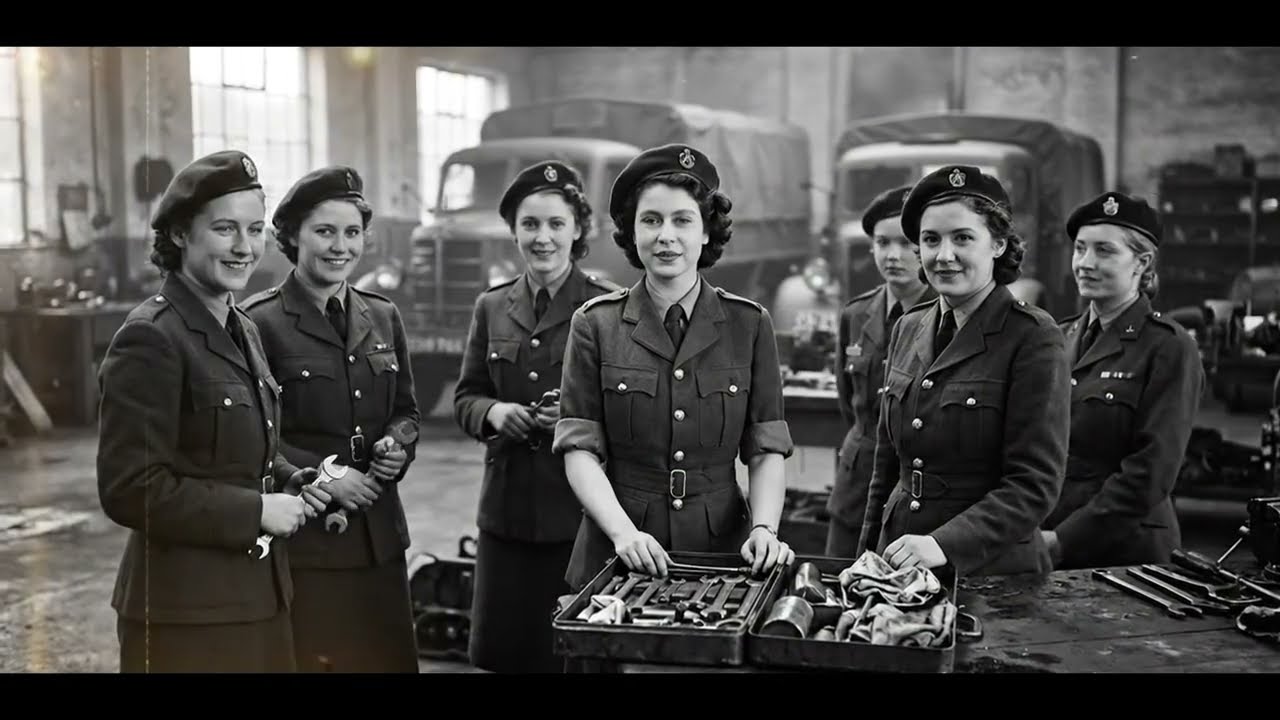
There was no coldness in any of that. This was the shape her sense of duty took. The war shaped her too. She came of age in a country under bombardment. Near the end of the war, as a teenager, she put on a uniform herself and did what few in her position ever do, serving as an ordinary girl among others. It was a brief glimpse of a normal life. Then the war ended, she married, and the long, quiet preparation for her fate continued around her year after year.
That fate arrived in the early hours of February 6, 1952. The King died, exhausted by a reign he had never wanted, and in that same moment his daughter became Queen. She began that day a princess, and before it ended she was a queen. She was 25 years old. Consider that scale. A young woman of 25, in one night becoming ruler of the country, with the weight of the crown thrown onto her shoulders at once. The men who governed on her behalf were three or four times her age, veteran statesmen who had held power before she was born. She had no living model for the role except her father. And her father was the reason the role was now hers. And the reason she feared what the role could do to a person.
What she brought to the role was the one thing her upbringing had instilled in her: self-control. She would not be seen to stumble. She would not be seen to show her feelings. The private person withdrew behind the public ruler and stayed there. This is the character the whole story turns on. She is not a cold woman, but a disciplined one. Discipline was her tribute to her father and her defense against a role that broke those stronger than her.
Think of what that role demanded of her. Day after day for the rest of her very long life. She had to meet those she loved and those she could not stand in exactly the same way. The same measure of courtesy. She sat through long, dull ceremonies without showing a flicker of feeling. She would never let the world, in public, see which way her heart leaned, because a ruler who shows bias stops being ruler of everyone equally. And here lies why the funeral morning mattered. When a woman like that, who had spent 13 years never showing bias, suddenly and deliberately does so, the gesture carries the weight of all the years she did not. Rarity is the essence of the meaning.
She spent her reign holding the line, keeping her private side out of sight. To cross that line once, in full view of the world, for one man, she must have felt something strong enough to justify the cost of letting others see her feelings. So the real question becomes a question about him. Who was the man who could move the most constant woman alive? He had been waiting for her from the start, an old man nearing the end of a long life. And when they first came together, there was no logic to the pairing.
When she took the throne, the man waiting to serve her was already old when her father was a boy. Winston Churchill was 77 in February 1952, and he was serving as prime minister for the second time in his life. Born at Blenheim Palace in Oxfordshire in 1874, in the middle of Queen Victoria's reign. He had served as a young cavalry officer in that Queen's own army. He had held a seat in Parliament for more than half a century. He had held high office under Elizabeth's great-grandfather, her grandfather, and her father. And now, in the autumn of that long life, he found himself reporting every week to a young queen who could have been his granddaughter.
It is hard to describe how strange this was in words. He was the most famous man alive. He was the voice that led the country through the darkest months of the war in 1940 and 1941, when its survival hung by a thread. He had helped steer that war toward its end. He was a figure from history books while still breathing, and his queen was a woman of 25 who had worn the crown only days. There was every reason for the situation to be awkward, and by surviving accounts, it was at first.
Churchill was difficult, emotional, and set in his ways. He had known Elizabeth only as a child, the little princess in newsreels. Now he had to serve her as his queen and receive his instructions, at least formally, from her. She had known him only as a symbol, the great man of her parents' generation. Now she had to receive him as her prime minister and hold her own in his presence. Two people separated by more than 50 years, by rank, by sex, and by everything life can put between two human beings, had to sit together alone once a week and work together on governing the kingdom.
Nothing in the long training of either had fully prepared them for the other. He had served monarchs who were themselves old men, from his own generation and the one before, and he knew how to bow to the authority of those elders. She had been educated to deal with statesmen, but as symbols of the state, not as a case like this: an aged legend sitting across a small table from him, a man who had helped shape the century she was only just inheriting. Each was, to the other, a kind of history suddenly brought to life. And it turned out that revering history from a distance was far easier than sitting across from it week after week, slowly getting to know it as an ordinary human being.
What grew in that gap surprised everyone who watched. The familiarity that developed was not mere awkwardness. It was warmth. The old man came to adore the young Queen. And the young Queen came to rely on the old man. From one of the strangest pairings in the history of governance, a genuine and documented affection emerged that neither dared express in plain words. An affection whose true scale the world only realized on the day he was buried.
It helped that Churchill approached the monarchy with something close to worship. He was a romantic about the crown. A man who believed with every fiber in the magic of old monarchy. And in Elizabeth, he saw that magic returned, young again. After the long, hard reign of her father, and after the war and the bleak years of austerity that followed, there was a new queen at the start of what he hoped would be a golden age for the country he had led through its worst times. He gave her his loyalty completely. And he gave it gladly. With the full devotion of a man who had waited his whole life for a cause he could serve without reservation.
The arithmetic of their lives, placed side by side, is strange almost beyond belief. He was 77. She was 25. He had served the crown in various offices for more than 50 years. He had been in Parliament since before her father was old enough to think about the throne. He had been a soldier, held high office under monarchs, and been a wartime leader. And now, at the end, he became servant to a young queen he had known while she was still a child. And every week he appeared before her, not with the heaviness of an old man performing a burdensome duty, but with the care of a courtier attending a formal occasion; dressing for it, preparing for it, and always staying far longer than state business required.
Those meetings shaped the relationship between them, and they were the most private thing in all of British public life. No official attended them. No secretary took a single note. Everything that passed between the oldest statesman in the world and the youngest monarch in living memory happened in a room built for silence. The only reason later generations know anything about them is that those around them could not help noticing how those meetings changed over the weeks. That change is where the next part of the story begins, behind a closed door in a room where nothing was ever written down.
Once a week the doors close, the officials leave, and no one writes down a word of what was said. The weekly meeting between the monarch and the prime minister is one of the oldest conventions of the British constitution, and its entire purpose is privacy. The two most senior figures in the state meet alone, without secretaries, minutes, or witnesses, so that both can speak with complete freedom. What the Queen truly thinks of her ministers, and what a prime minister confesses of his fears, stays in that room and dies there. It is a confessional at the heart of government, and its secrecy is not an accident but its essence.
For a little more than three years, that confessional room held an old man and a young woman. Churchill would come to the Palace, the doors would close, and for a time belonging to no one else in the world, the greatest figure of the age and the newest monarch of the era would sit and talk. What they said was lost on purpose. It went with them into silence. But its outlines remain. Because the men who worked around Churchill watched the pattern of those meetings with growing astonishment they could not suppress.
His private secretary was a man named Jock Colville, who served him for years and knew his habits better than anyone alive. Colville left recollections that have been quoted many times since. They are the closest thing we have to a window into that closed room. At first, he said, the audiences with the young Queen were short, businesslike, and done quickly. The old man was shy of her at first. Then, week after week, they grew longer and longer. The prime minister, who had been brisk and formal at the start, now stayed far longer than business required. Something was keeping him there.
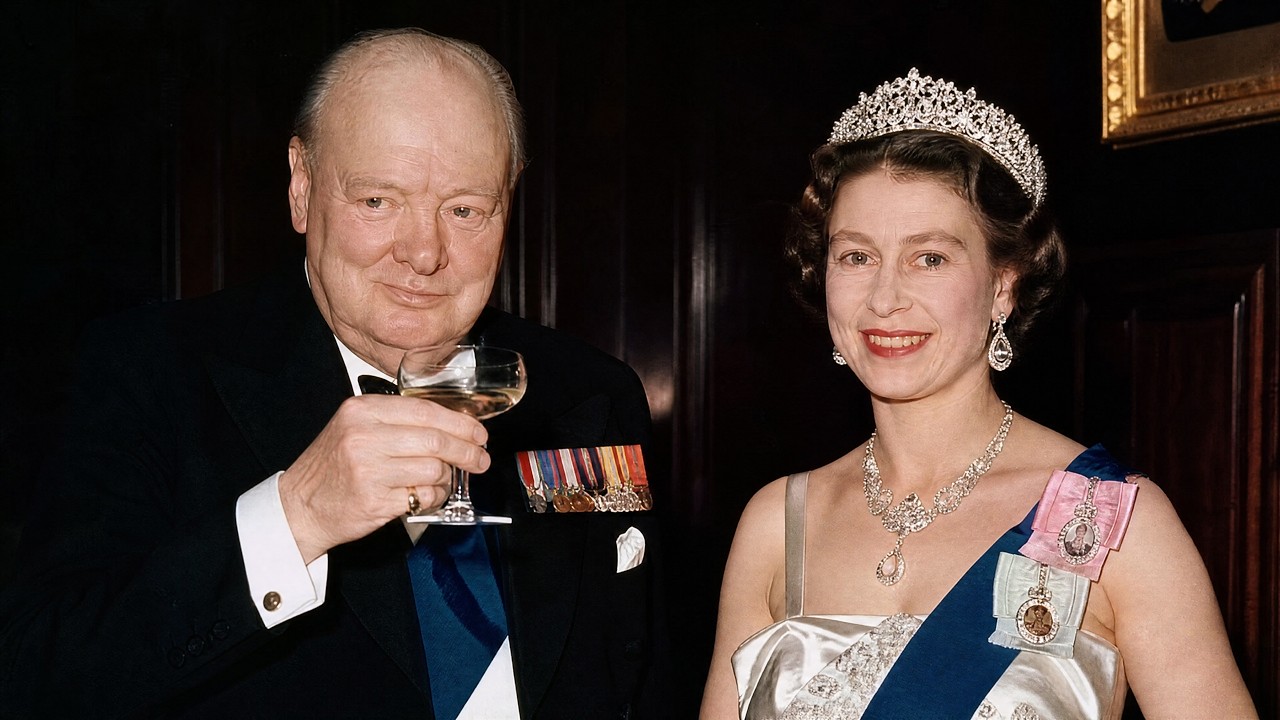
That recollection belongs to Colville and should be heard as his own memory, not as a record of what passed in the room, since no such record exists. But it points in one clear, unmistakable direction. Duty had turned into pleasure. Look closely at the two people in that room, and finding the reason is not hard. Churchill was a man of enormous appetites and overflowing emotions, emotional to the core, quick to tears and to feeling, a man who had lived his whole life at the peak of drama. Elizabeth was reserved, cautious, and possessed of self-control far beyond her years. A young woman trained since childhood to reveal nothing. On the surface, there were no two people less alike.
Yet the weekly audience gave them a space where their difference did not matter, and was in fact useful. She could ask questions as a ruler learning her trade. He could answer with wisdom gained over half a century at the top of political affairs. He could give and she could receive. And both roles fit them perfectly, like familiar old clothes. The convention of the weekly audience was centuries old. Over those centuries, it had paired rulers and ministers of every temperament, small and great, confident and cautious, willing and resentful. But it had rarely paired two people as far apart as these two. A man of 77 and a woman of 25. A statesman at the end of the longest public life in the country, and a queen at the start of hers.
The room existed so that the ruler and the prime minister could speak frankly to each other as near-equals, behind doors closed to the world. The astonishing thing is that across this vast gap in age and rank, that is exactly what these two did. The form of it was ancient. What they made inside it was entirely their own. For her, its value was enormous. She had taken the throne with almost no preparation for the political side of the job. A young woman handed the machinery of state and expected to understand it. And here, in her service, week after week, the most experienced statesman in the world was gradually teaching her how that machinery actually ran, which levers mattered most, and which men could be trusted.
She was a quick and serious student. She read her boxes late at night. She asked good questions and remembered the answers. And in Churchill she had a private tutor such as no new monarch in the country's history had ever had. A man who had seen everything worth seeing and forgotten none of it. For him, the value ran differently, and far deeper. At the end of a long life that held victory and bitterness in roughly equal measure, he found in the young Queen an object of pure, uncomplicated devotion. There was nothing to fight for in that room, nothing to win, no enemy across the table. There was only a young woman who represented everything his long life had been spent defending, and to whom he could offer the last of his loyalty without reservation or calculation. For a man who had spent 60 years in the arena, the peace of that room must have been a reward in itself.
The hidden truth of this story is simple and not a scandal at all. It is that the coldest and most formal duty in the entire state, the weekly audience, that meeting no living soul witnessed, had quietly turned into a friendship. The old man and the young Queen came to mean more to each other than either could have admitted. The world only learned how much on the morning he was carried into St. Paul's Cathedral. But those who knew them well had understood it long before, through one detail they could measure. The meetings were running long. And when Colville once asked his master what they found to talk about for hours, the answer was simple and unexpected enough to open the next chapter.
The prime minister and the Queen had one great shared passion, and it had nothing to do with government. When Jock Colville asked Churchill what he and the young Queen talked about during those steadily lengthening audiences, the old man's answer, as Colville remembered it, was that they mostly talked about horse racing, breeding, managing, and winning and losing on rainy racecourse afternoons. Two of the most different people in Britain had found the one field in the world where they met not as ruler and subject, but as equals. And that field was the racetrack.
Both were passionate owners of racehorses. Both followed the racing calendar with genuine, lasting devotion. For the Queen, it was the great private passion of her life. Perhaps the only place where her duty and her pleasure met without strain. A monarch can love horses openly and no one blames her for it. It was a world she understood from top to bottom, from pedigrees and trainers to the nature of the ground. And it gave her immense happiness. For Churchill in the autumn of his life, horse racing became a pleasure he pursued as if he were much younger. He owned his own horses and followed their fortunes with an enthusiasm that lit up his face.
So when state business was done, they could set the red boxes aside and talk as horse lovers about form, bloodlines, and the prospects for the coming season. It may sound like a small thing, but it was not. In a relationship defined by a vast distance between two people in age, rank, experience, and everything else, a shared love of racing was the bridge across that gap. It allowed them, for a few minutes each week, to be simply two people who cared about the same thing and talked about it as friends do. That is how affection grows between people whom every circumstance separates, on a patch of common ground. And their common ground was the racetrack.
The old man and the young Queen met there, and it brought them closer in a way no affairs of state could have. For an old man who had spent his life in the noise and quarrels of politics, that shared pleasure was a kind of rest. He had won elections and lost others, quarreled with colleagues and outlived most of them, and carried the survival of an entire nation on his shoulders through its darkest nights. Compared with all that, spending an afternoon talking about horses with a young queen who loved them exactly as he did asked nothing of him but pleasure. It gave the final stage of his public life a warmth his fighting career had never allowed him.
And when that private warmth sometimes showed in daylight at a public occasion like the coronation, it was clear to everyone who saw it that this reverence was not for the cameras. He meant every word and every bow he made. That warmth, built in private, began to show in public now and then. 1953 was the year of her coronation. That great ceremony that put the final touch on the new reign, and Churchill, her prime minister, stood near the heart of the celebrations. He was in his element. He loved ceremonial display as few ever have. He loved the monarchy with his whole being, and he loved this young Queen who was at the center of it all.
She was, in his eyes, the living proof that the country he had saved had a future worth saving. He spoke of her in elevated language he reserved for the things that moved him most, and pictured her as the bright hope of a new age. The scale of that year, seen clearly, is astonishing. The coronation came in 1953, and during the same year, Churchill suffered a stroke that nearly killed him. Between the young Queen and her prime minister stretched more than 50 years of history. She stood at the start of a reign that would last for decades and outlast everyone then alive. He stood near the end of a public life that had lasted more than half a century. And in that bright season, the beginning of her long story overlapped with the end of his. Each seemed to give the other something rare.
She gave him one last great occasion to believe in. He gave her the steady presence of a man who had already seen everything the world can do. Picture the old man bowing low over the young Queen's hand, and you will find the whole story in that single gesture. The reverence was real. Churchill was not faking a feeling he did not have, and he genuinely had it. To him, she was not merely a constitutional ruler to whom he owed formal, bare loyalty. She was the living symbol of the country he had fought for during its darkest year, and he served her with all the devotion he had left.
But nothing lasts, and both knew it. Churchill was old, his health declining, and the strokes had already begun their quiet work. The men around him pressed him, gently at first, then more sharply, to step down from the office he had held so long. The day was coming when the old man would have to give up his power and leave the young Queen to lesser ministers than he. When that day came, it produced one of the most affecting scenes in their entire relationship. A dinner in a modest house, a toast, and a farewell neither would ever forget.
Those close to him used one word to describe the old man's feelings toward the young Queen, and that word was "worship." This description came from Roy Jenkins, who was a veteran politician of that era and later one of Churchill's biographers. A man who knew from the inside the world both of them moved in. Jenkins wrote that Churchill felt something close to worship toward Elizabeth. Since this view came from a sharp-eyed political observer, not a sentimental admirer, it carries real weight. This was not a courtier flattering his sovereign for advantage. It was a realistic statesman honestly recording what he saw in another man's heart.
Lord Moran saw it too, and he was closest of all. Moran was Churchill's doctor, who attended him through his final years, and he carefully recorded the old man's conversations. Moran recalled that Churchill spoke of the Queen in the words of a man dazzled, saying that if all the filmmakers in the world scoured the earth, they could not find anyone better suited to the role. It is the praise of a showman and a romantic, a man who saw life as a series of great scenes and chose the young Queen as the perfect heroine of the era beginning. Again, this is what Moran passed on, his memory of the old man's words and not a transcript, so it should be treated as such. But it fits everything known about Churchill's feelings.
What was in the mind of this famous old man to produce such complete devotion? Part of it was the romance of the crown itself, which he believed in all his life as some men believe in a religion. Part of it was the moment he found himself in. He was old, and he knew the end was no longer far. And in the young Queen, he saw the future he would not live to see, Britain continuing after him under a new and untainted monarch, unstained by the failures and compromises of his long generation. And certainly, part of it was simpler and more human than all of that. He was an old man who had lost much and buried many. And here was a young woman who represented everything he had spent his life defending, and who received him with grace week after week. One can pour a great deal of feeling into such a figure, and Churchill was a man overflowing with all his feelings.
She was sparing with words all her life, and that is exactly what gave the few she said such weight. She kept no public diary of her feelings. She never gave interviews about the men who served her. Throughout her long reign, she left only a handful of scattered notes that revealed her true character. So a single written sentence, clearly intended and carefully kept, carries enormous weight in her case. It constitutes almost all the available evidence. And the sentence she wrote about Churchill is the warmest of its kind known to have been written about any minister who ever served her.
It was, in its oldest form, the loyalty of an aged knight to a young ruler, the most ancient pattern in the long history of monarchy. The old warrior, after the time of his battles has passed, kneels to the new ruler and offers what remains to him, his loyalty and his service to the end. Churchill was many things through his long and turbulent life, and not all of them were kind. He made enemies as easily as friends and defended his position ruthlessly. But in this last service to this young Queen, he was tender, and that tenderness was entirely genuine.
On her side, the Queen was not a woman who spoke of her feelings then or at any time in her life. So the evidence of what she felt for Churchill is quieter, rarer, and harder to find, but it exists and it is decisive. It is written in her own hand. It comes at the moment of their farewell in the spring of 1955, and it is the clearest known statement she made about him, or perhaps about any of the many ministers who served her over the decades. She wrote that no future prime minister could ever occupy, for her, the place of her first prime minister, the man to whom she and her husband owed so much.
Read that sentence slowly, because it is the key to the whole story. Here is a woman famous throughout the world for revealing nothing, writing down that one man held a place in her esteem no successor could fill. She did not say it in warm or ornate words, for that was never her style. She said it plainly, which for a reserved woman like her is equivalent to saying it with the deepest feeling. And she said it a full ten years before his funeral. The debt she mentioned in that letter, and the place she said he held that no one else could occupy, are exactly what she would embody in silence at St. Paul's Cathedral a decade later before the assembled leaders of the world.
So the affection, quite clearly, ran in both directions. He worshipped her, according to the considered phrasing of a man who saw them together. She valued his presence above every minister who followed, in words she wrote herself and truly meant. And in April 1955, the time came for them to part as prime minister and monarch for the last time. It did not happen in the council chamber or through an official state office. It happened at a dinner at his home on the last night of his power. And of all the scenes in this long story, this one may be the most expressive of what the two had become to each other.
On the evening before his resignation, the Queen came to dinner at his home, and the old man himself walked her to her car. The date was April 4, 1955. Churchill had turned 80, and the next day he would go to Buckingham Palace to resign as prime minister for the last time in his life. Before that, on his last full night in power, he held a dinner at 10 Downing Street, attended by the Queen and Prince Philip. It was an exceptional honor, and everyone in the house knew it.
The Queen does not, as a rule, dine at the official residence of the prime minister. 10 Downing Street is a house for work, a modest building behind a simple black door, the office and home of the head of government, not a place the crown visits for dinner. Its rooms are elegant but far from grand, a civil servant's house rather than a palace. For the Queen to come there, to sit at Churchill's table on the last night of his long career, was a mark of personal esteem entirely out of the ordinary. She was honoring him the way a monarch honors subjects she values, by coming to him at his own residence at his invitation.
The table that night gathered an elite of the era. Among the guests was Clement Attlee, the Labour statesman who had governed Britain in the postwar years, and his wife. There was Herbert Morrison, another major Labour figure of the century, with his wife beside him. There was Anne Chamberlain, widow of Neville Chamberlain. It was a room full of history, full of old quarrels and wounds set aside for one night, gathered under one roof to bid farewell to the greatest of them as he left the stage.
There is a quiet grandeur to how that evening unfolded. All his life, the summons had always come from the other direction. For more than half a century, Churchill was the one who went to the monarch, the one who was received, the one who waited on the crown's pleasure, as every minister must. On this last night, the crown came to him. The young Queen made the short journey from her palace to his door and sat at his table as his guest. In doing so, she reversed, for one night, the entire order of his life. It was a courtesy of the rarest kind, and a way of telling an old man, without the embarrassment of saying it aloud, how much he was valued at the very top of the state he had served so long.
Churchill stood in his formal coat, wearing his decorations on his chest, and proposed the toast of the occasion. He raised his glass to the Queen. It was the last time he would do so as her prime minister, and it embodied all the weight of those strange three years. The old servant saluting the young Queen one final time before stepping down. Then, as the evening neared its end and the hour grew late, he did not merely let her leave. He walked her himself through the house to her waiting car. And he stood there, an old man of 80, as she was driven away into the London night.
What he said after she left was recorded by Jock Colville in the memoirs he later wrote under the title "The Fringes of Power." When the Queen had gone and the last guests had dispersed, the old man sat on his bed, still in his formal clothes, and spoke about the man who would succeed him the next day, his chosen successor. Churchill said simply and heavily that he did not think Anthony could do it. It was the doubt of an exhausted leader about the man who would come after him. And that doubt hung in the quiet of the house as it began to empty.

The next day, he went to the Palace and offered his resignation to the Queen. And power passed into other hands. Then the Queen wrote to him. It was in the aftermath of that resignation that she crafted the sentence that sums everything up. No prime minister could ever occupy in her heart the place held by the first of them, the man to whom she and her husband owed so much. The dinner and the letter completed each other. They were two halves of a single farewell. The dinner was the public side of the goodbye, with its toast, its guests, and that old man standing on the steps watching her car leave. The letter was its private truth. Feelings a dinner could not contain, written in her own hand for him alone to read.
They continued to meet after that, of course, for the bond between them did not end with his office. He remained a member of Parliament and a veteran statesman, and the Queen saw him from time to time in the years that followed. The old man moved slowly now, and his great strength was fading. But that special relationship between sovereign and prime minister, the weekly meeting, the closed door, and the long conversations about horses, all of that had ended and would not return. What remained was quieter. An old man slowly fading toward his end, and a young Queen continuing the reign he, before anyone else, had helped her learn to bear.
His decline would be long. It would take another ten years to complete. And throughout that decade, without the knowledge of the crowds still cheering him in the streets, the machinery of state was quietly preparing for the day he would finally depart. The Queen had already given the order that set those wheels in motion. The plan already had a name, a name wrapped in sorrow. From here begins the long goodbye.
While Churchill was still her prime minister, the Palace quietly began planning his funeral. The first warning came in June 1953, only months into the new reign, and while he still held the highest office in the land. Churchill suffered a severe stroke. It was serious enough that his life was on the line for a time. Yet the matter was hidden from the public with a skill that might be entirely impossible in any later age. The true scale of his illness stayed secret. And the men around him quietly kept working in his name while he recovered. No one was sure whether he would ever return to his desk at all.
There is a strange weight to thinking about this. For twelve years, two things ran side by side and never once met. In one, an old man lived the last decade of his life, sat in the House of Commons as a veteran statesman, followed his horses, and slowly weakened as the elderly do. In the other, a small, quiet circle of officials stayed ready for his funeral, adding each passing year to the plan, so that the state would not find itself unprepared when the day came. He kept living. They kept preparing. Neither could hurry the other, and neither could stop it. And the plan stayed there between them, patient and complete, waiting for a date no one could set and everyone knew must come.
He did recover. His physical constitution was remarkable; he came back from the edge of death and held office for about two more years. But the stroke did something that could never be undone. It turned his death from a certain but distant fact into a live, practical matter for the institution he served. If the greatest man in the country died, the state would have to bury him. And burying a man like that could not be arranged in a hurry in a single week. It had to be prepared in the finest detail, with enough time before it was needed.
So the order came from the highest level. The Queen instructed the Duke of Norfolk, as Earl Marshal and the hereditary official responsible for great state ceremonies in the kingdom, to begin preparing Churchill's funeral on a scale worthy of his place in history. Note the source of that instruction, for it is more important than anything else in this story. It came from her. The Queen herself set those arrangements in motion. She did not wait to be asked. She told the Earl Marshal not to plan an ordinary funeral for a retired politician, but a state occasion worthy of this man. And she ordered it while the man was still alive, and at that moment still her prime minister.
That order, quietly issued in the aftermath of the 1953 stroke, is the first of the three gestures on which this whole story rests. The other two would happen at the funeral itself, twelve years later, before the eyes of the world. But the decision to hold such a funeral, one rising to the level of royal funerals, was hers, and she made it in private long ago when almost no one was watching.
The plan was given a name, and the name carries a touch of quiet affection. It was called "Operation Hope Not." The hope, of course, was that the plan would never be needed, not now, not for a long time. It was a secret document kept by a narrow circle and kept updated over the years. And the years did pass, far more than anyone expected. Churchill, having survived the 1953 stroke, kept on living. He left office in the spring of 1955. And he lived through the rest of that decade. He passed his 80th birthday, and birthdays kept coming, and still he lived. And all that time, Operation Hope Not waited in its drawer, taken out and revised and put back again and again, because the man it was written for refused to die.
There is something almost unbearable in that picture when you dwell on it. For twelve long years, the state kept a ready plan for the funeral of a man still alive, and through all those years the man kept living, growing older and grayer and weaker, while the document was quietly updated around him. Officials came to work on it and retired from it. Details changed as the years changed. The plan was revised again and again, draft after draft. And Churchill, who must have known in general terms that such preparations existed, for the great always know, kept outliving his own funeral year after year.
The length of that preparation is part of what made the funeral, when it came, so complete and so moving to those who witnessed it. Nothing was left to chance, because for more than a decade nothing had been left to chance. Every stage of that day was planned, tested over the years, and polished until it was flawless. The lying in state, the route through the city, the service under the dome, the long journey to the grave, all of it was rethought so many times that when the moment came, the vast machine moved without a stumble. And behind that machine, giving it its official character, was the wish that had started it all. The Queen's instruction that this man be honored as few outside her own family ever have been.
For twelve years, the plan waited. Then, in the middle of a cold January, the waiting ended. On January 15, 1965, he suffered a stroke. And for nine days, the people waited at his door. Churchill was 90 years old. He was at his London home, on a quiet dead-end street called Hyde Park Gate in Kensington, a narrow street lined with tall houses a little away from the noise of the city. The stroke was severe, a cerebral thrombosis. And this time, there was no way back from the edge of death. His old body, which had carried him through so much, through wars and defeats and earlier strokes, had nothing more to give.
He began to fade slowly over days, while the country held its breath and watched that door. His doctor, Lord Moran, came out to the waiting press and told them the truth in the plain words such a moment requires, that Sir Winston was gravely ill. The nation understood at once what those words meant. And so began a strange and awe-inspiring vigil in a London street. Outside the house at Hyde Park Gate, reporters gathered and stayed through the cold days and colder nights. From the threshold of that door, medical bulletins were read, brief and cautious statements about the dying man's condition, issued day after day after day.
Crowds came and stood in the royal street, looking at the dark windows behind which the old man lay. There was nothing at all to see. But they came anyway, and simply stood to be near him at his end. There was a strange intimacy to that public death, even though it happened in full view of the world. A nation was allowed into the final chapter of one man's life, and allowed to stand in the street and wait beside the family to read each morning how the night had passed and whether he was still with them. People who had never met him felt they were losing someone who belonged to them.
They had grown up hearing his voice in their homes. They were children when he told them the country would not fall. And now they were grown men and women standing in a cold street in Kensington in the depths of a harsh winter, waiting for an old man they had never spoken to to finish his long departure. It was a grief the size of an entire people gathered in silence outside a single front door. And when the news finally came from the threshold that he had gone, the quiet in that street was the quiet of a family, not a crowd.
It went on for nine days. Nine days of bulletins from the doorstep, of silent crowds in the cold, of a whole country living in the shadow of a single deathbed in a side street in Kensington. It was a slow and public death. The long last farewell to a man the nation had loved, feared, and followed for nearly half a century. Newspapers set aside space on their front pages waiting for the news. The press of the entire world gathered in London to wait. And the old man clung to life, as he had for so long despite all the drafts of Operation Hope Not, unwilling even now, even at the last moment, to leave quickly or quietly.
He died on the morning of January 24, 1965. And in the date of his death, there was a coincidence so exact that Churchill himself had remarked on it in his later years. His father, Lord Randolph Churchill, had died on January 24, 1895. Winston died on the same day of the same year exactly 70 years later. It was a coincidence he had noticed himself in his final years. The son who had spent his whole life comparing himself to his father closed his days on that cold January date after 70 years.
The news spread around the world, and the world stopped what it was doing to hear it. For those old enough to remember the war, it was the departure of the man who had put their challenge into words when they needed them most. For the young, it was the fall of the last of the giants. A figure who had stepped out of history books into their newspapers, and was now finally leaving the stage of the living. The reaction was immense and crossed every border. Tributes came from every capital, from friends and former enemies alike. The man being mourned was not merely a British statesman. By 1965, he had become something closer to a shared possession of the entire free world. And the entire free world mourned.
At Buckingham Palace, the plan that had waited twelve years patiently was taken from its drawer one last time and put into motion. The Queen's old wish had to be carried out stage by stage, carefully. Churchill would receive a state funeral, the honor she had ordered prepared after his 1953 stroke, and it would be the largest funeral granted to any commoner in the memory of anyone then alive. But granting that honor was itself a rare and weighty act, far rarer than the crowds soon lining the streets realized. To understand how rare, one must understand what a state funeral in Britain really is, and for whom the country reserves it.
A state funeral in Britain is almost never held for anyone not of royal blood. It is the highest form of public mourning in the country, and it is surrounded by rules and conventions that restrict it, in almost every case, to the monarch and the royal family. It is not merely a large or solemn funeral, though it is both. It is a specific and serious constitutional act. It is funded by public money granted by a vote of Parliament. And most importantly, it cannot be held for anyone outside the royal family without the explicit consent of the reigning monarch.
And the convention runs deeper than money and a vote. By long tradition, the impulse to hold a state funeral for a great figure should not come from the crown, but from Parliament and the people. The House of Commons petitions the monarch to grant the honor. The monarch then approves the request. The direction of that exchange matters greatly. The nation is meant to speak through its elected representatives to ask the monarch to allow one of its greatest servants to be buried with ceremonies reserved for kings and queens alone. The monarch grants what the people have asked through Parliament. That is the settled shape of the thing. It is what keeps the honor rare, by making it something the nation must request, not something the crown simply gives.
Measured against that convention, Churchill's funeral stands out very clearly. State funerals for non-royals are extremely rare across all of British history. Before Churchill, the last had been for the Irish politician Edward Carson in 1935, a full 30 years earlier. Before that, they were scattered across the centuries, granted only to a very few of the nation's greatest servants. To be given a state funeral as a commoner means to be placed in death among that small and immortal group. Those subjects whom a grateful nation considered equal to its kings and queens. Churchill's funeral was the first for a non-royal in three decades, and by broad agreement the greatest anyone alive could remember.
Rarity was the whole essence of its meaning. An honor that comes easily does not deserve the name. And the state had kept this honor rare across the centuries for exactly that reason. Kings and queens were buried with these ceremonies as a matter of course, for the ceremonies were designed for them. Only a very few others, scattered across the long centuries of the nation's history, were judged worthy of joining that elite. And every one of those few names was one any schoolchild could recite. So adding Churchill to such a short and shining list meant, in the most formal language the country possesses, that he belonged among the nation's immortals, not merely among its politicians and ministers.
And the fact that the sovereign herself had wished it for him in advance, quietly, years before the need arose, rather than merely approving it when the House of Commons finally asked, gave the whole tribute a warmth the cold machinery of petition and consent could never have provided on its own. The forms would all be observed in their proper time. But the heart of the matter had been settled long before in a single private wish. And in his case, the wish for it came from the crown itself. And it came years before it was needed. The Queen did not wait for the House of Commons to petition her. She issued the instruction herself, quietly, after his 1953 stroke, asking the Earl Marshal to prepare a funeral worthy of his place in history.
When the moment finally came in 1965, the machinery of the state funeral set off already carrying the Queen's long-standing blessing, ready and waiting. The honor was the nation's honor, expressed in its time through all the forms of petition and consent, but the wish to grant it, and its first spark, had come from the Queen from the start. Compare that fact with everything else in this story, and it changes the shape of the whole tale. Her first of three great gestures toward Churchill was not on the morning of the funeral at all. It was made twelve years earlier in a quiet, private decision that this man, when his time came, would be buried as if he were one of her own family, with the honors of royal blood.
A state funeral is the tribute the crown keeps for its own. By granting it to Churchill, and by wishing it for him long in advance, the Queen was saying something clear about the place she gave him in her heart. She was placing him in death among her own, among the monarchs. The scale of what that single decision set loose upon the city was itself a kind of statement. This was not merely the ordinary departure of a retired statesman. The body would lie in the ancient stone heart of the Palace of Westminster, where the bodies of monarchs rest. The funeral service would fill the country's greatest cathedral to its walls. The leaders of the entire world would be summoned to London, and they would come. The streets would fill with crowds larger than the city had seen in its long history for almost any other occasion.
All of this flowed from the granting of that single honor, a state funeral, the mark of a nation burying one of its immortals with the ceremonies of kings. And its first stage, before the kings and presidents arrived, would be given entirely to ordinary people. They came in their hundreds of thousands, waiting for hours in the January darkness to file past the coffin once. From January 26, Churchill's body lay in state in Westminster Hall, the oldest surviving part of the entire Palace of Westminster, a vast stone hall whose great timber roof has stood since the Middle Ages, the largest of its kind in England. It is the place where the bodies of monarchs lie before their funerals, the stage for the final farewell to kings and queens.
Now it held the body of a man who had never worn a crown, raised on a platform called a catafalque, covered and guarded by tall candles burning at its corners, with soldiers standing motionless on watch at every hour of night and day. And the people came to him. They came out of the cold winter streets and through the doors into the dim vastness of the great hall. They walked past the coffin in a silent, slow, endless river of humanity. They came by day and they came through long nights, because the hall stayed open around the clock to receive them, and still the line did not end.
Old soldiers came who had served under him or fought in the war he led. Widows came. Parents came and took their children by the hand to see with their own eyes the coffin of the man they had been told never to forget as long as they lived. They did not linger, for they could not. There were always too many waiting behind them. Each mourner got a moment, a few slow steps beside the raised coffin, a look, perhaps a bowed head or a whispered word, and then was gently moved along to make room for the next in line.
Inside the hall, the only sounds were the shuffle of feet on the ancient stone and, on the hour, the slow ceremony of the changing of the guard around the coffin. Soldiers stood watch at its corners, rigid as carved statues, while the river of mourners kept moving past them without pause. Outside, those waiting in line endured the worst days of winter. People stamped their feet against the cold and spoke little. Strangers shared thermoses and held each other's places in the queue. Some came from distant parts of the country and would return the same night, spending a full day and most of a night for a few seconds beside the coffin. Nothing was asked of them, and nothing was offered in return. Yet they kept coming by the thousands, and the long line did not shorten.
The numbers reflect the scale of the event and deserve to be recorded clearly. Over three days and three nights of lying in state, about 321,360 people passed through Westminster Hall before the coffin. To reach it, they queued in lines that often took three hours in London's biting January cold. The line stretched from the doors of the hall along the bank of the Thames, a slow-moving column of mourners for miles through the frozen dark. Many stood most of the night to reach the coffin for the few brief seconds the pace of the line allowed. No one forced them to come. No order summoned them. They came because they wanted to, more than 300,000 of them, to give a public figure a personal and private farewell.
There is something in that picture no official ceremony, however grand, can manufacture. The kings and presidents would have their turn under the dome of St. Paul's Cathedral soon, in their robes and decorations and gold, but the lying in state belonged to ordinary people, and they earned it by the hundreds of thousands, standing in the cold with no personal gain, only to pass beside a box holding the body of the man who once told them they would fight on and never surrender. The nation mourned personally, one ordinary citizen after another, for three days and three nights without pause or break.
During those same three days, the rest of the great machine moved smoothly toward its climax. Around the world, the leaders of more than a hundred countries prepared to travel to London for the funeral. In embassies and grand houses across the city, the final arrangements for the day itself were reviewed and settled. Operation Hope Not, revised and rehearsed over twelve long years, was unfolding stage by stage with precision, exactly as written. The lying in state was its first great movement. The funeral service at St. Paul's Cathedral on January 30 would be the second and greatest of all. And somewhere inside the Palace, away from the crowds and cameras, the Queen was preparing for her role in that coming day. She knew the details of the ceremony by heart. In a sense, she had known them for twelve years, since she issued the order that set the whole plan in motion.
The Queen arrives last. And the Queen departs first. Those were the rules of any such day, fixed and ancient and beyond discussion. What no one yet knew, and what no written plan could have anticipated, was what this disciplined Queen would quietly choose to do inside the great ceremony when the morning finally came. That morning is the destination the story has been moving toward since its first word.
At the largest funeral London had seen in living memory, the smallest gestures mattered most. The dawn of January 30, 1965, broke cold and gray over the city, and the scale of what unfolded that morning was almost too large for the mind to take in. St. Paul's Cathedral held around 3,500 mourners beneath its dome. Representatives came from about 112 countries of the world. Among them were five kings and one emperor, along with former and current presidents and prime ministers, in numbers the ancient cathedral had never before held gathered under its roof. French President Charles de Gaulle was there. So was Dwight Eisenhower, former president of the United States, who had helped Churchill manage the war at his side.
The service was designed to suit the man it honored. The hymns were rousing, chosen for a warrior rather than a saint. Among them was an old call to fight the good fight and be a brave pilgrim, and the American "Battle Hymn of the Republic," a deliberate nod to Churchill's American mother and to the great transatlantic alliance he had done so much to build and preserve. The music rose and faded inside Wren's high dome, and the assembled ranks of the powerful and the grieving sat together beneath it in the cold. There was even a moment of real danger when the coffin, far too heavy, nearly slipped from the hands of its bearers while climbing the long western steps of the cathedral, had soldiers stationed behind them for exactly that fear not saved it. The weight of the state and the whole world had gathered in one building to bury one man.
And in the midst of that vast, strict, precisely ordered occasion, the Queen did two simple things no queen does. They are the heart of everything this story has been building toward. The first was her arrival. By the unbending rule of her court, the Queen comes last, so that everyone has gathered and sat waiting for her entrance. That morning, she came early. She took her place inside the cathedral before the coffin reached the steps, and before the Churchill family entered through the doors. So when the family finally came in, following their dead, they found the Queen already there, in her seat, waiting for them as any ordinary mourner waits for a funeral to begin. She gave up her right to arrive last, so that Churchill and the family who loved him would not have to wait for her.
The second was her departure. The rule is equally strict; the one being honored leaves first, and the others remain in their places until that one has gone. That morning, she stayed. She remained in her seat and let Lady Churchill, the old man's widow, and the rest of the family leave the cathedral before her. The widow of the dead man walked out ahead of her queen. Elizabeth waited, and only when the family had gone did she rise and follow them out.
Take those two acts together, and the meaning is unmistakable to anyone who understands the rules she was breaking. The sovereign arrives last and departs first. That is the rule of her whole life. The visible and unmistakable sign of her precedence over everyone else in the kingdom. That morning, she turned both halves of the rule upside down. She came first and left last. Which meant she deliberately placed herself, in full view of the world, in a rank below the man in the coffin and the family mourning him. It was no slip. It was a message in the only language a monarch is permitted to speak.
Churchill's grandson, Nicholas Soames, who was a boy at the time and later became a member of Parliament, understood the gesture exactly. Long afterward, he put it into words. He said it was an extremely exceptional thing, if not unique, for the Queen to give precedence to anyone. And that her arrival before the coffin and before his grandfather was very beautiful and very moving. His words should be taken as the family's own reading of what was done for them.
It is true that there was a faint old precedent, so faint that few in the cathedral might recall it, that the Queen's own grandfather, King George V, had similarly given up his precedence at the state funeral of Field Marshal Lord Roberts in 1914. So the gesture was not entirely without parallel in the history of the crown. But it was so rare, and so nearly unprecedented, that everyone who saw it knew they were witnessing something they would not see again. And the Palace said nothing at all. No statement explained the early arrival or the late departure, because no explanation was asked for, and none was needed. The gesture explained itself perfectly to everyone who saw it.
There was nothing hidden behind it, no secret reason, no buried grief the Palace was quietly trying to cover. There was only a queen honoring the man she had once described as her first prime minister, in the only way a ruler truly can. The silence was not a cover for anything. It was simply that everyone there already understood. When the coffin passed along the Thames, the great cranes on the docks bowed their heads one after another. The service under the dome of St. Paul's Cathedral had ended, but that long day was not over.
Churchill's coffin was carried to the river, to Tower Pier, and placed aboard a small boat named Havengore to sail on the Thames. As the boat moved into the gray water and began its journey, something happened that was not part of any official plan, and it would stay in the memory of everyone who saw it more than the great ceremony itself. Along the south bank of the river stood London's working docks, and the tall cranes that loaded and unloaded the ships that were the city's lifeline. As the boat carrying the coffin came level with them and passed, the crane operators lowered their long arms one after another along the line, dipping them slowly toward the water like a row of men bowing their heads in turn.
It had been quietly arranged with the dockworkers themselves, the river men who offered their own respect to the old man in their own way, without robes or orders or invitations to the cathedral. On a day crowded with kings and presidents and emperors, the cranes were what people remembered most, the hard iron of the working city bowing its neck as Winston Churchill's coffin passed on the water. For all the official grandeur, the simple human details stayed most firmly in memory. Dockworkers lowering their cranes in tribute to a man most of them had never seen face to face. A giant locomotive bearing his name leaving the city he had saved.
The state gave him everything a state can give in the way of splendor. But ordinary people gave him what no ceremony could arrange. The cranes bowing on the river, the crowded little churchyard, the long, patient wait in the bitter cold. Those silent gifts, in the end, told the truest story of what the man meant to the country he served. From the river, the coffin was taken to Waterloo Station and placed aboard a special funeral train prepared for him. The locomotive pulling the train bore, by a fitting coincidence, his name; a giant steam engine long known as "Winston Churchill." The train carried him out of London to the quiet Oxfordshire countryside, away from the vast crowds and the weight of ceremony, toward the modest place he had chosen for himself long before.
For all the splendor the nation lavished on his departure, Churchill did not wish to be buried among the kings and poets in Westminster Abbey at the heart of the capital. He chose instead the yard of a small country church, far from all of it. The place was Bladon, a village near Blenheim Palace, the vast baroque house a grateful nation had given to his ancestor, the first Duke of Marlborough, and the house where Churchill himself had been born 90 years earlier. There, in the churchyard of St. Martin's, in a private family service away from the watching eyes of the world, he was buried in the grave of his parents, beside his brother.
The contrast could not have been clearer or more deliberate. In the morning, the largest ceremony a nation could stage, 3,500 mourners and the leaders of 100 countries under the dome of Wren's cathedral. In the afternoon, a small grave in a village churchyard, and a man laid quietly to rest beside his mother and father in the ground near the great house where his life began. And the people did not forget that small grave either. Within a week of the burial, more than 100,000 visitors made their way to the quiet churchyard at Bladon to stand beside it. And they kept coming year after year, in steady numbers that did not diminish. The man who was buried in privacy, away from the crowds, became a place of pilgrimage after his death. That small country grave drew the same crowds the great cathedral had drawn on the day of the funeral itself.
And so the day that began with the Queen arriving very early at St. Paul's Cathedral ended with an old man gently laid to rest near his birthplace. The circle of his life closed there at Bladon, from Blenheim Palace to the grave a few miles away, with 90 full years stretching between the two points. And with it, the circle of the funeral day closed. That day began with the Queen breaking the oldest rule of her life to honor him. It ended with ordinary people stepping out of their ordinary routines to come and stand in silence at his grave. And between those two things, the Queen's silent gesture in the cathedral and the endless crowds in the churchyard, lies the full truth of what this man meant to both the crown and the country.
There remains only the question the whole long day raised and never answered explicitly. Why? Ten years before the funeral, she had written a single sentence, and at St. Paul's Cathedral, she simply carried it out. When Churchill resigned in the spring of 1955, the Queen wrote to him that no prime minister could ever, for her, occupy the place of her first prime minister, the man to whom she and her husband owed so much. That was the answer to the question the whole day raised.
Everything she did on the morning of the funeral, arriving early, leaving late, and giving up her precedence before the assembled leaders of the world, was that written sentence turned into action. She had said it once in words to him alone, a decade earlier. And now she said it again in the only public language a monarch is permitted to use, the language of ceremony and protocol. Because that is the real heart of the whole story. A monarch may not voice personal feelings. It is almost the first rule of the entire office, the rule Elizabeth learned as a child watching her father exhaust himself, and kept without a single breach for thirteen long years.
She could not stand in that cathedral and say aloud what Churchill had meant to her over the years. She could not weep at his coffin, or climb to the pulpit and praise him. The woman inside her was never allowed, whatever happened, to appear through the public Queen. So she had only the vocabulary the Queen truly owns, the vocabulary of precedence and rank, of who arrives when, and who is permitted to leave first. And in that strange, ancient vocabulary, arriving early and leaving late were words. They were, in fact, the most private and affectionate words she could offer anyone.
That is why the gesture moved the people who understood what they were watching so deeply. They realized what it must have cost her, she who had never shown preference for any living soul, to show it so clearly and publicly, and for a man rather than the great institution she represents. Granting another person precedence over her was, for her, an expression of the deepest respect, because precedence was the one thing in the world that was always, exclusively, and unquestionably hers. She gave it away that cold morning to Winston Churchill. It was the highest honor in her possession, and she laid it at his coffin without saying a word.
That moment stood at the meeting point of two eras of the world. Everyone in the country felt Churchill's death as a true end of an age. The closing of the war chapter in British history. The departure of the last of the giants who had led the world through its worst and darkest years. The great crowd of kings and presidents gathered at St. Paul's Cathedral was a true farewell to that fading generation of men. And the young Queen who honored him stood exactly at the link between the old world and the new one coming. A queen who had worn a uniform herself at the end of the war, now bowing her crown once for the man who had been the living embodiment of the age that ended with his passing.
It was a moment at another link too, between private life and the eye that watches without pause. 1965 was the dawn of the television age, and cameras carried Churchill's funeral to a vast audience around the world. One of the first great shared events on screen that would help bind the century together. In an earlier reign, the Queen's small gestures of precedence might have passed almost unnoticed, seen by a few hundred inside the cathedral and remembered by fewer still. In the age of the camera, they became part of the permanent record of her character, watched by millions, remembered, and retold again and again. The most private of women performed her most personal gesture in the most public of places, and the world kept the image of that scene forever.
And so the story finally returns to where it began, to the cold cathedral waiting, and to the Queen who came early. She took her place before the coffin reached the steps, and before the family entered through the doors, a queen sitting quietly in a hall not yet ready for her, waiting as any mourner waits. The Palace never explained it, because the gesture was its own explanation, complete and needing nothing added at all. She had written that sentence ten years earlier, that no one would ever occupy his place. At his funeral, in a way only a queen can, she simply kept her word.