On the rainy afternoon of November 24, 1971, the day before Thanksgiving, a man in a dark suit and a clip-on tie walked up to the Northwest Orient Airlines counter in Portland, Oregon, and paid cash for a one-way ticket to Seattle. He gave his name as Dan Cooper.
He carried a plain black briefcase, ordered a bourbon and soda once seated in row 18, and lit a cigarette. To everyone around him, he was utterly forgettable, just another middle-aged businessman heading home for the holiday.
Thirty minutes later, he would become the most hunted man in America. For more than half a century, he would remain something far stranger than a fugitive. He would remain a ghost.
The FBI chased him through five decades, a thousand suspects, and 45 years of dead ends before finally giving up. But the answer, it turns out, may never have been hiding in the wilderness of the Pacific Northwest at all.
It may have been sitting quietly at a family dinner table in Utah, guarded by two children who spent their entire lives protecting a secret they never asked to carry.
Shortly after Flight 305 lifted off, Cooper passed a handwritten note to a flight attendant named Florence Schaffner. She assumed it was just another lonely passenger slipping her his phone number and dropped it into her pocket without reading it.
Cooper leaned in close. "Miss, you'd better look at that note. I have a bomb."
When she hesitated, he opened the briefcase just enough to reveal red cylinders, wires, and a battery. His demands were precise: $200,000 in $20 bills, four parachutes, and a fuel truck waiting on the runway in Seattle.
There was no shouting, no panic, no manifesto. Witnesses would later describe him as calm, polite, almost courteous. He ordered a second bourbon and paid for it.
On the ground in Seattle, the FBI scrambled to assemble the ransom while the plane circled overhead. When it finally landed, Cooper released all 36 passengers in exchange for the money and the parachutes, keeping only a skeleton crew on board.
Then he issued his final instructions. Fly toward Mexico City at low altitude, with the landing gear down, the flaps at 15 degrees, and the rear staircase of the Boeing 727 unlocked.
Somewhere over the dense, storm-lashed forests of southwestern Washington at around 8:00 that night, the crew felt a sudden pressure bump in the cabin. When the plane landed in Reno, the rear stairs were hanging open, and the man in seat 18C was gone.
He had jumped into a freezing black sky, into wind and rain, with 21 pounds of cash strapped to his body, and vanished so completely that hundreds of agents, soldiers, helicopters, and bloodhounds combing the drop zone could not find a boot print, a scrap of fabric, or a broken tie.
A paper wire error transformed his alias Dan Cooper into D.B. Cooper, and the mistake stuck. A legend was born out of a typo.
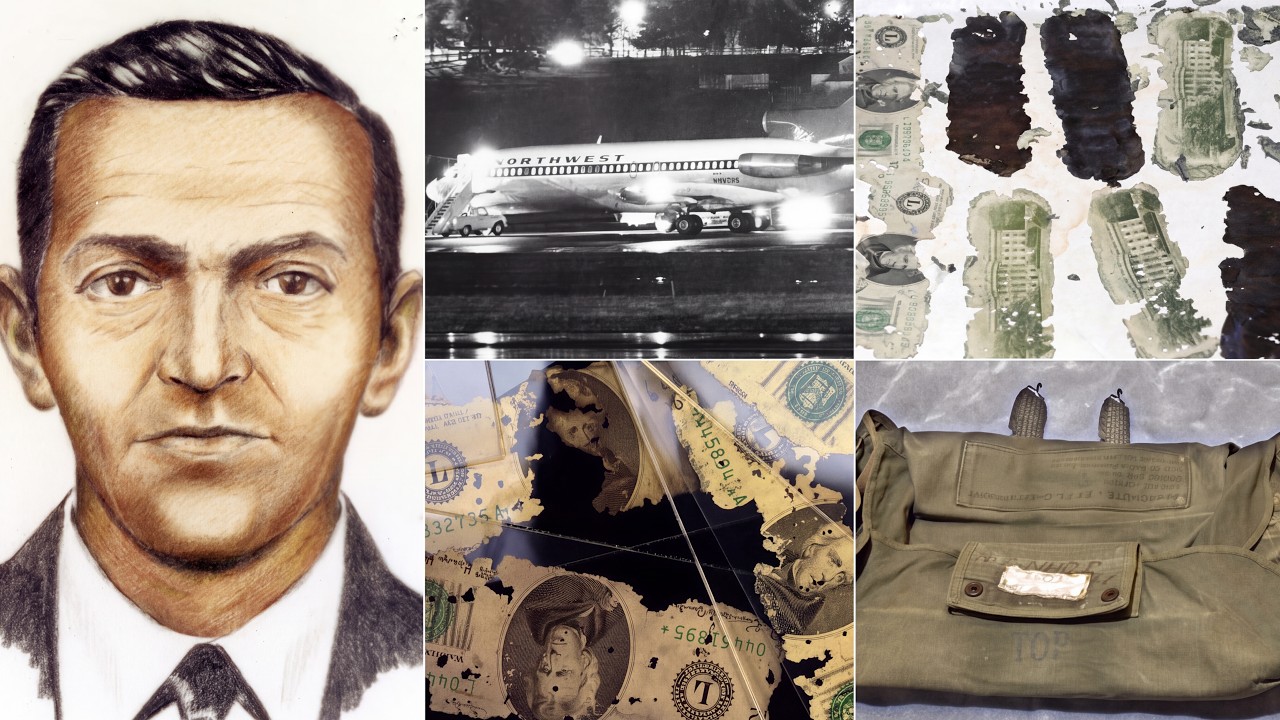
What Cooper left behind on the plane was almost nothing. Eight cigarette butts, which the FBI would later lose, and one cheap black clip-on tie purchased from J.C. Penney.
That tie would become one of the most analyzed objects in American criminal history. Decades later, forensic scientists managed to pull three distinct partial DNA profiles from it.
But the tie was a mass-produced item, sold by the thousands, and there was no way to determine whether the genetic traces belonged to the hijacker, to a previous owner, or to a factory worker who packaged it before it ever reached a store shelf. The one physical link to Cooper's identity was a scientific dead end.
For nine years, there was nothing. Then, in February 1980, an 8-year-old boy named Brian Ingram was digging a fire pit in the sand along the Columbia River at a spot called Tina Bar when his hands uncovered three rotting bundles of $20 bills still bound in rubber bands.
The total came to exactly $5,800. When the FBI checked the serial numbers, every single bill matched the ransom money handed to Cooper on the tarmac in Seattle.
It was the first and only piece of the money ever recovered, and instead of solving the case, it deepened it. If Cooper died in the jump, why was only a fraction of the money found miles from any plausible landing zone? If he survived, why would he leave $5,800 buried in a riverbank?
Divers scoured the Columbia. Analysts studied sediment layers and river currents. The questions multiplied and the answers never came.
In July 2016, after 45 years, the FBI formally closed the case. Norjak, the longest unsolved hijacking investigation in American history, was shelved.
But cases like this never really close. They just wait for the right person to become obsessed with them.
That person was Dan Gryder, a veteran commercial pilot with tens of thousands of flight hours and a YouTube channel devoted to aviation. Gryder approached the mystery not as a true crime hobbyist, but as an airman.
He studied the flight path, the wind data, the jump conditions, and the parachute rigging with a professional's eye. The more he studied, the more his attention kept returning to a name that had circled the case for 50 years without ever quite sticking: Richard Floyd McCoy, Jr.
On paper, McCoy looked like the last man on Earth who would hijack an airplane. A devout Mormon from Utah, a decorated Vietnam veteran who had flown helicopters into combat zones, a husband, a father, a Sunday school teacher, a law-abiding student at Brigham Young University.
But on April 7, 1972, just five months after Cooper vanished, McCoy boarded United Airlines Flight 855. What he did next reads like a photocopy of the Cooper hijacking.
The same aircraft type, a Boeing 727 with a rear staircase. The same quiet note passed to a flight attendant. The same bomb threat, the same demand for parachutes, the same ransom, this time half a million dollars, and the same escape out the rear stairs into the night sky under a parachute.

It was Cooper's playbook executed line by line, and this is not folklore. It is documented in FBI records.
McCoy was an expert skydiver with hundreds of jumps, a man who taught parachuting and could rig a chute in his sleep. But unlike Cooper, McCoy made mistakes. He left a handwritten note behind and his fingerprints on an in-flight cup.
Within days, agents arrested him at his home in Provo, Utah. He was sentenced to 45 years.
Two years later, he escaped from a federal penitentiary in a stolen garbage truck, ran for three months, and died in 1974 in a shootout with FBI agents at a Virginia safe house.
Here is where the story gets uncomfortable, because the FBI did investigate whether McCoy was Cooper, seriously and immediately back in the 1970s, and they ruled him out. The two flight attendants who had spent hours face-to-face with Cooper looked at McCoy's photograph and said no.
Cooper had been described as a man in his mid-40s with olive skin and dark features. McCoy was 29 years old and fair-skinned. On the strength of those discrepancies, the Bureau officially crossed him off the list and labeled him a copycat. For 50 years, that was the final word.
Dan Gryder never accepted it. His argument was simple. McCoy was a trained military operator. Aging your appearance, darkening your complexion, altering your handwriting, changing the phrasing of a note — these are not obstacles to a man like that. They are tradecraft.
But an argument is not evidence, and for years Gryder had nothing physical to stand on. Then he found the parachute.
Following the McCoy family's trail, Gryder gained access to property connected to the family, and inside, buried among old boxes and forgotten belongings, was a carefully bundled military-style parachute rig. This part is not speculation. The discovery is real and has been widely reported.
What made Gryder's hands shake was not the parachute's age, but its details. It was a military container that appeared to have been modified, and Gryder believed those modifications matched specific characteristics documented in the FBI's original 1971 case files, details that had never been fully public.
This was not a chute that had been lost or thrown away. It had been kept deliberately and quietly within the family for half a century.
And then something happened that almost never happens with a case the government has already declared dead. The FBI came back.
In 2023, agents took possession of the parachute for laboratory examination and collected DNA samples from McCoy's children, presumably to compare against the partial genetic profiles recovered from the J.C. Penney tie decades earlier. For the first time since 2016, the machinery of the world's most famous cold case was turning again.
But the most extraordinary development in this story did not come from a laboratory. It came from a living room.

Richard McCoy's children, Shonnie McCoy and Rick McCoy III, had spent their entire lives refusing to discuss their father. For decades, they denied the rumors, dodged reporters, and stayed silent.
Their silence was understandable. Their mother was still alive, and any admission could have had consequences for her. But after her death, the calculation changed.
When they finally sat down in front of cameras, what they said detonated across the internet. They admitted it. They said that, based on everything they knew about their father, everything they had seen and lived with, they believed he was D.B. Cooper, and that deep down they had always known.
Think about the weight of that for a moment. This was not an internet sleuth's theory or a deathbed attention seeker. More than a thousand of those had already come and gone. This was the man's own son and daughter ending 50 years of silence to say the ghost was their father.
So, is the case solved? This is where honesty matters more than a satisfying ending.
The FBI held the parachute for roughly two years. The world waited for a press conference, a DNA announcement, a formal identification. It never came.
In December 2025, with no statement, no findings, and no explanation, the bureau quietly returned the parachute to the McCoy family, a handover that only became public in early 2026. No confirmation, no denial. Just silence. The same silence that has surrounded this case since 1971.
Veteran Cooper researchers urge caution for a reason. Some experts have pointed out apparent inconsistencies between the model of the recovered parachute and the rigs actually handed to Cooper in Seattle, discrepancies that have never been fully resolved. The tie's DNA remains ambiguous. The eyewitness problem from the 1970s has never gone away.
Officially, D.B. Cooper is exactly what he was in 1971: unidentified.
And yet, look at what now sits on one side of the scale. A hijacking replicated in near-perfect detail just five months later by a decorated skydiving instructor with the exact skill set the crime demanded. A military parachute with unusual modifications hidden for 50 years inside that man's family. A federal investigation reopened after being declared dead. And two children who looked into a camera and said their father was Cooper.
No other suspect in the entire 50-year history of this case, not one of the thousand names the FBI ran down, has ever accumulated anything close to that.
Perhaps that is why this story endures. In 1971, America was drowning in distrust, in war, in institutional failure, and out of that chaos came a polite man in a cheap tie who beat the system and dissolved into the rain. The country didn't just fail to catch him. Part of the country didn't want him caught. He was more useful as a legend.
But legends have a cost, and in this story, the cost was paid by a family in Utah, by two children who grew up under the shadow of a father who died in a hail of FBI gunfire carrying a suspicion too heavy to speak aloud. Their confession wasn't about fame or legacy. It was about finally putting the weight down.
The FBI may never say the words. The parachute has gone home, the file remains closed, and the government's official answer is still a shrug.
But after 50 years, the mystery of D.B. Cooper no longer feels like a ghost story. It feels like a family story, one about a brilliant, restless, damaged man who may have pulled off the most famous vanishing act in American history, and about the people who loved him and kept his secret until they simply couldn't anymore.
Whether the name Richard Floyd McCoy Jr. ever gets stamped onto an official finding, one thing has changed forever. The man who jumped into the darkness over Washington finally has a face that his own children are willing to point to.