One of the last foreign policy gestures made by Sir Keir Starmer before he left 10 Downing Street was a traditional show of strength, sending one of Britain’s two enormous aircraft carriers to sea as a deterrent against increasingly aggressive Russian moves in the Arctic. The ship in question was HMS Prince of Wales, the second of the Queen Elizabeth class carriers, weighing nearly eighty thousand tonnes fully loaded and carrying a full crew of sixteen hundred sailors. It was supposed to project British power across the globe. Together with her sister ship, HMS Queen Elizabeth, the two vessels account for ten percent of the Royal Navy’s entire workforce.
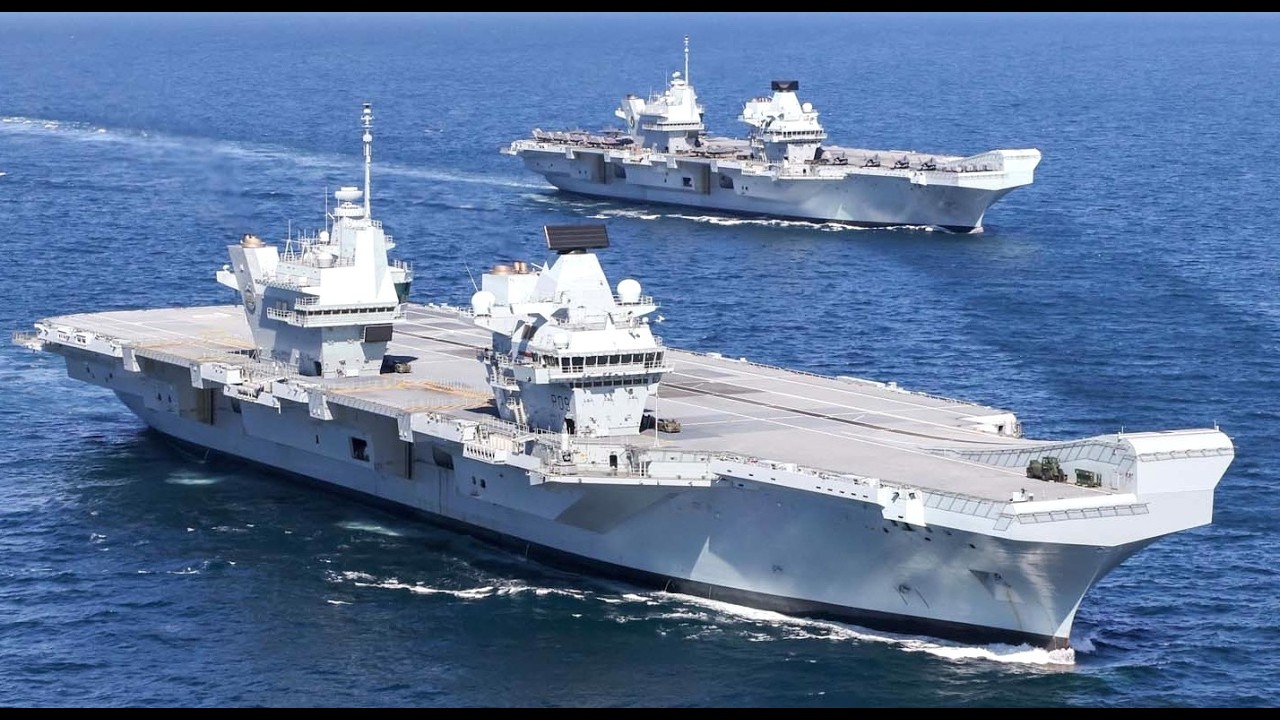
That workforce is under immense strain because of poor recruitment and retention rates. Maintaining such massive warships with a navy as small as the current one has raised serious questions for years. In any case, the Prince of Wales was scheduled to head north in July 2026 as the centrepiece of an operation called Firecrest. Protecting and escorting an aircraft carrier is, of course, vitally important.
But assembling a full carrier strike group made up entirely of the Royal Navy has become impossible because of the shortage of available escort ships. Successive governments and the Ministry of Defence have followed a seemingly nonsensical plan to reduce the destroyer and frigate fleet to almost nothing while continuing to convince the gullible that the Royal Navy is a fully equipped fighting force. The Admiralty was forced to make desperate efforts just to provide two escort vessels to accompany the Prince of Wales. Somehow the destroyer HMS Duncan was made ready for service out of six ships of the same class, three of which were in long-term maintenance at the time.
One elderly frigate, HMS Somerset, also joined the task group, one of only four frigates still in service. Sending those two ships away must have left the country almost defenceless during the carrier deployment. Defence was left to just eight patrol boats. A third British vessel, the supply tanker RFA Tidespring, accompanied the carrier as well.
For comparison, an American carrier is usually surrounded by a escort fleet of between five and eight cruisers, destroyers, and nuclear attack submarines. Given Britain’s naval weakness, the Prince of Wales strike group was forced to bolster its ranks with escort ships from foreign navies, including the French frigate FS Aquitaine. But if that was not bad enough, there is a genuinely funny part to this story. When the Prince of Wales sailed from Scotland toward the Arctic, the one thing the carrier left behind was its aircraft.
The Prince of Wales is supposed to carry an air group of up to thirty-six F-35B Lightning II jets. The problem is that the Royal Navy has to share the F-35s it bought from the United States with the Royal Air Force, and the total British fleet currently numbers just forty-seven aircraft. The Royal Navy does not get enough to fill one of its carriers, let alone two. So when the Prince of Wales sailed to the Arctic to display British naval might, it carried an air group of only eight F-35s, even though it was designed to accommodate up to thirty-six.
The rest of the air wing was just six helicopters. I do not think the Russians will be trembling in their fur boots at that shameful display. Back when we had real carriers in the late seventies, we regularly deployed full air groups. For example, the last catapult-equipped carrier we operated, HMS Ark Royal, carried an air group of up to forty aircraft, including twelve Phantom FG.
1s and fourteen Buccaneer S. 2s, plus five Fairey Gannets. Add to that Sea King and Wessex helicopters. Ark Royal displaced only about fifty-four thousand tonnes fully loaded, compared with the current Prince of Wales at nearly eighty thousand.
So we have a gigantic carrier carrying hardly any aircraft sailing to the Arctic to demonstrate British naval resolve against Russian aggression, in an operation better described as Paper Tiger. So why does Britain have two giant aircraft carriers it cannot afford to properly equip with aircraft, carriers that are mechanically unreliable and consume so much crew that the navy cannot adequately operate its other ships? Instead, the fleet is being dismantled. And as with so much that is wrong in Britain today, we have Tony Blair to thank for the carriers that are essentially useless white elephants.
Blair approved the carrier deal in 2006 at an estimated cost at the time of 3. 9 billion pounds for both vessels. The idea of Britain having no aircraft carriers at all was unbearable in certain circles. Carriers are the battleships of the modern age, and without them you are just a third-rate navy.
One senior naval officer of that period described the crisis as a mixture of naval vanity and crony politics. At the time, Britain had three small Invincible class carriers in service, each displacing around twenty thousand tonnes fully loaded, each carrying an air group of up to twenty-four aircraft, usually including around nine Harriers as the main strike force. They were not impressive compared with the old carriers of the seventies, but they were enough for the shrinking, underfunded Royal Navy of the nineties and the two thousands. The new carriers were to be built mainly at Rosyth in Scotland, a location that conveniently sat next to the constituency of the Chancellor of the Exchequer, Gordon Brown.
So, nothing to do with crony politics and patronage, then. Brown eventually succeeded Blair as prime minister and continued the carrier project. By 2008, the cost of the carriers had risen to 6. 2 billion pounds.
When David Cameron became prime minister in 2010, he tried to cancel the carriers. But the Ministry of Defence told him that the cost of cancelling the contracts with the shipbuilding companies, led by BAE Systems, would be higher than the cost of continuing with construction. Rory Stewart, a Conservative minister at the time, wrote in his memoirs that Cameron went ahead and bought two aircraft carriers we did not need, had no escort groups for, and could not afford the aircraft for. In a desperate attempt to cut costs, the Ministry of Defence made some truly bad decisions.
Originally both carriers were supposed to be like the old Royal Navy carriers and current American ones, fitted with catapults and arresting gear, known as cats and traps, to allow aircraft to launch loaded with heavy fuel and weapons. The old procedure ran through the mind: the flag drops, another shudder runs through the ship, Phantom ready, launch, check the gear and parts, ditch the tow rope into the sea after fifty launches, Phantom and cable stop at the arresting gear, Buccaneer, catch the ball, and the shuttle returns again. Instead, the Ministry of Defence changed the design to short take-off and vertical landing carriers, or STOVL. Less efficient, making the new carriers giant copies of the small Invincible carriers already in service.
But all the Invincible carriers were scrapped, and with them went the Harriers. They were sold cheaply to foreign navies or to our ally the United States to be used as spare parts to keep their own Harriers flying. To replace the Harriers, Britain, forced by Ministry of Defence austerity policies, had to buy the short take-off and vertical landing version of the expensive and fragile F-35, the F-35B Lightning II. It costs a fortune to buy and a fortune to operate, up to thirty-five thousand dollars per flight hour.
It can carry less weapons and fuel than the American F-35A and F-35C versions. The Royal Navy also suffers from a shortage of spare parts. The jets are full of software bugs and require enormous amounts of maintenance. They also require constant updates from the Pentagon.
Without those updates, they become inoperable, which effectively means the United States controls these aircraft and how they are used, despite all the British government’s claims to the contrary. The fact that we ended up with American aircraft like these says a great deal about how far the British aviation industry has declined over the last fifty years and our increasing reliance on American-made equipment in the defence sector. The F-35B Lightning II is certainly not like the Harrier or the Phantom when it comes to endurance at sea. The final cost borne by British taxpayers for the two Queen Elizabeth class carriers reached 7.
6 billion pounds, a staggering figure that has negatively affected the entire navy budget. So what did we get for 7. 6 billion? Two aircraft carriers, neither of which seems to operate at full capacity except rarely, sometimes neither is in service, and there are never enough aircraft to justify their existence and operating costs.
In short, they are white elephants the navy cannot even defend properly while they are at sea. As the Paper Tiger exercise in the Arctic showed, the navy cannot even use its expensive toys properly, and it reveals to its enemies just how weak it has become. It is not the fighting force it was fifty, forty, or even thirty years ago, and things will not improve unless the escort fleet is fully expanded. In 1979, when Britain operated HMS Ark Royal for the last time, it was the last true carrier equipped with catapult and arrestor systems and fast jets.
The Royal Navy had plenty of escort ships available to protect such a valuable vessel, fifty-five destroyers and frigates. Today, we have two massive carriers and only eleven escort ships, most of which are not operational. Do the math yourselves. It is clearly an unsustainable situation.
It is also a national disgrace that successive governments have managed to destroy the Royal Navy in this way. What was once an excellent and capable fleet, respected worldwide, is now a laughing stock. None of this reflects in any way on the performance of the men and women serving in the Royal Navy. The blame should be directed where it belongs, at the ministers and public officials responsible for this farce.
And with all this talk of aircraft carriers, perhaps the biggest aircraft carrier of all is the United Kingdom itself, at least from the American point of view. Did you know that America has more F-35 fighters at a single airbase in Suffolk than we have in the Royal Air Force and Royal Navy combined? More on that in a future video. Thank you very much for watching.
Please subscribe and share. Feel free to visit my audiobook channel, War Stories with Mark Felton. You can also help support both of my channels through PayPal and Patreon.
Details are in the description box below.