In April 1945, American forces advancing through central Germany encountered scenes that defied the language of military reporting. Behind the wire of German prison camps, they found thousands of American soldiers reduced to skin and bone, barely holding onto life.
James Walker, a 23-year-old medic with Third Army's Medical Corps, was among those who walked through the gates. He had spent nine months following General George S. Patton across France, Luxembourg, and into the heart of Germany. Nothing had prepared him for what he saw inside.
The smell hit before the sight did. Death, hunger, and despair mixed into one suffocating presence. The men inside no longer looked human in any conventional sense. They were living question marks wearing the remnants of uniforms.
One prisoner reached for Walker's hand. His grip was weak, but not from any failure of character. His body had simply run out of the raw material required to produce strength. He looked at Walker's uniform, then at the Red Cross on his arm, and said two words: "You came."
Walker would think about those words for the next 80 years. Embedded in them was an entire history of waiting, of not knowing if anyone was coming, of surviving one more day not because survival felt possible, but because stopping felt like surrender.
The context that Walker did not fully grasp in April 1945, but assembled across the decades since, explains how this happened. Third Army had been moving at a pace the Germans had calculated was operationally impossible. By April, Patton's forces were advancing between 15 and 25 miles per day against rear guard resistance over difficult terrain, with supply lines stretched to the absolute edge of what logistics officers could sustain.
That speed was intentional. Patton believed velocity was protection, that a fast army was harder to kill, harder to counter, and harder to predict than a slow one. Every formation, every supply system, every command structure was optimized for speed.
What no one had fully calculated, including Patton, was what that speed would find when it outran the German capacity to manage what they were leaving behind. Tens of thousands of Allied prisoners were distributed across a network of camps designed for permanence in a Reich that no longer had any permanence to offer.
When the German administrative system began to collapse in the final weeks, it collapsed fastest at the perimeter. Guards fled. Supply lines to the camps evaporated. The men inside received what the German administration felt like providing, which in the final months was as close to nothing as possible while technically maintaining a pulse.
Captured German officers, when asked about conditions in the camps during those final months, said the same thing in different languages. They knew. The word kept appearing in interrogation reports. The knowing did not produce action.
On the morning of April 5, 1945, Colonel Hartford walked into Walker's forward aid station. Walker had watched Hartford receive casualty reports that would have broken a lesser man. He read them the way a carpenter reads a level — steady, calibrated, adjusting without drama.
So when Hartford's face looked the way it did that morning, Walker put down what he was doing. Hartford said, "Walker, we have a situation." Those four words were the beginning of the most important 36 hours of Walker's life.
The numbers were accurate: 4,200 prisoners, 98-pound average body weight, scurvy, pellagra, tuberculosis, frostbite. Walker helped compile some of them. But numbers do not prepare you for the moment you walk through a gate and a man reaches for your hand.
These were not men caught in a legitimate military food shortage. They had been deliberately starved, systematically, across months, with documentation going up the German command chain to people who received reports and filed them and issued bureaucratic language about prisoners not being allowed to fall into American hands in conditions that would provide propaganda material.
The men Walker was treating were not propaganda material. They were his countrymen. They were somebody's sons. They were 20-year-old kids from Kansas and Georgia and Pennsylvania who had been captured during the Battle of the Bulge in December 1944 and had survived four months in German captivity by consuming whatever calories their captors had chosen to provide.
By February and March of 1945, that amount was approaching zero.
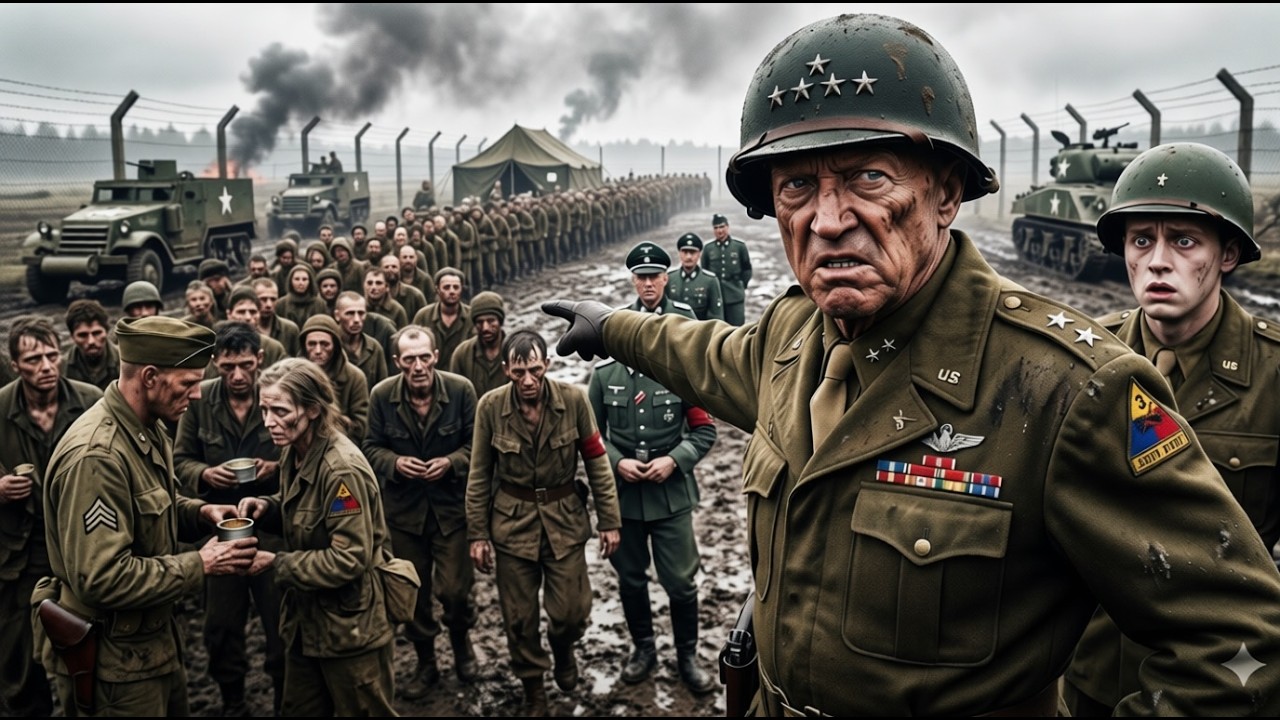
Walker was in the middle of his 18th consecutive hour of work when the runner arrived. He had a written order signed by Colonel Hartford. It cited, in the formal bureaucratic language that military orders require, General Patton's direct instruction.
The order said, "You will find the capacity."
Third Army's Medical Corps in April 1945 was operating at documented capacity limits. The system was designed for a specific throughput, and it had been running at or above that throughput for most of nine months. Every medical officer knew the system was full.
Patton had looked at that system and added to its load without ceremony and without asking whether the capacity existed. He told Hartford to find it. Hartford told his men.
In practice, this meant medical personnel were not permitted to perform assessments of the liberated prisoners. An assessment is organized. An assessment takes time. Patton had removed time from the equation.
What they were ordered to perform instead was immediate stabilization. Treat the man in front of you. Do it now. Do not wait for capacity to exist. Create the capacity by treating the man in front of you and then treating the man behind him.
Walker had three months of combat medical experience. He had never encountered refeeding syndrome, the medical crisis that occurs when a severely malnourished body receives nutrition it can no longer properly process. In April 1945, neither had most of the medical staff around him. They learned the term later.
What they encountered in real time was men dying within hours of receiving the food that should have saved them. In Third Army's zone, 847 men died in the first 72 hours following liberation.
These were men who had survived German captivity. They had survived the deliberate starvation and the forced marches in January and February at minus 12 degrees Fahrenheit, covering 15 to 30 miles per day with no food and no shelter. They had survived all of that, and then they died within three days of rescue because their bodies had been too damaged by systematic deprivation to survive the nutritional intervention that was their only remaining chance.
Walker was holding the hand of one of those men when he died. He did not have the medical knowledge in that moment to fully understand what was happening. He understood that he was losing him. He understood that he had done everything he knew how to do.
He also understood that the gap between what he knew and what was required had been created not by his inadequacy, but by six months of deliberate German administrative neglect.
When Hartford received the preliminary mortality report and brought it to Patton, Patton did not revise his orders. He accelerated them. Resources coming into the position increased. More supplies, more personnel, more food commandeered from German warehouses and farms within 20 miles of every liberated camp by Patton's quartermaster units, ordered to take what was needed and deliver it immediately.
Allied military government doctrine at the time required a systematic inventory of German civilian resources before any requisition. Patton had skipped the inventory. Someone apparently asked about the legal framework. Patton's documented response, recorded by his aid, was that the law would catch up to the need or get out of the way.
The food arrived.
What gets lost in historical summaries, Walker says, is that this was not humanitarian work performed as a pause from the war. The war was still happening. Third Army was still advancing. German formations were still fighting rear guard actions across the same operational zone where liberated prisoners were being treated.
The machinery of combat was running at full speed, and Patton had inserted a second demand into that machinery without reducing the first. He had done it because he had decided both things were military priorities of equal urgency.

Patton believed that armies are made of human beings. He believed this not as sentiment, but as operational logic. He had built Third Army around the premise that the care of human beings was not a distraction from military effectiveness, but the precondition for it.
When he walked through those gates and saw what German administration had produced, he was not encountering something foreign to his professional framework. He was encountering the ultimate consequence of discarding that framework entirely.
He responded the only way he knew how to respond to any problem that required immediate action. He treated it as a logistics problem. He moved supply lines. He activated medical structures. He issued non-negotiable orders.
He did not make speeches about the moral weight of what he was witnessing, although the moral weight was obvious to everyone present, including him. He did not pause to express the appropriate emotional responses, although those responses existed. He had already made the moral calculation before he arrived. What remained was operational.
Compassion without organization is theater. Theater does not save lives. He organized.
On April 12, Patton arrived at Ohrdruf, bringing Eisenhower and Bradley with him. He had specifically communicated the day before that they needed to see it — not read a report, but see it. Eisenhower vomited. Bradley stood without speaking for several minutes. Patton moved through the facility with the controlled velocity of a man conducting a tactical assessment. He was already calculating.
Walker was not at Ohrdruf. He was at a different, smaller facility, working with a team of four other medical personnel to process what they were encountering. They had been doing this for 18 hours. They had not slept. They had not eaten because every time one of them thought about eating, they looked around and stopped thinking about it.
On April 14, 1945, Patton issued a written directive requiring the mayors of every German town within operational proximity of a liberated camp to personally tour the facility. Not to send a representative. To attend themselves. To see what had been done in their names or at minimum within their administrative jurisdiction.
Several officials requested that armed guards accompany them on the tour. The requests were denied. Patton's written response to one such request is preserved in Third Army command records. It reads in its entirety: "No."
Among the medical personnel Walker was working with, reaction to the order was complicated. Some found it satisfying. Some found it beside the point. They had too much work in front of them to spend significant time processing the emotional valence of German mayors being walked through facilities that their patients had spent months trying to survive.
But Walker understood what Patton was doing even then. He was ensuring that the knowing could never again be separated from the seeing. He was removing the bureaucratic insulation that allows institutions to commit atrocities by ensuring that no one person is directly responsible for the entire chain of consequences. He was making people look.
The documentation Patton ordered compiled went to SHAEF, to the War Department in Washington, to the International Red Cross in Geneva, and to accredited press correspondents embedded with Third Army. The photographic and statistical record became primary source material for the Nuremberg war crimes proceedings that began in November 1945.
Justice Robert H. Jackson cited Third Army's documentation in his opening statement as among the most systematically collected evidence of its kind available to the tribunal. That documentation had been collected by a combat army whose primary mission was the destruction of German military resistance. Patton had made it happen anyway, in the same 36 hours in which he was managing an active advance across central Germany.
German officers later asked about this said the same thing repeatedly in different interrogation rooms to different American intelligence personnel. They had not expected it. Their professional consensus had been that American forces in the final advance would be focused on military targets. They had not expected a three-star general to treat the documentation of a humanitarian atrocity as a tactical objective with the same urgency as the seizure of a Rhine crossing.
They had underestimated the speed. They always underestimated the speed.
Private First Class Donald Caldwell of the 28th Infantry Division had been captured during the Battle of the Bulge in December 1944. He was liberated from Stalag 9B on April 10, 1945. Walker did not treat Caldwell personally, but his account, recorded in 2003 and held in the Library of Congress Veterans History Project, says something Walker has returned to more times than he can count.

Asked what he remembered about the moment of liberation, Caldwell described the arrival of American forces this way: "They didn't just open the gate. They came in."
That is the whole story. That is Patton's order translated into human consequence. You could open a gate and stand at the perimeter. You could issue a report. You could document the conditions and forward the documentation to the appropriate command authority and wait for the system to process the information and generate the appropriate institutional response. That would be following procedure. That would be entirely defensible under the applicable military regulations of April 1945.
Patton came in. He ordered his army to come in with him. He ordered medical teams in. He ordered supplies in. He ordered accountability in, in the form of counterintelligence teams hunting the guards who had fled, who were apprehended in the weeks following liberation and held for the war crimes documentation process.
Between April 5 and May 8, Third Army's counterintelligence teams apprehended 215 individuals identified by former prisoners as camp personnel. He ordered the documentation in. He ordered the mayors in personally, without armed escorts, to see what their administrative proximity had produced.
And he ordered a 23-year-old kid from Ohio into a liberated camp with the instruction that he would find the capacity.
Walker did find it. He does not say that with pride, exactly. Pride implies that it was difficult in a way that reflects credit on the person who did it. What he found the capacity to do was simply to keep working, to treat the man in front of him and then the man behind him, to learn in real time as Hartford's protocols adjusted across 48 hours in response to the mortality patterns they were seeing.
Re-feeding required different nutritional approaches than they had initially applied. They made the adjustments. They continued.
The 847 men who died in the first 72 hours stayed with Walker. They will stay with him until he stops staying anywhere. But Third Army's liberated prisoner recovery rate in the first 30 days following liberation was 94.3 percent. The theater-wide average across all Allied liberating forces was 89.1 percent.
The 5.2 percentage point gap represents, in absolute numbers, approximately 680 additional survivors out of Third Army's liberated population. 680 people who are alive because the response was faster, better organized, and more aggressively resourced than the theater average. 680 people who went home.
Walker has done the math more times than he can count, not to make himself feel better, not to construct a narrative in which the tragedy has a redemptive arc that erases the losses. 847 men died. That number does not get smaller because 680 others survived who might not have. Both things are true simultaneously. That is the arithmetic of catastrophe.
You measure what you saved and you carry what you lost and you do not permit either number to cancel the other.
The principle Walker took from those 36 hours, tested across the rest of his life in every domain he has worked in, is this: Urgency without organization is panic. Organization without urgency is bureaucracy. The only thing that saves lives in war, in medicine, in every crisis that has ever demanded a response is the capacity to be both simultaneously.
Patton was both every time. That was what made him terrifying to his enemies and occasionally to his allies and fairly often to his subordinates. He had no tolerance for urgency that dissolved into chaos and no tolerance for organization that calcified into delay. He wanted the thing done and he wanted it done right and he wanted it done now, and the tension between those three demands was not a problem to be resolved. It was the condition under which effective action occurred.
When Hartford came to Walker and said they had a situation and handed him an order that said he would find the capacity, he was transmitting that principle directly from Patton through the chain of command to a 23-year-old kid who did not yet have the intellectual framework to name what he was receiving.
Walker has the framework now. What Patton gave him in that order was not a demand that exceeded his capabilities. It was a refusal to let him define his capabilities by what they had been before the problem arrived.
He was not asking Walker to do what he had done before. He was telling him that what he had done before was not the ceiling. That the ceiling was wherever the need was. That his job was not to measure the distance between the need and his previous capacity and report back on the shortfall. His job was to close the distance.
He closed it. Not because he was exceptional, but because the order was clear, the stakes were visible, and the man in front of him had two words left in whatever reserve he had been surviving on.
You came. The least he could do was come all the way in.