In December 1952, two sisters vanished from their isolated farmhouse in McDowell County, West Virginia, leaving behind frozen cups of tea and an open front door in the bitter cold. Eleanor and Margaret Blackwood, aged 32 and 29, had lived alone on the property for five years following their parents’ deaths, and their disappearance remains one of the most unsettling unsolved cases in Appalachian history. The alarm was raised on December 7, 1952, by mail carrier Thomas Whitley, who had known the Blackwood family for years. He found their mailbox overflowing with nearly two weeks of uncollected correspondence, which he called highly unusual for the sisters, who were private but meticulous about their affairs.
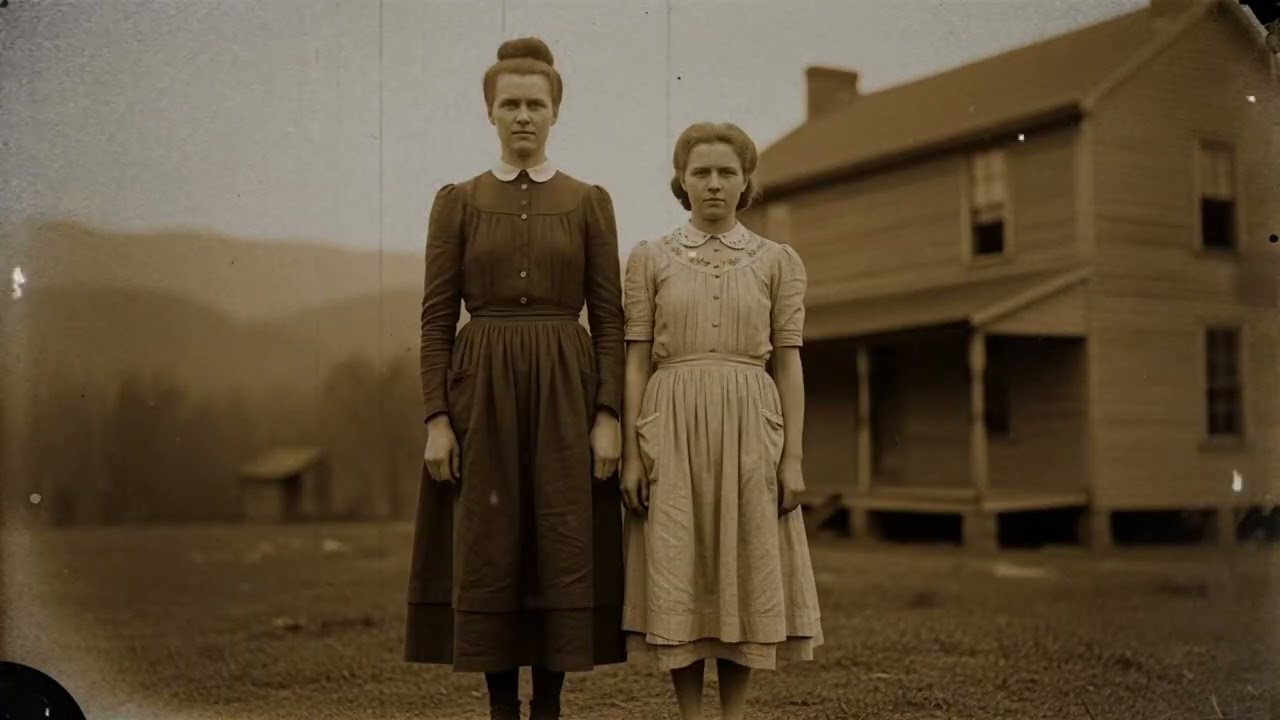
Approaching the house, Whitley described an unnatural stillness. The front door was slightly ajar, a kettle had boiled dry on the stove, and two cups of tea sat frozen solid on the kitchen table. There was no sign of forced entry, no sign of struggle, and no trace of the sisters themselves. The Blackwood women had lived a deliberately quiet life.
Their father, Howard Blackwood, had been a mine manager near Welch until a 1939 accident left him with a severe limp and chronic pain. Their mother, Vivien, formerly a schoolteacher, homeschooled the daughters in relative seclusion. Eleanor was described as analytical and reserved, with a remarkable memory, while Margaret was considered more outgoing and intuitive. After their parents died—Howard in 1947 and Vivien just three months later from complications listed as natural causes—the sisters grew increasingly isolated and wary of others.
In the months before their disappearance, neighbors reported small but telling changes. A local store owner recalled Margaret asking whether anyone unusual had been seen in town, saying the house felt different lately, “like it’s breathing when we’re not looking. ” A hardware store owner noted that Eleanor had purchased three new deadbolts in October alone. The sisters never reported any specific threat, but their growing vigilance was noticed by the few people they encountered.
Sheriff James Harden’s initial investigation yielded almost nothing. Their clothing appeared intact, roughly $47 was found in a tin box in Eleanor’s bedroom, and their father’s hunting rifle remained mounted above the fireplace. A heavy snowfall had already obscured any outdoor evidence. However, in the basement, investigators found a locked wooden chest containing journal entries written by Margaret.
The fragments were cryptic, describing marks appearing on the back porch in sets of five straight lines, strange sounds at night that Eleanor said sounded like breathing, and the sisters taking turns sleeping in the weeks before they vanished. Seven months later, in the summer of 1953, a geology student named Robert Caldwell made a startling discovery in an abandoned mine tunnel tied to the same operation where Howard Blackwood had once worked. Inside a chamber that had been deliberately sealed with debris, Caldwell found a woman’s shoe believed to belong to Eleanor, a silver locket containing a photograph of the sisters as children with their parents, and a leather-bound ledger written in Howard Blackwood’s handwriting. The ledger, spanning 1939 to 1947, contained disturbing entries about events following the mining collapse in 1939, including references to what the company had done and what had been buried.
One entry read, “They’re watching the house now. I see them at the edge of the woods… They know I’m the only one who remembers what the company did, the only one who knows where all the bodies are buried. ”
State police lieutenant Samuel Crawford was assigned to the case and began investigating the original 1939 mining disaster. Official records listed only three deaths, but Crawford found newspaper accounts suggesting that as many as fifteen men may have died.
Several miners who were not local to McDowell County appeared on payrolls before the collapse but vanished from all official records afterward, with no transfer notices, termination records, or death certificates. Crawford also discovered that Vivien Blackwood had consulted a lawyer in Charleston shortly before her death, apparently about possible legal action against the mining company, though the nature of the case was never specified. Crawford’s examination of the tunnel where the artifacts were found revealed a hidden passage, deliberately concealed behind mining equipment, connecting the mine to a natural cave system beneath the Blackwood property. In one chamber, investigators found what appeared to be a long-term living space: a cot, shelves with canned goods, a kerosene lamp, and hundreds of photographs of locations and people throughout McDowell County, with faces circled in red ink.
The Blackwood sisters appeared in several photos, marked not with a circle but with a distinct X. A desk held newspaper clippings documenting unsolved disappearances in the area dating back to 1940, all of which involved people with little local connection, and none of which had been resolved. A trapdoor concealed beneath the floor of the tool shed connected the Blackwood house directly to this underground chamber. An audio surveillance device was later found, along with cassette recordings labeled from 1947 to 1952.
The tapes captured mundane household conversations, but interspersed throughout were monologues by an unidentified male voice. The speaker referred to a duty to protect a secret tied to the 1939 discovery, described the sisters as either potential allies or obstacles, and expressed growing concern that Eleanor was getting too close to the truth. The recordings stopped abruptly on December 1, 1952. A former miner named Joseph Reeves, dying of cancer in Ohio, contacted Crawford after reading about the case.
Reeves said he and Howard Blackwood had been part of the rescue team at the 1939 collapse. What they found was not just fallen rock: inside a natural cavity, they encountered stone tablets with strange markings, carved bone figures with distorted proportions, and a perfectly circular pit that seemed to go down forever. Reeves described how company officials and unknown men in suits quickly took control of the site, required secrecy, and offered bonuses. The official story was that only three local miners had died, while the other victims, mostly itinerant outsiders, were effectively erased.
Reeves said Howard Blackwood was deeply troubled and argued that the artifacts belonged in a museum, but the company wanted everything buried and forgotten. A second, smaller chamber was later found behind a narrow crevice. Investigators discovered a handwritten journal belonging to someone who called himself “the keeper. ” The writer described a self-imposed mission to guard what lies below and keep the pit sealed and forgotten.
The final entry, dated December 6, 1952, read simply: “It is done. They have made their choice. The secret remains protected for another generation. ” Despite this ominous statement, there was no physical evidence in either chamber to suggest violence against the Blackwood sisters, no blood, no remains.
By late 1954, Crawford faced increasing pressure from local authorities and state officials to close the case. The mining company had allies in state government, and the implications of the 1939 cover-up were politically sensitive. Crawford submitted his final report classifying the disappearance as unresolved due to insufficient evidence. Much of his evidence regarding the 1939 mining incident was subsequently classified by state authorities.
Before submitting the report, Crawford made copies of key documents, photographs, and audio recordings, sealed them in a waterproof container, and hid them in an undisclosed location. Crawford later left law enforcement and pursued graduate studies in archaeology, returning to McDowell County in 1968 to document indigenous sites. On September 12, 1968, he failed to return from a solo expedition near the former Blackwood property. His vehicle was found with equipment laid out methodically beside it, and footprints led into the woods, but Crawford himself was never found.
In his vehicle, investigators found a sealed envelope addressed to the state police, containing a map of cave systems, a circled area, and a note reading, “I believe I’ve found the original chamber. If I’m not back by nightfall, seal the entrance at these coordinates. Some secrets should remain buried. ” The documented cave entrance was found collapsed and was never cleared.
In 1972, a geological survey team found a damaged metal container hidden in a hollow tree near where Crawford’s vehicle had been found, containing waterlogged papers that were largely illegible, though one fragmented document signed by Crawford made passing references to finding them alive, a community of keepers, and willing participants in something larger than any of us understood. The letter raised more questions than answers. More than seventy years later, the fate of Eleanor and Margaret Blackwood remains unresolved. The house was demolished in the early 1960s, and the cave entrance was sealed during highway construction in 1965.
Local legend warns travelers that on cold December nights, the echo of women’s voices can be heard in the hollow, and locals caution against digging too deeply in certain parts of the county. Some secrets, it is said, belong to the mountains alone.