On the afternoon of May 27, 1831, Jedediah Smith knelt at the edge of a shallow, muddy water hole on the Cimarron Plains. He was alone, hours from his caravan, his mouth cracked and his shirt stiff with four days of dried sweat. Somewhere behind him, moving across grass so quietly that a horse could be on top of a man before he heard it, fifteen Comanche warriors had just watched him kneel.
Within roughly forty seconds, one of the greatest explorers in American history was dead on the ground with a lance in his back. His body was never found. His killers rode away with his saddle, his rifle, and the Bible he carried in his pack.
That is the version the roadside markers tell, more or less. What they leave out is stranger and harder to explain.
Smith was the most experienced scout on the Santa Fe Trail. He had ridden through Comanche country before. So why, on the morning of May 27, did he leave a caravan of seventy-four armed men and ride out alone into country he knew was hunting ground?
Some historians now believe he was not lost. They believe he was led. And there is a second question that has haunted the story for nearly two hundred years. When his saddle turned up for sale in a Santa Fe shop weeks later, the merchant said something odd. He said the Comanche had told him exactly who they had killed. They knew Smith's name.
Smith was thirty-two years old the spring he died, and by any honest measure he should already have been dead many times over. Born on the New York frontier in January 1799 to a devout family of modest means, he had by his twenties walked, ridden, and starved his way across more of the American West than any white man alive.
He was the first to cross the Sierra Nevada from the west. He was the first to reach California overland from the east. He survived a grizzly bear attack so violent that it tore his scalp loose from his skull and left his ear hanging by a strip of flesh. A partner sewed it back on with a needle and thread while Smith gave the instructions.
Smith did not drink. He did not curse. He carried a Bible into the wilderness and read it by the fire at night while his men gambled and caroused. He wrote letters home framed in scripture. In one sent years earlier to his brother Ira, he described his life on the frontier in a single line: he had been preserved, he wrote, through the mercies of God, to whom he gave all the praise.
He believed in his bones that something larger than his own skill was keeping him alive. He once said, in a phrase that survives in secondary accounts, that he wanted to be where there was no white man's foot. That was his hunger. Not gold, not glory. Emptiness.
By 1831 that hunger had thinned. He had dissolved his fur trade partnership. He was tired. He wanted to make money on the Santa Fe Trail for one more season and then go home to Ohio. So that spring he joined William Sublette's caravan bound for Santa Fe, with wagons of trade goods and seventy-four hired men. He was not going west to explore. He was going west to retire.
Sublette was a seasoned trader and businessman, a stark contrast to the austere Smith, yet the two rode together as partners out of necessity and shared ambition. And somewhere south of the Arkansas River, moving across the same grass in small, fast bands, were the Comanche.
They were not raiders in the way American newspapers described them. They were a nation of horsemen defending water — every spring, every seep, every muddy pool in a country where water was life itself. The Cimarron cutoff ran straight through the heart of their land. To them, every caravan was a trespass, and every trespasser had chosen his own risk. Smith knew this. He rode in anyway.
The combined caravan — Smith's men and Sublette's men riding loosely together — numbered seventy-four. That figure comes from a letter written weeks later by a Santa Fe trader named Austin to Smith's brother Ira. Seventy-four men, perhaps twenty wagons, mules and oxen straining under bolts of cloth, kegs of powder, iron tools, and manufactured goods bound for the Mexican markets of Santa Fe.
The men were mostly young, mostly poor, mostly from Missouri and the river towns — farmers, sons, laborers looking for wages. A handful had ridden the trail before and knew the Cimarron stretch by reputation. Most did not. They carried rifles and knives and rode alongside wagons that groaned like ships in a slow convoy across an ocean of grass. Their pace was fifteen miles a day if they were lucky.
Their leader was a man half of them had never met, a man who barely spoke, who read scripture at night and rode alone by day.
Against them — though the word is wrong, because at this point the two sides did not yet know each other existed — moved the Comanche. Not an army, not a formation, but a scattering of small bands riding light across their own country. Fifteen men, twenty, sometimes fewer. They carried lances tipped with iron, bows of osage orange, hide shields, and increasingly trade rifles obtained through the Comanchero networks that ran between the plains and the pueblos.
They moved without wagons and without a supply train. Their supply was the country itself: buffalo, antelope, and the water holes they had known since childhood. Their leaders had earned the position by living long enough to earn it, and they had been watching the Santa Fe Trail for a generation. They knew when caravans passed. They knew where the trail forgot itself.
The Cimarron cutoff is the reason Smith died. From the Arkansas River south to the Cimarron, the trail crossed roughly sixty miles of open, treeless plain with no reliable water in between. In a wet spring the springs held. In a dry one they vanished, and caravans staggered across baked ground with mouths so dry the men could not swallow their own tongues.
Late May 1831 was a dry spring. The grass was already yellowing. The wind pulled moisture out of a man's skin faster than he could drink. The horizon shimmered. A rider on a rise could be spotted from four miles off. A lone man kneeling at a water hole could be watched patiently for as long as a hunter chose to watch him.
On the Cimarron you could not hide — not from wind, not from thirst, not from eyes. If the Comanche saw Smith ride out that morning, and there is now good reason to believe they did, then he was watched from the moment he left the wagons. Every step, every stop, every glance over his shoulder. The land itself was the trap. He was simply walking into it.
By the fourth day out of the Arkansas crossing, the caravan was in trouble. The water barrels lashed to the wagons were low. The mules were failing. The men were beginning to talk about the springs the way men talk about a woman they once loved and might never see again.
On the morning of May 27, according to traditions passed down by the survivors, Smith gathered a small group at the front of the caravan and told them what he had already decided. He was going to ride ahead alone to find water. Whether he said it with a preacher's calm or a captain's authority, we do not know, but we know the shape of the moment.
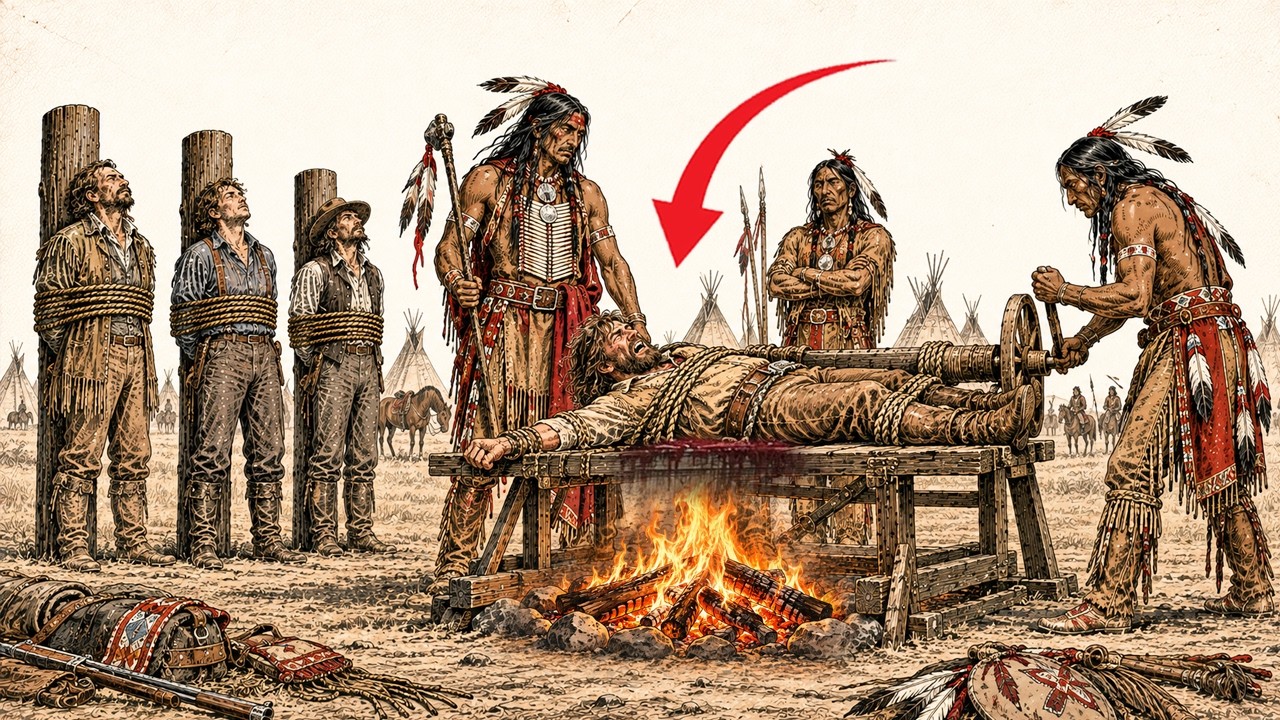
Sublette would have objected. So would the more experienced hands. Send two men, they would have said. Send three. Do not go yourself, Jedediah. Not here. Not alone.
Smith would have answered that no one else in the caravan could read the country the way he could, that a lone rider moved faster than a pair, that every hour they waited was another hour of thirst for the mules and the men. He had made choices like this a hundred times before. Every time he had been right.
He mounted. He rode south. He did not take a second man. Behind him, seventy-four men watched their leader disappear into the shimmer of the plains and had no idea they had just seen him alive for the last time.
Here is the cruelest detail. Smith's fame, his entire reputation across the West, was built on doing exactly this: riding alone, finding water, coming back. He had built a career out of surviving what killed other men. And that career, that reputation, that confidence, was the thing that would kill him. The very skill that made him great made him overconfident about the one country where his skill did not apply.
Somewhere ahead of him, in a shallow depression on the prairie, a small pool of muddy water waited. Somewhere to the south of it, fifteen men on horseback had already turned their heads.
The first hour of Smith's ride would have been familiar. The rhythm of the horse, the wind, the sun climbing higher. He would have angled south away from the wagons, following the shallow drainages that in this country sometimes hid a spring at their bottom. Every scout knew the technique. Follow the dips. Follow where the grass grew a shade greener. Follow the tracks of animals if you could find them.
He was still in the world he understood. He was reading the land. He was doing what he had done for fifteen years. But the Cimarron country was different. Here the springs were rare and separated by hard miles. Here the tracks of animals often led to water that had already dried. And here, unlike the mountain country where he had made his name, there was nowhere to hide when the reading of the land failed.
Somewhere in the second or third hour, according to the traditional account, he began to angle further from the trail. Perhaps he saw a promising line of vegetation. Perhaps he saw hoof prints. Perhaps he saw the low glint of water in a depression and rode toward it.
And here is where the story turns strange. Some accounts, including newer historical reconstructions, say that before Smith reached the water hole he met a small group of Comancheros. These were the plains traders, men of mixed Hispano and Pueblo heritage, who moved between the Mexican settlements and the Comanche bands, buying and selling, translating, brokering. They were not warriors. They were middlemen, and they knew at any given moment exactly which bands were in which valleys.
If Smith met them, they would have spoken. He would have asked about water. They would have pointed. They would have watched him ride on. And then — this is the part historians have argued about for generations — they may have ridden the other direction and told the Comanche what they had seen. A lone American, armed, well-mounted, carrying trade goods, not with the caravan. Alone.
Whether this happened exactly this way, we cannot prove. The Comanchero detail does not appear in Austin's letter. It appears in later reconstructions built from Mexican traders' accounts heard in Santa Fe. But the geography and the timing fit. Something told the Comanche that Smith was coming. And on the open plains of the Cimarron, the only something that could was another human being.
If the Comancheros did betray him, they did not do it out of hatred. They did it because that was the economy of the plains. Information was currency. A lone American was worth a story, and a story was worth a horse, and a horse was worth a season of survival. Smith was not killed because he was hated. He was killed because, for one afternoon, he was a commodity.
South of Smith's line of travel, in a shallow valley or along a low ridge, the Comanche war party — probably fifteen to twenty men — received whatever information reached them and moved. They did not need much. On the Cimarron, an experienced band could close a five-mile gap in less than an hour without ever being seen by their target.
They rode without dust because they knew how. They rode without noise because they knew how. They kept to the low ground. They spread out. One or two likely went ahead as scouts, tracking Smith at a distance, watching him zigzag south and west across the prairie, waiting for him to dismount — because that was the rule. You did not attack a mounted, armed American on the open plain if you could help it. His rifle had reach. His horse had speed. You waited until he stopped. You waited until he knelt.
Around noon, or perhaps a little after, Jedediah Smith reached the shallow, muddy pool he had been looking for. He swung down from his saddle, walked to the water, and knelt.
We do not know at what moment Smith saw them. Perhaps it was as he was scooping water into his mouth. Perhaps it was as he stood and turned back toward his horse. Perhaps it was a flicker of movement at the edge of his vision, a shadow, a shape, a silhouette on a rise where no silhouette had been the moment before.
But we know he saw them, because we know what he did next. He did not run. He could not have run. They were already too close, spread in a slow arc around the water hole, riding in from three sides on ponies that made almost no sound in the deep grass. He would have counted them fast, the way a man in his profession counted. Fifteen, maybe more.
And then, in the last calm decision of his life, Smith did what he had done a dozen times before in his career. He raised his empty hand. He made the sign for peace. He tried to speak.
This is the moment the school books want you to remember. The hero, hand raised, trying to make peace, martyred by savages. But that is not what happened. What happened next is more complicated and more horrifying than the myth.
Because the man who raised his hand was not just the man who had crossed the Sierra. He was also a man carrying a rifle across land that was not his, part of a caravan of seventy-four armed men crossing a nation that had told them again and again that this ground was not open to them. The peace sign was real. The provocation was also real. Both things are true.
The war party did not charge, not at first. They tightened. A Comanche surround on open ground was not the mad rush of a Hollywood film. It was slower, and it was worse. The riders spread into a loose ring, keeping fifty to eighty yards between themselves and the target, and then they simply began to close, one or two horses at a time, testing, watching, reading the man in the middle for what he would do next.
Smith did what a mountain man was trained to do. He kept his hand raised. He tried to make the trade signs, the finger patterns and gestures that had for years saved his life among tribes from the Snake to the Mojave. He may have called out a few words of Spanish picked up from Comancheros on earlier trips. Trade. Friend. Water.

The warriors did not answer, because here is the thing Smith did not fully understand in that moment. On the Cimarron in the spring of 1831, the peace signs of a stranger armed with a rifle at a water hole did not mean what they meant in the mountains. This was not a first-contact situation. The Comanche had been dealing with Americans and Mexicans on this stretch of trail for decades. They had learned the signs. They had learned the words. They had learned that the men who came with wagons did not go home again unless force made them.
Smith saw the ring tighten. He saw the ponies get closer. He saw at last that this was not going to be a negotiation. And so, because he was Jedediah Smith, and because he had never in his life stopped moving forward, he made his choice. He reached for his rifle.
Think about the calculation in that hand movement. He knew that lifting the rifle meant the negotiation was over. He knew that not firing meant he was dead. He knew that firing also meant he was dead. In the space of one second, at the edge of a muddy water hole in country he did not own, the most careful, most sober, most religious mountain man in America made peace with the fact that he was not going home.
The rifle came up. We do not know what type of gun it was. Probably a Hawken-style Plains rifle, .53 caliber, heavy-barreled, with a range of perhaps two hundred yards in trained hands. Smith's hands were trained. He had killed grizzly bears with rifles like this one. He had killed men with them. He had spent fifteen years learning to breathe out, hold, and squeeze at the exact moment the world got quiet.
He aimed at the man at the front of the arc — the leader, the one closest, the one whose horse was already breaking into a canter. The shot cracked across the prairie. The traditional account, passed down through Mexican traders who heard it later from the Comanche themselves, says that Smith's bullet found its mark. The leader — described in later frontier tales as the chief, though we will never know his real rank in the band — went down. Whether he was killed instantly or wounded, whether he fell from the horse or slumped in the saddle, we do not know. But he went down. Smith's last shot was true.
For a fraction of a second on the open plain, the entire ring paused. A warrior at the front of a Comanche war party had just been killed by a lone man at a water hole. It was the kind of moment that in another century and another country might have earned Jedediah Smith a monument built by his enemies. But this was 1831, and this was the Cimarron. The pause lasted only as long as it took for the rest of the warriors to understand what had just happened.
Then they came. Fourteen or nineteen, the exact number does not matter. What matters is that they were mounted and he was not. That they had lances and he had one empty rifle. That they were fifty yards away and he had perhaps four seconds before the first of them reached him.
Smith would have tried to reload. Every mountain man's reflex, drilled into him a thousand times. Patch, ball, ram, prime. On a range, an expert could do it in twenty-five seconds. In the terror of a Comanche charge on open ground, no one has ever done it in four.
He may have gotten as far as reaching for his powder horn. He may have drawn his pistol, if he carried one. He may have drawn the knife every mountain man wore at his belt, the heavy blade twelve inches long, meant for skinning buffalo and, when it came to it, for the last close-quarters fight of a man's life.
But the accounts we have, thin as they are, agree on one detail. The warriors did not shoot him. They did not ride him down and club him. They came in with lances and killed him at close range. And the fatal blow, the one that ended it, was a lance thrust into his back.
That detail matters, and it is worth understanding why. A lance in the back does not mean cowardice on either side. It means that in the swirl of horses and men around a small water hole, Smith turned — perhaps to face another rider, perhaps to raise his knife against a threat coming from the front. And in that turning, another warrior closed from behind and drove the iron point of a lance between his shoulder blades. It was the way a mounted lancer took a man on foot in tight quarters. It was efficient. It was final.
He would have felt it as a hard, sudden shock, not as pain at first. The body does not register a wound like that as pain in the first second, but as an impact, then a loss of strength, then the collapse of everything below the chest as the lung filled and the legs stopped answering. He would have gone down onto the grass at the edge of the water hole he had ridden all morning to reach.
The whole encounter, from the raised rifle to the last breath, probably lasted less than a minute. Sixty seconds. That is the entire span of the fight that ended the life of the man who had crossed more of the American West on foot and on horseback than any other human being alive. Sixty seconds at a water hole so small that most people today could not find it on a map.
The Sierra Nevada did not kill him. The Mojave did not kill him. A minute on the Cimarron did.
The Comanche did not linger. They rarely did. In the minutes after Smith went down, the warriors would have moved quickly and efficiently. They took his rifle. They took his pistol, if he had one. They took his knife, his powder horn, and his shot pouch. They took his saddle, valuable in itself, and they took his horse. They took his coat and likely the pack that held whatever else he had ridden out with, including almost certainly the Bible he had carried with him for fifteen years across the American West.
What they did with his body, we do not know. They may have left it where it fell. They may have moved it into brush or into the shallow bank of the water hole. There is no account of them scalping him, though the traditional frontier stories often assumed it. There is no account of them mutilating him, though again the assumptions of later writers often filled in that detail. The truth is that we do not know what they did with him, because no one who came looking ever found him.
Then they mounted and rode. Fifteen men minus their leader, riding south with the goods of a lone American they had killed on the twenty-seventh of May. They would ride to the Comanche camps. They would trade. The rifle would move. The saddle would move. Somewhere along that trade route, within days or weeks, a Mexican merchant in Santa Fe would end up with a saddle he had not paid a Comanche much for, and a story he had not paid anything for at all.
Back on the trail, ten miles north, seventy-four men were still moving with their wagons, still watching the horizon, still waiting for their leader to come back. The sun was moving west. His shadow, if it still fell on the ground beside the water hole, was lengthening.
By evening the caravan had stopped for the night without water and without word. The men would have been past the point of casual concern. Smith had ridden out in the morning. He had not returned by noon, which was strange but not alarming. He had not returned by midafternoon, which was worrying. He had not returned by sunset, which meant something was wrong.
They would have talked in low voices. Sublette, if he was there, would have made the decisions. Do we send out riders now, in the dark? Do we wait for morning? How far do we search? How much water do we still have?
The answer was already forced on them by the country. They could not send men out on tired horses at night into hostile ground with no water. They could barely stay where they were. The mules were failing. The teams' tongues were swollen. Every hour they searched for Smith was an hour they moved closer to losing the entire caravan.
At some point in the next day or two — the exact time is not preserved — the caravan made the decision that must have felt like betrayal to every man who made it. They stopped searching. They pushed south. They rode for Santa Fe.

None of them knew yet that they were riding toward the confirmation of his death rather than away from it. None of them knew that the man they were leaving behind on the prairie had already been on the ground for a day. None of them knew that his saddle was already moving south faster than they were. And none of them yet knew the strangest part of the whole story — the part that would come to them not from a battlefield, not from a witness, not from a body, but from a shop counter in a town they had not yet reached.
They reached Santa Fe in early July, worn thin, mourning a leader they had never confirmed dead. They rode into the plaza with their wagons dust-caked and their mules half-starved, and they began the slow process of doing what they had come to do: trade.
And then, in the ordinary business of trade — in the marketplaces, in the courtyards, in the back rooms of the merchants who bought and sold the goods that moved across the Cimarron — someone saw it. A saddle. American-made, familiar, the kind of tooled leather that a man carried across fifteen years of expeditions. A member of Smith's caravan recognized it immediately. So did the rifle laid beside it. So did the pistol. So did the knife.
Everything Jedediah Smith had ridden out with on the morning of May 27 was in the possession of a Mexican merchant in the middle of Santa Fe. They confronted him, and in a laconic exchange that historians have quoted for nearly two hundred years, the merchant answered them with the single sentence that ended the mystery of Smith's disappearance. He said simply that Comanche Indians had killed Jed.
That was the whole statement. Not where, not exactly when, not by how many. Just that the men who had brought him the saddle were Comanche, and that the previous owner was dead. It was a merchant's answer, matter-of-fact, uninterested in ceremony, delivered across a counter in a language two or three of the caravan men could barely follow. And it was, in every meaningful sense, the death certificate of one of the greatest American explorers who ever lived. No body, no grave, no last words. A saddle on a table and one flat sentence.
The news moved north the way all frontier news moved north: slowly, in the hands of traders, riding with caravans and letters back across the same trail that had killed him. An American trader in Santa Fe named Austin took it upon himself to write to Smith's family. He sat down, probably within days of the caravan's arrival, and put ink on paper.
The letter was short. It was precise. It contained the two facts that mattered most. Smith, he wrote, was killed by the Comanche Indians on the twenty-seventh of May on the Cimarron River, between the Arkansas River and Santa Fe. His company and Sublette's consisted of seventy-four men. That letter remains the closest thing history has to a primary source for the death of Jedediah Smith. A trader's letter, a date, a river, seventy-four men. Nothing about how he fell. Nothing about who found the body. Nothing about the water hole. Just the where, the when, and the who.
The letter traveled east across the summer of 1831. It reached Ira Smith, Jedediah's brother — the same brother he had written to two years earlier about the mercies of God — sometime in the fall. Ira read the letter. He read it again. And that was how one of the most consequential families of the American frontier received the news that their most famous son was not coming home.
There are three small aftermaths worth holding on to.
The first is Ira. He never traveled to look for his brother's grave, because there was no grave to travel to. The body was never recovered. No search party ever went back to the Cimarron. Ira lived the rest of his life with a brother who had disappeared into a sentence in a letter. In the family, Jedediah's death was mourned in the language he had used in life — in scripture, in prayer, in the assumption that the God who had preserved him through the grizzly and the desert had in the end allowed him to be taken. Whether Ira believed that with any comfort, we do not know.
The second is the caravan. The seventy-four men Smith had ridden out with completed the season in Santa Fe, sold their goods, and rode home. Most of their names are lost. They went back to Missouri farms and river towns and, for the most part, did not write down what they had seen. The survivors of history's most famous expeditions are almost always the ones who leave the fewest words behind.
The third is the saddle. It was purchased back, by some accounts, by members of the caravan or by American traders in Santa Fe, and eventually made its way east. The rifle, the pistol, the pack — those are lost. The Bible, if it was in the pack, is lost too. Somewhere on the plains or in the trade circuits of the Comancheros, the book he had read every night for fifteen years disappeared.
The mysteries we opened at the start of this story now have their shapes, if not their full answers. Why did he ride out alone that morning? Because he had built a career doing exactly that, because the caravan was dying of thirst, and because he did not yet understand that the very reputation that made him great was the thing that would kill him.
Who told the Comanche he was coming? Perhaps no one. Perhaps the Comancheros. Perhaps the eyes of a scout on a rise four miles off, watching him ride away from the wagons. On the Cimarron, being seen was the same as being betrayed. The land itself was the informer.
But his death, the sixty seconds at a water hole, was not the end of the story. In many ways it was the beginning of a different one. Jedediah Smith's death changed the map of American memory more than it changed the map of the West. His journals — the detailed, meticulous notes of a man who had walked more of the continent than any of his contemporaries — were reportedly lost or scattered in the years after his death. Routes he had pioneered had to be rediscovered by others. Passes he had found were credited to men who came later.
In the popular imagination, Smith was overshadowed within a generation by the more flamboyant Kit Carson, by the storytelling Jim Bridger, by the manufactured heroes of frontier dime novels who did less and said more. He became a footnote in the very story he had written.
And there is one detail that reframes almost everything. For most of the twentieth century, the official site of Smith's death was Wagon Bed Spring near Ulysses, Kansas, where a bronze plaque still marks the place and a roadside sign tells travelers that Smith was lost and without water for four days before he was killed. But recent research by the Santa Fe Trail Association argues that this location is wrong. Smith likely died at Fargo Spring, roughly thirty-two miles away. The monument that has stood for generations, the plaque that thousands of tourists have photographed, marks the wrong patch of prairie. The man whose exact grave was never found is now remembered in the wrong place. Even his monument is a ghost.
The Comanche warriors who killed him — the fifteen or so men who closed the ring around the water hole, the leader Smith shot, the lancer who drove the iron between his shoulder blades — have no names in this story. They never did. In every telling, from Austin's letter to the roadside plaque, they are simply Comanche Indians. A category, a hazard, a weather system.
They were not a weather system. They were men defending water on their own land, part of a nation that would fight for another fifty years to hold that land before being broken. The story of Jedediah Smith is remembered. The story of the man he shot at the edge of the water hole is not. That absence is not accidental. It is the shape of how the frontier was written.
Go back one last time to the water hole. He is thirty-two years old. He has crossed the Sierra Nevada. He has walked out of the Mojave. He has been sewn back together by a partner after a grizzly bear tore his scalp from his head. He carries a Bible in his pack. He said he wanted to be where there was no white man's foot.
He got his wish. He died in a place so obscure that his own monument has been in the wrong location for a hundred years. He died fighting men whose names history did not preserve. He died in sixty seconds, on his knees, in the country he had spent his life trying to reach.
If you want to know what happened to the American frontier, do not look at the monuments. Look at the water hole.