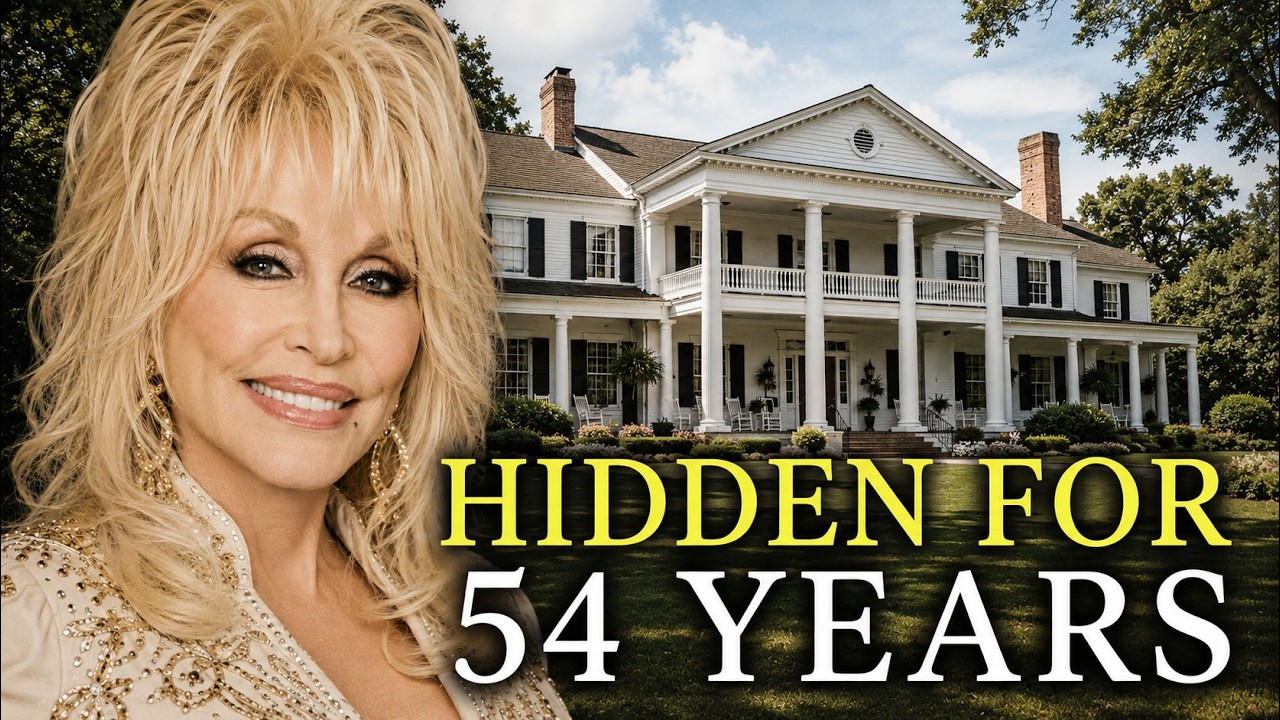
Dolly Parton spent 54 years living in a 23-room house on roughly 75 acres in Brentwood, Tennessee, about ten miles south of Nashville. It was a property the public never entered, a home no magazine crew was ever allowed to photograph, and an estate that remained so shielded that the only images available for decades were taken from the air. The story of that house begins with a decision she made in 1972, years before she became a global superstar. She was 26 years old and had not yet scored a hit single.
She told her husband, Carl Dean, that they needed to buy enough land for privacy because tour buses would eventually come. He agreed without question. Parton later wrote about that conversation in her memoir, 22 years after the purchase. She recalled that Dean’s willingness to accept her vision made her love him even more.
But the decision was also a strikingly confident real estate move. A country singer with no major hits bought 75 acres because she was sure enough about what was coming to plan her surroundings in advance. The house itself was not built by a major construction company. The primary builder was her uncle, Dot Watson.
Her brothers Denver and Randy also worked on it, and Carl Dean, by her own account, put his blood and sweat into the project. When completed, the home contained 23 rooms and just over 7,000 square feet. That scale was notable for 1972, especially since it was built by relatives and her husband before the fortune had arrived. She named the estate Willow Lake.
Fans began calling it Tara, after the plantation in Gone with the Wind, because of its white columns and Southern look. Parton addressed this directly in her memoir, writing that it would always be Willow Lake Plantation to them. The distinction mattered. Tara was a fictional set, a symbol of a South that existed mostly in a novel.
Willow Lake was a working property with barns, ten miles from the asphalt company her husband operated. Over five decades, the couple added considerably to the property, but not in the way most people might expect. There was a guest house exceeding 5,000 square feet and four barns. When they added the fourth barn in 2014, it was built to match the other three exactly.
All four were 17 feet high, designed in the same architectural style and placed within the existing sightlines so nothing would spoil the look of the place. There were also garden sheds, a swimming pool, and a tennis court. At the end of a gravel road sat a small wooden church. That church says a great deal about the property.
No one was ever invited to it. It stood at the end of a road on private land within an estate that never opened to visitors. Parton had been publicly and consistently vocal about her faith for 60 years, and she built a private place to practice it away from view. The size of the house raises an obvious question: why would a childless couple build 23 rooms?
Parton was one of 12 siblings. She and Dean helped raise many of her younger brothers and sisters while she was building her career in Nashville. The house was built large by people who had grown up in a two-room cabin for a family that was about to expand. Her nieces and nephews called her Aunt Granny, a nickname that stuck so firmly it ended up on a restaurant in Dollywood.
Carl Dean was the other reason the home remained closed to the world. He gave no interviews during six decades of marriage. He ran an asphalt paving company and worked on roads around Nashville while his wife became one of the most photographed women in the world. He was occasionally seen in public near the property but almost nowhere else.
The last known photograph of him outdoors was taken in December 2019 in Brentwood near the estate. He died in March 2025. The privacy of the house was not accidental. It was designed.
The home sat far back from the main road, surrounded by dense trees. The buildings were spread across the land rather than clustered in one spot where a camera lens might catch them. In 1999, the couple bought the neighboring property for $400,000. They did not need another house.
They needed the buffer of land between themselves and anyone else. It was the same logic Parton had applied in 1972, repeated 27 years later with the money she had by then acquired. By that time, tour buses had indeed become a reality, as she had predicted. In 2020, something happened that 50 years of press requests had failed to achieve.
The pandemic halted touring, and Parton began filming videos from home. She posted them on Instagram. She read children’s books and talked to fans from inside her rooms. For the first time, people saw the interior of Willow Lake.
Not through a magazine or a licensed tour, but through a phone held by the woman who lived there because she could not go to work. The surprise was not the size but the simplicity. The main residence had about 12,000 square feet of living space across two floors, with a traditional layout rather than the open designs popular today. The walls were covered with custom artwork, family photos, and career memorabilia.
Traditional rustic furniture mixed with classic prints. The rooms looked collected over time rather than professionally styled. Reports noted that her decorating style did not match her stage persona at all. There were no rhinestones and no dedicated wig room in that house.
Parton did have a wig room, but it was in an entirely different property. In 2004, she quietly bought a farm compound in Solvang, California, a town with a Danish character. She purchased it through her company rather than in her own name. She said it reminded her of her grandmother’s home.
She installed reflective windows and built a covered wooden-lattice walkway so a person could move between buildings without being seen from outside. She placed seven locks on the bedroom door and built a dedicated wig room. The difference between the two properties reveals much about her personality through architecture. In Tennessee, there were 75 acres, a small church, family-built rooms, and no cameras for 50 years.
In California, there were reflective glass, a covered walkway, and seven locks on the door of the room where she slept. Brentwood was not her only real estate holding. In 1980, the couple bought a two-story stucco house in Nashville for $50,000. There was also property near Sevierville in the Smoky Mountains, close to where she was born in Locust Ridge.
There was the Solvang compound in California, and Dollywood itself on land in the county she came from, with a replica of her childhood cabin. Notably absent from the portfolio were a New York apartment or a Los Angeles home, despite decades of film work. There was no villa anywhere in Europe. Every property she held was either in Tennessee within a few miles of where she grew up or chosen because it reminded her of her grandmother.
In July 2026, a British newspaper published aerial photos of the Brentwood estate. The images showed what no one on the ground had been able to see: buildings spread across heavily wooded land, the swimming pool, the tennis court, and the barns. The paper described her as having been hidden away there for the past year. That was not accurate.
She had appeared at Dollywood in March of that year and delivered a keynote speech. She had also appeared in June to surprise visitors at the opening of a travel station in Cornersville. But the framing showed what the estate had become in the public mind after 50 years of no one being allowed inside. A house no one is permitted to photograph eventually stops being a home and becomes a rumor.
In 2025 and 2026, Parton faced serious health problems. She told the public she had kidney stones, an infection, and an immune system disorder, and that she needed medical procedures. She recorded videos from home to say she was fine, and even asked the camera whether she looked sick. She received treatment at Vanderbilt.
She died on August 25, 2026, at Vanderbilt-Ingram Cancer Center. A statement from her team said she had fought a short battle with cancer. It was the first time the word had been used. In the final stage of her life, the house performed exactly the function she had designed it for in 1972: it kept people from looking in.
Both people who lived there are now gone, 17 months apart. Carl Dean was buried in March 2025 in a private ceremony limited to close family. Dolly Parton was buried in August 2026. The 23-room house, the 75 acres, the four barns, the guest house, and the small church now sit empty.
The legacy she left to the public, Dollywood, the Imagination Library, and her foundation, employs thousands of people and will continue to operate. The house itself will not. Fans looking for a place to visit still have the replica of her childhood cabin at Dollywood, which remains open. The replica of the two-room cabin where she grew up is open to everyone.
The 23-room house ten miles from Nashville was seen by almost no one. Some of this can be explained. She explained the size of the land because she wrote about why she bought it. She explained who built the house because she named her uncle, her brothers, and her husband in her memoir.
The privacy can be explained because her husband would not allow himself to be photographed, and she protected that for six decades. The aerial photos can be explained because a house no one could enter was the only one worth flying over. But some of it resists easy explanation. In 1972, a country singer with no major hits bought 75 acres because she was confident the tour buses were coming.
They came, and she was right. The small church also resists explanation. She built a place for prayer at the end of a dirt road on private land, in a life where every other belief she held was spoken publicly to millions. The locks resist explanation too.
Seven locks on a bedroom door in a house bought through a company, in a town she chose because it resembled her grandmother’s town. She spent 54 years in a 23-room house, and the only images we have were taken from a helicopter.