By the middle of 1946, the American war machine in the Pacific had become a machine for disposal. The fleets had sailed home. Airstrips that once launched thousands of sorties were being dismantled and carried off piece by piece. Across 4,000 miles of ocean, the great forward bases were shrinking to caretaker garrisons.
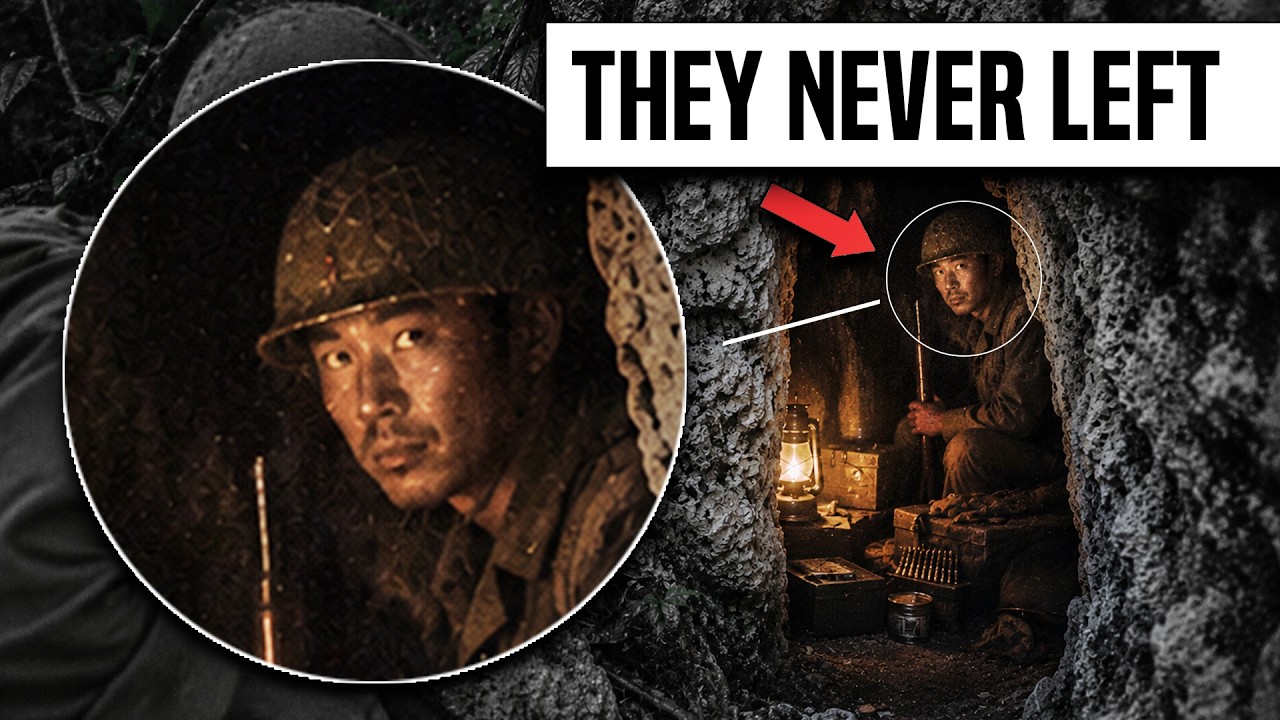
Their daily routine was eating American food from American tins and hauling the empties to a pit at the edge of the coral. One of those islands was Peleliu. Six miles long and two miles wide, it is a claw of jagged white limestone at the southern end of the Palau chain. In the autumn of 1944, the 1st Marine Division and the Army’s 81st Infantry Division spent two and a half months taking it, against a commander’s prediction that it would fall in days.
The Japanese garrison of around 11,000 men did not hold the beach and break. They withdrew into several hundred caves cut back into the ridges and forced the Americans to come in after them, opening by opening, with satchel charges, flamethrowers, and jellied gasoline poured into porous rock and set alight. Archaeologists who surveyed those caves seventy years later found gas masks melted onto the walls with bones still inside them. Several hundred Korean and Okinawan laborers gave themselves up.
Of the 11,000 Japanese soldiers, 19 were taken alive. Everyone else died. And somebody was still eating. There were about 30 of them under a ridge near the shore, north of the airstrip.
They were there because of an order. Before he killed himself in November 1944, the Japanese commander on Peleliu told the 56 men still on their feet to break into small parties and keep attacking. The officer who took that instruction and kept it was a lieutenant of the second infantry regiment named Yamaguchi, a veteran of the fighting in China who had survived the battle by not being where the flamethrowers went. What held his men in the ground for two and a half years after Japan quit was not confusion about the calendar.
They knew what year it was. An American television crew asked Yamaguchi about it in 1994 when he was an old man standing outside his own cave. His answer was, “We couldn’t believe that we had lost. ”
That is a refusal, not ignorance.
From boyhood on, the Japanese army had told those men that the outcome now in front of them could not happen. Peleliu got more of that encouragement than anywhere else. During the battle, radio broadcasts from home told the garrison that the whole country was counting on them, and the emperor sent 11 personal telegrams to the island urging the defenders on, more than he sent to any other engagement of the war. Every American attempt to tell them otherwise arrived as paper dropped out of an aircraft by the enemy, exactly what a trick would look like.
So they held, and they built a life around holding. The cave was a slit in the rock about a yard high and a foot wide. Inside, a grown man could crouch and no more. They sat in there through the daylight hours and came down to the American garbage after dark.
Kiyokazu Sushida, a sailor in that group, told archaeologist Rick Necht 60 years later that they ate better out of the American pits than they had eaten during the battle itself. Yamaguchi remembered creeping up on weekends to watch the movies the garrison showed in the open air. “Foreign films,” he said. That was one side of the island.
On the other side, in March 1947, the American presence was 150 Marines and 35 dependents, wives and children, in bungalows on ground still full of unexploded shells and unburied men. The Palauans had come home in 1946 to a landscape stripped down to bare white rock. Two of the island’s five villages had been flattened before the war to make room for the Japanese airstrip; the other three were destroyed in fighting. Late that month, a Marine patrol walking near a Palauan village took hand grenade and rifle fire.
Nobody was hurt. The holdouts shot at villagers too, and it was the islanders who told the Americans there were still Japanese soldiers living in the ridges. The response moved fast, and it was not gentle. On March 17, per the Marine Corps historical chronology, 21 Marines from garrison forces on Oahu flew in, and 41 more came up from Guam.
Honolulu newspapers at the time put those figures at 31 from Pearl Harbor and 40 from Guam, with 15 more to follow. Intelligence at the naval base had it that a band of holdouts, perhaps 50 strong and well armed, meant to attack the base installations, including the housing where families slept. The reinforced garrison had orders to find the group and destroy it. By early April, roughly 120 Marines were working the ridges.
They had the men for the job, and they had done it before on that exact ground. Three years earlier, it had taken satchel charges, napalm, and bulldozers to shut those ridges up. Finishing the job the first time cost at least 1,600 American dead. Nobody wanted to pay that bill twice for 30 men and a lantern.
Rear Admiral C. A. Pownall, commanding naval forces in the Marianas, went looking for another way. What he found was a prisoner.
Rear Admiral Michio Sumikawa had commanded the Fourth Fleet. In spring 1947, he was in the war crime stockade on Guam, appearing as a witness at the Guam trials. Pownall had him flown some 800 miles to Peleliu to talk his own countrymen out of a hole in the rock. Before the second attempt, Sumikawa explained why he had agreed to try: he wanted to tell them the truth, he said, out of a personal wish to save these men and to save bloodshed.
The mechanism is the whole story, and it is not the one most people assume. Sumikawa was a naval officer; Yamaguchi was an army lieutenant. There was no authority running between them, no lawful order the older man could give the younger one, and both knew it. He could only prove something to them.
The first attempt went badly. He walked into the bush with a Palauan guide and located the cave the Americans believed the group was using. He found the lantern still burning inside, along with food, clothing, ammunition, a pamphlet of instructions to combat troops, and a copy of the emperor’s charge to his soldiers. The place was lived in, and the men inside were near enough to hear him.
They were choosing not to come out. He called into the opening anyway. Nothing answered. He left a personal letter asking them to give themselves up and walked back down through the ridges to the Americans waiting on the road.
The answer arrived days later, and it is the most revealing item in the episode. The men in the cave sent out a note saying the whole thing was a fraud. The Americans, they wrote, had stood a Japanese American in front of the cave to play the part of a Japanese officer. If Admiral Sumikawa was on the island at all, let him come and stand where they could see him.
The note gets something important right. The United States had spent the whole Pacific war using Japanese American linguists to talk into caves on Saipan, Attu, and Okinawa. The men under the ridge had the American method dead right. They had drawn the wrong conclusion from it, and the fault was not in their reasoning.
It sat in the premise underneath it: Japan could not have lost. So the Navy set about proving a fact to a hole in the ground. On March 31, they flew Sumikawa back in, escorted by Commander Maurice Curry of the Office of Naval Intelligence. This time he came loaded.
He carried his personal seal, the carved stamp a Japanese officer used in place of a signature, so that any letter from him could be tested against a mark no one else could make. Also in the bag were Japanese newspapers, photographs of himself so his face could be matched against the man standing out in the open, photographs of Japanese soldiers being shipped home to their families, and a copy of the instrument of surrender carrying the emperor’s own name. The Navy handed him a loudspeaker so that whatever he had to say could be heard by men who would not show themselves. Then somebody went further.
The Americans obtained letters from the men’s families in Japan and brought them out to Peleliu. Thirty-odd conscripts in a cave on a coral island 2,000 miles from home, and the United States went and fetched their mothers’ handwriting. That was the machine those men had been stealing tins from. It could reach inside a war crime stockade, pull out a fleet admiral, fly him across the Philippine Sea, and then locate in a wrecked country under military occupation the correct 30 families.
The belief did not collapse all at once. It came apart in stages, which is how a real one goes. On April 3, a sailor walked out of the bush and gave himself up. That was Sushida.
Nobody shot him. He was fed, and he talked. What he told the Americans was that the rest of them still would not accept that Japan had surrendered and were getting near to going out in a suicidal charge rather than starve or burn. That news went up the chain in a hurry.
On April 5, another 25 Marines landed from Guam to reinforce the 100 already moving against the group. Both things ran side by side all that month, the cordon tightening and the paperwork going in. Nobody in the Marine Corps was betting the whole outcome on a carved stamp. Inside the cave, men who wanted very much for those documents to be forgeries went through them anyway.
They handled the seal, the newspapers, the photographs of men in uniform going home, the surrender paper with the emperor’s name, and the letters in their family’s handwriting. There is no account of what was said in there, and there never will be, because nobody wrote it down and the men who could have told it are gone. What survives is the result. On April 20, Lieutenant Yamaguchi came down out of the ridge with 26 soldiers and sailors behind him.
They marched to the island headquarters building. Eighty Marines stood drawn up and waiting in full battle dress. Some of those Marines had been on Peleliu in 1944. Their orders three weeks earlier had been to hunt this group and finish it.
Instead, they held ranks at attention while a defeated enemy lieutenant received the full formal courtesy of a surrender ceremony. Yamaguchi saluted and handed over his sword and his unit’s battle flags to Captain L. O. Fox of the United States Navy, commandant of the Palau Islands.
The following day, seven more men came out of the ridge and gave themselves up. The last organized Japanese resistance of the Second World War ended on that island, 19 months after the surrender was signed in Tokyo Bay. What the Marines then did with them was brisk and unsentimental. There was no war left to hold them prisoner of.
The United States had declared hostilities at an end on December 31, 1946, three and a half months before Yamaguchi handed over his sword. The men were fed, examined, disarmed, and put on transport. By April 23, according to Japanese accounts, 34 of the Peleliu holdouts were on their way home. Yamaguchi went on to a long life.
He returned in 1994 for the 50th anniversary of the battle and crawled back into his old cave for an American television crew. He was on the island again ten years after that. So was Sushida, who spent his later years searching Peleliu for Japanese dead. An archaeologist noticed him at the 60th anniversary of the battle sitting alone in a Japanese naval forage cap and only found out through a translator who he was.
The numbers in the story do not agree with one another. The Marine Corps chronology gives 26 men on the day Yamaguchi came down and seven the morning after. Gordon Rottman’s order of battle study calls the affair Operation Capitulation, dates it a day later, and counts 27 soldiers of the Second Infantry Regiment plus eight sailors of the 45th Guard Force. The archaeological survey says 34 men in the cave.
The Japanese side says 34 went home. Naval intelligence had guessed 50; the Marine Corps chronology, three weeks earlier, had said 12. Nobody on the American side knew how many men were under that ridge until they came out and stood in a line and were counted. One more thing sits in the file and cannot be settled.
A Japanese sailor told an American reporter in 1947 that Yamaguchi had shot one of his own men for wanting to surrender. It was never confirmed. No American inquiry into it survives, and whether the lieutenant believed the war was still running or could not be the officer who quit is a question his own answers never quite reach. The sword and the battle flags went to Captain Fox.
The last Marines were pulled off Peleliu that July, and the island passed to the Trust Territory Administration.