Dale Elizabeth Harper was born in Melbourne on January 3, 1948, with spina bifida. She did not take her first steps until she was nine years old.
That single fact frames everything that followed. A woman later known for physical restlessness — fishing wild rivers, running four fashion collections a year, giving dinner parties every week — began her life unable to stand. She would end it the same way, paralyzed and in a wheelchair. Everything else happened in the forty-year gap between.
Her father, Barry Harper, was a wealthy man whose money came from printing and publishing in Melbourne. The family had money but no title, no land, and no ancestry that carried weight in the world she would later try to enter. Her mother was Jean. Dale was the eldest of three, with a brother, Derek, and a sister, Sheree, who worked as an air stewardess.
It was ordinary Australian prosperity — comfortable and new — and it carried none of the freight that mattered in London drawing rooms.
The disability shaped everything before it. Every account of her early years agrees she was born with spina bifida and suffered for years from paralysis, which she fought off with a determination that would define her. A child spends those years watching other children move, learning early and in the body itself what it means to be set apart. Then, against the odds, she walked — and she never seemed to stop moving again.
Her working life began in the trade that would eventually destroy her. In the late 1960s she became a reporter on the society pages of The Australian Women's Weekly in Melbourne. She learned the craft from the inside: what a quotable line was, how a paragraph about a person's private life was assembled, sold, and printed. She learned it as a professional, not a bystander.
That training is the engine of the entire story. Every decision she ever made about journalists — every choice to speak and every choice to stay silent — was made by a woman who understood exactly how the machine worked.
In 1969 she moved to London and carried on with the magazine's office in Fleet Street, the old heart of the British press. Accounts of how she first supported herself differ: one calls her a public relations officer for an airline, another softens it to a former air hostess, a third says simply that she spent a couple of years temping in the city. What is not in doubt is that she arrived as an outsider — rich, but Australian rich, printing money from Melbourne, with no title, no estate, and no name that opened a single door in the world she meant to join.
Within two weeks of reaching London, she had met the man she would marry. Four years later, she was married inside a royal palace.
The letter came through her sister. Sheree had a friend in Melbourne named Patricia Tryon, sister of Anthony Tryon, heir to an English barony. Patricia gave the Harper sisters a letter of introduction to her brother in London, and Dale used it. By her own account, what followed was fast and unguarded. Anthony was a bachelor of 34 with no intention of marrying anyone. Then, the day before she was due to fly home to Australia, he took her to lunch and said, "Do not go home. Marry me."
He flew to Australia himself to ask her father's permission.
Anthony George Merrick Tryon was born on May 26, 1940. He had been to Eton. He was a merchant banker, a director of the old City house of Lazard Brothers, and a captain in the Wessex Yeomanry. He was already, before Dale ever met him, a member of the Prince of Wales's inner circle. When his father died in November 1976, he became the third Baron Tryon.
But the thing that made the marriage extraordinary was not the barony. It was what the Tryon family had done for the Crown. Anthony's father, Charles Tryon, the second baron, had been Keeper of the Privy Purse and Treasurer to the Queen. He was appointed in the autumn of 1952, the year of the accession, and served until 1971, having been assistant keeper before that under George VI. Put plainly, a Tryon controlled the sovereign's money for nineteen years.
Anthony himself had been a page to his father at the coronation of 1953 and then a page of honor to the Queen from 1954 to 1956. This was a family woven into the private machinery of the monarchy across generations, trusted with the most intimate thing a court possesses: its money and its discretion.
On April 13, 1973, she was married in the Chapel Royal inside St. James's Palace. The reason an outsider could be wed inside a royal palace was the family she was joining. Because Anthony's father had been Keeper of the Privy Purse, and because Anthony had been a page to the Queen, the doors of the Chapel Royal opened for the wedding.
As she walked down the aisle — the chapel where Queen Victoria had been married — she felt, she said, on a crest, as if she could never be happier.
That single sentence holds both the height and the coming fall in one breath. The girl who could not walk until she was nine walked down the aisle of a royal palace on the arm of a man whose family had served the sovereign for a generation. She believed in that moment that happiness had a floor beneath it that would hold.
What she did not yet understand was that the world she had climbed into measured a person by one thing above all: whether they could keep quiet once they were inside.
In her Wiltshire drawing room, beneath an inherited clock, stood a signed photograph of the Prince of Wales — and she was happy for a magazine to describe it.
That photograph is the whole woman in one object: the relationship, the proof of it, displayed in her own home and then described to reporters. She wanted people to know, and she arranged her house so that they would.
The house was Augsbury House near the village of Great Durnford, a few miles up the valley from Salisbury. It sat beneath an ancient hill fort called Augsbury Camp, above the Woodford Valley and the River Avon, on an estate of several hundred acres. A magazine feature from the late 1970s cataloged the life inside it with a kind of wonder: three gardens and three gardeners, beef herds run by tenant farmers, a donkey called Foss and a green parrot called Gladys, six working Labradors, and a champion hunter named Maribou that had been a finalist at the Montreal Olympics. And beneath a fine old clock inherited from a great-great-aunt named Clementina Tryon stood the signed photograph of Prince Charles.
The London house was a modernized four-story place in Knightsbridge. She had taken a course in Cordon Bleu cookery and gave at least one dinner party a week.
The children came quickly. A daughter, Zoe, was born in the spring of 1974. A son, Charles, followed in the spring of 1976. Twins Edward and Victoria arrived at the end of 1979. And the son carried a mark of the family's closeness to the throne: Prince Charles stood as his godfather, christening the boy at St. Andrew's Church in Great Durnford.
The record is clear on the direction of that bond. He was godfather to her son. She was not — whatever was later assumed — godmother to either of his.
The friendship lived most truly on the water. Prince Charles was a serious and lifelong fisherman, drawn to the salmon rivers of Scotland and the chalk streams of the south. Every summer the Tryon family made a journey to fish a river in the far northeast of Iceland, the Hofsá, well away from the reach of the London press. Prince Charles was among the earliest regular guests at the lodge there. So closely was he tied to that water that a pool on the river still carries his name.
An Australian magazine confirmed at the time, without fuss, whose event it was. One of the Tryons' annual fixtures, it reported in the late 1970s, was salmon fishing in Iceland with Prince Charles — though that particular year Dale would likely miss it because she was expecting twins around Christmas, and the house in Iceland was a long way from a doctor.
The bond was not merely her husband's, lent to her by marriage. It was hers. She was a genuine angler in her own right, good enough to be written up in a book about women and salmon, described there as the scourge of the fro, with her own line about how you never forget your first salmon.
Later the family moved within the same estate into an eighteenth-century house so large it almost defies imagining: the old manor house with 109 rooms, a place that had once been run as a girls' school by Anthony's own mother. The scale of it came with an immediate deflation that tells the whole truth of late twentieth-century aristocratic life. To pay for its upkeep, the Tryons let out hunting, shooting, and fishing holidays to paying guests. Grandeur maintained by trade.
The Iceland river told the same story of privilege measured in numbers: a stretch of water some 85 kilometers long with 83 named pools, fished by only six rods at a time and yielding across the years an average of more than a thousand salmon a season. It was one of the finest and most private pieces of fishing in the northern world, and the Tryons brought the heir to the throne to it year after year, well before the press ever learned the fact.
In December 1977, she sat down with a mass-circulation magazine and talked warmly and at length about the Prince of Wales. She was 29 years old and four and a half years married. Her children were small — a daughter of three and a half and a son of one and a half. And in the pages of the magazine she had once worked for, she spoke about her marriage, her country house, and her friendship with the future king.
This interview is the single richest thing in the whole record, because it is her, in her own words, doing the exact thing that would one day cost her everything.
What everyone seemed to have forgotten, she told the reporter, was that the Prince of Wales was the godfather of her son. The prince was a wonderful friend, she said, one of her husband's five closest friends, and that was how she had met him. She admired him. He was one of the nicest people anyone could meet, she said, and the country was lucky he would be its future king. Prince Charles called her Kanga, she explained, though it was really her husband's name for her. And in England, everyone called her that.
In summer, she said, they went to a wonderful wild place to fish, and she could not say where it was because the prince went there too, and it was his one real retreat.
Look closely at the shape of that. She guarded the location of the river with real care. And in the very same breath, she volunteered the intimacy: the nickname he used, the godfatherhood, the fact that he was one of her husband's five closest friends. She thought she was being discreet. She was drawing her line in precisely the wrong place. She protected the geography and gave away the relationship.
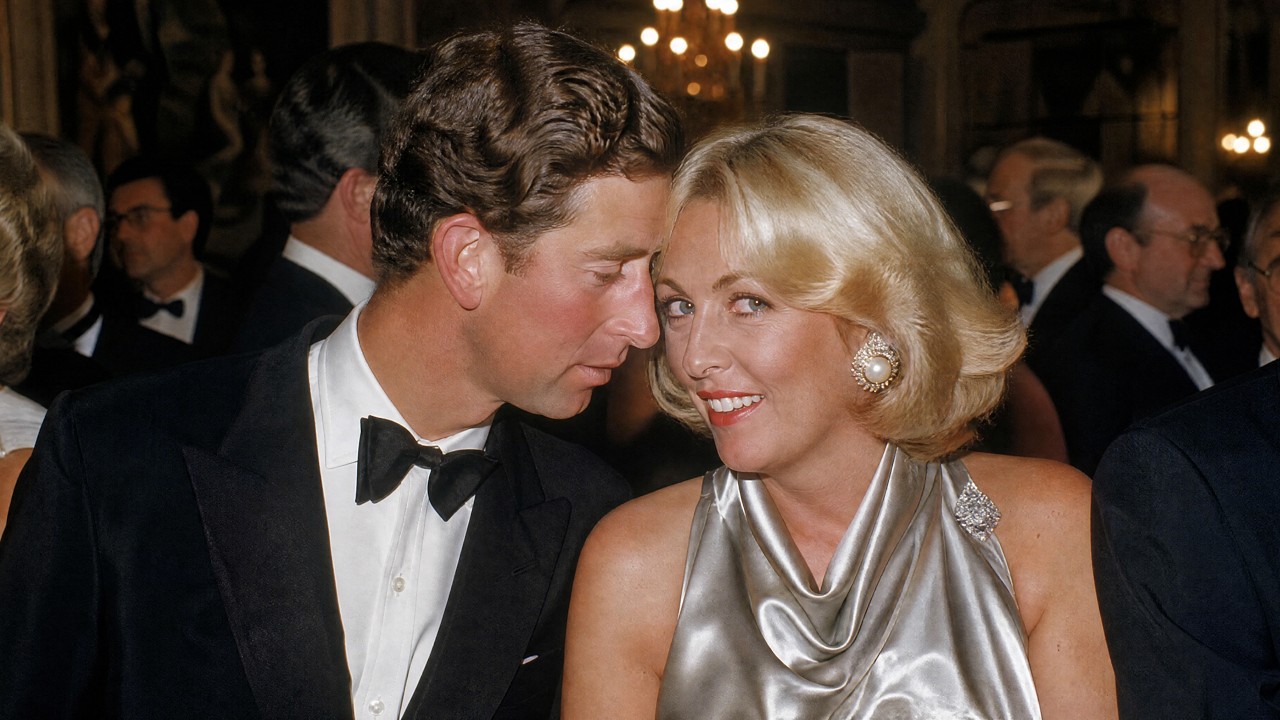
The extraordinary thing is that she did it as a professional. She had been a society reporter. She knew what a quotable line looked like because assembling them had been her job. She did this with her eyes open, having decided quite deliberately that being known to be close to the prince was worth talking about.
Note, too, a phrase she used almost in passing: one of my husband's five closest friends. Her place in that circle was borrowed. She had married into Anthony's friendship with the prince, and her standing flowed through her husband like water through a pipe. Membership held on those terms is membership that can be taken back. When the marriage ended, so would the standing, and there was nothing in her own name to hold it in place.
The same interview shows a woman working hard and knowingly to belong. She had known nothing about shooting when she first left Australia, she said, but she had realized that if she wanted to see anything of her husband at weekends, she would have to follow some of his interests. So she had learned to fish and to shoot and to keep a country house, adopting a life she had not been born to, item by item, the way a student learns a language.
She also spoke, unusually for the time, about her faith, which she said she never forced on anyone — something within that she felt and knew, a source she prayed to and leaned on, without which she said she could never have got through certain experiences.
There was a second interview two years later in the same magazine. She talked about color, about how she loved light shades — the eternal blue of the Australian sky, the vivid green and the sheer white — and how she had wanted to bring her own sense of color to her English houses, still carrying Australia, she said, in her heart and mind. She talked about how the family lived: they never entertained at home for business reasons. When her husband attended the House of Lords, he dined at his club, and their houses were kept for the children, for themselves, and for friends.
And then there is the line that ought to close any account of who she was before the fall. Happiness, she said, comes from within. You cannot rely totally on another person to make you happy. She had seen people going from husband to husband in search of it, and she said they would never find it.
It is a hard, clear sentence, and it came from a woman who at that moment had every outward reason to feel safe. Two decades later, almost every one of those things would be gone, and the sentence would read like a warning she had written to herself and failed to hear.
In 1983 she opened a shop called Kanga on Beauchamp Place — 200 yards of the most photographed pavement in London. It was the one thing in her life that was entirely her own: built by her, named for her, run by her. And it stood on exactly the piece of ground where her private world and the public glare were guaranteed to collide.
The business had begun by accident on a stopover. On a journey to visit her mother, she passed through Hong Kong and met a designer making one-size, uncrushable, drip-dry dresses with elasticated waists — clothes that traveled and forgave the body. She became the agent for them in Britain and came home with about twenty samples in a suitcase. She took premises with another agent, then struck out alone, having her own polyester georgette printed in Japan and her clothes made in Hong Kong.
In 1983 the name Kanga went above a shop door on Beauchamp Place in Knightsbridge. Around the turn of the decade she added a couture line under her own name in Italian and French cloth. Branches followed in Salisbury, Hong Kong, and Dublin. Her clothes sold in England, America, Australia, France, and Spain. She showed at the big trade fairs and ran four full collections a year. At its height the business turned over at times more than a million a year.
What she was selling was, in the end, herself. The market she served had a name coined at a glossy magazine in the middle 1970s: the Sloane Ranger — the young, well-bred, county-minded set clustered around Knightsbridge and Chelsea. A handbook to the type, published in 1982 with the young Diana on its cover, became the bestselling trade book of the decade and passed a million copies. Its author explained its success in a sentence that is also the commercial thesis of a shop like Kanga: the sales figures showed it was selling a lifestyle that could be adopted as well as inherited.
That was exactly Dale Tryon's own biography. She had adopted a life rather than inheriting it, learned it as an adult from the outside. And now she made her living selling other women the same possibility — the promise that a certain kind of English life could be bought as well as born into.
The street mattered as much as the shop. Beauchamp Place had turned over the century into a run of antique dealers and expensive boutiques, and by the 1980s it was one of the most watched pavements in the city. The reason was a restaurant a few doors along. San Lorenzo at number 22 was the Princess of Wales's regular table for decades, which meant photographers stood in that street as a matter of daily routine. Diana's own couturier had premises on the same pavement. So did another designer the princess favored. The unofficial mascot of the street, as one writer put it, was Princess Diana herself.
Kanga's shop stood on 200 yards of ground shared with the Princess of Wales's dressmaker and the Princess of Wales's restaurant — a strip of London permanently staked out by the press. The whole commercial logic of the place was proximity to Diana, to the royal world, to the glamour that sold the dresses. The commercial logic and the coming personal catastrophe were the same thing.
She gave her energy to charity as the women of that world were expected to, showing collections at debutante balls and grand luncheons, raising money at glittering events for a cancer appeal, and organizing several balls for a mental health charity. That last cause would take on in time a terrible private echo, for the woman who raised money to help the mentally ill would herself one afternoon in a Wiltshire village be detained under the Mental Health Act.
In December 1990 she gave a Kanga ball in London, grand enough that both Diana and Prince Charles were photographed arriving.
And then the record thins to almost nothing. Somewhere in the recession of the early 1990s, in a single clause of a single newspaper, her business folded. No year, no figures, no mechanism survive. The one thing that had been wholly hers — the shop with her name above the door on the watched street — was gone, and it went just before her body began to fail.
The set around the Prince of Wales prized one virtue above all others, and that virtue was discretion. This was a circle defined by something rarer than money or a title: a gathering of people who could be trusted to know things and never say them.
The membership across the 1970s, 80s, and 90s was a small and settled world. There were the couples the prince had known for decades, met at university or through shooting and hunting, with estates in Norfolk and Hampshire and Gloucestershire. There were Olympic skiers and members of parliament and old families with land. There were Andrew and Camilla Parker Bowles. And there were the Tryons.
The bond among them was real, and it had been tested by real disaster. In March 1988, a party of the prince's friends was caught in an avalanche while skiing at Klosters in the Swiss Alps. One of the wives, Patty Palmer-Tomkinson, suffered severe injuries to her legs and lungs and spent four months in a Swiss hospital. This was the circle at its most human and its most closed: a group bound together by a shared brush with death, and by the shared instinct never to speak of the private lives at its center.
The single best piece of evidence for the code they lived by is the adjective a newspaper obituary desk would choose thirty years later to sum up Dale's own husband: steadfast and discreet.
One writer chronicling that world described a united front and a network of what he called safe houses — the discreet country homes where the private lives of its members could unfold unwatched — and quoted a servant of the prince saying they had been told to speak to no one about anything, that they all kept the secrets. Whether every word of that is precisely as it was printed is uncertain, and it should be carried as reported rather than proven, but the shape of it is confirmed from every direction.
For a person born inside that world, the rule was second nature, absorbed in childhood along with everything else. For Dale Tryon, it was a foreign language learned late. She had studied it, and she spoke a great deal of it well — the shooting and the fishing and the running of a country house. But the deepest grammar of it, the instinct for silence, she never truly acquired, because it ran against the whole grain of who she was.
According to one biographer's account, exclusion from the prince's circle came quietly, as silence rather than as any confrontation. The prince would simply stop speaking to a person. The small courtesies went first, the please and the thank you falling away, and then came total social exclusion, with no farewell after years of service. That account must be handled with care: its named examples were paid servants and courtiers, not social friends, and it is one writer's characterization of a method rather than a proven finding. But the method it describes maps precisely onto what every other source reports happening to her. No confrontation, no explanation — just a circle that quietly closed.
She had married into the circle through her husband. Her place in it was borrowed, held on terms that could be revoked. So when it came time to close the door, there was no need for a scene. The people who had shared her table and her fishing and her house simply stopped answering. For a woman whose deepest need was to be acknowledged, there was no worse sentence that world could pass. There was no shouting. It simply looked past her.
The most famous sentence about her — the one in her obituaries and still in print decades later — cannot be traced to the man who supposedly said it. She is the only woman who ever understood him.
That line is the title of a hundred retellings of her life, printed as though it were the plain historical truth, and no locatable source has ever placed those words in the mouth of Prince Charles. It is always secondhand. It circulates in three different wordings: the only woman who ever understood me; the only woman who really understands me; the only woman who understood him. That drift between versions is the signature of a line passed along by hand rather than written down from life.
To see where it truly came from, look at the weather of the press in the summer of 1987, because that is the season the sentence was born into. In June of that year, the Princess of Wales attended a rock concert without her husband, sitting near a male companion. The tabloids seized it. One splashed a headline about her rock date with a man they called "sexy Phil." Another turned it into a disco caption, and a gossip columnist ran the details hard. The papers first named a young investment banker as the companion and claimed the princess had rested her head on his shoulder — a story he flatly denied, calling the whole account a complete fabrication. The palace then named a different man, a captain of the Household Cavalry. None of it was solid. All of it was printed.
Through that whole autumn, the press counted the marriage in units of absence. A wire agency reported in early November that the prince and princess had gone their separate ways for twelve weeks, meeting only once in that stretch. They had spent their sixth wedding anniversary apart. One newspaper reported the prince had spent 39 days at Balmoral while the princess stayed in London. And through all of it, the palace steadfastly refused to comment, which left a vacuum — and vacuums in the press are filled.
Into that emptiness, into a season when the papers had already invented one romance for the princess out of a concert and were counting the days her marriage spent divided, a sentence arrived about a woman at Balmoral who understood the prince. Whether or not he ever said it, one can see exactly why it was printed and exactly why nobody stopped to check.
The earliest traceable appearances in print both come from 1989, and one of them is explicitly about the press manufacturing the line rather than reporting it. A book on the methods of the tabloids quoted the sentence as a specimen of the trade, noting carefully that the paper reported the prince was spending time at Balmoral with his longtime confidant, Lady Dale Tryon, whom he was said to have described as the only woman who understood him. Every verb in that passage holds the claim at arm's length. In the same year, another book gave it for the first time in the familiar first-person form, quoting the prince as having wistfully declared that she was the only woman who ever understood him, and giving no source for the words at all.
From there it spread, tightening as it went. By the time she died, it had hardened into fact. On the day the news of her death broke, one newspaper wrote that for many years she had been, in his own words, the only woman who ever understood him. Another opened its report of her death with the sentence presented as a direct quotation from the prince. The line had traveled the whole distance from a hedged tabloid claim to a flat statement of record in ten years, and it kept going. Later writers, more careful, drew back to saying only that he had been quoted as saying it. And as recently as 2024, a newspaper printed it again, unattributed, as though its truth had never been in question.
There is one more detail from that autumn that shows just how quickly the same papers could turn. When the prince and princess finally appeared together on a state visit to Germany, a London tabloid that had spent weeks counting the days they had spent apart swung round in a single morning and declared that happy days were here again.
That was the machine into which the sentence about Dale Tryon was fed. A press that could manufacture a crisis and a reconciliation in the very same season, printing whatever the moment wanted and checking little of it. A line about a confidant at Balmoral who understood the lonely prince was exactly the kind of thing that machine produced, and exactly the kind of thing it never troubled to verify.

Nobody ever produced a date, a place, a witness, or a moment. The sentence has no origin anyone can point to, only a chain of retellings stretching back to an unnamed tabloid front page in the middle of a feeding frenzy. And that is the strange, sad heart of the matter for a woman defined by her relationship with the press. The most intimate thing ever said about her was written by the newspapers on all their behalf, and then repeated so often that it hardened into truth.
Two married women stood in the same place beside the same man for the same twenty years, and only one of them ever spoke. That is the comparison the whole story is built on, and it has to be handled with care, because it is a comparison about strategy and outcome and never about character.
One woman treated silence as the price of admission and paid it in full for decades. The other treated the friendship as something to be talked about, and she talked. One of them became queen. The other died at 49, excluded, using her maiden name again.
The other woman was Camilla Parker Bowles, and she is present in this story almost entirely by her absence from it. For thirty years she said nothing to anyone on the record about the man at the center of it. The single time she is caught speaking of the rivalry at all, she is dismissive, and the sentence itself breaks off in the only version that survives, trailing away into nothing about how Dale Tryon had never really been such a friend of the prince as people claimed. Even her one recorded remark refuses to give the press a whole quotation. That is the discipline the system rewarded.
The rule the two women were tested against was far older than either of them, and the establishment had run the experiment before. In the reign of Edward VII there were two famous mistresses. One, Alice Keppel, was absolutely discreet, so trusted that she was folded into the last years of the reign with the tolerance of the queen herself, and she died respectable. The other, Daisy Warwick, talked, and years later tried to sell the letters the king had written her, and she was frozen out completely. Ninety years apart, the two pairs of women ran the same experiment and got the same result.
The lesson the British establishment has taught over and over is a simple one: silence is rewarded, speech is punished, and fidelity has almost nothing to do with it.
Where Dale Tryon actually stood in the prince's world across those years is more painful than a clean exclusion would have been. She was never securely in, and she was never fully out. One account has her friendship with the prince cooling once he met Camilla, only a few years after Dale herself had arrived, and has her bitterly disappointed that she never regained her old place as confidante and adviser after the collapse of the prince's marriage. Other accounts describe a genuine return in the 1990s, the prince inviting her back into the circle after the separation. Both cannot be wholly true at once, and the honest reading holds them together rather than choosing.
For twenty-five years she was in and out, tolerated and then cooled toward, welcomed back and then quietly dropped again, never certain from one season to the next whether she was inside the door or outside it. That is a harder place to live than exile, because exile at least ends the hoping. She spent a quarter of a century close enough to the warmth to feel it, and never close enough to keep it.
The rule that governed both women has a name that can be stated plainly. The British establishment reserves its punishment for one thing above all others, and that thing is visibility. What a person did in private was survivable, provided it stayed private. What could not be survived was letting it be seen.
Dale Tryon sat on the wrong side of that line from the very beginning, and being an outsider made it worse. The people born into that world learn its single most important rule before they can even name it. They know without being told that the door stays open only for those who will never describe what lies behind it. She had learned everything else about the life, but this she had to learn as an adult from the outside, and she never fully believed in it.
That disbelief was the very thing that made her good company for a lonely man surrounded by people trained never to be spontaneous. And it was the very thing that made her impossible company for a future king who could not afford a friend who talked. It is one of the cruelest symmetries of the story that the quality which drew him to her and the quality that guaranteed she would be dropped were one and the same.
In the early summer of 1996, at a confidential clinic in the Surrey woods, she fell from a window. That sentence is almost the only thing about the event that can be stated plainly, and even it has to be held carefully, because nearly everything else about that fall is contested, unresolved, or was never established at all.
The road to the window ran through her body. The spinal condition that had kept her from walking as a child came back in the 1990s and brought several painful operations and major surgery on her back. With the surgery came heavy doses of painkillers. In 1993 she was diagnosed with cancer of the uterus and treated at the Royal Marsden. She was by the middle of the decade a woman in serious and chronic pain, on strong medication, and in the careful words her obituary would later choose, given to the unwise consumption of vodka and champagne.
One newspaper drew the whole arc of her health in a single line: a woman born with spina bifida who overcame cancer of the uterus only to be defeated in the end by a depressive illness.
She had gone in that state to a place called Farm Place, an addiction clinic near Ockley in Surrey. Farm Place was a listed seventeenth-century farmhouse, timber-framed with diamond-paned windows, set in about ten acres of the Surrey countryside, taking up to twenty-five residents at a time. It had been founded in the middle 1980s. It worked on the principle of complete abstinence and placed an explicit emphasis on confidentiality.
She fell from it in the early summer of 1996, about eighteen months before she died. No source gives an exact date.
What the press could not even agree on was how far she fell. One newspaper report described a fall of 25 feet from a third-floor window. The same newspaper months later described a first-floor window, and her obituary in another paper agreed on the first floor. Twenty-five feet is consistent with a third floor and not with a first. The plain truth is that the papers could not agree how far she dropped, and no one ever settled it.
The cause is the most sensitive point in the whole story, and it is unresolved. Most accounts say only, in neutral words, that she fell from a window. One single news report on the day her death was announced asserted that she had thrown herself, and that report was contradicted by its own newspaper's obituary two days later, and it was never a finding of any kind.
What happened at that window has never been established. And this is where the strongest and truest line of the story sits: there was no inquest. No inquest into the fall or into her death could be found, and there is no evidence one was ever held. There was no coroner's finding, no investigation outcome, no official determination of any sort. Nobody in any position of authority ever formally established what happened at that window in the Surrey woods, and no one ever will.
Farm Place had a history of its own. It had been founded in the middle 1980s by a husband and wife, and it was serious enough in its methods to be written up in a medical journal of addiction more than once. Its management claimed that more than seventy in every hundred of its patients completed their treatment. It is no longer a clinic at all. For years now, the old farmhouse has been supported housing for young adults.
Her own friends could not agree on what had brought her to that window, and the disagreement is itself part of the record. Some attributed her collapse to a sense of rejection, to the slow, accumulated grief of a woman edged out of the circle she had crossed the world to join. Others pointed to the years of heavy medication she had taken to hold down her pain. Both explanations may be true at once, and neither of them requires a verdict.
She was a woman who had been born disabled, recovered, and been disabled again. She was in serious chronic pain. She was on strong drugs. She had been drinking. She had just come through cancer. Any one of those things can break a person, and she was carrying all of them at the same time.
What the papers reached for in the end was the vaguest and most damning word available. She had been defeated, one of them wrote, by a depressive illness. It is a phrase that explains nothing and closes everything — the kind of sentence that turns a complicated and suffering human being into a diagnosis.
Behind the phrase lay the plain physical facts that no diagnosis could soften: a fractured skull, a broken back. A woman who had walked up salmon rivers now unable to rise from a chair. From that summer she was paraplegic, and she would spend the last eighteen months of her life in a wheelchair. She spent ten months in full-time hospital care at the spinal injuries unit of Salisbury District Hospital and only afterward began coming home at weekends.
Even then, the restlessness that had defined her whole life would not let her rest. A neighbor remembered it with a kind of helpless affection, saying she tended to overdo it, that she would have thousands of people round for lunch and simply would not rest.
On June 17, 1997, three days after being told her husband wanted a divorce, she telephoned a news agency about it herself. Of all the documented days of her life, this is the one recorded in the most detail, hour by hour, and every part of it repeats the pattern of the whole story one last time at the very bottom of her fortunes.
The week had opened with the only good news she would get. In the middle of June she spent three days at the Royal Marsden undergoing tests, and she was told the cancer had not come back, that she was clear of it after a three-year battle. Days later, on a Saturday, her husband returned from a fishing trip to Russia and told her he wanted a divorce.
That weekend, newspaper stories appeared in which she spoke about the state of her marriage, noting with visible hurt that while the Prince of Wales had sent her flowers during her three days of tests, her husband, she said, had not come to visit. A gossip column observed that she was no longer wearing her wedding ring and quoted a friend saying no one should expect the couple to celebrate their silver wedding the following spring.
Then came the Tuesday. That morning she telephoned a local news agency and told them her husband had come back from Russia and asked for a divorce, that she was shocked and distraught, and she put the phone down. She had briefed the press about her own divorce personally, three days after being told of it.
At lunchtime she went to the garden of the Black Horse Inn in Great Durnford in her wheelchair and sat with the actress Sarah Miles. The landlord, John Clancy, who had known her for twenty-five years, remembered it simply and without drama: that Kanga had come in to chat in the pub garden in her wheelchair, and that she just needed someone to talk to. He said she had nothing to drink, and that she left shortly after two o'clock.
At about twenty past two, the police were called to a house in the village. The officer who dealt with it, Inspector Jeff Hicks of Wiltshire Police, gave a careful public account of what followed. On arrival, the police spoke to her and she was making what he called spurious allegations, telling them that she felt her life was in danger from someone else. From that, the officers formed the impression that she could be detained under the Mental Health Act, and she was detained and brought to Salisbury Police Station, which the act designates a place of safety. Psychiatrists began an assessment of her there.
From the police station she went voluntarily to the spinal injuries unit at Salisbury District Hospital in a satisfactory condition, where her treatment was to include talking with psychiatrists about how to cope with her spinal injury.
Getting the law right here is what stops the account from sounding like an accusation, because the law has since changed in exactly the way that makes a modern reading wrong. The power used was almost certainly the one that lets a constable who finds in a public place a person who appears to be suffering from a mental disorder and to be in immediate need of care or control remove that person to a place of safety. As the law stood in 1997, the limit on that power was 72 hours, not the 24 hours it later became, and that reduction did not arrive until two decades afterward. In 1997, a police station was a lawful and routinely used place of safety. The restriction on using police stations came later too. So the detention of Lady Tryon at Salisbury Police Station was ordinary practice for its time.
There has been a claim that she was held for 28 days, which would point to a different and heavier power, one requiring the recommendations of two doctors and a formal application. But that figure does not appear in the careful contemporary reports, and the record is genuinely unclear on which power applied and for exactly how long. What is fixed is the end of it. She was discharged on a Thursday, one month after that afternoon in the village, and the date can be pinned down from her own later words.

Told carelessly, the story of a paralyzed woman taken from a village by police and held in a cell sounds like an outrage, a scandal of official cruelty. Told accurately, it is something quieter and far sadder. The police did what the law of the day plainly allowed, in the manner it was routinely done, to a woman who was telling them her life was in danger and whom two psychiatrists then began to assess. There is no villain in the machinery here. There is only a woman in unbearable circumstances colliding with a system that treated her exactly as it treated everyone else.
The day after she was detained, her husband stood on the manor lawn and told the reporters his wife had flipped. It is the harshest sequence in the whole record and the hardest to write fairly, because there are two comprehensible people inside it, and the documented facts belong to neither of them — only to the sequence and the words that were actually spoken.
On June 18, at the manor house in Great Durnford, Lord Tryon announced that he intended to divorce his wife, blaming what he called months of odd behavior. His words were blunt and they were widely printed. "She has flipped," he said. "The whole thing was a complete tragedy." He said she had had a breakdown or something like that, and the divorce decision had been caused by months of odd behavior. She had flipped before, he went on, and he did not understand the workings of the human mind, and she had said in the past that he was going to murder her. A divorce, he said, would be very likely for the sake of the children as much as anything.
The same reports carried the detail that several times she had called the local police making allegations he described as false about the household staff and the theft of her jewelry.
His mother, the elderly dowager Lady Tryon, spoke that same night, and her few words carry the grief of the whole family. They were brokenhearted, she said, and she was appalled for her grandchildren's sake. One was absolutely miserable. She was, she said, a very unhappy old woman tonight.
And the wife answered him publicly, because of course she did. She denounced her husband of twenty-four years after he said he was divorcing her on the grounds of unreasonable behavior, and she protested that he had falsely accused her of being mad and an alcoholic.
Set one sentence beside another across the length of the marriage, and the distance is almost unbearable. In 1977 she had told a magazine that her husband was so gentle, but so strong, and such an honorable person, and that she would never hurt him. Twenty years lay between that sentence and this one, and the gap between them is the marriage itself.
The fair thing is to hold both people and take neither side. A man whose wife of twenty-four years was paralyzed and in and out of psychiatric assessment, telephoning the police with allegations he said were false while he raised four children through all of it, was in a position most people would struggle to imagine. A woman who was paralyzed, just cleared of cancer, told within days that her husband wanted a divorce, detained by the police, and then made to read about it in the national newspapers, insisting she was neither mad nor an alcoholic, was in one just as terrible. The documented facts are the order of events and the quotations. The motives underneath them were never documented, and they cannot be supplied now.
Then came the moment that holds the entire story in a single gesture. On July 30, six weeks after she had been detained and three and a half months before she died, she went back to work. Paralyzed, humiliated in the national press, in the middle of a divorce, on her first day back at the Kanga shop in Beauchamp Place, she invited the photographers to come and see her.
A press agency caption records her there in her own shop, telling reporters it was her first day back at work, that she had come out of hospital a week last Thursday. That phrase dates her discharge exactly to one month after the afternoon in the village.
Look hard at the timing of that photo call, because the timing is the whole meaning of it. She had been paralyzed for a year. She had been detained by the police six weeks earlier and assessed by psychiatrists. Her husband had stood on his own lawn and told the national press that she had flipped. Her marriage was ending in the courts. She had, by any ordinary reckoning, every reason on earth to want the cameras as far from her as they could be got. And on her first morning back behind the counter of her own shop, she picked up a telephone and asked them to come.
There is a version of this story in which she is only a victim, a woman set upon by a cruel press and a colder world. That version is easier to tell and false to the evidence. She was a woman who chose over and over across twenty years to be visible, and who chose it once again at the very bottom, when every instinct of self-preservation would have counseled the dark. The choice had dignity in it, and defiance, and a terrible loneliness all at once. She understood the machine perfectly. She had been a journalist, and she kept feeding herself into it, because being inside it was the only proof she had left that she still mattered.
Her marriage ended in law the day after Diana died in Paris, and she outlived the princess by just eleven weeks. The two deaths are not connected, and nothing here should be read as suggesting they were. What the closeness of them did was bury her story so completely that a famous woman tied to the Prince of Wales could die in London, and the country would barely turn its head.
On August 31, Diana was killed in a car crash in Paris, and Britain went into a period of public mourning without modern precedent. The very next day, on September 1, the decree nisi of Dale Tryon's divorce was pronounced. Her marriage of nearly twenty-five years had legally ended on the day after the princess died.
She reverted to her maiden name and became Dale Harper again, the name she had carried out of Melbourne before any of it began. She took a room at the Ritz and spoke of holding a party there for her fiftieth birthday in the new year. She flew to Australia to be with her mother, Jean, and from there she went on to Delhi for a course of treatment from a doctor who — in one last thread of the connection that had shaped her life — had been introduced to her by the Prince of Wales. After the exclusion, after the divorce, weeks from the end, he was still trying to find her a doctor.
She became seriously ill in India and was flown home at the start of November. Around November 8, she was admitted to the London Clinic with complications from severe bed sores, and her condition turned critical after surgery to treat one of them. On November 15, 1997, she died of septicemia. She was 49 years old.
Her four children and her brother Derek were with her in her last days. By one account, her husband was there too.
She had been born unable to walk, and she died unable to walk. Between the two, she had crossed the world, married inside a palace, fished the same rivers as a king, built a business with her own name above the door, and been broken by the one appetite she could never master: the need to be seen.
There is a scale to that closing week that explains everything about why the country looked past her. Diana had been in the newspapers almost every single day for eleven weeks, on the front pages and the inside pages, in supplements and specials and reminiscences. More than 32 million people in Britain had watched the princess's funeral. Into that saturation, in a single stretch of seven days, came a political funding scandal, a massacre abroad that killed six Britons, and a royal golden wedding. A woman died at 49 in a London clinic in the middle of it, and there was simply no room on any front page in the land for her name.
Three days before she died, a political donation scandal broke that filled the front pages. Two days after she died, a massacre at Luxor in Egypt killed 58 people, six of them British, and drove everything else aside. Five days after that came the Queen's golden wedding.
She used to leave the prince's letters lying about so that visitors would recognize his spider handwriting, and then they vanished. That habit, more than any single event, holds the whole of her in one gesture. She wanted people to know. She arranged her rooms so they would, and it never once served her.
The funeral was private. Where she is buried has never been publicly recorded. There was no memorial service that any source can point to, no grand farewell in a great church, nothing to match the Chapel Royal where she had been married a quarter of a century before. A woman who had spent her life making sure she was seen was put into the ground in a place that is written down nowhere.
According to a single newspaper account published long after her death, she had been in the habit of leaving the prince's letters around the house so that visitors would recognize his distinctive hand. Shortly before she died, those letters disappeared. The same source suggested her husband may have posted them back to the prince, and added that they had certainly never turned up in all the belongings the family sorted through after Lord Tryon's own death years later. It is one source, one newspaper, and it must be held as unresolved, but the detail beneath it is the truest thing in the whole story. She left his letters out for visitors to see. It is the same impulse as the interview she gave in 1977, the same impulse as the photograph beneath the clock, the same impulse as the reporters she called to the shop with her body broken.
There were reports in the tabloids of what she left and to whom, of sums running past a million pounds, and of a settlement framed as a final act of defiance toward her husband. Every one of those figures reaches the present only through a single newspaper article that cannot now be read in full, and so every one of them has to be held lightly or set aside altogether.
What can be said is smaller and shorter. She had built a business with her own name over the door and lost it in a recession. She had kept a great house going by selling holidays inside it. She had ended her life in a hotel room under her maiden name, planning a party she never reached.
Her children scattered into their own lives and their own distances. The elder daughter in particular took the inheritance in a direction no one could have predicted. She read anthropology and then went to live in the rainforest of the Ecuadorian Amazon among an indigenous people, working for their land and their rivers against the oil companies, and later founding a charity of her own. It would be too neat to make a tidy moral of it, and the story does not need one. But the image sits at the edge of the family's history and will not quite leave: the daughter of a woman consumed by the society pages of London choosing to spend her life in a forest at the other end of the earth, as far from a camera on a Knightsbridge pavement as a human being can get.
The house at Great Durnford stayed with the family. The church there, St. Andrew's, where the prince had stood godfather to her son in 1976, would in time receive her former husband himself, buried from it years after her own quiet and unrecorded funeral.
As for the man at the center of it all, there is a silence there too, and it is the loudest thing in the record. No public statement, no tribute, no reference of any kind to Dale Tryon by Charles, as prince or as king, can be found anywhere. The only remark ever attributed to him about her in all these years is the one sentence that gives this story its title, and no one has ever been able to prove he said it. The woman said to have been called the only woman who ever understood him has never, in fact, been publicly mentioned by him at all. She spent her life describing the friendship. He has spent the decades since her death saying nothing whatsoever — which is precisely what that world always demanded, and precisely what she never could do.
A boy at a school dance gave her a name when she was sixteen, and she never got her own name back. In 1966, at a dance near Melbourne, a seventeen-year-old heir to the British throne, sent to school on the far side of the world, called a sixteen-year-old Australian girl Kanga. She carried that name for the rest of her life. It was in a magazine headline when she was twenty-nine. It was in her obituaries when she was forty-nine. And twenty-one years after she died, it was still in the headline of her former husband's obituary — a woman named in death inside the death notice of the man who had divorced her. In her final months she went back to being Dale Harper, and the newspapers went on calling her Kanga anyway. That is what it looks like when a person becomes a character in somebody else's story. The story keeps the name and gives nothing back.
Two married women stood in the same place beside the same man for twenty years. One understood that the currency of that world was silence — that access is granted only to those who will never describe it — and she paid in silence for thirty years and was in the end crowned. The other one talked. She talked to a magazine in 1977 about the prince who was godfather to her son. She talked to weekend newspapers about her marriage. She telephoned a news agency about her own divorce. She left his letters lying out for visitors. And she called photographers into her shop with her body broken. She did it again and again, knowingly, because being known to be close to him was in the end the thing she actually wanted.
And the system did what that system always does. It did not punish her for the friendship. It punished her for describing it. And it did so in its cruelest fashion, with silence — which was the one thing a woman built as she was built could not endure.
Her children carried the story onward in their own directions. Her son became the fourth Baron Tryon in his turn. And her elder daughter, the child who had been three and a half years old when her mother sat down to talk to that magazine, grew up and went to live in the Amazon among the people of the Ecuadorian rainforest, as far from the society pages of London as a person can travel.
And then the story closed its own circle in public, in silence, exactly as it had always worked. On Garter Day in June 2024, a ten-year-old boy named Guy Tryon served as a page of honor to King Charles, walking behind the sovereign in the old ceremony. He was Dale Tryon's grandson — the fourth generation of his family to serve in the royal household, after a great-grandfather who kept the sovereign's purse, a grandfather who was a page as a boy, and a father who was a page in his turn. It is a fact and only a fact. What it meant no one can say, and no one should pretend to.
She had raised money in her grander years for a mental health charity, standing at the front of glittering balls to help the very people that society preferred not to look at. And when her own turn came, when her mind was said to have given way under a weight no one could truly measure, that same society reached for the oldest and cruelest explanation it had: a failure of will, a want of discipline, a woman who had simply let herself go. The charity she had served would spend the years after her death fighting exactly that idea. She did not live to see the fight begin.
She had been born unable to walk. She had married inside a palace. She had been given a name she never chose and could never put down. She had reached her whole life for the one thing that world would never forgive her for wanting. And she had said it herself, years before the end, in the plainest words she ever spoke.
Happiness comes from within, she said. You cannot rely totally on another person to make you happy.
She had spent her whole life reaching for the cameras. In the end, they looked away.