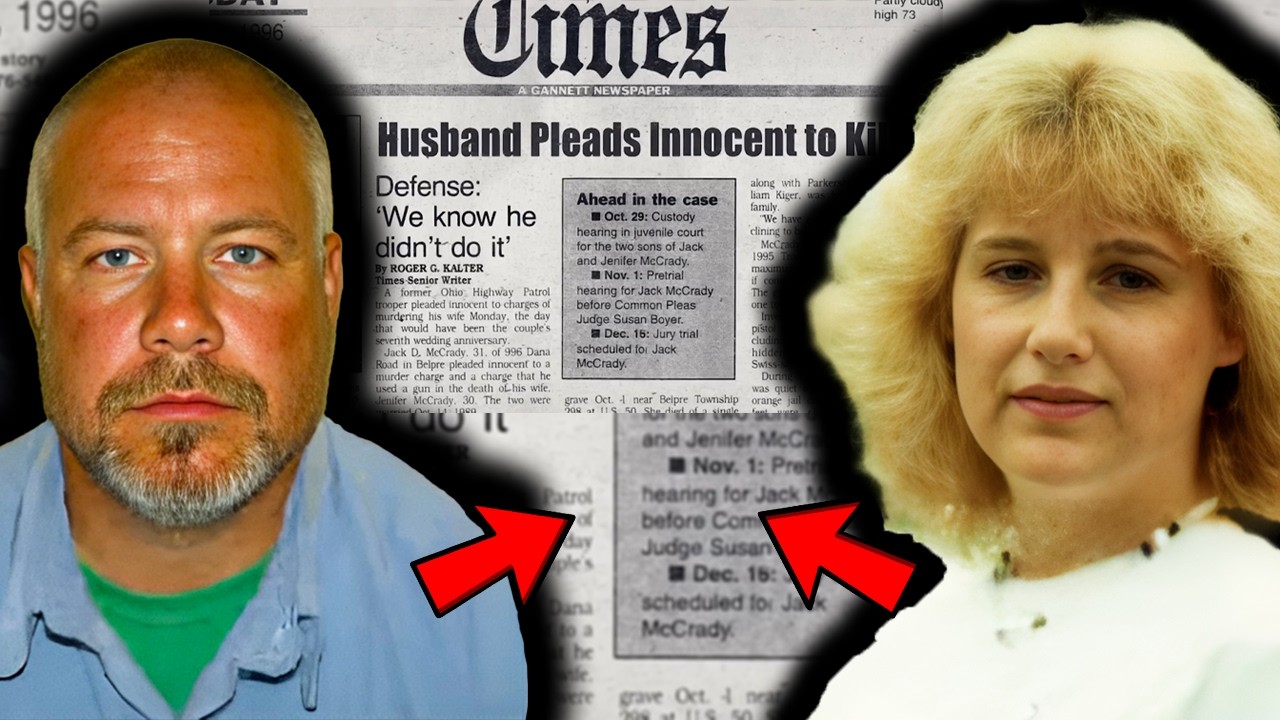
On September 19, 1996, an Ohio State Highway Patrol trooper called police to report that his wife was missing. A few hours later, he canceled the report, claiming she had left on her own with some belongings and a small amount of cash. As the days passed without word from her, he eventually filed an official missing person report, prompting investigators to begin looking into her disappearance.
The case would end in a shallow grave south of Belpre, Ohio, and in the conviction of the very man who first made the call.
Jennifer Lee Barrett McCrady was born on December 4, 1965, in Tiffin, Ohio, to Dr. Thomas Barrett and Janet Barrett. Her father, originally from Marietta, graduated from Vincent High School in 1952 and earned his doctor of veterinary medicine degree from Ohio State University in 1959.
After starting his veterinary practice in Tiffin, he moved the family to Belpre, Ohio, in 1976. There he opened a clinic that treated large, small, and exotic animals for more than three decades.
Dr. Barrett was deeply involved in his community. He helped start the Belpre Rotary Club, served on the Belpre Health Board, led the Ohio Veterinary Medical Board, and co-founded the Parkersburg Veterinary Emergency Clinic. He also ran a beef cattle farm.
Jennifer was raised in that supportive, close-knit environment. When the family settled in Belpre around the time she turned 11, she became part of a small town known for strong community values and pride.
Jack McCrady was born in 1948 and was 48 years old at the time of the events of 1996. He worked as a trooper with the Ohio State Highway Patrol, a job that called for discipline, responsibility, and regular interaction with the public.
His duties included patrolling the Belpre area, where he became a familiar face to many residents. His position made him a well-known and respected figure in the community. Before joining the highway patrol, Jack had worked with the Wood County Sheriff's Office and received training at the Corrections Academy in Huntington, West Virginia.
Jennifer and Jack McCrady were parents to two young sons, Bradley and Jaime, who were still small children when the tragedy unfolded. The family lived in Belpre, not far from Jennifer's parents. People who knew the couple described their life as steady and normal, which made what followed all the more shocking.
On September 19, 1996, Jack McCrady contacted authorities to report that his 30-year-old wife was missing, but his tone reportedly lacked any real urgency. Just three hours later, he called back to cancel the report, saying he had checked the house and noticed she had taken most of her things along with $3,000 in cash.
He claimed the only items she left behind were her wedding rings. What he did not mention then was something even more troubling: she had also left behind the two sons who meant everything to her.
Two days went by without any sign of Jennifer. Believing she was not going to return, McCrady tried to file a missing person report with the Washington County Sheriff's Office in Marietta, Ohio. Because the family lived in the small town of Belpre, he was told to contact the local city police instead.
Having served for five years, McCrady was familiar with almost everyone in the area's close law enforcement community. When word spread that Jennifer, who was known and well-liked, was missing, many officers promised to help find her. McCrady suggested she might have left with another man, but those who knew Jennifer found that hard to believe.
A few days into the investigation, a detective from the sheriff's office contacted the Belpre City Police to check for updates. Once they compared what McCrady had told each of them, they noticed his stories did not match. That raised concerns, and they decided his statements needed to be examined more closely.
When asked about their marriage, McCrady described it as happy and strong. He said that while they had small disagreements like any couple, they were very much in love and shared the goal of raising their sons, then one and four years old, in a loving home. Even so, detectives could not shake the sense that he was not telling them everything.
With no solid evidence of a crime and nothing clearly pointing to foul play, the case reached a standstill. With the investigation stuck, the dispatcher who had answered McCrady's first call recommended that the lead detective reach out to a psychic named Georgia Rudolph, who had helped police in Marietta solve a case in the early 1990s.
The experienced detective was skeptical, but he allowed the dispatcher to follow up on the suggestion herself. The dispatcher found Rudolph in Pittsburgh, Pennsylvania, and explained the situation, asking if she could provide any clues about where the missing woman might be. Without hesitation, the psychic replied that the woman they were looking for was not missing. She was already dead.
The dispatcher passed the message to the lead detective, who remained doubtful. However, with no suspects, no clues, and no clear proof that a crime had occurred, he decided to contact Georgia Rudolph on September 24. Though they began with polite conversation, the detective was cautious about what he shared.
After the small talk, he asked Rudolph what had happened to Jennifer. She told him the woman had been shot once in the head in an execution-style killing. When the detective asked who the shooter was, Rudolph said she did not know his name but described him as a strong, imposing man, like a lumberjack. Her next words sent a shiver through the detective: she said the killer was very likely a police officer.
The detective's doubts began to fade quickly. He asked if she knew where Jennifer could be found. She told him the body was buried just south of Belpre at the top of a gravel road numbered 298. He thanked her and ended the call, left with a great deal to consider.

As he thought about her words, he could not help noticing that the description of the killer matched Jack McCrady perfectly. At over six feet tall and more than 200 pounds, Jack had the strong build of a lumberjack. He was also very focused on his appearance and was known to use steroids to increase his muscle size.
By chance, the very next day, a witness came forward. She said she had seen a highway patrol car driving down an old oilfield road in Torch, Ohio, about 11 miles south of Belpre, a few days earlier. When she looked at the officer behind the wheel, he gave her a cold, hard stare that made her feel very uneasy. She was so disturbed that she believed the trooper might be dangerous to her or to others.
On October 1, after hearing about the unsettling encounter south of Belpre, the detective decided to check the access road mentioned by the witness. When he got to Torch, he spotted a sign for a rarely used road. It was labeled T298, exactly as Georgia Rudolph had said.
He parked at the bottom and walked up the dirt and gravel path. There he saw a patch of earth that looked recently disturbed, like a fresh grave. Because he was outside his jurisdiction, he stopped and called local police for help.
When an officer arrived, he knelt down and brushed away the top layer of dirt with his hand. He soon found what looked like a blue sleeping bag and called for crime scene experts. Once the area was secured, the investigator began digging up what was buried just below the surface.
Inside the sleeping bag was the body of Jennifer McCrady. She was barefoot in pajamas with a gunshot wound behind her right ear, making it clear she had been murdered.
On October 2, Jennifer's family was told about the grim discovery. Her parents, who never believed she had left willingly, were heartbroken. As for her husband, investigators observed that while he bowed his head and seemed to grieve, he could not shed a single tear.
Believing he was responsible for her death and had hidden her body in a shallow grave, detectives pushed Jack McCrady to confess. Instead of cooperating, he hired a lawyer right away, shutting down questioning before it could begin.
During a search of the family home, investigators found plenty of evidence pointing to McCrady. In the garage, they discovered Jennifer's purse, identification, and keys. They also found a .357 Magnum revolver, the same type of gun used in the killing, and added it to the evidence.
A ballistics expert could not match the bullet from Jennifer's body to that gun because someone had drilled out the barrel, ruining the grooves needed for comparison. A shovel taken from the garden shed was found to have dirt on it that matched the soil from Jennifer's grave.

Three days later, McCrady was officially charged with murdering his wife. As expected, he pleaded not guilty. The trial began on October 20, 1996.
During the trial, one of Jennifer's co-workers testified that Jennifer had been planning to leave her husband before she died. She had been open about the fact that their marriage was ending and said she wanted to take her sons and start over. This differed sharply from the happy marriage McCrady had described to police.
Prosecutors believed that on the night of September 19, Jennifer told her husband she was leaving him and taking their sons. They argued, and the fight quickly turned violent. In a moment of rage, McCrady shot his wife, killing her immediately.
He then covered her head with a trash bag to stop the blood from spilling on the floor and carpet before wrapping her in a sleeping bag. When the body was found, the white kitchen trash bag was still tied around her head.
While his young sons slept quietly in their beds, McCrady drove a short distance to the oilfield road in Torch and buried his wife's body in a shallow grave. Because he was in a hurry, he managed to dig only a few inches. Investigators believed he planned to move the body later, but Georgia Rudolph's insight and the witness who saw him stopped those plans from succeeding.
The jury spent 14 hours before reaching a verdict. Ultimately, McCrady was convicted of murder and sentenced to 15 years to life. He is now held at the Chillicothe Correctional Institution.
McCrady has applied for parole twice and was denied both times. In 2014, the parole board rejected his release, stating that they believed he posed a risk to public safety.
In October 1996, Jennifer's parents were given custody of their grandsons. The boys, the most innocent victims, lost both their parents in a terrible act on the night of September 19, 1996, an event that can never be undone. With the love and care of their grandparents, it is hoped they found a way to heal from the past.
Despite what McCrady said at the time, Jennifer was not involved in a secret affair, nor was she running away. She was a devoted mother who would have done anything for her children and would never have left them behind with someone as unstable as their father.
Some speculated that McCrady's steroid use might have worsened his anger, but there is no way to be sure. It is possible the drugs brought out his need to control everything, but it is also likely he saw Jennifer as something he owned and could not stand the thought of her living without him. Since he refused to talk about it and probably would not be honest even if he did, his real reasons will likely never be known.
Though they were doubtful at first, the detectives later praised Georgia Rudolph for providing important clues in the case. If she had not guided them to the spot before McCrady could move the body, Jennifer might never have been found. After the trial, the prosecutor who won the conviction called Rudolph personally to thank her, and the investigators who helped put Jennifer's killer behind bars always made sure to recognize her role.
What happened to Jennifer McCrady at the hands of the man who was supposed to protect her remains a tragedy. Her life, her devotion to her sons, and the small-town world she grew up in are remembered by those who knew her.