The world knew Wallis Simpson as the woman who cost a king his throne. The American divorcee for whom Edward VIII gave up his crown. But the people who served her in a rented house on the edge of Paris remembered something colder.
They were told to curtsy to a woman the law said held no title at all. They called her "Your Royal Highness" because her husband demanded it. They changed the napkins twice at every dinner and carried from room to room a small notebook in which she wrote down their every failing.
A duchess without a country, keeping a court of 15 in scarlet livery, in a house she did not own, over a husband who could not bear to let her leave the room.
On the western edge of Paris, where the avenues give way to the trees of the Bois de Boulogne, there stood a house that behaved as though it were a palace. It was nothing of the kind. It was a villa of 14 rooms built for a private family in the late 1920s, and the couple who lived in it did not own a single brick of it.
They held it from the city of Paris on a lease for a rent so small it was closer to a courtesy than a payment. And yet a visitor who stepped through its doors entered something that looked and sounded and even smelled like the household of a reigning monarch.
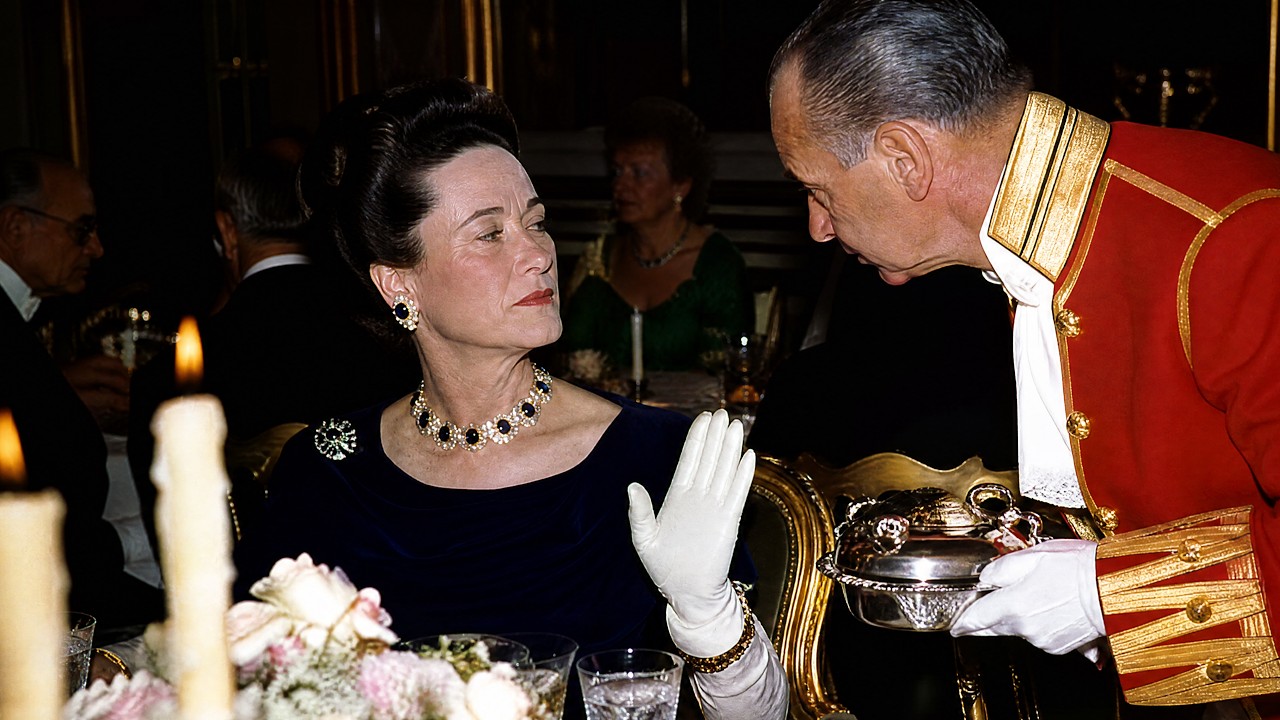
Footmen moved through the rooms in scarlet and gold. A silk banner bearing a royal coat of arms hung in the marble hall, and the servants, without exception, bowed or curtsied to the woman of the house and addressed her by a style that no law in the world recognized as hers.
Her name was Wallis, Duchess of Windsor. To the newspapers, she was the most notorious woman of the century. To the 15 or so people who worked below her stairs, she was something more particular and more demanding. She was an employer.
The account those employees left behind in memoirs and interviews is not the account of a romantic heroine. It is the account of a woman of ferocious and exhausting standards, who counted the spoons, who kept a notebook of faults, who rehearsed her dinners like a director rehearsing a play, and who within a year of her husband's death would turn a devoted servant of 30 years out of the house.
"Rude," some of them called her. "Grasping," said others. "Impossible to please," said very nearly all of them.
The road to that rented court began a long way from Paris, in a country town in Pennsylvania called Blue Ridge Summit, where she was born in the summer of 1896. Her father died before she was a year old. The family she came from was old and respectable and poor, a genteel Maryland line that had run out of money, and she was raised largely on the charity of a wealthy uncle.
She grew up inside grand houses that were not her own, watching other people's servants lay other people's tables, always the poor relation, always aware of exactly where she stood and exactly what she lacked.
She married young and badly the first time, to an American naval flyer who drank. She married again to a shipping man named Ernest Simpson, and it was his London life in the early 1930s that carried her at last to the edge of the only society that mattered.
Even then, before any of the titles and the trouble, she had a reputation as a hostess. In London, she was recognized for giving some of the finest small parties in the city, for the elegance of her table and the care of her food, and for the way she worked hand in glove with her cooks.
It was in that London world, at a country-house weekend, that she met Edward, Prince of Wales, the most eligible bachelor on earth and the heir to the British throne.
In December of 1936, after less than a year as king, Edward VIII gave up the throne of the United Kingdom and its empire rather than reign without her. He signed the instrument of abdication on the 10th of December. It took legal effect the following day.
He was created Duke of Windsor, and the next June, in a château in France, he married the woman he had ruined himself to have. His reign had lasted 327 days, the shortest of any British monarch since Lady Jane Grey.
But the story of this house begins precisely where that one ends. Because when Edward gave up his crown, he found he could give Wallis almost nothing that the state would let him give.
No country would have them for long. No official role was ever found for him again. And the one thing she wanted above all others, the rank and the honors of a royal wife, was withheld from her by his own family in a single cold document a week before the wedding.
So he gave her the only kingdom left in his gift. He gave her a house and the money to run it and the power to run it exactly as she pleased. The household became the substitute for the throne. The servants became the subjects of a court that had no country.
By the middle 1960s, the establishment in the Bois de Boulogne ran to about 20 people at work. The indoor staff proper numbered around 15, housed in the basement of the house, where the great safe for the jewels also stood.
There were footmen in royal livery and a chef whose kitchen was reckoned among the finest tables in Europe. There was a butler who ran the whole machine, a lady's maid, chauffeurs, a private secretary who functioned as the manager of it all.
The rule that governed every day of their working lives was the strangest thing about the place. The servants were required to treat the Duchess as royalty. They bowed to her and they curtsied to her. They called her "Your Royal Highness."
The style had been refused her by the crown, refused in writing, and every person in the house knew it. And still inside these walls, she received the honors of a princess day after day from a staff whose wages depended on remembering to give them.
The curtsy England would not give her, her servants gave her every day.
In the summer of 1940, the Duke and Duchess of Windsor arrived in the Bahamas, where the Duke had been made governor and where for the next five years they would keep their first real household together.
The house was called Government House, and the Duchess took one look at it and was appalled. A reporter for an American magazine who saw it about the same time described it without kindness. A cracked and flaking building, he wrote, with about as much warmth and atmosphere as an army barracks.
In the Duchess's first week, a piece of the ceiling came down near her desk. An inspection declared the place unsafe, and the couple moved out to a private house while the repairs went on.
To a woman for whom the appearance of things was very nearly a moral matter, it was intolerable. She wrote to her aunt in a letter that has been quoted many times since, saying that together they were going to "dish this shack up" so that at least one of them would not be ashamed to ask the local people in.
What the money bought was pure Wallis. She brought in wallpapers from New York. She had rattan run along the skirting. She set on a table a replica of her own signature, all of three feet of it.
And in the anecdote that has clung to the house ever since, she is said to have had one room painted the exact shade of her favorite face powder, with samples of the powder held against the wall until the match was perfect.
A whole new wing had to be built onto the house simply to hold the enlarged staff she required. She had arrived at a shabby colonial residence and set about turning it into a stage worthy of the performance she intended to give.
The same American magazine reporting from Nassau that first week caught the mood in a single dry line. "At Government House," it wrote, "the staff expected to be held on a tight rein."
Moving through it all, learning the trade of service in a house run to a standard most great English homes had already abandoned, was the Bahamian boy of 16 who would carry that standard and that memory for the next 50 years.
His name was Sydney Johnson. He was working as an attendant on the beach when the Duke first noticed him at about the age of 16. He was taken into the household as a footman.
He would rise in time to be the Duke's own valet, and he would follow the couple from this island to Paris and serve them for more than 30 years.
After the war, the Windsors drifted, restless and homeless in the way of the very rich, between hotels and borrowed houses and the resorts of two continents. And then by the early 1950s they found the house that would become their monument and in the end their prison.
It stood in the Bois de Boulogne on a quiet road at the western edge of Paris, and it belonged to the city of Paris, which handed it to the exiled couple on terms that tell you everything about how the world still wished to flatter them.
The rent was, by the most commonly cited figure, $50 a year. Around that peppercorn rent, the city wrapped a set of further kindnesses that made the true value of the arrangement enormous. There was free security. There was exemption from income tax, from duty on the things they bought abroad, and from tax on the profits of their investments.
It was a gift disguised as a lease, and it let them keep, on almost none of their own money, a house grand enough to answer the family that had cast them out.
The house itself was a handsome thing, French and neoclassical. Built at the end of the 1920s by a Paris architect, 14 rooms spread over three floors with reception rooms whose ceilings rose to 15 feet, set in gardens of a little under three acres.
She gave the work to one of the great decorating houses of Paris, and she supervised every choice herself. The marble entrance hall was hung with a banner of red and gold bearing a royal coat of arms.
The grand salon was done in pale blue and gold with a great woven rug carrying a design of silver feathers, the feathers of the Prince of Wales, the emblem of the man the Duke had been before he was king.
Her own bedroom was done in a color the world came to know as Wallis blue, a shade mixed to order back in 1937 to match her wedding dress and her eyes.
The Duke's bedroom was made over into a copy of the room he had loved best in England, his rooms at his old house, Fort Belvedere, down to a bed cover embroidered with the letters "ER." For Edwardus Rex, the cipher of the monarch he had chosen to stop being.
The house was less a home than a shrine to a life that had ended, kept by a woman who had helped end it.
There was a second house, and it mattered because it was the only one they ever truly owned. It was a former flower mill in the countryside beyond the city, at a place called Gif-sur-Yvette, bought around the start of the 1950s for something in the region of £80,000.
The old mill stood in a wooded river valley of some 23 acres. Its buildings dated back to the 1700s. The Duke loved to garden here in old clothes with his hands in the earth, and he nicknamed the steep wooded slope behind the house "Cardiac Hill."
The Duchess called the mill their only real home, which is a strange and revealing thing to say about the lesser of two houses until one recalls that it was the only roof over their heads that actually belonged to them.
The Duke of Windsor asked once how the household worked and gave an answer that has outlived almost everything else he said in his long exile. The Duchess, he explained, was the cruise director. She ran everything. The house, he said, was the ship.
He justified the sheer number of servants by quoting his own father, King George V, who had held that to get anything done to a royal standard, you needed a man and a half for every job.
There were at the working heart of the Paris house about 15 indoor servants, rising toward 20 when every hand was counted. They lived in the basement.
The footmen at least wore a livery of scarlet and gold that belonged to another century. And they served a household run, in the phrase that comes down from those who knew it, with military precision, where the meals arrived on time and looked as perfect as they would have looked at Buckingham Palace.
For much of the great period, the butler was a Frenchman named Georges Sanègre, who with his wife formed the long-serving heart of the domestic staff. One writer who studied the house described Sanègre with affection and a little dread as the major-domo, the listener at doors and the counter of spoons.
There was a lady's maid. There was a French chef named Lucienne whose cooking was famous and whose temper was his own. There were chauffeurs. And presiding over the paperwork of the whole enterprise was the private secretary, an American named John Utter, a former diplomat who served as the manager of the establishment.
It was a pyramid in the old style, with the Duchess at its point and a descending order of function beneath her. Each servant knowing exactly where he stood and exactly to whom he answered.
A great house in England ran a staff like this to manage an estate of thousands of acres and the lives of a whole village. The Windsors ran one to manage themselves.
The single object that the servants of the Windsor household remembered most vividly was not a jewel or a painting or a piece of the famous silver. It was a small notebook.
Through the course of the day, the Duchess moved from room to room with it in her hand. And as she went, she wrote. She wrote down every fault she found, every flower an inch out of place, every smear on a glass, every failing in the running of her house, and then she tore out the pages and handed them to the staff for correction.
The household had its own name for the practice, which is the surest sign that it was real. They called it the grumble book.
It was, by one account, a golden notepad, and in it the duchess recorded her judgments on the things that mattered most to her, the pairing of the wines, the making of a sauce, the quality of the pastry.
The regime the notebook served was exacting to a degree that startled even people used to grand houses. Dinner in the Paris house began at 9:00, and it began at 9 exactly. During the course of a single meal, the napkins were changed not once but twice.
Nothing in the house was too small to be noticed. Nothing that fell short went unrecorded, and the recording was not for its own sake. It was handed back in the morning to the person who had failed, so that the failure could be put right, and above all, not repeated.
His name was Alan Fisher, and he was an English butler who entered the Windsors' service in the middle 1950s and stayed about six years, and who went on years later to be butler to the Prince and Princess of Wales.
When his memoirs came up for sale many years afterward, the phrase the newspapers seized on was his own private name for the duchess. He called her a "queen dictator."
Fisher remembered the manner as much as the standard. Orders came to him in the third person, relayed as though from a throne. "Her Royal Highness," he would be told, "wants you to get a haircut immediately."
He remembered a row over a set of windows left unlocked that brought him to the very edge of walking out. And he remembered his own reply thrown at the woman the whole house was built to flatter. "Your Royal Highness," he told her, "you can stick your job."
And he came away after six years inside her house believing something the world had never been told, that she had never truly loved the Duke at all.
The perfectionism cut both ways, and an honest account says so. The same standards that made her exhausting to serve made her table one of the finest in Europe and her houses, in the words of the photographer who came to record them, more surpassingly clean than any interior he had ever seen.
But there is a coldness in the picture the servants leave that no amount of admiration quite warms. A woman walking her own rooms with a notebook hunting for the fault is not a woman at ease in her own home.
She was performing always for an audience that was not there, against a judgment that had already been passed on her, in a house she had furnished to answer it.
The Duchess of Windsor did not simply order dinner. She rehearsed it. Days before a dinner of any size, by her own account, she would summon the chef and go through the whole meal with him course by course, arguing it out.
Three or four days ahead she began. The dinner that a guest ate in an hour had been fought over for the better part of a week.
No detail was too small for the argument. The food, she believed, could be as rich as the cook liked, so long as it did not look rich, because a guest who saw richness would grow cautious and eat little, and a guest who saw lightness would eat freely and go home happy.
"If you make it not look rich," she promised her cook, "they will eat it."
For years, the kitchen of the Paris house was ruled by a French chef, remembered simply as Lucienne. When she pressed on him the tinned and the frozen and the convenient, he resisted her to her face. "Why, madame?" he demanded of her, when he had only to walk six blocks to buy something fresh.
The dining room of the Paris house could seat 30, and in the grand years before the Duke's death, it was nothing unusual for 40 to sit down to crested linen and crystal.
The Duchess had firm and particular ideas about the right shape of an evening. Ten, she said, was the perfect number for dinner. More than eight, she held, meant there could be no soufflé, which she counted always a melancholy omission.
Two things were banished from her kitchen altogether: onion and garlic, which she declared to be poisoned to the Duke and to her.
Every dinner she gave was recorded, not in memory, but on paper. She kept, she said, a full account of all her dinners, the lists of who had come, the menu itself, the arrangement of the seating, the decoration of the table, which china had been used, and which silver.
A week before the Duke and Duchess of Windsor were married in the early summer of 1937, a single document settled the shape of the rest of their lives.
It was issued under the authority of the new king, the Duke's own younger brother, George VI, and it concerned the matter of titles. It granted that the Duke should keep the style of a Royal Highness, but it did so in a phrase that has never lost its chill: "for his own personal use and enjoyment alone."
And it declared of the woman he was about to marry, and of any children they might have, that they should not have the said style, title, or attribute.
The Duke would be royal. His wife would not.
By the ordinary rule of the law, a wife takes her husband's status, and the whole apparatus of government had to be turned to preventing it in this one case.
The home secretary of the day put the difficulty with brutal simplicity. She would acquire the rank by marrying the Duke, he noted, unless something were done to prevent it. And on balance, he advised, it should be done.
Even the law officers privately admitted the weakness of it. The attorney general conceded that no truly convincing argument could be made against anyone who called the whole maneuver a questionable use of the royal power.
The insult was sharpened by the fact that everyone knew the ordinary rule because it had just been followed for everyone else. When the future King George VI had married a Scottish earl's daughter, she had become at once and without question a Royal Highness.
Wallis alone of all the women who married into that generation of the family was refused what the law gave the rest of them for nothing.
A great authority on the peerage would later call it in print the most flagrant act of discrimination in the whole history of the dynasty.
The refusal was driven, by every account, by the new king and behind him by his mother, the old Queen Mary, and by his wife, the new queen.
Was she, King George VI is said to have asked, a fit and proper person to become a Royal Highness after what she had done in this country?
And more revealingly still, if she were made a princess now, he is reported to have reasoned, then she could have been a queen in 1936, and the whole moral of the thing would be lost.
The Duke received the news as a blow aimed at the thing he loved, which is exactly what it was. "This is a nice wedding present," he is remembered to have said.
The fullest account of his reaction comes from a man who was in the room, his equerry. The Duke, the equerry recalled, put down his beautiful head with its golden hair in the lap and sobbed helplessly. His heart, the man said, was broken.
He vowed from that day that he would never bring her back to live in England until she was granted the style, a condition the family never met, so that he never truly came home again.
Denied the honors of royalty by the state, the Windsors simply built inside their own walls the court that would render them.
The staff were required to call her "Your Royal Highness," the very style the crown had denied her. In that house, the curtsy England would not give her, her servants gave her every day.
The grievance ran so deep and so long that it worked on the Duke even at the end. His nurse recalled that as he lay dying, the matter of his wife's title still played on his mind.
On the Duke's grave, his titles are given in full: "His Royal Highness, Prince Edward." On the Duchess's beside him, there is only her name: "Wallis, Duchess of Windsor." The letters she had wanted her whole life were withheld from her even there.
If the Duchess ruled the household, there was one person over whom her rule was total and unresisting, and it was the Duke himself.
His own official biographer, writing with the caution of a scholar, put it in words that have never been bettered. "By the end of 1934," he wrote, "the Duke was irretrievably besotted and he became in time slavishly dependent on her."
The butler, Georges Sanègre, remembered how when the Duchess went to her hairdresser in Paris, the Duke would not settle to anything while she was gone. He would take a chair by the lift and simply wait there, longing for her to be ready.
Another of the household, the butler Alan Fisher, put the imbalance without any tact at all. The Duke, he said, was in love with her 100% of the time, and she was in no way in love with him.
"It took so little to please him," Fisher remembered. "Any small gesture from the Duchess, however slight, was all important to him."
The photographer Cecil Beaton, who saw the couple more than once and had an eye trained to read a face, thought the Duke essentially sad, and thought the Duchess beside him looked hard and calculating and strangely unlovable for all her famous elegance.
In their private letters, they spoke to each other in a nursery language of their own, a baby talk of pet words and cooing endearments, and the man doing most of the cooing was the former king.
The editor who first read those letters could only describe the relationship they revealed as almost that of a mother and a son.
The Duke's own private secretary, John Utter, left the coldest image of the marriage at rest. The two of them alone in the evening with nothing left to say. "They were not tired enough to go to bed," he remembered, "but they had nothing to say to each other. So the contents of the decanter just went slowly down, down, down."

As the Duke lay dying slowly of the cancer in his throat, the first question he asked on waking every single morning was whether the Duchess was awake.
His nurse remembered it as the fixed point of his every morning. The couple still kept their old private routines even then, a late breakfast taken together between their two rooms, always the same, scrambled eggs and thin slices of bacon.
In the late spring of 1972, the thing the household had never allowed itself to name arrived. The Duke of Windsor was dying in the house in the Bois de Boulogne, in the bedroom made over to look like the rooms he had loved as a young man in England.
The man who was closest to him in the plainest physical sense was not a doctor or a duchess but a servant. The Bahamian valet who had dressed him every day for 30 years. His name was Sydney Johnson.
He had come to the Windsors as a boy of 16 on a beach in Nassau. And he had followed them across an ocean and up through the ranks of the household to become the Duke's own man.
The Duchess, unable to face what was happening upstairs, kept to the routines that had always held her together, receiving her friends, sitting at her table, going through the motions of the life the two of them had built, while above her, the man it had all been built for was dying by inches.
When the dying was done on the 28th of May in 1972, it was Johnson who was called to perform the last service of all. He was asked to choose the suit in which his master would be buried.
He picked one out, as he had picked out the Duke's clothes for three decades, laying it ready, as he had laid ready 10,000 mornings of clothes before it.
And then the men who had come to prepare the body told him it would not be needed. The Duke would wear nothing at all. "As he comes," one of them said to the valet, "so he goes."
Johnson remembered the moment to the end of his own life. The strangeness of dressing a man every morning for 30 years and then being told at the last that there was nothing left to dress.
The Duke's body was taken home to England to lie in the place his family had denied him in life and granted him only in death. The funeral was held at St. George's Chapel at Windsor in the first week of June.
The Duchess crossed to England for it, frail and bewildered, to be received by the family that had spent 35 years keeping her at arm's length. She was received for those few days with a cold and flawless correctness that gave her everything but welcome.
Then the Duke was buried at Frogmore in the royal burial ground, and the Duchess was taken back across the channel to the 14 rooms and the 15 servants, and the empty bedroom with the royal cipher still stitched on the bed.
The Duchess was 75 years old, and already at the Duke's death, her mind had begun to cloud with the hardening of the arteries that would in time take everything from her.
Within a year of the Duke's death, Sydney Johnson would be gone from the house he had served for 30 years.
One careful record of his life notes only that he left in 1973 and that the accounts differ as to whether he resigned or was dismissed.
By the most repeated version, Johnson's own wife had died at about the same time as the Duke, leaving him a widower with four children to raise, and he asked the household for a change to his hours so that he could be home to care for them. The household, so the story goes, would not grant it.
And so a man of 30 years standing was let go, or made to feel he had no choice but to go, at the very moment his loyalty most deserved a kindness in return.
An honest account has to set beside it the plainer and less cruel reading. With the Duke dead, the great household simply made no sense any longer. It had been built to serve two people, and one of them was gone.
Several of the staff left in those years, one biographer notes, for the simple reason that there was no longer the work or the reason to keep them.
But whichever reading one takes, the fact remains. The most faithful servant of the whole reign was outside the household within a year of the Duke's death.
In time he found work in one of the great hotels of the city, and a strange twist of fortune would eventually carry him back into the very rooms he had served in.
As the old servants left and the old secretary lost his grip and the Duchess herself drifted further from the world, a vacuum opened at the center of the house around a rich and helpless old woman with no husband, no child, and a fortune suddenly unguarded.
In 1973, someone did fill that vacuum. She was not a servant and she was not family. She was a lawyer.
Her name was Suzanne Blum, and she was one of the most formidable lawyers in Paris. She had been born in 1898 and she had built a career of rare distinction in a profession that had little room for women, acting in her time for some of the largest names in the world.
The great American film studios had been her clients. So had figures as famous as Charlie Chaplin and Rita Hayworth.
In 1973, she took power of attorney over the Duchess's affairs. What had been managed by others was now managed by her.
The Duchess's British lawyer was pushed aside. Her American private secretary, the man who had run the household for years, found his authority taken from him and in time was gone.
One by one, the people who had stood between the Duchess and the world were removed until only Blum remained, holding the single key to a rich, isolated, and increasingly helpless old woman.
From about 1973 until the Duchess's death, 13 long years, all roads to her ran through her lawyer, and her lawyer decided who reached her and who did not.
The most damning account comes from a biographer of the Duchess whose book on these final years set out to describe what he called, in the plainest terms, the criminal exploitation of an old and sick woman after her husband's death.
By that account, the Duchess was cut off from her friends, who were told she was too ill to see anyone. Her financial papers were burned. The locks were changed. Her staff were let go. Her possessions were sold, some of them, it was alleged, on the authority of a power of attorney the biographer believed might even have been forged.
And the great fortune was steered in the end toward a French medical charity in which the Duchess had never in her life shown the slightest interest.
One reviewer summing up the biographer's view of the lawyer wrote that he had come to regard her as something very close to the devil in tweeds.
There is another side, and fairness demands it be given. Blum always maintained that she had acted out of friendship and loyalty to a helpless old woman with no one else to protect her.
A younger man who worked as her assistant from the end of the 1970s, and who through her gained access to the Windsors' private papers, has consistently defended her against the charge of exploitation.
So the story of Suzanne Blum is genuinely two stories, and no honest account can pretend to know for certain which is the true one.
What is not in dispute is the shape of the thing. A woman who had once counted every spoon in her own house was now at the end a possession herself, controlled and managed and kept.
By the early 1980s, the Duchess of Windsor could no longer speak. The woman who had corrected her servants without mercy, who had argued menus with her chef course by course, had lost the power of speech altogether.
The decline had been long and merciless. It had begun even before the Duke's death with the hardening of the arteries that starved her mind, and it had deepened year on year into a full dementia.
She had fallen more than once. She had broken her hip twice. She had suffered a series of small strokes, each one closing another door in her. And the arthritis that twisted her hands grew so cruel that in the end her fingers could no longer hold the wedding ring the Duke had given her.
By about 1980, her speech was gone. By the year after that, the reports say she could not move or speak or feed herself.
For something close to her last six years, she lay in her bed in the house in the Bois de Boulogne and did not leave it.
The house went on around her in a horrible parody of its old life. The footmen were still there. The livery was still there. The royal banner still hung in the hall.
Fifteen or so servants still kept the great machine of the household turning, still cleaned the surpassingly clean rooms, still maintained the outward form of a royal court.
But the court had no queen now, only a silent, shrunken old woman in an upstairs bed, kept alive by nurses, soothed by the records played softly in her room hour after hour.
Her friends turned away at the door with the message that she was too ill to receive them, deprived even of the little dogs she had loved.
The perfection went on being performed for no one. The ship sailed on immaculate with no one at the wheel and no port to make for.
The biographer who studied these years drew a picture almost too bleak to read. The Duchess, he wrote, lay in her bed, cut off from the friends who were told she was too ill to see them, deprived of the dogs, shut away from the whole world she had once commanded.
She was, in his terrible phrase, powerless and trapped in a body that did not know how to die.
The release came on the 24th of April in 1986. The Duchess of Windsor died in the house in the Bois de Boulogne, in the bed she had not left for years, of a pneumonia in the chest, two months short of her 90th birthday.
She was 89 years old. She had outlived the Duke by nearly 14 years. Almost all of them spent in silence and the dark.
They took her home to England one last time to be buried beside the Duke. The funeral was held at St. George's Chapel at Windsor on the 29th of April, and about 175 people came to it.
It was a short service, less than half an hour, with no address and no eulogy, exactly as she had wished, closed with a blessing from the Archbishop of Canterbury.

The Queen laid a wreath. Eight soldiers of the Welsh Guards carried the coffin of English oak.
The royal family came, the ones who were left. The Queen was there and her husband and the Prince and Princess of Wales and Princess Anne and the Queen Mother herself, now in her middle 80s, the woman who more than any other had seen to it that Wallis was never made royal.
On the coffin, on the silver plate that named the woman inside it, there was written the last word in the argument that had shaped her whole life.
It read simply, "Wallis, Duchess of Windsor," and the years of her birth and death. That was all.
Not the style she had been denied in 1937, and had wanted every day of the 49 years since. Not the initials her servants had been made to speak to her at every meal. Just her name and her husband's title, and nothing of the rank the family had refused her while she lived, and refused her still now on her coffin in silver in front of them all.
She was buried at Frogmore in the royal burial ground beside the Duke under a plain stone that gives again only her name. Fewer than 20 people stood at the graveside.
The old Queen Mother did not go to it. She had come to the chapel, but on the advice of the Queen, she did not follow the coffin to the grave.
And there was one witness at that funeral who saw something almost no one ever saw. The Princess of Wales, the young Diana, said afterward that it was the only time in her whole life she ever saw the Queen weep.
There was a last small perfect detail, and it came from one of the great ladies who attended. Looking at the flowers sent for the funeral of the most famous woman of her age, she felt something close to heartbreak at what they told.
They were all, she noticed, from dressmakers and jewelers, from the great fashion house, from the jewelers of the Place Vendôme, from the hairdresser who had done the Duchess's hair for decades.
The tributes at the grave of the woman who cost a king his throne came from the shops. It was, the great lady said, tragic.
A year after the Duchess died, in the spring of 1987, her collection was laid out in Geneva and sold at auction, and the sale became one of the legends of the trade.
There were 306 lots, and they were the gifts of a lifetime. The Cartier and the Van Cleef and Arpels that a besotted king had given the woman he could give nothing else.
The estimate before the sale was around 7 million. The jewels made about 50 million, some seven times over.
A flamingo brooch of platinum and diamonds and colored stones went for around $565,000. A brooch in the shape of the Prince of Wales feathers was bought by the film star Elizabeth Taylor for more than $600,000.
A ruby brooch, a Christmas gift from the Duke, made more than 800,000. A necklace of rubies and diamonds made something above $2.5 million. A bracelet in the shape of a panther in onyx and diamond made more than a million and a quarter.
And all of it, every last stone, went under the hammer for the benefit of a French medical charity, a body in which, as one writer observed with some bitterness, the Duchess had never in her life shown the slightest interest.
The house went too, though it stayed standing. It had never belonged to the Windsors, only ever leased from the city of Paris, and on the Duchess's death, it fell back into the city's hands.
Later that same year, it passed to a new tenant, one of the richest men in the world, an Egyptian businessman who took a long lease on it at a rent of a million francs a year on the condition that he spent 30 million francs restoring it.
He kept the lower rooms exactly as the Windsors had left them, a museum to the couple, arranged as though they had only just stepped out to dinner and might come back at any moment.
And to curate it, to keep the rooms he had known better than anyone alive, he brought back a familiar figure. For the man the new owner installed as keeper of the Windsor house was none other than Sydney Johnson, the valet who had been turned out of it more than a decade before.
"He is a dictionary," the man said of him, a walking record of a lost way of life.
At the reopening, Johnson stood in the house and said that he felt on top of the world, that the work was so faithful that he half expected to see the Duchess herself come down the staircase and ask him how she looked.
He did not have long to enjoy it. He died in Paris in January of 1990, aged 69.
The contents that were not kept were sold. The new owner gathered up some 40,000 of the couple's possessions, more than 3,000 lots of them, and put them to auction in New York.
The sale had been meant for the autumn of 1997, but it was put off because on the last day of August that year, the owner's own son was killed in a car in a tunnel in Paris. And the young woman who died beside him was Diana, Princess of Wales, who had wept once at the Duchess's funeral.
The sale was held instead early the following year. It made more than $23 million. The very desk on which the Duke had signed away his throne fetched over $400,000.
Piece by piece, the court was carried out of the house and knocked down to bidders. The jewels to Geneva, the desk to New York, the rooms to a museum, the servant to his grave. The household that had taken 50 years to build was dismantled and sold inside a decade.
There is a larger story folded inside this one, and the servants who lived it were among the last people on earth who could have told it.
For the household the Windsors kept, the great establishment of liveried footmen and counted spoons and a chef arguing menus three days deep, was already, by the time they kept it, a thing very nearly extinct.
They were running an Edwardian great house into the 1970s, a full generation after such houses had all but died, and the servants who staffed it were the last practitioners of a craft the modern world had no more use for.
For the first half of the 20th century, domestic service had been the single largest kind of paid work for women in Britain. An entire economy of butlers and footmen and housemaids and cooks.
And then in the span of a few decades, the whole world of it was gone. The two great wars carried the young women off into the factories and the offices, and never gave them back.
The servants who kept the Windsor court were therefore something more than servants. They were survivors. The last living holders of skills the world had stopped teaching.
The Windsor kept the old world going as though nothing had changed. They kept the livery. They kept the footmen. They kept the chef and the butler and the counted silver and the dinners for 40 in a Europe that had almost entirely forgotten how such things were done.
His whole exile was called, by one summary of his life, a purposeless one, a study in wasted potential. A man who after giving up the throne never again sought or found a single useful thing to do.
And into that emptiness the household expanded until the keeping of it was the only occupation either of them had left.
The court in the Bois de Boulogne was the last of its kind, kept alive by grievance long after the thing that grievance fed on had died everywhere else.
The Duchess's own fortune, when it was counted, came to something like £5 million, and she left almost all of it, like the jewels, to the French medical charity, as a tribute, it was said, to the country that had taken the exiled couple in when their own would not.
The royal family, who had denied her the rank, received nothing of note.
In the end, the household was never really about the dinners. It was never about the flowers or the placing of a fork or the shade of blue on a bedroom wall or the two changes of a napkin in the course of a single meal.
All of that was the surface. Underneath it, driving every counted spoon and every corrected fault and every page torn from the little notebook, was a single wound that never healed.
The wound was the refusal. A week before her wedding, the state had told her in writing that she would never be royal.
She could not answer that in England, where no one would curtsy to her. So she answered it in France, in a rented house, in the only court left in the world that she could command, the court of her own servants.
The perfection was not vanity. It was grief dressed in the clothes of vanity, worn every day for the rest of her life.
Every liveried footman was an argument. Every flawless dinner was a rebuttal. Every servant made to say "Your Royal Highness" was a small daily victory in a war she had already lost and could never stop fighting.
The curtsy England would not give her, her servants gave her every day, and it was the only crown she was ever allowed to keep.
One thing should be said at the last about what the servants actually gave her, because it was more than the world ever did.
For all the coldness they recorded and the exactitude and the fear, they gave her every day the one thing she had built her whole life to win and never truly had.
They bowed. They curtsied. They called her by the style the crown had refused. And they did it not once for a photograph, but 10,000 times in the ordinary business of ordinary days, until the fiction had almost the weight of a fact.
Whatever they privately thought of her, and some of them thought very little, they made her inside those four walls the queen she could be nowhere else on earth.
It was the servants in the end, and not the family and not the state, who gave the Duchess of Windsor the only reign she ever had.
It lasted exactly as long as they did. And when the last of them had gone, and the rooms were emptied, and the jewels were sold, there was nothing left to say she had ever ruled at all, except the memory carried in the heads of the people who had served her, and the half a title cut into her stone.
The curtsies are all gone now, and the notebook is closed, and the only verdict that outlived her is the one her own servants carried out of the house in the years when the doors were closed.
Not a palace, not a marriage the world could envy, but a wound kept immaculate by a staff of 15 for a woman who could never once be told that she was enough.
She had asked to be treated as a queen, and for a time in one house she was. And the servants who did the treating knew better than anyone who ever curtsied to her that it was the loneliest throne in the world.