On the night of July 17, 1918, a basement room in Yekaterinburg measured roughly five meters by six. The wallpaper had vertical stripes. A single electric lamp cast a yellowish light that made everyone look vaguely unwell. There were no windows that opened. The room smelled the way rooms smell when people have been living too close together for too long.
The family was led in just past midnight. One of them asked for chairs. The boy could not stand for long periods without pain in his joints. Two chairs were brought. That detail is worth holding on to. A member of an armed Bolshevik execution detail stopped what he was doing and found two chairs because a woman asked him to, and because a 13-year-old boy had an illness that made standing for any length of time an act of small endurance.
Nicholas Romanov, former Tsar of all the Russias, stood holding Alexei in front of him. Alexandra sat. The four daughters, Olga, Tatiana, Maria, and Anastasia, arranged themselves in a cluster behind their parents. The family physician, Dr. Eugene Botkin, who had voluntarily followed his patients into captivity and refused every chance to leave, stood to one side. The valet, the cook, and three servants who had chosen to stay when they could have walked out stood against the far wall.
The family thought they were being moved. They had been told as much. The White Army was closing on Yekaterinburg. The city was no longer secure. There had been gunfire in the streets. They were being relocated for their own safety. They had heard variations of that explanation before. What they had not heard before was Yakov Yurovski reading from a sheet of paper at 2:15 in the morning while 11 people stood blinking in the lamplight. He told them the Ural Regional Soviet had sentenced the former Tsar to death.
The family physician managed one question before the shooting started. "So they aren't taking us anywhere."
Nicholas was the first to die. He was 50 years old. In the next 12 minutes, all 11 people in that room were killed. The youngest was 13. The daughters had diamonds sewn into their corsets, and the diamonds deflected bullets. Several of the girls were still alive after the first volley. Guards used bayonets to finish what the guns had not.
When it was over, Yurovski's men carried the bodies out through the courtyard and into trucks. They drove through the dark, buried the family in a field outside the city, and tried to destroy the evidence with acid and fire. The Soviet state would maintain for decades that the family had survived. They did not survive.
Their names were Nicholas Alexandrovich Romanov, Alexandra Fiodorovna Romanova, Olga Nikolaevna, Tatiana Nikolaevna, Maria Nikolaevna, Anastasia Nikolaevna, Alexei Nikolaevich, Eugene Botkin, Anna Demidova, Alexei Trupp, and Ivan Kharitonov. That is where this story ends. A basement, 11 people, 12 minutes.
The last entry Nicholas made in his diary, four days before this night, mentioned the weather. It had been warm. He had read some history.
The question is how it started.
Nicholas Alexandrovich Romanov was born on May 18, 1868, at Tsarskoye Selo, the imperial village outside St. Petersburg. He was the first child of the Tsesarevich Alexander Alexandrovich and his Danish-born wife, Maria Fyodorovna. The palace where he was born was enormous. The grounds were manicured to a standard that required hundreds of staff. The country over which his family ruled covered one-sixth of the earth's land surface.
He grew up afraid of it. Not obviously afraid. He was not a child who cowered or wept openly. He learned to present himself well, to ride horses, to appear comfortable in uniform, to make small talk with visiting dignitaries. His tutors noted that he was quick to learn and genuinely warm to the people around him. Beneath the pleasant surface, the people who knew Nicholas closely kept noticing the same thing. He did not want the job. He said so repeatedly to people he trusted. He wrote it in his diary.
In 1892, when he was appointed to the finance committee of the state council, he recorded his reaction in one sentence. "A good deal of honor but little pleasure." He added that he had been kept so late by the meeting that he missed an engagement at the military academy. Statecraft bored him. Military ceremony delighted him. That ratio would hold for the rest of his life.
The father Nicholas grew up under was a different kind of man. Alexander III stood six-foot-three and could bend iron pokers with his bare hands as a party trick. He considered himself the rightful absolute ruler of Russia and acted accordingly. His political philosophy fit on a postcard. Autocracy, orthodoxy, and nationalism, in that order, with no room for amendment or debate. He had watched his own father, the reform-minded Alexander II, bleed to death on the floor of the Winter Palace after a revolutionary's bomb caught him on the street, and he had drawn the obvious lesson. Reform was weakness. Weakness invited attack. The only safe response to dissent was the iron fist applied early and often.
Alexander III did not believe in preparing his son for power. Whether this was because he expected to live much longer than he did, or because he could not imagine his quiet, sweet-natured eldest being capable of it, is a question historians have argued about without resolution. What is clear is that Nicholas reached adulthood with an excellent knowledge of foreign languages, a genuine love of military drill, deep Orthodox faith, and almost no practical understanding of how to govern a country of 130 million people.
He knew this about himself. That is one of the strange qualities of Nicholas's story. He was not deluded about his limitations. He acknowledged them clearly, sometimes with a directness that was almost startling for a man raised to be an emperor.
The moment that illustrates this best came in October 1894, when Alexander III was dying at Livadia, his palace in Crimea. Nicholas was 26 years old. He sat beside his cousin, Grand Duke Alexander Mikhailovich, known in the family as Sandro. Through his tears, he asked a question that Sandro later recorded in his memoirs. "What is going to happen to me and to Russia? I am not prepared to be a Tsar. I never wanted to become one."
Sandro did not have an answer. No one did.
Four days later, Alexander III was dead. Nicholas was the Tsar. He was the most powerful autocrat in the world. He ruled by divine right, and he believed in that right sincerely, completely, in a way that left no gap for doubt or adjustment. He would spend the next 23 years governing an empire he had never wanted to govern, defending a system of absolute power that he lacked the personality to exercise, making decisions that cost millions of lives while writing in his diary about the weather, the afternoon walks, the games of tennis, and his children's progress at their lessons.
His diary is a record that historians have argued about almost since it was opened to scholars. Some cite it as proof of his stupidity or indifference, a man who could record the kill count of a day's hunting while his country boiled with revolutionary tension. Others point out that this is not quite fair, that all diaries are partial documents. Nicholas may have processed his deeper thoughts elsewhere. Both sides are right in different ways.
What the diary does confirm is the pattern. Bloody Sunday happened in January 1905, and troops shot down a peaceful procession of workers outside the Winter Palace. Nicholas was not in the city. He heard about it that evening. He wrote, "A hard day. Petersburg. There was serious unrest due to the workers' wish to reach the Winter Palace. Troops had to shoot in different parts of the city, and there were many killed and wounded. Lord, how painful and hard."
Twelve words for the deadliest day in the history of the city since the Napoleonic Wars.
To be fair to him, Nicholas felt things genuinely. He was not numb. His sister, Grand Duchess Olga, who spent the rest of her long life defending his memory, insisted that he felt everything and felt it deeply. The problem was not the depth of the feeling. It was what he did with it afterward. He felt it. He wrote about it briefly. He prayed. Then he had tea and went for a walk.
That capacity for what might politely be called compartmentalization, and less politely be called a total failure of political imagination, was the mechanism through which one disaster after another went unaddressed until it was too late to address anything.
But to understand how that mechanism formed, you have to go back before Alexander III's death, before the coronation, before the throne. You have to go back to a 13-year-old boy standing in the hallway of the Winter Palace while his grandfather lay dying on the floor.
Alexander II, Nicholas's grandfather, was returning from a routine military review on March 13, 1881. A revolutionary threw a bomb under his carriage. The bomb injured his escort but left Alexander unharmed. He stepped out of the carriage to check on the wounded men. A second bomb was thrown. This one exploded directly beneath him, tearing off both his legs and destroying his stomach. He was carried to the Winter Palace, where he died three hours later.
Nicholas was 13 years old. He watched his grandfather die.
His father moved the family to Gatchina Palace out in the countryside, with the intention of keeping them safer and further from the city's dangers. The lesson Nicholas was taught and absorbed was that the world outside was lethal, that reformers were assassins in waiting. The only safe response to dissent was the suppression of dissent.
He was also taught this by Constantine Pobedonostsev, chief procurator of the Holy Synod, who served as his tutor. Pobedonostsev was the intellectual architect of Russian reaction. He believed parliaments were frauds, that constitutions were foreign poisons, that democratic government was a machinery for manufacturing lies. He spent years telling the future Tsar exactly that. Nicholas absorbed it as gospel.
The result was a young man who believed passionately in his own divine right to absolute power, who also could not stand to exercise power when exercising it meant confrontation. These two qualities are not just uncomfortable together. They are mutually destructive in the way that a building can only stand if its foundation is either solid or flexible, but collapses when it manages to be both rigid and hollow at once.
The other person you have to understand before the rest of this story makes sense is the woman he married. Her name was Princess Alix Victoria Helena Louise Beatrice of Hesse and by Rhine. She was born on June 6, 1872, in the palace at Darmstadt, Germany, the fourth child of Grand Duke Ludwig IV and his wife, Princess Alice.
Princess Alice was one of Queen Victoria's daughters. Alix therefore grew up as a favorite granddaughter of the most powerful woman in Europe, and she grew up in the particular shadow that cast. She was six years old when her mother died.
Princess Alice had a gift for emotional generosity that Alix would spend the rest of her life trying to capture. When the youngest child, Marie, died of diphtheria in November 1878, Alice broke the rule doctors imposed about quarantine and held her surviving children while she told them what had happened. She caught diphtheria from one of them. She died on December 14th, which happened to be the 17th anniversary of her own father, Prince Albert's, death.
The loss hit the children in different ways. Alix, the most sensitive of them, felt it as a wound that did not properly close. She became shy in a way she had not been before. More guarded, more watchful, slower to trust. The open, affectionate child her mother had loved became a more interior person, not cold but careful, not unfriendly but self-protective in a way that read to strangers as aloofness.
Queen Victoria, who felt some guilt about the losses her Hess grandchildren had suffered, took a particular interest in them. Alix visited Balmoral and Windsor regularly. She was educated to a high standard, spoke English as fluently as German, and developed the intense religious feeling that would remain with her through every stage of her life. At 14, she was already described by courtiers as deeply serious, somewhat intense, and beautiful in the particular way of a woman who carries a private sadness.
She first met Nicholas at a family wedding in 1884. She was 12, he was 16. He was taken with her immediately and wrote about her in his diary with a warmth that surprised people who knew his usual reserve. She was less immediately struck. He was a child, and he was, despite being a Tsesarevich, still a slightly shy young man rather than the overwhelming figure she might have expected.
They met again in 1889 at another family gathering. By this point, something had shifted. Nicholas was 21 and fixed. He wanted to marry her. He had no interest in anyone else.
His mother, Empress Maria, had concerns about the match. She thought Alix's Protestant background might make the conversion to Orthodoxy difficult. Queen Victoria, who loved Alix fiercely, had concerns of her own. She thought Russia was too unstable, a place too dangerous. She had watched enough of her family marry into Russian courts to know that the happiness promised in those gilded rooms was rarely delivered. She wrote letters recommending caution. She was ignored, which was a thing that happened to Queen Victoria more often than people imagine.
What was harder for Alix to accept was the conversion itself. She was a believing Protestant in a way that was personal, interior, deeply thought through. Russian Orthodoxy asked her to convert entirely, to accept a new faith as her true one, to renounce the tradition she had carried since childhood. She spent two years refusing.
Nicholas waited. He was extraordinarily patient in matters of personal sentiment, whatever his failures elsewhere. He wrote her letters. He arranged for Pobedonostsev, of all people, to explain Orthodox theology to her. He did not push. He simply made it clear, quietly and repeatedly, that he was not going anywhere.
In April 1894, at Coburg for a family wedding, Alix agreed to convert. Her conversion, when it came, was not a diplomatic gesture. It was the act of a person who could not do things halfway. She threw herself into Orthodoxy with the fervor of someone converting to a faith rather than adopting one. She studied Russian. She took the name Alexandra Fyodorovna. She accepted the church's structures and ceremonies and calendar with a completeness that impressed even the Russian clergy.
She also accepted it with an intensity that had nowhere to go but inward, into mysticism and private devotion. That would eventually become the opening through which Rasputin walked. But that was years away.
In October 1894, what arrived first was grief. Alexander III's kidneys had been failing for months, and the illness progressed faster than anyone had expected. Nicholas and Alexandra had barely been engaged when they had to travel together to Crimea to watch the old Tsar die.
Alexander III died on November 1, 1894, at Livadia, with his family around him. Nicholas held his father's hand. He cried. The two cousins sat together afterward. Nicholas asked the question about not being prepared to be a Tsar.
Seventeen days later, in the same period of official mourning for the dead emperor, Nicholas and Alexandra were married. It was a small ceremony as imperial weddings go. Alexandra had arrived in Russia in a funeral cortege and married almost before she had time to learn the language properly. Russian gossips were already beginning to call her "the funeral bride," which was uncharitable but not entirely unfair as an omen.
Nicholas's mother, Empress Maria Fyodorovna, grieved for her husband and found it difficult to step aside. She had been the center of the Russian court for 13 years. She was beloved, capable, and deeply aware of the machinery of royal protocol. Her daughter-in-law was a German woman of 22 who spoke Russian with an accent and had trouble with the Orthodox ceremonies. The two women circled each other with a wariness that never quite became warmth.
Maria Fyodorovna thought Alexandra was peculiar. Alexandra found her mother-in-law overbearing. Nicholas, as was his habit with any conflict that distressed him, refused to take a side and hoped everyone would eventually stop being difficult. They did not stop.
Maria Fyodorovna was Danish by birth and had been shaped by a royal court that was, by the standards of European monarchies, actively informal and human in its conduct. Her parents, King Christian IX and Queen Louise, ran a large family with warmth rather than ceremony. Children who came out of that household, which included not just Maria but also the future Queen Alexandra of Britain and Queen Thyra of Hanover, tended to value personal charm over institutional rigidity in a way that their German and Russian counterparts did not.
Maria had governed the Russian court for 13 years as Alexander III's wife. She was beloved in Russia in a way that her daughter-in-law never managed to become. She was beloved because she had learned how to be warm in public without being weak in private, how to manage the enormous ceremonial demands of the court without disappearing into them, how to make the business of being empress look natural rather than effortful.
She watched Alexandra struggle with all of these things and felt something between pity and frustration. Alexandra's awkwardness at public functions, her visible anxiety at large ceremonial gatherings, her retreat from the social life that Maria considered essential to the monarchy's public role. All of this was, from Maria's perspective, damaging the institution she served. So she said so, not always with great tact.
Alexandra experienced Maria's manner, which was often direct in the way that people who are confident in their position can be direct, as a series of corrections and criticisms from a woman who occupied her rightful place as the dominant figure of the Russian court and was slow to yield it. There was probably truth on both sides. Maria was reluctant to step back. Alexandra was more rigid in her responses to social feedback than she might have been if she had received less of it.
Nicholas mediated this conflict by refusing to mediate it, which was his technique with all conflicts that distressed him. He expressed love for both women, agreed with whoever he had spoken to most recently, and hoped the situation would improve. It did not improve. The two women maintained a careful surface of mutual courtesy that fooled almost no one and satisfied neither of them.
The marriage itself, whatever its political and social complications, was one of the genuinely loving ones in European royal history. Nicholas and Alexandra were not performing affection for public consumption. They were besotted with each other in a way that lasted until the night they died. Their letters over 23 years are full of the kind of language that makes historians slightly embarrassed to quote at length. He called her Sunny. She called him Nicky. They were, by every account from everyone who spent time around them, completely absorbed in each other, and in the family they were building together.
This was, in the specific circumstances of ruling an empire in the early 20th century, one of the most dangerous things they could have been.
The coronation was held in Moscow on May 26, 1896, almost two years after Alexander III's death. The ceremonies lasted for days. Nicholas moved through them with the practiced composure he had been trained to maintain. There were two small accidents on the day of the coronation itself. He stumbled slightly on the steps of the cathedral. The chain of the Order of St. Andrew first-called broke loose and fell. Russians who paid close attention to omens noted both. A cavalry officer named Gustav Mannerheim caught the falling order. He would later command the Finnish army. But on that day in 1896, a broken chain was just a broken chain, and the stumble was just a stumble, and the ceremony continued.
Four days later, on May 30, the coronation celebration moved to Khodynka Field, a large open space on the edge of Moscow where stalls had been set up to distribute gifts to the people. The gifts were modest by any standard. A bread roll, a piece of sausage, pretzels, gingerbread, and a commemorative enamel cup. Rumors spread through the crowd of half a million people that there were not enough gifts for everyone. Those who arrived late would get nothing. People began to push toward the stalls before dawn.
The field had not been cleared of the trenches and open ditches that the military garrison used for exercises. When the push became a surge, people fell into the ditches. Others fell on top of them. The surge became a crush that could not be stopped by the field marshals or the local police, because no serious crowd control plan had been put in place. The Grand Duke Sergey, Governor General of Moscow and one of the Tsar's uncles, had been told there were safety concerns beforehand. He had dismissed them.
1,389 people died.
Nicholas heard about it on his way to Khodynka that morning. He saw carts carrying the dead and wounded as his procession moved through the streets. He wrote in his diary that the news left him with a "disgustful impression" and that the stampede was "a great sin." He was described by witnesses as genuinely shaken. He wanted to cancel the day's events, including the ball that evening at the French ambassador's residence.
His uncles overruled him. France was Russia's only meaningful European ally. The Marquis de Montebello had gone to extraordinary lengths for this ball. He had shipped tapestries from Versailles, 100,000 roses from the south of France, and silver plate from Paris. The diplomatic cost of cancellation, they argued, would be severe.
Nicholas deferred, as he almost always deferred to the last person in the room who made a coherent argument. He went to the ball. He opened the dancing, danced with the ambassador's wife, and stayed for a portion of the evening before leaving early. A Chinese diplomat who witnessed the whole thing remarked with some amazement that a Chinese emperor would not have attended.
The Russian people did not forgive it. They did not call him Nicholas the Reformer or Nicholas the Grieved. They called him Nicholas the Bloody, and kept that name for the rest of his reign.
The next day, Nicholas and Alexandra visited the wounded in hospital and donated a large sum to families of the dead. It was the right gesture made one day too late. He would spend the next 22 years making the right gestures one step behind the moment when they could have actually helped anything.
The trip to Japan in 1890 deserves its own account. Not because the details are obscure, but because the specific incident that occurred there is one of those moments that biographers reach for when they want to illustrate something true about a person's character through an event rather than through a direct statement.
Nicholas was 21 when he set out on the grand tour of Asia that his father had arranged for him. Partly as education, partly to give the heir a view of the world beyond European royal courts, partly because Alexander III had recognized, if not quite faced, the question of how a young man who had never done anything difficult was going to govern an empire of 130 million people. The tour was military and ceremonial. Japan, China, India, Egypt, Turkey, Greece. They traveled by ship and train and in carriages. Every stop, the local dignitaries turned out in force, and the ceremonial uniforms came out, and the local customs were observed with the diplomatic patience that Nicholas had been trained to maintain.
In Japan, on April 29, 1891, while traveling through the town of Otsu by rickshaw, a policeman named Tsuda Sanzo stepped out of the crowd lining the road and struck Nicholas twice on the head with a sword. Another policeman, a man named Murata Kitaro, blocked a third strike. The wounds were not fatal. A scalp wound is dramatic in appearance, but the skull is resilient. Nicholas was lucky in the precise angle of both strikes. He lost a significant amount of blood and was treated by Japanese doctors. He was conscious throughout.
The incident sent a shock through both countries that is difficult to convey a century later. Japan was in the middle of its forced opening to the Western world, and the diplomatic implications of an assassination attempt on the Russian heir on Japanese soil by a Japanese policeman were severe enough that the Emperor of Japan traveled to Kobe to visit Nicholas in person. Japanese crowds gathered outside the hospital in expressions of collective apology. The Japanese government was terrified.
Tsuda was convicted and sentenced to life imprisonment rather than execution. There was no law providing for death as a penalty for attempted murder of a foreign dignitary, and the Supreme Court was pressured to find an extraordinary penalty and refused to exceed what the law permitted. Tsuda died in prison less than a year later, by some accounts of self-inflicted illness.
Nicholas's recorded reaction is the interesting part. He was shaken, of course. But what the witnesses from his own party described was a young man who was, once the immediate danger had passed, almost too composed. He did not rage. He did not demand harsher punishment. He did not respond with the injured fury that his position could have justified, and that many of his relatives would have expressed loudly. He wanted to continue the tour, which was not possible in the circumstances, and he accepted the curtailment without apparent bitterness.
That quality of emotional flattening in the face of crisis would show up repeatedly over the next three decades. It was interpreted at the time as maturity and control, and perhaps in a man suited to power, it would have been those things. In Nicholas, it was something slightly different. A genuine inability to let extreme events register at the level of action, even when they deserved to.
His father never finished teaching him to be Tsar. Alexander III died in October 1894 at 49, from a fright that worsened faster than expected. He had been too big a man in every physical sense for his kidneys to sustain. He had been sick for some time before the family gathered at Livadia for the final weeks. Nicholas sat at his father's bedside and watched the man who had defined the terms of power in Russia for 13 years grow smaller and quieter.
The new Empress Alexandra sat beside her future husband and prayed. Grand Duke Alexander Mikhailovich, in his memoirs, records the last conscious days and their effect on Nicholas in terms that make the coming reign seem almost predictable. A young man who had been trained to defer to the strongest personality in the room, who now found himself the strongest personality in the room by default and by law, with absolutely no idea what to do with it.
The weight fell at 26. He carried it for 23 years without ever finding the right way to carry it.
There is a specific detail from the first weeks of Nicholas's reign that the journalist and historian Robert Massie, in his biography of Nicholas and Alexandra, considered revealing. The day after Alexander III's death, Nicholas received Sergey Witte, the finance minister, for a routine report. Witte had served Alexander III for years and had shaped Russian economic policy with a vision and force that the old Tsar had respected and sometimes overridden. He arrived expecting to brief the new Tsar on the ministry's current projects.
Nicholas received him, listened to the report. At the end of the audience, he told Witte that he hoped their relationship would continue in the same manner as it had with his father. This was the correct diplomatic thing to say. It was also, Witte later reflected, the entire extent of what Nicholas said. No questions. No engagement with the substance of the report. No indication of his own views or his own understanding of the issues being described. Just the formal pleasantry and the close of the meeting.
Witte was an intelligent man who had spent his career reading the intentions of powerful people, and what he read in that first meeting was that the new Tsar was either being deliberately careful or had nothing to offer. In the following years, Witte decided it was both. Nicholas was careful in the way of a man who understood that revealing ignorance was dangerous. He was also genuinely uncertain about most of the complex economic questions Witte was putting before him. His solution, consistently and without exception, was to listen without committing, to smile and thank people for their efforts, and to decide things later, privately, in ways that often reflected whatever the most recent private conversation had told him to think.
Witte wrote in his memoirs, "His Majesty has one characteristic which, however, is not a virtue. He lacks firmness of character, but he is not timid."
This distinction matters. Nicholas was not afraid of people. He was not a coward in the conventional sense. He could sit in a room with men who were angry at him and maintain his composure, smile, and give them nothing. What he lacked was the ability to make a decision and hold it against pressure. Not because the pressure frightened him, but because conviction at that level required a kind of settled self that Nicholas did not have. He had doubts about everything except his duty to maintain autocracy. And even about that, he had more private doubts than he usually admitted.
Men who served him best understood this. Stolypin understood it and worked with it, presenting the Tsar with decisions that had already been framed so narrowly that the only choice was yes, or the explicit choice to reverse a previous agreement, which Nicholas would avoid. Stolypin could get things done this way. He was, in a phrase that a minister used about him at the time, a man who knew how to hold the Tsar's hand and move him in the right direction without Nicholas noticing he was being moved.
The problem is that this method required someone as capable as Stolypin to execute it. And Stolypin was shot dead in 1911.
Before we arrive at Rasputin in full, it is worth spending a moment on the atmosphere of the court at the turn of the 20th century, because Rasputin did not appear in a vacuum. He appeared in a court that was already saturated with mysticism and with the particular desperation that comes from a combination of extreme wealth, genuine anxiety, and the absence of any reliable framework for addressing the anxiety.
St. Petersburg in the 1890s and 1900s was a city in which spiritualists, faith healers, fortune tellers, table turners, and practitioners of various forms of religious and quasi-religious consolation moved through aristocratic drawing rooms with relative ease. The Russian Orthodox Church provided one channel for spiritual life, but it was a formal, hierarchical, often cold channel. Many people of the educated classes who wanted something more personal, more immediate, more experiential looked elsewhere.
The tradition of the wandering holy man, the startsy, the pilgrim, the man set apart from ordinary life by an assumed or genuine spiritual call, was a real and respected element of Russian religious culture, and it provided a category that Rasputin could slot into convincingly.
Alexandra was susceptible to this tradition because she was a convert who had taken Orthodoxy with full seriousness, who needed it to be real and not merely ceremonial, and who had the convert's tendency to want the faith to deliver more than it ordinarily does. She had tried several people before Rasputin who claimed various forms of healing or spiritual access and had been disappointed each time. When Rasputin arrived, he had the additional advantage of apparently working, at least with Alexei, which no one else had managed.
Historian Dominic Lieven, who has written one of the most balanced recent assessments of the last Tsar, describes Alexandra's relationship with Rasputin as the relationship of a desperately anxious parent with the only person who seems to be able to alleviate her child's suffering, filtered through a religious framework that turns the practical dependence into a spiritual conviction. Once the practical and the spiritual were fused in this way, any attempt to remove Rasputin was not just an intrusion on family life but an attack on providence. Alexandra could not hear criticism of Rasputin as information. She heard it as spiritual assault.
Nicholas understood this on some level. His comment that he knew Rasputin was probably not celibate and that this did not matter because the boy was alive is not the statement of a man who believed Rasputin was a saint. It is the statement of a man who had decided that his wife's need and his son's life together outweighed his discomfort, and that no amount of political cost could change that calculation. It is understandable as a father's reasoning. It is also, as has been noted, catastrophically inadequate as a ruler's reasoning.
The cost, measured in the political legitimacy of the dynasty and in the quality of governance produced by Rasputin-influenced appointments, was enormous. Nicholas absorbed all of that cost rather than make a decision that would cause his wife pain.
Rasputin's letters are perhaps the most extraordinary documents to survive from this period of Russian history. Alexandra wrote to him frequently and at length, and some of those letters have survived. They address him as "my dear, my friend," occasionally in terms that outsiders found shocking, though what shocked outsiders was probably the intimacy of tone rather than anything sexually explicit, since the letters that are preserved are almost entirely spiritual and maternal in their register. She asks for his prayers. She tells him what Nicholas has been worried about. She seeks his counsel on political matters with a directness that makes plain how seriously she took his opinion.
Rasputin's replies, which also survive in fragments, are less polished. He was not a literary man, but they show a person who understood exactly how to speak to someone whose need is primarily for reassurance and spiritual affirmation. He told her God was watching. He told her the Tsar was strong. He told her the people loved the family. He told her whatever the night's specific anxiety required.
He was, in the specific and limited function of comforting an anxious woman and apparently soothing an ill child, effective. In every other function attributed to him, from political adviser to channel of divine grace, he was a disaster.
Political figures who were appointed at Rasputin's recommendation or approval in the war years ranged from the incompetent to the actively harmful. Boris Stürmer, appointed in January 1916 on Rasputin's endorsement, was a man whom members of the Duma compared, in parliamentary language, to a bureaucratic shell with no substance inside. He was not incapable in the narrow sense. He had administered a provincial government adequately for years, but he was in no way suited to managing a war cabinet, and he had no mandate from any constituency except Alexandra's confidence and Rasputin's recommendation.
Alexander Protopopov, appointed interior minister in October 1916 with Rasputin's blessing, was the figure who perhaps best illustrates how far gone the system was. His mental stability was questioned by multiple people at the time, including eventually by Rasputin himself, who apparently began to have second thoughts about his appointment within weeks of recommending it. He continued in office anyway because Alexandra defended him.
Mikhail Rodzianko, the president of the Duma, wrote a letter to the Tsar in late 1916 that was probably the most direct communication that any official figure managed to send Nicholas about the state of things. "There is not a single honest or reliable man left in your entourage," Rodzianko wrote. "All the best men have been removed or have resigned, and only those who enjoy no confidence remain."
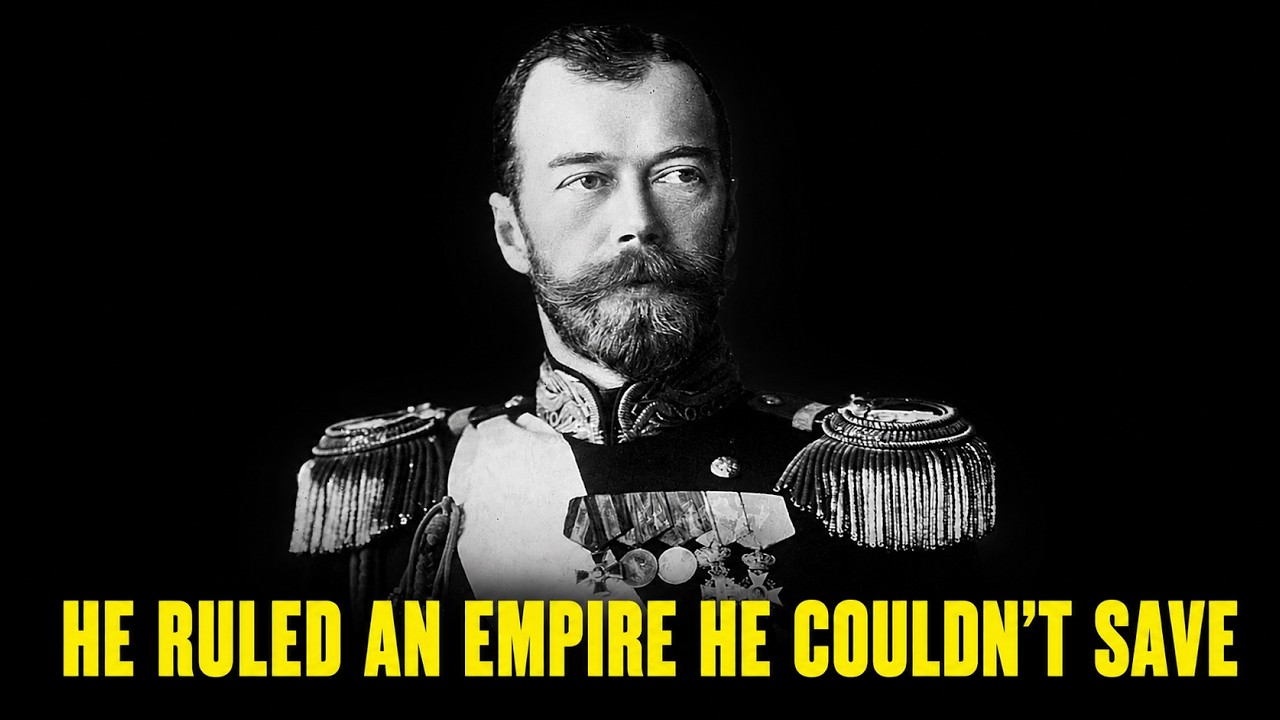
He was describing a government that had, through a combination of Rasputin's influence and Alexandra's push for hardline autocracy, reduced itself to people who would not challenge anything and could not execute anything. It was an empire being run by fear of confrontation.
Nicholas read Rodzianko's letter. He thanked him for his concerns. He made no changes.
The first years of Nicholas's reign established a pattern that would hold with minor variations for the next two decades. He received ministers. He listened. He nodded. He expressed sympathy or agreement. He showed the ministers out. Then he did whatever his last impulse told him to do, which was usually whatever preserved the maximum amount of autocratic power while requiring the minimum amount of direct confrontation with anyone.
Sergey Witte, who served as finance minister and was arguably the ablest administrator Russia had in this period, spent years trying to work with Nicholas and years trying to understand him afterward. His memoirs contain a description of the Tsar that has never been improved upon. According to Witte, Nicholas would agree with any minister who made a well-reasoned case in a private meeting. The minister would leave the meeting feeling satisfied. He had been heard, perhaps even approved. The policy he had proposed would then quietly fail to happen. A week later, an opposing minister would have an audience and advance the opposite case and be equally well received.
This was not strategic ambiguity or cunning statecraft. It was a man who could not say no to anyone in the room and made up for it by saying yes to everyone. The result, across 23 years, was a government that moved in circles. Able men were appointed, grew frustrated, resigned, or were dismissed.
The minister Plehve, who was hardline, was assassinated in 1904. The minister Stolypin, genuinely capable and genuinely trying to reform the land ownership system that kept the Russian peasantry in conditions not far removed from what they had endured as serfs, was shot in a Kiev theater in 1911 while Nicholas sat in the same theater 30 feet away. Nicholas's recorded response was that he was sorry about it. He also noted in a letter to his mother that the situation was "somewhat easier to manage" without Stolypin, who had been pressing him toward reforms that Nicholas found uncomfortable.
He dismissed his most capable men, or outlasted them, or watched them be killed, and felt relieved.
The diaries Nicholas kept from 1882 until three days before his death are not the diaries of someone who wanted to be understood. They are the diaries of someone who wanted to record without revealing, to mark the days without exposing the interior life that moved through them. The entries are short, factual, specific about weather and activities and the identities of people met. They are almost entirely silent about the decisions being made, the pressures being applied, the private reckoning that the external record does not capture.
This is why historians have such difficulty reading them as evidence of his inner life. What he felt about the 1905 revolution, about Rasputin, about the decision to mobilize in 1914. The diaries mark these events without illuminating them.
The entry for January 9, 1905, Bloody Sunday. "Hard day. The news from Petersburg about serious disorders among the workers. Painful and sad." Eleven words for a day on which imperial soldiers shot between one and two hundred people marching peacefully toward his palace. The entry closes with the weather and a note about his evening walk.
The gap between the events and the language is so consistent that it cannot be accidental. Nicholas was not an inarticulate man. His letters to Alexandra are full of feeling, observation, love expressed without reserve. He simply did not put those qualities into the diary. The diary was a record, not a confession. He wrote it in the knowledge, conscious or not, that it would be read.
What this means for any assessment of his inner life is that we are largely working from what other people reported about him, from what he reported about himself. The memoirs of Witte, Kokovtsov, Giliard. These become primary sources for Nicholas's psychology because he declined to be one himself. It is not an unusual feature of diaries from this era or this class. It is, however, a striking feature in a man assessed for psychological failure. It means the evidence of his psychology is mediated through people who mostly had reason to explain him in particular ways.
He called the early calls for constitutional reform "senseless dreams" in a public speech in 1895, his first year on the throne. He said this not because he was vicious or contemptuous of the people who wanted representation, but because Pobedonostsev had taught him since childhood that parliament was a fraud and that God had appointed him to rule alone. He believed it. He believed it even as the evidence mounted that believing it was going to destroy him and everyone he loved.
This is not the portrait of a monster. It is something more interesting and more tragic than that. Nicholas was not cruel by nature. He was not stupid, though he was limited. He was not indifferent to suffering, though his responses to it were often wildly inadequate. He was a gentle, loving man who genuinely enjoyed his family and his country walks and his dog, who was kind to servants and warm to his children and sincerely devoted to God, and who was placed by birth in a position that required qualities he did not possess and could not acquire.
Yurovski's verdict that Nicholas lacked the intellectual capacity to run a village post office is entertaining, but wrong. Too simple, and too convenient, coming as it did from a man who had strong reasons to portray the Tsar as a fool. A more accurate assessment belongs to Alexander Kerensky, the liberal politician who led the provisional government after the abdication. "The daily work of a monarch he found intolerably boring," Kerensky wrote. "He could not stand listening long or seriously to ministers' reports, or reading them."
This was not stupidity. It was a fundamental mismatch between what the job required and what the man could sustain.
The tragedy is that Nicholas knew. His sister Olga, who remained loyal to him to the end, wrote that he often said he was wholly unfit to reign. "This was not his fault, that he had been trained as a soldier and should have been taught statesmanship and was not. He had intelligence. He had faith and courage," she wrote. "He was wholly ignorant about governmental matters."
This is the kindest version. It is also, on the evidence available, accurate.
The woman he had married was not ignorant about governmental matters in the same way. Alexandra had opinions, strong ones, and they were consistent. She believed in autocracy as a system ordained by God. She believed the Russian people, the real Russian people, the peasants, loved their Tsar as a father and a spiritual leader. She believed that the nobility and the educated class who pushed for constitutional reform were enemies of both God and Russia. She communicated these views to Nicholas with a directness that few other people in his life were willing to match.
Their correspondence is a document that historians have returned to constantly and somewhat uncomfortably, because it reveals a relationship in which one partner had considerably more force of conviction than the other. "Be Peter the Great, be Ivan the Terrible, crush them all," Alexandra wrote to Nicholas during the war years when the pressure for political reform was at its most intense. She was not speaking metaphorically. She meant it as policy guidance.
Nicholas did not crush anyone. But he also did not reform anything. Alexandra pushed him toward resistance, which he could not sustain because his character would not allow it. The result was a government that was too repressive to reform and too weak to repress effectively. Both sides had cause to be angry. Everyone was.
Alexandra arrived in Russia already at a disadvantage. She was German by birth and German by early formation, even if she had technically grown up in an English-influenced court. When Russian society encountered her reserve and her accent and her preference for her own household over the broader social obligations of the court, they interpreted it as coldness or contempt.
She was not cold. She was shy, painfully and genuinely shy, in a way that came out as stiffness in public settings. The more Russian society misread her, the more she withdrew from it. The more she withdrew, the less she understood what Russia was actually like beyond the palace walls. She came to love Russia with a deep, almost obsessive devotion. But it was Russia as a mystical ideal. Russia as the land where God had planted her family for a holy purpose. It was not Russia as the country where factory workers were laboring sixteen-hour days in conditions that produce the kind of anger that does not stay contained forever.
She had no feeling for that Russia. She would have said she believed that those workers loved the Tsar and were being misled by agitators. She would have been wrong.
Between 1894 and 1904, Nicholas and Alexandra had five children. The first four were daughters, producing disappointment that they tried to conceal but did not entirely succeed in concealing. Every royal court in Europe was waiting for the heir. Four girls was four disappointments. This is not a criticism of any of the individuals involved. It was the mathematics of dynastic succession, and everyone knew the mathematics and watched accordingly.
The fifth child, Alexei Nikolaevich, was born on August 12, 1904. The joy lasted six weeks.
Hemophilia is a blood clotting disorder. People with it bleed far longer than normal from injuries and can bleed internally without any external wound at all. A bruise becomes a crisis. A fall becomes a hemorrhage. The joints fill with blood and swell and cause pain severe enough that children with the disease have been known to scream for hours without stopping.
Queen Victoria was a carrier of the gene. She had passed it to several of her descendants, including Alexandra's brother. Alexandra carried it. Alexei had it. They kept it secret for as long as possible, which was not very long, because a child with hemophilia cannot hide what happens when he bumps a knee or twists an ankle.
Alexei was a boy who ran and played and fell over the way boys do. The bleeding episodes started almost immediately and were sometimes severe enough that the doctors expected him to die. The court knew something was wrong. The gossip circulated through St. Petersburg and beyond. People who saw Alexei noticed that he moved carefully, that he was sometimes carried. His parents watched him with a particular quality of fear that could not be explained by ordinary parental concern.
Alexandra's response to her son's illness reshaped everything. She had already inclined toward mysticism. Conversion to Orthodoxy had intensified it. The loss of her mother in early childhood had given her a relationship with suffering that was deep, personal, in a way that made rational detachment very difficult. Now she watched her child endure pain that no doctor could reliably stop. The rational world offered her nothing, so she looked elsewhere.
Before Rasputin, there was a French charlatan named Monsieur Philippe who claimed to be able to influence the sex of unborn children and generally managed to make himself indispensable to Alexandra through a combination of personal warmth and spiritual claims that the empress chose to accept rather than examine. The Russian Okhrana, the secret police, sent a report to Nicholas explaining that Philippe had no medical qualifications whatsoever and had been prosecuted in France for practicing medicine without a license. Nicholas read the report, thanked the police, and continued to receive Philippe in his home.
Alexandra drove the man away eventually, when she realized he had falsely convinced her she was pregnant. But the template had been established. The door that Philippe opened was never fully closed.
Rasputin first came to the palace in 1905, referred by two Montenegrin princesses who moved in court circles and found him impressive. Grigori Yefimovich Rasputin was from western Siberia, the son of a peasant. He was large, physically imposing, with a black beard and pale, intensely focused eyes. He could not be easily ignored, and he had learned, through whatever combination of natural magnetism and practiced calculation, a certain kind of intense attention that made women feel seen in a way that polished men in uniforms usually did not manage.
He was introduced to Alexandra as a man of God, a holy man in the Russian tradition of the starets, a wandering spiritual elder. Whether he was any such thing is a question that has been argued about since his lifetime. What he certainly was, and what matters here, is what happened when Alexei had a severe bleeding episode and conventional medicine failed. Rasputin somehow stopped it.
The medical explanation that historians and physicians have settled on involves aspirin. Aspirin, which was commonly prescribed at the time, inhibits blood clotting. It was, in the specific case of a hemophiliac, potentially lethal, and was in any case making Alexei's episodes worse. Rasputin, who had no medical training and may have had no idea what aspirin was, told Alexandra to stop giving the boy whatever the doctors were giving him. She did. The episodes became less severe.
Rasputin also appears to have had some hypnotic ability, or at minimum a profound calming presence. Since anxiety and psychological distress can trigger or worsen hemorrhages in hemophiliacs, his effect on Alexei may have been partly real.
None of that mattered. What mattered was that Alexandra believed Rasputin was sent by God to save her son. She told Nicholas this. Nicholas received the news as he received most uncomfortable news from his wife. He accepted it, filed it away, did not act on the doubts he almost certainly had. He described Rasputin in a letter as "an ordinary Russian man, pious and simple, who came to them to provide tranquility."
This was generous to the point of incoherence, since Rasputin's behavior outside the palace was hardly tranquil. But Nicholas chose not to examine the contradiction.
What followed was one of the strangest periods in the history of any ruling family in the modern era. A Siberian peasant with a criminal record, a documented history of what his own religious associates called debauched behavior, and a genius for personal manipulation became the most discussed figure at the Russian court. Aristocrats who approached Alexandra about Rasputin were dismissed. Ministers who raised the subject with Nicholas found the conversation ended before they had finished their sentences. The police accumulated files on Rasputin's activities in St. Petersburg that were presented to the palace and politely returned. Nicholas told one minister that he understood the problem but that the matter was, by his account, none of the government's business.
The Tsar of all the Russias said this about a peasant who was visiting his wife.
The year 1904 brought two things simultaneously that together began pulling Russia toward the edge. Alexei's birth and the Russo-Japanese War.
Russia and Japan were competing for influence in Manchuria and Korea. The Japanese had been warning through diplomatic channels for months that they considered Russian encroachment intolerable. Nicholas's foreign policy advisers were divided. Some thought Japan would not fight. Some thought Russia would win quickly if Japan did fight, because Japan was small and Russia was enormous. Surely an Asian power could not defeat a European one in a serious military contest.
Japan attacked the Russian naval base at Port Arthur on the night of February 8, 1904, without a declaration of war. It was bold, effective, and an early demonstration of what the next century would spend a great deal of time learning about: the danger of assuming you knew in advance how a conflict would go.
The war that followed was a disaster for Russia by almost every measure available. The Baltic Fleet, dispatched to relieve Port Arthur, sailed around the world for seven months and was destroyed at the Battle of Tsushima in May 1905, in one of the most comprehensive naval defeats in history. Of 38 Russian ships, only three reached the port of Vladivostok. Twenty-one were sunk. Nicholas called it "an enormous catastrophe" in his diary, which was accurate. Port Arthur had already surrendered in January 1905, before the fleet arrived to relieve it.
The shock that ran through Russia at these defeats was not just military. It was civilizational. Russia had never lost a war to an Asian power in modern memory. The idea that Japan, a country most educated Russians thought of as a curiosity rather than a threat, had destroyed the Russian Navy and taken a Russian Pacific fortress was the kind of event that makes people reassess everything they thought they knew about the order of things.
It was against this background of military humiliation and mounting economic hardship that Father Georgi Gapon organized his march to the Winter Palace. January 9, 1905, by the old Julian calendar used in Russia, was a Sunday. It was very cold.
Father Gapon was a priest and an activist who had been organizing workers in St. Petersburg for several years. He was also a complication that historians enjoy. A police informant. The Okhrana had cultivated him as a way of keeping an eye on the labor movement. Whatever his private arrangement with the police, his public message was genuine in its way. He was going to lead a petition to the Tsar, a request from loyal subjects to their father-Tsar, asking for shorter working hours, living wages, an end to the war, and a national parliament. He collected thousands of signatures.
Nicholas was not in the city. He was at Tsarskoye Selo, the palace outside the capital. He had been informed that there would be a march. He had been informed, by the chain of advisers between himself and any uncomfortable fact, that the march was not expected to cause serious trouble.
Between 130,000 and 150,000 people walked toward the Winter Palace. The troops who had been stationed to meet them opened fire.
The death toll was contested at the time and remains disputed. Official Russian records put it at 130 dead. Opposition sources claimed figures ten to thirty times higher. The truth is likely somewhere in the middle, and the exact number is not the important fact. The important fact is that the Tsar's soldiers shot peaceful marchers who had come to petition their sovereign, and destroyed in a single afternoon the semi-religious reverence for the Tsar that had kept the lid on Russian popular politics for generations. The Tsar-father that the peasants were supposed to love was either not home or was willing to let his soldiers kill them.
The readings were devastating. The event acquired the name that fit it. Bloody Sunday.
Father Gapon escaped the shooting and fled Russia, turning up in London and Geneva and Paris in the months afterward, dining with Lenin, writing an autobiography, announcing himself as a revolutionary hero of the working class. He returned to Russia in 1905 under an amnesty and was killed the following year, hanged in a dacha outside St. Petersburg by Socialist Revolutionary Party operatives who had discovered the extent of his police informant history and decided his usefulness as a symbol of martyrdom was exceeded by his usefulness as an example of what happened to traitors. He was 32 when he died.
His life and death, taken together, say something that is also true about the broader revolutionary period. Almost no one in that world was playing only one role, and almost no one's story ended the way they had planned when they started.
Nicholas's diary entry for that evening, as noted already. "A hard day." Three words of emotion, followed by a brief factual summary. He was not in the city. He did not see any of it. His distance from it was both geographical and evidently psychological. He summoned a delegation of workers to the Winter Palace ten days later and gave a short speech about how grieved he was. He did not go to Petersburg, and he did not appear at any public ceremony that acknowledged what had happened. He stayed at Tsarskoye Selo.
The 1905 revolution that followed, strikes, peasant uprisings, mutinies, political assassinations, was not defeated by Nicholas. It exhausted itself. He was forced to issue the October Manifesto, which created a parliament called the Duma and promised civil liberties. Not because he believed in any of it, but because his prime minister, Witte, told him it was the manifesto or the end of the dynasty. He signed it.
He spent the next several years trying to limit, undermine, and eventually claw back the concessions he had made, dissolving the first Duma after 73 days and the second after three months. The constitutional experiment that might have redirected Russia, given a Tsar who meant it, became something more like a constitutional pantomime under a Tsar who did not.
The 1905 revolution is usually presented in summary as a brief crisis that Nicholas survived by issuing the October Manifesto. This is technically accurate, but undersells how close the system actually came to complete collapse, and how differently things might have gone if Nicholas had made different choices in the weeks before the October Manifesto was signed.
The autumn of 1905 was, for the Russian government, a period of genuine systemic paralysis. Strikes that had begun after Bloody Sunday had spread through the year, growing to include the railway workers, who were the most strategically significant labor force in any industrialized country, and whose walkout in October 1905 effectively stopped the movement of goods, troops, and communications across the empire. Factory workers in every major city were on strike. Peasant uprisings were spreading in the countryside with an intensity that the rural police could not contain. The military, which was supposed to be the instrument of order, was strained by the ongoing war with Japan and by the early signs of the loyalty problems that later, in 1917, would become the revolution's decisive factor.
Sergey Witte had been the Russian representative at the Treaty of Portsmouth, negotiating the peace that ended the Russo-Japanese War in September 1905. He had done this well enough that Theodore Roosevelt, who mediated the negotiations, had a high opinion of him. Witte returned to Russia to find a government in crisis and was summoned by Nicholas, desperate for advice.
Witte gave him two options. The first was a military dictatorship, appointing a general with full powers to suppress strikes and the unrest by force, without legal constraints, until order was restored. The second was a constitutional manifesto that would establish a parliament and civil rights and attempt to draw the moderate reformers away from the revolution by giving them part of what they had been asking for.
Nicholas was deeply uncomfortable with both options and spent days trying to find a third. There was not one available. He asked his uncle, Grand Duke Nikolai Nikolaevich, whether the Grand Duke would accept appointment as the military dictator. The Grand Duke reportedly said he would shoot himself rather than accept such an assignment.
Nicholas eventually, after considerable anguish, chose the manifesto. Witte drafted it. Nicholas signed it on October 17, 1905.
The manifesto promised a Duma with real legislative power, freedom of speech and assembly, and the inviolability of person. The moderate reformers who received it were cautiously optimistic. Radical revolutionary parties said it was insufficient and changed nothing. The conservative nobility thought it was a disaster and a surrender.
Nicholas thought so, too. He signed the manifesto and then almost immediately began working out how to limit it. He told his mother in a letter that it was a terrible day and that he had cried and cried before signing. He had done it because there was no other choice, and that it went against everything he believed about his divine responsibility as Tsar.
He was not performing this anguish for political purposes. He genuinely believed he had betrayed his sacred obligation. It is the core of his political tragedy. He believed in divine autocracy as a doctrine. He was willing, under sufficient pressure, to sign documents that reduced autocracy. But he was never willing to mean them. The gap between what he signed and what he intended to sustain created a pattern that made every reform gesture a fraud and every constitutional step fake. The reformers could never trust the concessions. The conservatives were permanently alarmed by them. No one could build anything stable on the foundation of a Tsar who signed constitutional documents while privately planning to reverse them.
The specific detail of how Nicholas dismissed ministers is worth dwelling on, because the pattern is so consistent across his reign that it constitutes a behavioral signature. The Tsar did not fire people. He had people fired by other people, after they had left his presence. This is a small distinction with large political consequences, because it meant that ministers never received direct criticism from the man they served, never had the opportunity to respond to concerns, never knew from any direct signal from the Tsar himself that their position was in danger. Dismissal arrived as a cold letter, or as the absence of the normal summons. It arrived when the minister was not in Nicholas's presence and could not make any argument in his own favor.
This method served Nicholas's need to avoid confrontation. It was also profoundly disorienting for the people who governed under him, because the uncertainty about whether you retained the Tsar's confidence was total and perpetual. One minister described the experience of serving Nicholas as being in a room where the lights might go out without warning and without any previous indication that the power supply was unreliable.
Vladimir Kokovtsov, who served as both finance minister and later as prime minister, experienced the pattern directly. He had several years of productive service during which Nicholas gave no indication of dissatisfaction. He then received a letter, a letter not a summons, informing him that he was relieved of his position. The letter was polite, expressed gratitude for his service. It provided no reason. When Kokovtsov subsequently met Nicholas at a formal function, the Tsar was warm and friendly and gave no indication that anything had changed between them. Nothing was said about the dismissal or its cause. Kokovtsov later found out, through the usual channels of court gossip, that Alexandra had told Nicholas that Kokovtsov was insufficiently respectful of Rasputin's guidance. He had been finance minister for seven years.
The testimony of the men who served Nicholas II is one of the most consistent bodies of evidence in the historical record of his reign. They disagreed about many things, about policy, about Russia's direction, about each other. They agreed, with a uniformity that is striking given how varied their backgrounds and perspectives were, on the essential nature of the man they had served.
Witte, who was probably the most able administrator Russia had in this period, described Nicholas in his memoirs as a man of limited intellectual courage, who was capable of charm and personal warmth, and who was, beneath the warmth, fundamentally a nihilist. Meaning not a political nihilist, but a man who at the deepest level believed in nothing strongly enough to act on it consistently. This is a harsh assessment and maybe somewhat unfair. Nicholas clearly believed in his divine appointment and in his family, and believed in both deeply. Witte's underlying point, that belief without the capacity for sustained action is politically equivalent to no belief at all, holds.
Kokovtsov, who served as both finance minister and prime minister and was dismissed without explanation after years of apparently satisfactory service, wrote that the Tsar was fundamentally good at heart, but that governing under him required a specific understanding that personal affection and professional confidence were completely separable. You could be liked and dismissed. You could be thanked for your work and replaced the same week. The warmth of a meeting told you nothing about your tenure, and this uncertainty was not incidental to Nicholas's management style but central to it.
Alexander Izvolski, who served as foreign minister, wrote in memoirs published after his removal that Nicholas had "a strange alternation of apparent and real indecision" that made him unpredictable and impossible to plan around. He could seem, in a meeting, to have come to a clear conclusion, and within hours that conclusion would evaporate without explanation, replaced by whatever the next conversation had produced.
The pattern that emerges from all these accounts is of a man whose internal state was fundamentally private and whose external behavior was fundamentally diplomatic. The gap between the two was so large and so consistently maintained that the men who served him spent years trying to read signs that were not there.
The broader question of whether Nicholas's ministers could have saved him from himself is one that several historians have approached from different angles. The consensus roughly is that the better ministers knew what the problems were and could not address them without the Tsar's sustained support, and that the Tsar's sustained support was never reliably available for anyone.
Stolypin came closest to a coherent program of reform that might have given the empire enough of an economic and social base to survive the coming pressures. His land reform, which he began implementing after 1907, was redistributing communal land to individual peasant families at a pace that by 1911 had already produced measurable improvements in agricultural output in some regions. The analysis that historians have done of what the full implementation of Stolypin's program might have produced, given another decade, suggests an agricultural economy that could have supported a larger, more politically stable peasant class. The kind of peasant class that in Western Europe provided the social ballast that prevented revolutionary politics from gaining the traction they gained in Russia.
He needed until perhaps 1924 or 1925 for the reforms to transform the social basis of the empire enough to matter. He was given until 1911.
The assassin who shot him was both a revolutionary and a police agent, which says everything about the specific institutional mess that Russian court looked like by the last years of Stolypin's life. Nicholas's relief at the assassination is the fact that stains his record in this period beyond the various other failings. It is possible to excuse him for not having been Stolypin, that is, for lacking the specific talents that Stolypin possessed. It is not possible to excuse him for being visibly more comfortable without the man who had the best chance of saving his empire than he was with him.
The elections to the Duma produced repeatedly assemblies that were more reform-minded than Nicholas was comfortable with. His response, consistently, was to dissolve them and issue new electoral laws that were more restrictive, gradually shifting the electorate toward the property-owning classes who were more likely to produce conservative majorities. The first Duma was dissolved after 73 days. The second Duma lasted 103 days. The third Duma, constituted under the restrictive electoral law that Stolypin had pushed through by extra-legal means, lasted its full term. It was a parliament significantly less representative of Russia than the first two had been.
What Nicholas said about the Duma in private was that he found it exhausting and irritating and that he did not see why people who had been given a parliament were not grateful and quiet. He did not understand, or would not allow himself to understand, that a parliament that had limited powers, was repeatedly dissolved, and whose electoral base was manipulated to produce manageable outcomes, was not, from the perspective of the people who had wanted parliamentary reform, much of a parliament. It was a simulacrum of representation produced by a man who believed in autocracy and could not say so openly after signing the October Manifesto.
Duma members, including some genuinely conservative ones who wanted a functioning state rather than revolution, understood this perfectly well. That is why by 1916 even the conservative Duma was producing speeches about "dark forces" in the government. They were not revolutionaries. They were men who had been given a half-functioning constitutional system and were watching it be used against them, and they were beginning to run out of patience.
Nicholas received the reports about the Duma speeches. He found them irritating. He went for a walk.
To understand what Russia lost when Stolypin was shot in Kiev in September 1911, you have to understand what Stolypin was trying to do and how rarely Russia had a minister capable of trying to do it. Stolypin was the prime minister from 1906 to 1911. He came from the provincial nobility. He had served as a provincial governor. He had the kind of concrete practical intelligence that Russian political life of this era badly needed and rarely rewarded.
His land reform program was the most ambitious attempt in Russian history to address the fundamental economic grievance of the peasantry. Land ownership was trapped in communal structures, the mir, that prevented individual families from building anything stable. Stolypin wanted peasants to own their land, to become small farmers with a stake in the existing order rather than a reason to burn it down. He called it "wagering on the strong."
Whether this would have worked is impossible to know, because he was not given enough time to find out. Five revolutionary assassination attempts had already failed to kill him before a man named Dmitri Bogrov shot him in the Kiev opera house on September 14, 1911, while the Tsar sat thirty feet away in the royal box. Bogrov was both a revolutionary and, like Gapon before him, an Okhrana agent. The circumstances of how he obtained a pass to the opera that evening have never been fully clarified.
What is clear is that Nicholas reacted to Stolypin's death, and to the question of whether the Okhrana had failed in its duties or something darker had happened, with a calmness that troubled people who knew how things worked. He sent a telegram to Stolypin's wife expressing his condolences. He wrote a letter to his mother noting that the situation was "in some ways simpler" now.
Simpler. The death of the man who might have saved his empire was simpler for Nicholas, because Stolypin had pressed him toward reform and Nicholas did not like being pressed. He preferred the men who agreed with him already, which meant he preferred the men who were telling him what he wanted to hear rather than what the country needed to know.
This is not unusual behavior in rulers. It is, however, fatal behavior in rulers who face the specific combination of circumstances that Russia presented in the years between 1905 and 1917. A country transforming faster than its political institutions could manage. An empire fighting a series of military humiliations. A revolutionary movement that was growing in sophistication and organization. And a government that responded with a mixture of repression and inconsistency, and a monarch who dismissed his most capable men and kept the mediocre ones because the mediocre ones were more comfortable.
The comfortable ones led Russia off the cliff by degrees.
By 1912, the Rasputin situation had become genuinely unmanageable. People at the Russian court who were watching it happen were beginning to speak with a desperation that even their careful language could not quite contain. The former court official Alexander Mosolov wrote that the empress's belief in Rasputin was absolute and impenetrable. Ministers who attempted to raise the subject found the audience ended. The empress's ladies-in-waiting found that criticizing him in her presence was incompatible with remaining in her presence.
Rasputin himself was by this point a public figure of a particular kind. His behavior outside the palace, his drinking, his public boasting about his access to the empress, the encounters with women that were described with varying degrees of outrage by various witnesses, was the subject of newspapers and pamphlets and court gossip and private reports to the Tsar.
Nicholas read the reports. The Okhrana delivered them with cover letters that tried to convey urgency without seeming presumptuous. He acknowledged them and filed them and did nothing.
One exchange with Nicholas was recorded in which he admitted to a trusted adviser that he knew Rasputin was not the saint his wife believed him to be. He said that the man was probably, as rumored, not celibate. He said that none of this mattered because when Alexei was at his worst, Rasputin calmed him, and the boy was alive, and nothing else took priority over the boy being alive.
This is, as human reasoning goes, entirely understandable. A father watching his child suffer is not a rational policy maker. He is a father. The problem is that Nicholas was simultaneously a father and the head of state of an empire of 170 million people. Those two roles required different things, and he could not find a way to hold both of them at once.

The broader political cost of Rasputin's presence at court was severe by any measure and it was getting worse. Russian society, not just the liberal intelligentsia but the conservative nobility, the church hierarchy, the military officer class, people whose support Nicholas most needed, was appalled. The rumors about Alexandra and Rasputin were almost certainly false in the specific sexual sense, but were understandable given the extraordinary access he enjoyed, and they circulated with the malicious energy that rumors acquire when they touch something people can almost believe. Pamphlets passed hand to hand. Stories got darker and more specific as they traveled.
And then came the war.
Europe went to war in July and August 1914 through a process that historians have spent the century since trying to fully explain. The immediate trigger was the assassination of Archduke Franz Ferdinand in Sarajevo on June 28, 1914. The underlying mechanisms were more complicated. A web of military alliances. Expectations built into war plans that could not be adjusted once mobilization began. Cumulative suspicions of great powers watching each other accumulate military capacity. A series of miscalculations by leaders who believed the coming war would be shorter and more controllable than it turned out to be.
Nicholas and Kaiser Wilhelm II of Germany. Nicky and Willy, as they addressed each other in the extraordinary private correspondence that survived, exchanged telegrams in the days before mobilization with a quality of frantic improvisation that suggests both men understood something terrible was happening and neither of them could stop it.
"Nicky" Wilhelm wrote on July 29, 1914, "I am exerting my utmost influence to induce the Austro-Hungarian government to deal straightly to achieve a satisfactory understanding with you. I confidently hope that you will help me in my efforts to smooth over difficulties that may still arise. Your very sincere and devoted friend and cousin, Willy."
Nicholas wrote back, "An ignoble war has been declared on a weak country. The indignation in Russia, shared fully by me, is enormous. I foresee that very soon I shall be overwhelmed by the pressure forced upon me and be forced to take extreme measures which will lead to war. To try and avoid such a calamity as a European war, I beg you in the name of our friendship to do what you can to stop your allies from going too far. Nicky."
This is not the tone of men steering toward conflict. It is the tone of men being dragged towards something they cannot stop. They were both too weak, too hemmed in by the systems they presided over, to alter what the systems were going to do.
Nicholas cried when he received the report that general mobilization had begun. He knew what it meant. Russia mobilized. Germany mobilized. The war that the Willy-Nicky telegrams had failed to prevent ground into motion.
The early phase of Russia's war was disastrous. The military was not prepared, not in equipment, not in supply lines, not in officer quality, not in strategic coherence. The Battle of Tannenberg in late August 1914 resulted in the destruction of two entire Russian armies and the suicide of the commander of the second army, General Samsonov. One hundred thousand Russian soldiers were taken prisoner in under two weeks. Losses continued at a rate that the empire's military structure could not sustain.
Nicholas's response, in August 1915, was to assume personal command of the army at the front. This decision was, by the near-unanimous verdict of his own ministers and of every historian who has examined it since, one of the worst choices of his reign. There were several reasons why this was so.
The most practical one: Nicholas had no real military experience at the command level. Placing himself in nominal command meant that every subsequent military failure would be directly attributed to him personally, rather than to his generals.
The second reason: leaving the capital with Alexandra in charge meant leaving Alexandra's judgment and Alexandra's factions in charge, which by this point meant leaving Rasputin in charge.
His ministers wrote him a letter. Eight of them signed it. It was a remarkable document, respectful in tone but explicit in its meaning. Placing the Tsar at the head of the army was dangerous. Placing the empress in effective control of the home government while he was away would have grievous results.
Nicholas read the letter, thanked the ministers for their concern, and departed for the front. He had the eight signatories of the letter dismissed within the next several months.
At the front, Nicholas performed the ceremonial functions of a commander-in-chief. He reviewed troops. He visited hospitals. He pinned medals on wounded men. He was genuinely moved by what he saw and wrote about it to Alexandra with real feeling. He wept at the hospital visits, which the soldiers who saw him found meaningful. He had a gift for that kind of personal warmth. He was not a figurehead who was going through the motions. He cared about the men.
He was also not capable of strategic direction. The men around him who were capable of it worked around his presence rather than with it. It added friction to a system that already had plenty.
Meanwhile, in Petrograd, the city had been renamed from the German-sounding St. Petersburg at the start of the war, Alexandra was effectively governing the empire. She wrote to Nicholas daily. The letters were detailed, opinionated, urgent. She told him which ministers to dismiss and which to appoint. She reported what Rasputin had said about this or that policy question. She pushed.
Nicholas, who could not stand confrontation in person, found it easier to respond to her pushing by giving her what she wanted at one remove.
Between 1915 and 1916, Russia went through four interior ministers, three foreign ministers, three war ministers, three transport ministers, and two prime ministers. Contemporaries called it the ministerial leapfrog. Rasputin had recommended most of the replacements. Some of the men he recommended were simply mediocrities who had managed to flatter him. Others were genuinely inclined toward a separate peace with Germany, which was Rasputin's consistent political position, and which made him, from the perspective of the Allied powers and of Russian military officers who were watching their men die at the front, something close to a German agent, regardless of what his actual loyalties were.
The word treason began appearing in conversations at court. Whispered, then said clearly by men who had nothing to lose because they felt everything was already lost.
Prince Felix Yusupov was 29 years old, one of the wealthiest men in Russia, married to a niece of the Tsar, convinced that Rasputin was destroying the Romanov dynasty from within. He was also, by every account, a man of somewhat melodramatic temperament who had a gift for theatrical planning. The conspiracy he assembled in November 1916 was not primarily his idea. He was joined by Vladimir Purishkevich, a right-wing member of the Duma, and Grand Duke Dmitri Pavlovich, a cousin of the Tsar. But he was its most visible executive.
Yusupov invited Rasputin to Yusupov's palace on the night of December 29 to 30, 1916, under the pretext that Yusupov's wife, Princess Irina, wanted to meet him. Irina was actually in the Crimea, but Rasputin was led to believe she would be present that evening. He accepted the invitation.
The murder of Rasputin has been told and retold in versions that vary considerably in their reliability. The version in which he was poisoned with cyanide-laced cakes and wine, survived multiple doses that would have killed any ordinary man, was shot multiple times and kept getting up, was beaten, and was finally thrown into the river while still alive, is partly legend, partly recorded by men who had reasons to make the story more dramatic than it was. The cyanide in the food may never have been administered. Doctors later reported finding no cyanide in his stomach. The multiple shooting version is probably accurate.
What is certain: Rasputin was shot in the cellar of the Yusupov palace, most probably first by Yusupov and then by Purishkevich. The body was wrapped in a blanket and thrown into the Malaya Nevka River through a hole in the ice. When the body was recovered, there was water in his lungs, which suggests he survived the shooting and the fall into the water and drowned. He was found on December 30, 1916.
Nicholas was at the front when it happened. He returned to Tsarskoye Selo on January 3. He exiled Grand Duke Dmitri to the Persian front. He sent Yusupov to his country estate. Neither was prosecuted. The penalty for murdering the man who the aristocracy of Russia, much of the church hierarchy, and the entire Duma had been begging Nicholas to dismiss was a comfortable exile.
Alexandra was prostrated. She moved the body to the royal chapel at Tsarskoye Selo and buried Rasputin in the imperial park. She placed an icon signed by her family in his coffin. Nicholas allowed it. He could not refuse Alexandra anything that touched her grief about Rasputin any more than he could have confronted her about Rasputin while he was alive.
The political consequences of the murder were not what its planners had hoped. Yusupov and his collaborators had believed that removing Rasputin would stabilize the dynasty and perhaps bring Nicholas back to his senses about the damage that had been done. Instead, it demonstrated how far gone things already were. An aristocrat and a member of the Tsar's own family had committed murder in the capital and gone without serious punishment. A government that allowed this was not a government in command of anything.
Two months later, it was gone entirely.
The revolution that took Nicholas's throne in February 1917 did not begin with an ideological uprising. It began with bread. Petrograd's bread supply had been disrupted by the combination of the war's drain on agricultural labor and the railway system's collapse under military demands. By late February, bakeries were running short, and queues that had been long became lines that started before dawn and ended in doubt. Women who had been managing households through three years of wartime shortages were running out of patience at approximately the same moment, in approximately the same streets.
On February 23, International Women's Day, by coincidence, women in the Vyborg district went on strike and began marching. By February 25, 200,000 workers across the city were on strike. The marches were not organized by the revolutionary parties, who were as surprised as anyone by how fast things moved. Lenin was in Zurich. Trotsky was in New York. The Bolsheviks in Petrograd were a small, scattered group.
The revolution of February 1917 was not made by professional revolutionaries. It was made by women who wanted bread and workers who were tired of everything.
Nicholas was at the front. His diary for February 23 mentions a walk, some correspondence, and the weather, which was frosty but with sunshine. He was told, through channels that had a long tradition of softening bad news before it reached him, that there was some unrest in the capital. He ordered the military commander in Petrograd to restore order, which was the instruction of a man who thought he was dealing with something manageable.
He was not dealing with something manageable. The troops who were supposed to restore order began fraternizing with the demonstrators instead. The Petrograd garrison had been filled, over three years of war, with raw recruits who were not the professional soldiers of the pre-war army, and they were not willing to fire on people who were saying things the soldiers privately agreed with.
On February 27, the garrison mutinied. Nicholas received reports from General Khabalov, the commander of the Petrograd military district, that the situation required reinforcement. He sent back an order. "Restore order by tomorrow." The telegram that contained this order arrived with the quality of command that Nicholas always produced on paper and almost never followed through on in person. Khabalov had no reinforcements available. The troops he had were the garrison, which was not a professional army but a collection of raw recruits, convalescing soldiers, and men who had already been in one revolution, the 1905 version, and had learned from it what soldiers could do when they stopped following orders.
February 26. Some units fired on the crowds and some did not. The ones who did not were already a signal of what was coming. The Volynsky regiment, one of the oldest and most prestigious in the Russian army, mutinied on the morning of February 27. By the end of that day, most of the Petrograd garrison had either joined the revolution or ceased to function as a military force.
Alexandra, who was at Tsarskoye Selo managing the quarantine of the children who were ill with measles, sent her own telegram to the Tsar. She told him the unrest was being exaggerated, that troublemakers were leading people astray, that the loyal people were praying for the Tsar and the family. She was wrong about almost every word of this, and she sent it in good faith.
The Duma sent telegrams to the front. Nicholas's generals sent telegrams. Everyone who could reach the Tsar was trying to reach the Tsar. The messages agreed. The situation required immediate political concessions. A responsible ministry. A parliament with real powers. Something concrete to show the people.
Nicholas boarded the imperial train and headed for Petrograd. The train was stopped twice at stations where revolutionary soldiers had taken control of the railway. He redirected to Pskov, the headquarters of the Northern Front.
In Pskov, General Ruzsky met him without ceremony and without the usual courtesies. The general explained the situation. Nicholas asked questions and received answers that he described as "very disagreeable." Telegrams arrived from his other generals. He read them. All said the same thing. Abdication was the only option remaining.
Nicholas abdicated on March 15, 1917, in a rail car, in favor of his brother Michael. He had originally abdicated in favor of Alexei, but he was told that Alexei, as a hemophiliac, could not be separated from his parents without risking his life. And this Nicholas could not accept. He signed his son's name off the throne to protect his son.
Michael, confronted the next day with the weight of what he had been handed, declined the crown and asked for a constituent assembly to decide Russia's future. Three hundred and four years of Romanov rule ended at a railway siding in the middle of the night.
Nicholas's diary entry for that day included the formal record of what had happened, then added, "For the sake of Russia, keep the armies in the field, I decided to take this step." Then, at the end of the entry: "Left at 1:00 in the morning. All around me I see treason, cowardice and deceit."
The diary entry for the next day noted that he had slept well, taken a walk, and read Julius Caesar.
Princess Alice of Hesse, Alix's mother, was one of the more remarkable figures in the dense family web of Victorian royalty. Her specific qualities, her emotional directness, her willingness to do practical charitable work in an era when royal women were expected to wave rather than roll up their sleeves, shaped her daughter's formation in ways that Alix probably spent the rest of her life trying to replicate.
Alice had grown up as one of Queen Victoria's more capable children, less constrained by ceremony than some of her siblings, more drawn to the particular kind of usefulness that involved actually being with people rather than presiding over them. She married Ludwig of Hesse and found herself in a small German ducal court where the social demands were considerable and the resources were limited. She managed the gap between obligation and means with the pragmatic ingenuity of a woman who had decided that character mattered more than display.
She established a women's hospital in Darmstadt. She wrote to Florence Nightingale about nursing methods and received Nightingale's considerable opinions on the subject in return. She organized a system of nursing during the Franco-Prussian War of 1870 that was practically effective and recognized as such by the men it served.
When she held her daughter close and told her that her little sister was dead, she was acting out of an emotional philosophy that believed grief was better confronted than managed around. The diphtheria that she caught from that embrace killed her. Alix was six years old.
The logic of grief at six does not run through philosophical frameworks. It runs through the body. The safety that a mother represents is not a concept at six. It is the central organizing fact of experience. That safety disappears without warning or preparation. The resulting anxiety has no language and no resolution. It simply becomes part of how the world works.
What Alix made of this over the years of childhood that followed, years spent between Darmstadt and Balmoral and Windsor, raised by loving but preoccupied relatives, educated well and watched over by Queen Victoria with the particular intensity of a grandmother who felt she owed these children something, was a character that was profound but armored. She was not closed or cold. She was capable of deep attachment and sustained devotion. But the attachment came slowly, and the armor was not optional. It was structural. It had been built out of necessity.
The Russian court that received her in 1894 did not understand this and did not try to understand. It was one of the most consequential misreadings in the history of the dynasty. They saw reserve and they named it arrogance. They saw carefulness and they named it coldness. They saw a woman who was still learning the language and the customs of a vast new country, and they named it indifference.
The naming was wrong. The consequence was that Alexandra, who needed warmth and received judgment instead, drew further into the world she could control. Her family. Her faith. Her small circle of intimates.
In that small circle, she was genuinely warm. People who actually knew her, her ladies-in-waiting, the family tutor Gilliard, the children's nurse Margaretta Eagar, consistently describe a woman who was attentive and kind and capable of humor, and who maintained the demands of royal life alongside the demands of a mother with five children and a chronically ill youngest child with a patience that the formal portraits do not capture. She spent hours with each child individually. She read to them. She corresponded with them when they were separated. She sewed. She prayed with them. She maintained routines for them because routines were what held anxiety at bay. And she knew this from her own experience.
The illness was, for the whole family, the defining fact of the household in a way that people who have never watched a child suffer through a chronic, potentially lethal illness may find hard to fully imagine. An episode of hemophilia in a child before the era of modern treatment was not a quiet medical management problem. It was a crisis that could appear without warning from any small injury or internal spontaneous bleed, that progressed with a speed that outpaced the treatments available, and that produced pain severe enough that the child lost the ability to function or communicate for days at a time.
Alexei was 11 when he had the episode at Spala in Poland in 1912. It was the worst of his life up to that point. He was in terrible pain for days. His thigh and groin had swollen to enormous size from internal bleeding. The family physician, Dr. Eugene Botkin, and the specialists summoned from St. Petersburg and beyond, were unable to stop the bleeding or materially reduce the pain. His temperature ran high. He screamed. He begged his parents to let him die. He said to his mother and to the people sitting with him, "Dying would make the pain stop." He was 11 years old.
Alexandra sat with him through this for days. Nicholas came and went, visiting the child, and then, because a Tsar cannot suspend his official functions entirely, even for a dying son, tending to reports and receiving ministers and doing the work of empire while his child screamed from the room down the hall.
The degree to which this specific context shaped Nicholas's response to almost everything that followed is not easily measured, but it is not nothing. A man who is spending years watching his child suffer from an illness that cannot be cured is not governing from a position of rational equilibrium. He is governing from a position of chronic grief and chronic fear and chronic helplessness. And all of those things affect judgment.
Alexandra sent a telegram to Rasputin at Spala in desperation, while the doctors were preparing to issue an official bulletin acknowledging that Alexei was not expected to survive. Rasputin replied that "the little one will not die." The next day, the bleeding began to slow. Within a week, Alexei was improving.
By the standards of any rational medical explanation, this was a coincidence in the pattern of the bleeding. Hemophilia does not follow a predictable upward progression. It ebbs and surges. By the standards of a terrified mother who had just spent a week sitting with her dying child, it was a miracle. The agent of the miracle was the man who had somehow reached across the distance and stopped it.
From that moment, no argument against Rasputin had any purchase with Alexandra at all.
The war changed the lives of all five children in different ways and at different speeds, and the changes are worth tracing because they reveal something about who each of them actually was, stripped of the ceremonial roles that royal childhood normally requires.
Olga and Tatiana were old enough in 1914, 18 and 17 respectively, to become nurses. Not honorary nurses who attended formal ceremonies and wore the uniform as a distinction. Working nurses, in the military hospital that Alexandra established at Tsarskoye Selo, in the palace itself. Alexandra had been trained as a nurse by the Red Cross and took nursing seriously in the way she took everything seriously, which meant fully, with no interest in the comfortable version of it. The hospital received men directly from the front, sometimes within days of their wounds. The work was bloody and demanding and physically exhausting, and nothing at all like the life these three women had been raised to lead.
They did it without complaint. Olga and Tatiana assisted in surgeries. They dressed wounds. They sat with dying men. They wrote letters home for men who could not write. They came to know the soldiers as individuals, learned their names and home provinces and the names of their families, and found in the work a purpose that the formal life of the court had not provided.
Olga found it especially meaningful and especially hard. She was prone to absorbing the suffering around her in a way that did not discharge but accumulated, and the sustained proximity to wounded and dying men aged her in ways visible in the photographs from those years. Tatiana approached it more efficiently, which was her way with everything. She organized. She directed. She noted what needed doing and did it. She was good at maintaining the clinical distance that nursing requires, the ability to treat the body as the problem and keep the person's pain at one remove long enough to address it. She did not lack empathy. She had simply learned, more than Olga had, how to use it without being consumed by it.
Maria and Anastasia were too young for the nursing ward, so they worked differently. They visited the convalescent wards. They played games with the men. They brought humor and distraction and company to soldiers who had been lying in bed for weeks and who needed something other than more medical tension. Anastasia, whose gift was for making people laugh, was remembered by soldiers who survived the war as a small, energetic girl who could juice a room full of men in pain to helpless amusement. She did impressions. She made faces. She sat on men's beds and told them stories and generally refused to treat them as patients rather than as people who happened to be in beds.
Maria was the one who sat and talked. She was the one who remembered names and asked follow-up questions the next visit and made each individual man feel that someone in the imperial household actually knew who he was. The guards at the Ipatiev house two years later recalled this quality in her too. And it is probably no coincidence that of all the family members, she was the one best able to maintain something resembling human contact with men who had been told to treat the family as prisoners.
Alexei was 13 when the war began and 14 when his father took command of the army. His experiences of these years were entirely shaped by his illness. He spent much of the war period at headquarters with his father. This was Nicholas's response to the boy's recovery from the knee injury of the previous winter and his genuine wish to spend time with his son. Alexei at the front, wearing his uniform, reviewing troops, receiving awards for bravery from soldiers who knew perfectly well that he had not been in the fighting, was a fixture of the official photographs that showed the Tsar and his heir together and were distributed widely as evidence that the dynasty was unified and the heir was growing strong.
In private, the knee injury had not fully healed, and Alexei walked with difficulty for much of the remaining years of his life. He was in pain regularly. He was also, by every account, managing the pain with a quality of patience that astonished people who spent time with him. Dr. Botkin described his patient in his private letters as a child who endured suffering without self-pity and with a matter-of-fact courage that he found more moving than the courage of adults who had chosen difficult things. Alexei had not chosen his condition. It had simply arrived and stayed. He lived alongside it with whatever combination of genuine acceptance and quiet endurance is available to a boy of 13 and 14 in pain.
Pierre Gilliard, the Swiss tutor who had been teaching the children since 1905, is one of the most valuable witnesses to this family's private life. Partly because he observed them closely for 13 years, and partly because he was an outsider, neither Russian nor aristocratic, a man who had no court position to protect and no ideological stake in any interpretation of events. His memoirs, "Thirteen Years at the Russian Court," published in 1921, remain, for the small-scale personal details of the family's daily life, the most reliable record available.
Gilliard describes Nicholas in the family setting as a man who was transformed. The Tsar who was described by ministers as distracted in meetings, unreachable through official channels, almost evasive in his responses to anything difficult. This same man was, according to Gilliard, utterly present with his children. He played games with them on the floor. He chased them through the corridors. He wrestled with his son. He lay on the lawn in summer and let the younger children climb on him. He read to them, told them stories, conducted the informal history lessons that were the most accurate picture of his genuine intelligence.
Because with his children, he did not have to worry about appearing strong. With his children, he did not perform. He was simply there. His capacity for sustained, present engagement with people he loved, which was real and generous, could be fully expressed without the political consequences that it produced in any other setting.
One of the persistent ironies of his story is that the qualities Nicholas most clearly possessed, warmth, patience, genuine tenderness with people he was close to, were precisely the qualities that a constitutional monarch in a parliamentary system would have turned into political assets, and that a man with the same gifts in a different position might have used to build the human connections across classes and regions that would have mattered. Nicholas could have been a beloved constitutional monarch. He was not given the option. Or rather, he was given the option in 1905 and turned it down, because by that point the autocracy was the only vessel that contained his identity, however badly it fit.
The nursing period brought the older girls close to young men in circumstances that the pre-war world had not allowed. Photographs from those hospital years show a different quality of expression on Olga's and Tatiana's faces. Not girlhood faces performing dignity, but the faces of people who have been in proximity to real suffering and are carrying it in their bearing.
Olga had wanted to marry. Tatiana had been hoping for some time by 1915 that a marriage might be arranged that would take her out of the isolation of the palace and to a life that was hers in some more definite sense. The war ended those possibilities without formal statement. Everything became contingent, more contingent than impossible. Tatiana, who was practical, accepted the foreclosing of those possibilities and redirected her energy into the work available. Olga, who felt things more, spent parts of 1915 and 1916 in what the family described as one of her dark moods, which were longer and deeper than usual. She had her mother's tendency toward headaches, and her mother's difficulty in public settings. She did not have her mother's absolute certainty about the divine order of things. In Alexandra's case, that certainty acted as a kind of staining conviction that made genuine suffering temporarily manageable. Olga did not have that. What she had was her intelligence and her honesty, and the specific quality of warmth that made the wounded men she nursed feel genuinely cared for. It was enough to sustain her through the war, though barely.
Maria and Anastasia, younger, did not yet understand the full weight of what was coming. They were 16 and 14 when the abdication happened, and 19 and 17 when they were killed. In the years between, they moved from the comfortable bewilderment of children who know something terrible has happened to the specific understanding of young women who have read their situation clearly and are choosing how to face it. What they chose to face it with, in the Ipatiev house, was dignity without performance, warmth without sentimentality, and the maintenance of routines that kept the self intact.
The last diary entry. Reading Julius Caesar the morning after abdicating the Russian throne is a detail that historians reach for frequently. It is worth thinking about why. Julius Caesar is a text about a man who overreached and was destroyed by the men around him. Nicholas may have chosen it consciously as a private comparison. He may have reached for something he had read before in calmer times. Or it may have been random, and he simply happened to be in the middle of it. The diary does not say.
For Nicholas to read Caesar the morning after he signed away three centuries of dynastic rule, then to write that he slept well, is either the most profound stoicism or the most complete emotional compartmentalization in the modern historical record. Given everything we know about how he processed distress, the second explanation seems more probable. He felt things. He processed them inward. He did not act on them. And then he went for a walk or read a book and wrote about the weather.
The five children of Nicholas and Alexandra are worth knowing individually, because the version of this story that reduces them to names in a list does a particular injustice to what was actually lost.
Olga Nikolaevna was born in November 1895, the eldest. She was, by the account of almost everyone who spent time around her, the intellectually sharpest of the four daughters. She read widely, wrote poetry, played the piano well, and felt things deeply enough that she was prone to bouts of depression or anxiety that those around her described as "moods," meaning they recognized them but did not know how to address them. She was honest to a fault in the way that perceptive people sometimes are, meaning she could see through performance and found it difficult to pretend she couldn't. Guards at the Ipatiev house made dirty jokes within earshot of the family. Olga and Tatiana were visibly appalled. Olga was 22 when she was shot.
Tatiana Nikolaevna was born in June 1897. Where Olga was the intellectual, Tatiana was the organizer. The one who kept things running, who remembered appointments and managed logistics and maintained the household even in captivity with a practicality that did not announce itself as efficiency but simply got things done. She was considered the most beautiful of the four girls. Tall and dark-haired, she knew how to be in a room without disappearing into it. She was 20 at the time of her death.
Maria Nikolaevna was born in June 1899, the third daughter, and was called Mashka by her family. She was the most openly warm of the four girls, the one most likely to make friends with whoever was nearest, including, at the Ipatiev house, the guards themselves. She had eyes that her family called "Maria's saucers" because of their size, dark blue and very large, and an easy nature that sat alongside an unexpected steadiness when it was needed. One of the guards, Ivan Skorokhodov, had prepared a birthday cake for her 19th birthday. The patrol took it away from him before he could deliver it. Maria was 19 when she died.
Anastasia Nikolaevna was born in June 1901. She was the youngest daughter and the most mischievous. The family described her as the family comedian, the one who kept the atmosphere livable. She was small and energetic and had a way of cutting through a tense room with a joke or a physical performance that made even the most rigid people smile. In the later years of captivity, when the older sisters were nursing wounded soldiers with Alexandra in the military hospitals, Anastasia, too young for nursing duty, visited the wards separately and was remembered by soldiers who survived the war as the girl who made them laugh even when they had reasons not to. She was 17 in July 1918.
Alexei Nikolaevich was born in August 1904, the long-awaited heir. His life was one of the most carefully constrained and most genuinely painful of any European royal child in the modern era. The hemophilia that his mother had given him meant that ordinary childhood, climbing trees, playing rough games, running on hard surfaces, was banned or heavily restricted, and when episodes came, they could last days or weeks, and were severe enough that he sometimes lost consciousness from the pain. He bore this with a quality of patience that people who spent time with him noted as extraordinary for a child. He was thoughtful, sensitive, blushed easily at formalities, and had a particular closeness with a sailor named Derevenko, who had been assigned to carry him when he could not walk. He was 13 on the night of the execution.
These were the five people Nicholas's decisions put into that basement. Whatever else can be said about him, that fact sits in the center of every assessment. Whatever he mismanaged, whatever opportunities he missed, whatever reforms he refused, five children paid for it with their lives.
But the full portrait of this family requires going back to the mother's story, because Alexandra's character and history shaped the disaster at least as much as Nicholas's did. And in some ways, her story is the sadder one. She did not lack intelligence or commitment. She lacked luck, context, and perhaps most fundamentally, a clear-eyed adviser she would actually have listened to. And no one like that existed in her world at the right moment.
Alexandra's childhood was in many ways the formation of someone who would spend her adult life looking for certainty in a world that refused to offer it. She lost her mother at six. She lost her younger sister Marie to diphtheria in the same epidemic that killed their mother. The family she grew up in after those losses, managed by Queen Victoria, influenced by the serious Protestant tradition of Hesse, watched over by relatives who were kind but had their own concerns, was stable and affectionate in its way. But it was a family shaped by grief.
Queen Victoria's correspondence about Alix, as she was known before her conversion and renaming, is full of genuine warmth. Victoria spent a great deal of time with the Hesse grandchildren and felt responsible for them. She wrote after Alix's conversion to Russian Orthodoxy that she hoped her granddaughter would find happiness in Russia, though she had concerns. She expressed those concerns directly. She wrote to Nicholas's mother, Empress Maria Fyodorovna, that she was uncertain whether Alix had the temperament for the Russian court. Victoria had watched enough of her descendants disappear into royal marriages that required constant performance to know what a quiet, inward, slightly anxious young woman was likely to find when she got there.
She was right to worry.
The conversion of Alix of Hesse to Russian Orthodoxy took place on October 21, 1894, at Livadia, just before Alexander III died. The ceremony was brief by Orthodox standards and managed under the pressure of the surrounding grief. She was given a new name, Alexandra Fyodorovna. The patronymic honored the Theodosian icon, one of the oldest in the Russian tradition, and tied her symbolically into a line of devotion that stretched back centuries.
What the conversion meant to her personally is something she wrote about afterward with an expressiveness she rarely brought to other subjects. She told a childhood friend that she had felt during the ceremony that something had found its proper form at last. It is the language of someone who has been looking for something for a long time and recognized it when she encountered it.
The Orthodox tradition gave her the specific combination of aesthetic intensity, physical practice, and theological weight that the Protestant background of Hesse had not. The liturgy was sung, not spoken. The incense was physical. The icons were present in a way that put something solid between the believer and her anxiety. She had been anxious since she was six years old. The Orthodox tradition had at its core a formalized relationship to suffering that her grief had always been seeking.
She learned the prayers. She studied the theology with the serious application that characterized her approach to anything she took on. She learned Russian with an accent she never entirely lost, but with a devotion that produced a spoken language eventually fluent enough for private prayer. In the later years of the reign, when her religious practices had moved far beyond the institutional into something more personal and searching, the attachment to Orthodoxy was still the first and most durable layer. Her faith in Rasputin was built on top of her faith in God, not instead of it. And when Rasputin was gone, the Orthodox practice remained.
Her religion was one of the things that made the Russian intelligentsia and the modernizing classes of Petrograd dismiss her as backward. A mystical faith in a peasant healer. The superstitions of an earlier Russia. Icons in the corner of every room. None of this read as appropriate in a consort of a modern European monarch. They were right that it was not modern. They were wrong that it was nothing.
Alexandra arrived in Russia during the official mourning for Alexander III and was married, as noted, while the funeral candles were barely cold. The Russian court was enormous, formal, and deeply hostile to newcomers in the specific way that courts are hostile to people who will outrank everyone in the room and cannot be safely criticized. The ladies-in-waiting watched her. The Grand Duchesses assessed her. Officials she met performed deference that was several millimeters too thin. She felt it all and internalized it as personal rejection rather than institutional suspicion. She had no one to explain to her which one it was.

She was shy, which they read as cold. She was religious, which they found excessive. She was German, which became actively dangerous when Germany and Russia went to war 20 years later. She was devoted to her husband to the point of dependency, which they interpreted as control. She was protective of her children to a degree that, given what the children were dealing with, seems entirely reasonable, and yet was still somehow held against her.
The one relationship she developed in Russia that gave her what she needed, understanding, closeness, spiritual intensity, a sense that someone genuinely saw her, was with Rasputin. And that relationship destroyed whatever remained of the Romanovs' public legitimacy.
The fall of the Romanovs is a category of tragedy that historians call overdetermined, meaning that so many factors were pointing toward a particular outcome that changing any one of them might not have prevented it. Russia was changing faster than its political structures were changing, and the autocracy that Nicholas defended would have come under enormous pressure regardless of who was occupying the throne in 1894. A different, more capable Tsar might have managed the pressure differently. He might have found the balance between reform and stability that Stolypin was groping toward. He might have survived 1905 and 1914 with the dynasty intact. There is no way to know. Historians who write confidently about what a more capable Nicholas II would have done are in the end writing what they wish had happened more than what would actually have happened.
What we can say with confidence is that the specific Nicholas who existed, with the specific weaknesses and gifts he carried, made the worst possible version of almost every decision he faced. When he could have reformed, he didn't. When he could have led, he followed. When he could have kept capable men, he dismissed them. When he could have confronted the Rasputin situation, he deferred to his wife. When he could have made constitutional reform genuine in 1905, he made it a pantomime. When he could have stayed in Petrograd and managed the 1917 crisis from the capital, he was on a train going the wrong direction.
None of this means he deserved to die in a basement, or that his children deserved to die with him. That conclusion would require a moral framework that most people, on reflection, do not actually hold. Children do not inherit the consequences of their parents' political failures in the manner that a firing squad represents.
What it means is that the connection between Nicholas's specific decisions and the deaths in that basement is not metaphorical. It is reasonably direct. The decisions he made and the decisions he refused to make produced a political collapse that produced a revolution that produced a civil war that produced a Bolshevik government that decided, in the summer of 1918, that a living former Tsar was too dangerous to leave alive.
He was shot first. Nicholas Romanov died before any of his children saw what was happening, which may be the only mercy in the whole story.
To understand the final months of the Romanov family's life, you have to understand what captivity actually meant for each of them, and what it revealed about each of them in turn.
After the abdication in March 1917, the family was placed under house arrest at Tsarskoye Selo, in the Alexander Palace where they had lived and where the children had grown up. The provisional government had no clear plan for them. Alexander Kerensky, who led the government, visited Nicholas at Tsarskoye Selo and found him to be, as he later wrote, quite different from what he had expected. More human. More composed. More reasonable in conversation.
Kerensky decided he would help the family leave Russia for England. King George V was Nicholas's first cousin. George had initially agreed to offer asylum. George then changed his mind. His private secretary, Lord Stamfordham, advised that offering refuge to the former Tsar during a period of British labor unrest and anti-royal sentiment would be politically damaging. The King withdrew the offer. He did not do this directly. The British government handled the diplomatic retreat with the kind of cabling that left plausible deniability intact on all sides.
The family waited at Tsarskoye Selo while the diplomatic machine produced nothing.
Nicholas accepted the house arrest with a patience that surprised people who saw him. He cleared snow. He dug the kitchen garden himself. He chopped wood, sometimes for hours, until the pile was impressive enough to draw comment. He went for walks within the permitted area with his children. He read. He taught the younger children history. He prayed.
His diary during this period reveals very little distress. Either he had come to a private peace with his situation, or the diary's calm is itself a performance of composure, a habit of non-revelation so deeply set that even private notes could not break through it. People around him described a man who was genuinely calmer in captivity than he had been as Tsar, as if the removal of the burden had lifted something. This is psychologically plausible in a man who never wanted the burden in the first place.
Alexandra was less composed. She clung to the routines of prayer. She wrote letters. She continued to believe, through the spring and summer of 1917, that the provisional government would fail and the people would restore her husband to power, because the people loved their Tsar and the people knew no other way. She was wrong about this. The people were mostly not thinking about the Tsar at all, having more immediate concerns. Alexandra's world had always been small enough that what happened outside its walls felt hypothetical to her.
In August 1917, the provisional government, which was by this point under serious pressure from the Bolsheviks on one side and the military on the other, decided to move the family out of Petrograd for their own security. The political temperature in the capital was too high. Having the former imperial family in a palace near the city was a complication no one needed. They were sent to Tobolsk in western Siberia. The choice was partly strategic and partly a reflection of how little the provisional government had thought through what to do with them. Tobolsk was far away and cold and had no obvious political significance.
The family arrived by train and by steamer in August, moved into the former governor's house, which was large enough for their purposes, and staffed with the small group of loyal servants who had come with them. The Tobolsk months were, by the standards of what followed, relatively tolerable. The children were tutored. Alexei's health had improved somewhat in the relative calm of house arrest, and he was able to take walks in the walled courtyard. The girls sewed. Nicholas read extensively and gave lessons. There was a routine of sorts. Local Orthodox priests held services that the family attended with the genuine devotion that had characterized their religious life throughout. People in Tobolsk were, on balance, sympathetic to the family, or at least not hostile in the way that people in provincial towns are sometimes at a remove from the political temperatures of distant capitals.
There were small rebellions against captivity. Alexei, who was confined by the terms of the house arrest as strictly as the others, found ways to be a 13-year-old boy regardless, which sometimes meant the kind of accidental injury that sent Alexandra to her knees in prayer and Alexei to his bed for days. He broke his ankle in January 1918 on a snow slide the children had built in the courtyard. He recovered slowly over several weeks.
Nicholas wrote in his diary about the reading he was doing, the weather, the small events of daily life. He notes, for example, that he was reading the plays of Chekhov aloud to the family in the evenings. He notes the progress of lessons. He notes that Alexandra's headaches were frequent in captivity, which he recorded with the same matter-of-fact concern that he recorded everything else. Whatever else Nicholas failed at, concern for his family was never absent. He was present, consistently and genuinely, in a way that the larger world had never been able to draw out of him.
The October Revolution, the Bolshevik seizure of power in November 1917 by the Western calendar, changed everything about the family's situation. The provisional government that had been managing their captivity ceased to exist. The Bolsheviks had no particular plan for the Romanovs either. They were not the provisional government's reluctant hosts, and they were not Kerensky's complicated impulse to behave well toward a man he respected even as he kept him under guard. They were Bolsheviks, and the Romanovs were the symbolic center of everything they had come to power by overthrowing.
The family was not moved immediately. The Bolshevik committees in Tobolsk operated with their own internal tensions and a degree of local autonomy that the center did not yet fully control. The new local commissars were harder in their attitudes toward the family than the previous guards had been. The allowances that had permitted various small comforts were reduced. The food improved slightly when local sympathizers smuggled things in, and was scrutinized when the guards noticed what was happening.
In April 1918, orders arrived to transfer the family to Yekaterinburg, a Bolshevik stronghold in the Urals. Nicholas, Alexandra, and their daughter Maria were moved first. The other children followed when Alexei recovered from another episode of bleeding that had been triggered by, of all things, a careless sneeze that ruptured blood vessels in his nasal cavity. He had come close to dying for the sixth or seventh time in a governor's house in Siberia from the mechanical force of a sneeze. He did not die from the sneeze. He died four months later.
Yekaterinburg was not like Tobolsk. The guards assigned to the Ipatiev house, renamed the "house of special purpose," which tells you everything you need to know about how the Bolsheviks had moved on from the previous arrangement, had been selected for their political reliability and their hostility to what the Romanovs represented. They were not professional soldiers. Some of them were factory workers and party members who had reasons to hate the Tsar's family that were personal and historical. They scratched graffiti on the walls. They made the girls run a gauntlet of comments when walking past. They drew obscene pictures in pencil.
Nicholas says very little about this in the diary. The accounts come from other sources. The windows of the family's rooms were painted over with lime, cutting off the light. The family could hear the city outside but not see it. Nicholas was allowed to exercise in the small yard for a period each day, walking in circles. Alexei's knee had been badly damaged in a sledding accident, and he could not walk at all for extended periods. He was carried by his father.
The White Army, which was the main anti-Bolshevik military force, was advancing on Yekaterinburg by early July 1918, close enough that the Bolshevik authorities in the city could hear distant artillery. The central executive committee in Moscow was consulted. The decision that came back is recorded in the meeting notes as "approving the action of the Ural Regional Soviet." That is the bureaucratic language for "kill them."
Yakov Yurovski arrived as the new commandant on July 4. He organized the operation methodically. He rehearsed the sequence of events. He assigned specific victims to specific executioners so that the work would be efficient. He was, by the standards of his mission and his ideology, professionally thorough. He later wrote his own account, changed in some details over the years, but the outline was consistent.
On the evening of July 16, Yurovski told the family there would be a change of location that night for their safety.
Father Ioann Storozhev came to the Ipatiev house on July 14, 1918, two days before the family was killed. He had been permitted to conduct religious services for them several times during their Yekaterinburg captivity. His account of the final visit is one of the more quietly specific documents from this period.
He arrived with a deacon. Guards led them to the room where the family was waiting. Nicholas and Alexandra stood with the children. The service was the short litany for the dead, a brief Orthodox rite that Storozhev had conducted before at the house. Partway through, he noticed that the family was singing the responses in a way that struck him. He described it later as singing "as if for the dead." Not the precise liturgical description, but the one that stayed with him because of something in the quality of the voices.
Anastasia had not been singing. Storozhev noticed this during the service. She stood with her family but did not join the singing, which was unusual for her. He did not make note of it to anyone at the time. He made note of it in his account written afterward, which means he remembered it in the way that people remember small things that become significant only in retrospect.
At the end of the service, Nicholas thanked him. Storozhev described Nicholas's expression as one of calm that had something behind it, something he could not name precisely. He described it as the face of a man who knew. He did not suggest that Nicholas had been explicitly told what was coming. The evidence suggests that the family was not warned, but that something in the quality of that summer at the Ipatiev house had communicated itself without being spoken.
Storozhev left the house. He never saw the family again. His testimony, preserved in White Army investigation files and later published, gives the final service its specific texture. The voices singing as if for the dead. Anastasia's silence. Nicholas's face at the door.
The summer of 1914 deserves its own close accounting, because the decisions made in that brief period by governments across Europe had consequences that cannot be reversed by understanding them now, but deserve to be understood anyway.
Russia's relationship to the 1914 crisis began with the Austro-Hungarian ultimatum to Serbia after the Sarajevo assassination. Serbia was a Slavic country, and Russia had spent decades positioning itself as the protector of Slavic peoples in the Balkans, partly from genuine ethnic solidarity and partly from strategic interest in the peninsula. Austria-Hungary issued ultimatum terms to Serbia that were deliberately framed to be unacceptable, terms that the British foreign secretary Edward Grey described on reading them as "the most formidable document addressed to an independent state."
Russia faced a choice between abandoning a Slavic ally and risking a major European war. Nicholas consulted his foreign minister, his war minister, and his cousin, the Kaiser. He was told by his military advisers that partial mobilization, limited to the Austrian border rather than the whole western front, was technically impossible. The mobilization plans had been drawn up for either full mobilization or nothing, and switching between them once the process had started was not feasible in the time available. This was a constraint imposed by planning decisions made years before by military men who had not imagined the specific diplomatic situation now requiring partial measures.
Nicholas ordered full mobilization. He then received the telegram from Wilhelm urging him not to. He ordered the cancellation. He then received word from his military that the cancellation could not be implemented cleanly. He reordered mobilization. He cried. He told his foreign minister, according to accounts that survived the period, that he felt he had signed Russia's death warrant.
He had not signed it yet. But he had begun signing.
The debate about whether Russia should have stayed out of the 1914 war is one that historians continue to pursue. The argument for non-intervention is that Russia was not yet ready militarily. Stolypin's reforms had not completed their economic transformation. The war exposed weaknesses that might have been addressed with another decade of peace. The argument against is that allowing Austria-Hungary and Germany to dominate the Balkans unchallenged would have produced a different kind of strategic disaster, that the alliance obligations were real, and that their abandonment would have isolated Russia diplomatically. The 1905 revolution had already shown that the internal pressures on the system could not be deferred indefinitely.
Nicholas, at the center of this debate, was not approaching it with the strategic clarity of a ruler who had thought through all the implications. He was approaching it the way he approached most things. Through a combination of genuine emotion, incomplete information filtered through advisers with competing interests, and an inability to hold a complex decision steady against pressure. He mobilized. The war came. Russia was not ready.
The specific catastrophe of taking personal command of the army in August 1915 has to be understood against the background of what had already happened militarily by that point. The year 1915 had been Russia's worst of the war. The German offensive of May 1915 had broken through the Russian lines and resulted in the Great Retreat, a withdrawal of Russian forces from most of Poland and significant portions of the Baltic coast. A retreat that involved hundreds of thousands of casualties and the displacement of millions of civilians. The German advance was methodical, and the Russian defense was overwhelmed not just militarily but logistically. There were shortfalls of ammunition, of artillery shells, of rifles, of boots. Men were being sent to the front without weapons and told to pick up the weapons of the men who fell.
Grand Duke Nicholas Nikolaevich, the Tsar's cousin, had been commanding the army, and his performance had been competent given the material constraints. But the disaster of 1915 gave Nicholas's critics at court the opening to argue that the command should change. The argument that reached the Tsar, partly through Alexandra, partly through advisers who believed it genuinely, was that the men would fight better for their Tsar directly than for a cousin. That personal command would lift morale. That it was the right symbolic and practical decision for this moment.
The counterarguments were presented by those eight ministers in the letter they signed together. Their points were practical rather than political. The Tsar had no command experience at this level. Making himself responsible for military outcomes exposed the dynasty to blame for every subsequent failure. And removing him from Petrograd would leave Alexandra effectively in charge of the civilian government at its most critical moment. The ministers were not being disloyal. They were describing what was about to happen with reasonable accuracy.
Nicholas thanked them and departed for Stavka, the military headquarters at Mogilev. Within the following months, six of the eight signatories were dismissed.
At Stavka, Nicholas was not entirely without effect. He was a calming presence in some respects, steady in mood, consistent in his treatment of the staff, genuinely interested in the men and their welfare in the personal way that was his most available quality. General Alekseyev, the chief of staff who actually ran the military operations, found him a manageable presence because Nicholas did not insist on directing strategy himself and was willing to defer to technical military expertise in ways that he was not willing to defer to political advice.
The problem was not what happened at Stavka. It was what happened in Petrograd.
Alexandra's letters from this period fill the gaps in the record of the home front in ways that are almost unbearably specific. She was managing ministries and receiving reports and transmitting Rasputin's guidance to Nicholas with a certainty about her judgment and his that neither of them had earned through any form of training or experience. She was not managing badly because she was cruel or stupid. She was managing badly because she was relying on a framework for understanding Russia's crisis that told her the people loved the Tsar, that the agitators were Germany's agents, and that God had a plan that required only faith. That framework was not accurate. No amount of sincerity could make it accurate.
The letters also contain passages that reveal, in their intimacy, the emotional cost of the separation to both of them. She missed him. He missed her. The correspondence through the war years is at once a political document and a love letter, and the combination is jarring. It is also true to the nature of this specific marriage, in which political discussion and personal devotion were inseparable because Alexandra could not imagine making a distinction between them.
"Please, my treasure, tell Stürmer to be quicker. He is so slow," she wrote in one letter, in the same paragraph where she reports that Anastasia had a cold and that she had been praying all morning. The domestic and the governmental mixed without seam.
The murder of Rasputin requires more careful attention than the dramatic version allows, because the gap between what actually happened and what has been popularly repeated is large enough to matter.
Felix Yusupov, in his memoirs, describes a Gothic sequence. Cyanide cakes that had no effect. Wine laced with poison that Rasputin drank in quantity with no sign of distress. Shooting that failed to kill. A recovery that seemed supernatural. A second shooting. A descent to the river. Water in the lungs, proving that he was still alive when he entered it.
This version of events, which Yusupov published and promoted in the years following the revolution, served his purposes. He was presenting himself as the man who had killed the monster who was destroying Russia, and the more unkillable the monster, the greater the hero. Later forensic analysis of the remains found no cyanide in the stomach contents. The poison cakes either did not contain cyanide or were not eaten, or more likely, the account was embellished by Yusupov for the specific purpose that dramatic accounts usually serve.
The multiple shootings account is more plausible given the physical evidence. What is established is that Rasputin was lured to the palace under false pretenses, was shot, and died in the early hours of December 30, 1916. The body was thrown into the river. Water in his lungs suggests he was alive at least briefly when he entered the water. It is already terrible without embellishment. The embellishment has persisted anyway.
The conspiracy's participants moved with what they considered urgency and historical purpose. Yusupov was genuinely convinced that he was saving Russia. So was Purishkevich, the right-wing Duma member who had made a famous parliamentary speech listing the "dark forces" around the throne. So was Grand Duke Dmitri, who participated and who was close enough to Nicholas to have known, perhaps better than anyone, that this would not be received well.
It was not received well. Nicholas came back from Stavka on the 3rd of January. He had been told of the murder before he returned. His diary entry for January 3 is brief and unemotional. He notes the facts. He says it is "disgusting." He then records the evidence that he was physically shaken but resolved to maintain composure.
Alexandra was not composed. She had been at Tsarskoye Selo since the night of the murder and had spent the intervening days in a state that observers described with phrases like "barely controlled" and "distraught in a way I have not seen before." She had moved the body before the state investigators could fully examine it. She had written to Nicholas that she needed him home. She had prayed constantly.
When Nicholas returned, the decision was made quickly. Grand Duke Dmitri was sent to the Persian front, which was uncomfortable and distant but not life-threatening. Yusupov was sent to his country estate. No word of murder appeared in the official communications, but no prosecution was brought. The murder of the man who had been shaping the Russian government's personnel for two years was treated as a family matter and resolved in the way family matters were resolved in the Romanov world. With comfortable exile rather than justice.
The aristocracy that had hoped the murder would change things found, in the weeks that followed, that it had changed nothing. Appointments made at Rasputin's recommendation remained. Alexandra remained the dominant voice in the home government. Nicholas remained at the front. The system that had produced the crisis was intact. The difference was that the crisis was now seven weeks from the first street protests of the February Revolution.
The Tobolsk months were, by the standards of what followed, a period of relative calm that allowed each member of the family to find their level with captivity. Nicholas settled into his constrained life with a speed that surprised even the people watching him. He was almost immediately visibly more relaxed than he had been as Tsar. Gilliard, who was with the family throughout this period, noticed it and recorded it with the careful precision of a man who had spent 13 years observing this household.
The Tsar, who had seemed distracted and slightly unavailable in his official life, was suddenly completely present. He was with his children from morning to evening. He conducted lessons. He supervised the snow clearing that the children had organized in the courtyard. He chopped wood, which he found deeply satisfying in the physical way that people who have spent years behind a desk often find physical labor satisfying.
He was also, in the Tobolsk period, reading with a sustained purpose that his years as Tsar had not really permitted. He worked through historical texts. Russian history. European history. The long contexts that he had always been interested in but had rarely had uninterrupted time to pursue. He read to the family in the evenings. Chekhov's plays. Russian poetry. History. The quality of attention these evening readings drew from his children suggests that the family's reading culture was real. This was not a performance for captive audiences but a genuine shared pleasure.
The guards at Tobolsk were mixed in their attitudes. The earlier ones were relatively neutral, hired to watch rather than harm. The later ones, as Bolshevik authority tightened its grip through the winter of 1917 to 1918, became harder. The food was reduced. The household budget was cut. Some of the freedoms of the earlier period, the ability to walk in the garden, to attend church services with some regularity, were restricted.
Alexandra prayed through this period with an intensity that was her only stable framework. She wrote letters to people she had trusted. She wrote letters to Rasputin's daughter, who replied with the kind of consolation available to a person who had also lost someone and was also in a difficult situation. She maintained routines for the children. She organized their days. She was not psychologically equipped, by temperament or training, for the kind of improvised daily coping that captivity requires. But she had an iron will, and will applied against helplessness kept her functional when flexibility was not available.
The move to Yekaterinburg in April and May 1918 was accomplished in two stages because Alexei was ill, as described, and produced a separation that was brief but difficult. Nicholas, Alexandra, and Maria went first. The other four children followed when Alexei was stable enough to travel. The two stages meant that Nicholas and Alexandra spent several weeks not knowing the precise condition of the children they had left in Tobolsk. News was exchanged imperfectly. The children were eventually moved, and the family was reunited at the Ipatiev house.
The house was harder than anything they had experienced before. The guards were openly hostile rather than neutral. The family's access to the outdoors was reduced to short periods in a small walled yard. The food was adequate but not good. The windows were sealed. The graffiti on the walls, some of it obscene, some of it political, some of it in languages the family could read and some they could not, was an ambient presence that the guards saw no reason to clean.
Nicholas's diary from the Ipatiev house period does not describe the graffiti or the guards' behavior at length. He writes around it. He notes the weather, which could be observed from the narrow crack of light at the top of a sealed window. He notes Alexei's condition. He notes what was read at prayers. He notes briefly when an excursion to the yard was allowed.
The girls' accounts, preserved in fragments through letters and in the recollections of people who knew them, are slightly more revealing. Olga was withdrawn and spent more time in private prayer and reading. Tatiana organized whatever could be organized. The household tasks. The schedule of lessons for Alexei. Maria talked to the guards and continued the practice from earlier captivities of giving small handmade things to people who showed ordinary human decency. Anastasia wrote letters and made jokes, a 17-year-old fighting not to let the situation take the 17-year-old away from her.
The letters the children wrote during their captivity are among the more heartbreaking documents to survive this period. They survive only partially, since many were confiscated and some were destroyed. What remains gives specific color to the lives that general accounts tend to flatten into abstractions.
Maria wrote to a friend in the summer of 1917 from Tobolsk describing the garden they were cultivating, a large vegetable plot that Nicholas had organized with the energy he brought to physical work, and the progress of the tomatoes. The letter is so ordinary in its domestic specificity, the tomatoes, the weather, the household schedule, that the context of armed captivity and uncertain future is almost invisible in the writing. Which was probably deliberate. The girls had been trained from childhood to present whatever face was required by the audience. For a friend, the face was cheerful and specific about tomatoes.
Anastasia's letters are more difficult to find and more fragmentary. The ones that exist maintain the comic register that she apparently kept through most of the captivity. She describes incidents, usually slightly absurd ones, with the timing of someone who has always used humor as a tool for managing distance from uncomfortable facts. One letter from the Ipatiev house period is almost entirely cheerful, but the date at the top is May 1918, which means she was writing it two months before she died, in a house whose windows had been painted over.
Olga's surviving letters are fewer in number and more inward. She wrote to a childhood friend expressing a wish to be somewhere open, somewhere she could see the sky without constraint. The letter is brief and was clearly written in one of her darker periods. The specific quality of Ipatiev house captivity, enclosed, surveilled, deliberately demeaning, was pressing against the resources she had available to manage it.
Tatiana wrote to a former teacher with requests for books, specific titles she wanted to continue studying. Which is the most distinctively Tatiana thing about any of the surviving letters. Even in the Ipatiev house, she was trying to continue her education, to maintain the directed, purposeful activity that had always been her way of managing whatever the situation required.
Alexei's letters from captivity are very few and tend to be brief. His physical condition in the later months was difficult enough that extended writing was sometimes not possible. He wrote to his tutor Gilliard in Tobolsk expressing pleasure that his lessons were continuing and asking about a book they had been studying. He wrote to his father's former aide-de-camp with a brief note about the weather and the garden. He does not complain in any of the letters that survive.
Alexei lay in his bed for much of the Yekaterinburg period, his knee unhealed, in intermittent pain. Nicholas carried him between the rooms. Nicholas sat with him for long hours. A father who had governed the world's largest empire poorly was carrying his son from one small room to another small room in a requisitioned merchant's house, while artillery rumbled in the distance, and he was doing it with exactly the quality of consistent devotion that he had always been genuinely capable of.
The night of July 16 to 17 requires more time than the brief telling usually allows, because the specific sequence of what happened matters to understanding both the event itself and the 70 years of lies that followed it.
Yurovski had been at the Ipatiev house as commandant for 12 days when the order came. He had spent those 12 days taking stock of the situation and reorganizing the guard detail, replacing some of the original guards with men who had been selected for the specific operation ahead. He was a Bolshevik of the particular kind that the revolution produced in significant numbers. Methodical. Genuinely ideological. Not sadistic, but capable of compartmentalizing moral feeling when political necessity required it. He believed the execution was necessary. He prepared it as he prepared other organizational tasks, with attention to logistics and sequencing.
The plan was for 11 shooters, each assigned to a specific target, so that the execution would be quick. The room was too small for this to work the way the plan described. Once the shooting started, it became chaos almost immediately. The space was filled with smoke and noise. The executioners were firing into a press of people rather than at separated individuals. The bullets were deflecting off the walls and off the diamond-filled corset linings of the daughters in ways that nobody had anticipated.
Yurovski's own account, written years later, describes the scene with an ugly specificity. The daughters were not dying from the first volley. They were sitting against the wall, wounded, and some of them were conscious. Bayonets were used. Revolvers were used at close range.
The family physician, Botkin, died sometime during this. Accounts differ about the exact sequence. Alexandra was shot and died. The servants died. The last to die was almost certainly Anastasia.
This is the detail that the conspiracy theories about her survival have built on for a century, and it is worth addressing directly. She survived the first volley because of the diamonds. She was then bayoneted and shot at close range. She died. Bone fragments identified as hers in 2008 and confirmed by DNA testing in subsequent years are not circumstantially identified remains. They are human remains matched with high scientific confidence to the Romanov family's genetic line through multiple independent tests using multiple methodologies. There is no credible scientific argument for her survival.
The survival theory was started by the woman who became known as Anna Anderson, who first appeared in Berlin in 1920, claiming to be Anastasia, after having reportedly attempted suicide by jumping from a bridge. She was consistent, compelling, and in many details convincing. She knew things about the Romanov household that only an insider would have known. She bore a physical resemblance to Anastasia that was striking enough that some members of the wider Romanov family were uncertain about her. Other members of the family, including the Tsar's own sister, Grand Duchess Olga, met Anna Anderson twice and came away saying firmly that the woman was not her niece.
The two sides of the Romanov debate over Anna Anderson spent decades producing testimony, witnesses, documents, and counterarguments. A dispute that became one of the most prolonged identification controversies in modern European history. DNA testing ended it definitively in 1994. Anna Anderson had died in 1984. A tissue sample that had been preserved was tested against samples from living Romanov relatives and found not to match the Romanov line at all. Further DNA analysis, using samples from a relative of a woman named Franziska Schanzkowska, a Polish factory worker who had disappeared in 1920, produced a match. Anna Anderson was Franziska Schanzkowska, or at minimum shared that woman's mitochondrial DNA. She was not Anastasia.
The story of the imposters does not end there. Over the course of the 20th century, more than 200 people claimed to be members of the Romanov family, and principally to be Anastasia. None of the claims have survived serious examination. The family died in the basement. It is not a satisfying conclusion for people who want the story to be different. It is the conclusion supported by every piece of evidence gathered in a century of investigation.
The Soviet state maintained the lie about the family for decades, and the maintenance of the lie is in some ways as historically interesting as the lie itself, because it tells you something about how the regime understood the meaning of what it had done. The official Bolshevik announcement in July 1918 said that Nicholas had been executed and that his family had been moved to a place of safety. Their fate would be determined by the course of events. This was technically nothing. It acknowledged Nicholas's death while refusing to acknowledge anyone else's. It was designed, presumably, to avoid the specific accusation that the Bolsheviks had murdered five children, which was the accusation that had the most obvious potential to generate international condemnation and internal doubt.
Lenin knew what had happened. He had authorized it, or at minimum had not prevented it. The Ural Regional Soviet that issued the execution order was operating within the Bolshevik authority structure, and the documentary evidence from 1990s declassification confirms that the central executive committee was consulted and that Moscow's approval was recorded. The claim that the order came entirely from the regional Soviet without reference to Moscow is difficult to sustain against the documents.
The particular cruelty of the deception was what it did to the Empress Maria Fyodorovna, Nicholas's mother, who outlived her son by 10 years and refused throughout those years to accept his death. She had the letter of condolence from King George V, who knew what had happened through his intelligence services. She had the testimony of people who had been in Russia and had seen the White Army investigation's findings. She had, in short, everything a person needs to know something they do not want to know.
She chose not to know it. Or she chose to maintain the posture of not knowing, which is a different thing and possibly a more dignified one. Because the acknowledgement of Nicholas's death was the acknowledgement of Alexei's death and Olga's death and Tatiana's death and Maria's death and Anastasia's death. And a woman who had already lost her husband and her empire and her home country could not add all of that in one act of acceptance without something breaking.
She attended a service of requiem for the family after her death. Her family gave it to her in the last years of her life, but she never said in public that she believed they were gone. She died in Denmark in 1928. In 2006, her remains were brought from Denmark to the Peter and Paul Cathedral in St. Petersburg and interred beside the husband she had watched die and the son she had outlived. The reunion was ceremonial and posthumous and symbolic, which are the only terms available to history when the other terms have all been exhausted.
The broader question of what the Romanov execution meant to the course of Russian and Soviet history is one that every serious historian of the period eventually confronts, and the answers are not simple. The most direct argument is that the execution was a deliberate act of political warfare. By killing not just Nicholas but his children and the people who served them, the Bolsheviks were destroying any possibility of a future monarchist restoration. As long as even one Romanov of the direct line survived, there was a legitimate focal point for counterrevolutionary politics. The execution eliminated that focal point.
This argument has the advantage of explaining why the family was killed at this specific moment, when the White Army was close enough to Yekaterinburg that a rescue was genuinely possible, rather than earlier. The execution did not prevent the civil war, which continued until 1921. It did not prevent the survival of the broader Romanov family in exile. There were dozens of Romanov cousins and extended relatives scattered across Europe who continued to make claims and counterclaims about succession for decades. But it did remove the immediate family of the last Tsar from any possible symbolic role in a restored monarchy. In that specific and limited tactical sense, it worked.
What it did to the longer-term politics of Russia is harder to assess. The Soviet state built its legitimacy partly on the claim that it had liberated the Russian people from the Romanov tyranny. The execution of Nicholas was theoretically part of that narrative. But the execution of five children, two of whom were teenagers, complicated the narrative in ways the Soviet state managed by suppressing discussion of it for 70 years. It was not celebrated. It was not examined. It was kept in a bureaucratic drawer under a label that said "handled," and retrieved only after the Soviet Union had dissolved and Russia was trying to figure out what to do with its own history.
Boris Yeltsin's attendance at the 1998 state funeral was the moment at which the Russian state officially changed its position on the Romanov execution from "handled" to "crime." He did not use the word crime in his speech. He spoke of tragedy, of a dark page, of the need for reconciliation and repentance. The emotional import was clear, even if the legal language was not deployed. A Russian president stood before a coffin in the Peter and Paul Cathedral and said, in as many words as he could without using the specific ones, that the Soviet state had murdered these people and that Russia was sorry. It was 79 years late. It was something.
The Russian Orthodox Church's decision to canonize the family in 2000 produced a significant amount of commentary and disagreement outside Russia. Some of it from historians who were uncomfortable with the theological upgrading of a man whose governance had directly contributed to the suffering of millions of people. Some of it from Russian Orthodox believers who thought the canonization was appropriate and overdue.
The category of "passion-bearer," which the Moscow Patriarchate used rather than "martyr," is theologically careful in a way that the critics sometimes miss. A martyr, in Orthodox understanding, dies specifically for the faith, is given the choice to renounce Christianity and refuses, and dies for the refusal. The Romanovs were not given that choice. They were killed for political reasons by a regime that was anti-religious but that executed them for who they were, not for what they believed. The passion-bearer designation recognizes that they died with Christian submission. They faced death as believers, without claiming they died for the faith in the technical sense.
It is a reasonable theological distinction, and the church was entitled to make it. What it does not do is resolve the historical question of whether Nicholas's governance was compatible with sainthood in any broader sense, or whether the canonization represents a conflation of political rehabilitation with theological recognition. That question is not going away.
Pilgrims who walk through Yekaterinburg on the anniversary night are not, for the most part, making a theological argument. They are doing what people do with their grief. Giving it a form, a time, a route to walk. The family died badly, and the pilgrimage is a response to that fact, which is human and comprehensible regardless of one's views on what they deserved in life or what they represent in death.
The final years, specifically the period from the abdication to the execution, changed Nicholas in ways that people who observed him closely tried to record for the historical record. The accounts converge on a picture of a man who was, in a specific and important sense, more fully himself in those 15 months than he had been in the 23 years before.
The specific burden of governance, the decisions, the ministers, the petitions, the state papers, the constant performance of autocratic authority he could not genuinely exercise, was gone. What remained was a man in a constrained space with his family. And this man