For nearly 60 years, Dolly Parton was married to a man the public almost never saw. No red carpets, no award show close-ups. In more than half a century of fame, there are barely a handful of photographs of Carl Dean that anyone can point to.
Every time an interviewer asked about him, Dolly smiled the same warm, deflecting smile and gave the same charming answer. "He's my private life," she'd say. "He likes it that way."
The fans nodded and the fairy tale held. But a marriage that survives 60 years while one half of it stays completely hidden isn't just sweet. It's built on a bargain, and bargains have terms.
To understand the price of a marriage lived entirely in shadow, you have to go back to a rainy Tuesday outside a laundromat before Dolly Parton was Dolly Parton at all.
It was 1964. Dolly was 18 years old, one day out of high school, and she'd just stepped off a bus into Nashville with her belongings in cardboard cases and a headful of songs nobody had heard yet. She'd done her laundry and gone outside to let it dry.
She wasn't dressed for anyone. She was just a hungry teenager waiting on a spin cycle, watching the traffic go by. That's when a white Chevrolet slowed at the curb.
A young man leaned out the window and started talking to her, and Dolly, being Dolly, talked right back. She'd tell that story the same way for the rest of her life, down to the color of the car.
But the boy leaning out of that white Chevy wanted something almost no one who chases fame ever wants. And that single difference would quietly haunt them for 60 years.
His name was Carl Thomas Dean. He was 21, a Nashville native, and he ran an asphalt paving company that laid down driveways and parking lots around the city. He had no interest in music and even less in being known.
Where Dolly lit up a room on instinct, Carl was steady, plain spoken, and content to be the man nobody noticed. Fame wasn't something he was chasing and losing. It was something he actively didn't want.
For a while, that balance felt like a gift. She could dream out loud, and he'd listen without needing a piece of the dream for himself. He asked for very little. And what he did ask for was simply to be left alone.
But Dolly was walking straight toward the brightest spotlight in America. And the closer she got to it, the more he pulled the other way.
Dolly's whole design pointed outward towards stages and cameras and a name she wanted stitched into the fabric of the country. Carl's pointed inward toward a driveway, a garage, and a supper he could eat without anyone watching him chew.
For a while that difference read like balance. She had the ambition, he had the calm, and each seemed to steady the thing the other lacked. But a marriage isn't a still photograph, and the years ahead would keep tugging those two directions farther apart.
Before any of that, there were two years of something gentler. They dated slowly without fanfare in a Nashville that had no idea either of them existed. He'd take her to little diners, drive her around town, and mostly just talk.
When he was called away to serve, they wrote letters back and forth, and Dolly has said those letters were where she really fell for him. On paper, he could be tender in a way quiet men sometimes only manage in ink.
By the time he came home, she was sure. Sure enough to marry him. Sure enough to build a life on a man almost no one in her world had ever met.
The people around Dolly weren't cruel about it, but they were uneasy. She was chasing a career that demanded she be public, visible, everywhere at once. And she'd chosen a partner whose single clearest wish was to be nowhere near any of it.
They married in Ringgold, Georgia on May 30th, 1966. Dolly wore a simple dress, not the white satin gown she'd imagined as a girl. Carl's mother and the pastor's wife served as witnesses.
No photographers, no press release, no guest list. The ceremony lasted minutes. Afterward, they drove back to Nashville in separate cars because Dolly had a session that afternoon.
There was no honeymoon. She was in the studio by 3:00 p.m. tracking vocals for a single her label hoped would break her into the top 40.
When her label found out about the marriage, they were furious. A married Dolly was, to them, a broken product. The logic was blunt and merciless. A single girl could be anyone's fantasy. A wife belonged to one man, and that killed the illusion country radio depended on.
Her label made it clear she was to downplay the marriage in interviews, avoid mentioning Carl by name, and under no circumstances wear a wedding ring in public. So she didn't.
For years, Dolly performed and did press as though the ceremony in Georgia had never happened. Interviewers asked if she was dating anyone. She smiled and deflected. She kept a ring in her purse and slipped it on only when she crossed her own threshold.
Carl moved into Dolly's small rental house in Nashville, but she was almost never there. She was on the road 200 nights a year, sometimes more, playing honky tonks and state fairs and radio station parking lots.
He'd wake to an empty bed, eat breakfast alone, go to work at the asphalt company, come home to silence. There were no nightly phone calls. Long distance was expensive, and her schedule was chaos.
He didn't complain, didn't ask her to stay home, didn't demand a different kind of marriage. He simply waited.
In 1967, Porter Wagoner offered Dolly a spot on his syndicated TV show. It ran 5 days a week, reached 93 markets, and paid $60,000 a year. For a girl who'd grown up in a two-room cabin in the Smokies, it was a lottery ticket with strings attached.
Porter dressed her in gowns he picked out, booked her on tours he designed, recorded duets where his name came first on the label. She smiled through every introduction, every harmony, every photo where he stood just a little too close.
The audience loved them, the checks cleared, and Carl stayed home in Nashville, watching his wife on a screen like everyone else.
By 1973, Dolly had six solo albums and a dozen chart hits. But Porter still held her contract. Every song she wrote, every show she played, every dollar she earned passed through his production company first.
The contract Porter had drawn up in 1967 gave him producer credit, publishing rights, and a percentage of her touring income through 1975. It wasn't unusual for the time. It was also a cage with a 7-year lock.
By early 1974, she'd stopped sleeping. She was writing constantly, songs that had nothing to do with rhinestones or rhinestone cowboys. Songs that sounded like goodbye.
She walked into Porter's office in March 1974 with a cassette tape and a letter of resignation. He told her she couldn't quit. She played him the song. It was called "I Will Always Love You."
2 minutes and 53 seconds of gratitude wrapped around a steel backbone. By the second chorus, Porter was crying. He released her from the contract that afternoon.
She recorded the song 3 weeks later. It hit number one on the country chart by June, her first solo single to do it without his name anywhere on the label.
Porter sued her 6 months after that, claiming she'd used his studio musicians without permission and owed him points on the master. The lawsuit dragged for 18 months before settling out of court for an undisclosed sum.
She never badmouthed him in public. She'd say he gave her a start, taught her the business, believed in her when nobody else did. All of it true, none of it the whole story.
The song became one of the most covered tracks in history. Whitney Houston's version in 1992 sold 20 million copies. Dolly earned an estimated $10 million from that recording alone.
But freedom on the charts didn't mean freedom at home. Because the more she won, the more time she owed the road, and the less she had for the one man who never asked for any of it.
In more than 50 years of marriage, Carl Dean was photographed in public a handful of times. Not dozens, a handful. There's the black and white shot from their 1966 wedding, a blurry glimpse or two across the decades, and then a wall of nothing.
While Dolly walked red carpets in every city with a spotlight, Carl stayed in Tennessee running his asphalt paving business and tending the land. He didn't attend the award shows. He didn't sit in the audience.
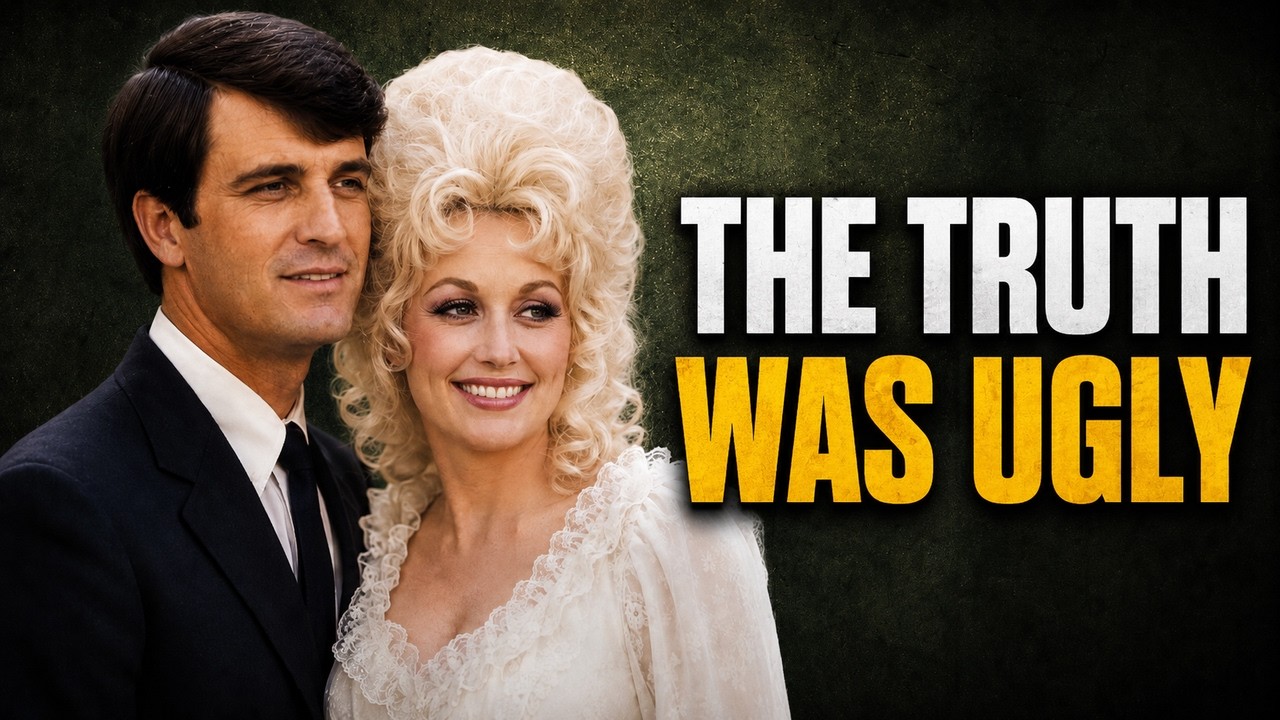
When she accepted trophies and thanked her husband, cameras panned to an empty seat because he was never in it.
So, the tabloids did what tabloids do. They started to ask whether Carl Dean existed at all. By the 1970s and 80s, the theory had legs. A husband nobody could photograph, who never gave interviews, who skipped every event, was that a man or a convenient story?
The more the couple said nothing, the louder the speculation grew until a private, ordinary marriage got treated like an elaborate publicity trick.
The truth was less scandalous and in some ways harder. Dolly toured 200 or more days a year. She recorded in Nashville and Los Angeles, filmed movies in Hollywood, and built businesses across state lines. Carl stayed home.
Weeks apart became months apart. She'd come home to their farm outside Nashville, rest for a few days, then leave again before the sheets cooled.
By 1978, she was running on almost nothing. She'd built her own band, split from the man who made her a star, and started chasing a crossover audience that demanded she be everywhere at once.
Some weeks she slept in fragments on a tour bus, waking in a city she couldn't name, singing until her voice frayed. Her weight dropped, her stomach turned on her with problems that would eventually put her on an operating table.
There was a night in the early 1980s when the heartbreak and the exhaustion and a private grief she rarely named all landed on her at once. She was upstairs alone, and she was not sure she wanted to see the morning.
There was a gun in the house. She has said without flinching that she sat with it, that the thought was real, that she'd reached the bottom of something she couldn't climb out of by willpower alone.
But something small and absurd stopped her hand that night.
When the noise got to be too much, there was exactly one place it couldn't follow her. Home. A quiet house, an ordinary yard, and a man who had never once asked her to be Dolly Parton.
Carl didn't come to the shows. He didn't want the parties or the premieres or the flashbulbs. He wanted her at the kitchen table, bare-faced, talking about nothing.
She has said he was the person who saw her cry and never told a soul. The one steady thing in a life built on being watched.
Dolly wanted children. She said it plainly in interviews scattered across decades. Carl did too. They tried for years in the early part of their marriage when the tour schedule still had gaps and the house in Nashville felt too quiet.
In 1984, she had a partial hysterectomy. The decision was medical, not chosen. She has spoken about the depression that followed, the weight of knowing that door had closed.
Carl never talked about it at all, not to anyone outside their home. They made peace with it in private, the way they made peace with everything.
Dolly became the godmother her siblings' children needed. She paid for education, showed up for birthdays, opened doors her nieces and nephews couldn't have opened alone.
In 1988, she launched the Imagination Library. It started in Sevier County, mailing free books to kids from birth to age 5. Today, it's delivered over 200 million books to children in five countries.
Carl watched it all from the farm. He never attended a ribbon cutting, never posed with a child holding a book. But he told Dolly he was proud in the few words he ever used for such things, and that was enough.
In 2016, Dolly told a story on television that made the audience laugh until they cried. She'd put on her full wedding gown, hair, and makeup done, and walked out to where Carl was watching TV. He looked up, confused.
She said she wanted him to see her as a bride one more time. He laughed. She laughed. It was absurd and tender, the kind of moment that only works when two people have been together long enough to stop performing.
Dolly never pretended she stopped noticing other people the day she married. She was in her 20s when she wed. Gorgeous, magnetic, and about to spend decades on the road, surrounded by charming men who wanted her attention.
She's talked about it more plainly than almost any woman of her generation would dare. There were sparks. There were men she found attractive. Moments where the pull was real and the distance from home felt very long.
She set rules for herself. Hard lines she wouldn't cross. And she'll tell you keeping them wasn't always simple.
Carl knew exactly who he'd married. He'd watched the world fall for her the same way he had, and he made a choice most men couldn't stomach. He decided her freedom wasn't a threat to him. It was the thing that let her come home.
By the 1980s, Dolly was one of the most famous women alive, and the supermarket tabloids had learned there was money in tearing her apart. The invisible husband was the perfect target.
The headlines came in waves. Secret affairs, a marriage on the rocks, Carl leaving her, Dolly leaving Carl, breakdowns, mystery illnesses. None of it was true, and none of it mattered to the people printing it.
The story that cut deepest wasn't about affairs or drinking or money. It was a rumor that Carl didn't exist at all. That Dolly had invented a husband to cover for a life she couldn't admit to.
For years, the tabloids ran it as a wink, a knowing joke, as if the quietest, most private man in Nashville were nothing more than a name on a marriage certificate.
Think about what that does to a real person. Carl was a flesh and blood man who paved roads and ran an asphalt company, who married her in 1966 in a small ceremony in Ringgold, Georgia. And the world had decided he was a prop.
Their answer to it revealed the strange rule Carl lived by. A rule that protected them and isolated them at once: never explain.
They would never respond, never clarify, never trot Carl out for a photo to satisfy anyone's curiosity. When the doubts got loudest, they let them get louder and answered with nothing.
At their home outside Nashville, Carl's world kept getting smaller. He rarely traveled with her. He almost never attended the parties, the premieres, the award nights that filled her calendar year after year.
Friends described a man who preferred his truck, his land, a quiet dinner at home to anything a camera might touch. Over time, the exceptions stopped being exceptions. He simply wasn't there.
There's a fine line between a private man and a hidden one. And somewhere in those years Carl drifted across it.
Think about the woman the cameras knew. 5-inch heels, wigs styled taller than a filing cabinet, nails painted, lashes on, a rhinestone for every square inch. That Dolly walked out under stadium lights and made 20,000 people feel personally winked at.
But the man behind the gate married a different person entirely. Carl fell for a barefoot girl from Locust Ridge, hair down, face bare, singing to herself while she cooked.
He never much cared for the sequined version, and by most accounts he'd only seen her perform a handful of times in decades.
By the mid-1980s the schedule had stopped resembling anything a marriage could survive. There were the movies: "9 to 5" in 1980, then "The Best Little Whorehouse," then "Rhinestone." There were albums stacked on tour dates stacked on television specials.
And in 1986, she opened Dollywood in Pigeon Forge, a theme park built on her own name, drawing millions and employing thousands. She was running an empire, and empires don't observe anniversaries.
The touring years meant weeks, sometimes months, on the road, while Carl stayed in Tennessee with his asphalt business and his quiet. She'd fly home for a few days and be gone again before the suitcase fully unpacked.
In 1984 and again into the mid-80s, the machine broke down. The public story was a battery of health troubles: endometriosis, internal bleeding, weight that dropped alarmingly, and eventually a partial hysterectomy that ended any lingering possibility of the child she'd never had.

She has said flatly that this was the darkest stretch of her life, that she gained weight afterward and sank into a depression that lasted months, and by her own admission, brought her close to the edge.
For the first time in years, there was no stadium to be somewhere, no plane to catch, no second Dolly to assemble at dawn. There was a house, a bed, a recovery measured in weeks, and Carl.
The gate she'd built to protect their privacy now closed around them both, and there was nowhere to perform to.
For most of their marriage, the arithmetic had worked because the pieces rarely sat in the same room. Dolly toured, recorded, filmed, and flew home in the gaps. Carl kept the farm, the trucks, the quiet.
Absence wasn't the flaw in the machine. Absence was the machine.
But recovery doesn't tour. Week after week, there was no plane to catch and no set to be on. Only two people who had built a life on being missed by each other.
What surfaced in that stillness wasn't a fight. It was a question about whether a marriage that ran on distance could survive being close.
The 1990s version of the marriage looked from the outside almost identical to the one before. Dolly worked, Carl stayed home. But underneath, the arrangement had been rewritten on purpose, and both of them knew the new rules.
The privacy hardened into something like law. No red carpets, no interviews, no photos he hadn't agreed to. When reporters asked, Dolly gave the same warm nothing every time, and the wall held.
In the spaces between the tours, there were small, unglamorous rituals of coming back. A hamburger from a fast food window eaten in the truck. A drive with no destination. A wedding anniversary marked not with a party, but with a plate for two.
Go looking for a photograph of Carl Dean, and you'll notice how few there are and how old. The most circulated shot dates back decades, a young man on his wedding day. After that, the record thins to almost nothing.
In the early years, the scarcity read as principle. He was the private one, the man who never wanted the camera, and Dolly guarded that choice fiercely. Fans came to expect his absence and stopped asking.
But at some point, the trickle didn't just slow, it stopped entirely. No new images, no glimpses, no candid frame catching him at the farm. Years passed and the public Carl simply ceased to exist.
By the early 2000s, the Brentwood property outside Nashville had become less a home and more a fortress. The gate stayed shut. The driveway curved out of sight from the road, and the trees Dolly had let grow tall did the rest.
She built the shield deliberately, layer by layer. Interviews turned into a routine where Carl's name came up warmly. Then the subject moved on before anyone could push.
In 2016 they hit 50 years. 50 years since that quiet courthouse ceremony in Ringgold, Georgia with almost nobody watching. To mark it, Dolly did something she'd refused for decades. She asked Carl to sit for a real photo shoot.
She wore a white gown, a bride again at 70. He stood beside her, older, softer, that same private face he'd kept out of the frame his whole life. She renewed their vows, and for once she let a handful of those images out into the world.
So here's what the darkness actually was. Not an affair, not cruelty, not a scandal buried in a vault. The darkness was the sheer weight of what this marriage demanded every single day for more than half a century.
It was Carl living beside one of the most photographed women alive while refusing to exist in a single frame, absorbing the loneliness of being the man no one was allowed to see.
It was Dolly carrying grief and worry she could never share on a stage. Smiling through decades of tabloid siege, of headlines inventing his affairs and her breakdowns, of near collapses she hid because the alternative was letting the world in.
Two people each carrying half of a secret so that one small unfamous love could survive intact.
Think about what Carl actually traded away over 60 years. He never walked a red carpet beside the most famous woman in country music. He never stood in a photo line, never gave an interview about her, never once let a stranger shake his hand and say, "You're Dolly Parton's husband."
No shared premieres, no double dates that made the papers, no easy nights out where they could just be a married couple in public. When she was on stage in front of 20,000 people, he was home in Tennessee, alone with the dogs and the quiet.
He gave up recognition, companionship, and the simple daily presence of the person he'd married. And he did it for a marriage almost no one ever got to see.
In 60 years, Carl Dean gave the public almost nothing. No memoir, no sit-downs, barely a photograph. But he did speak, just rarely.
He once said he never wanted to be in the spotlight, that it just wasn't his way. When people assumed he must resent living in her shadow, he pushed back in his own quiet fashion.
By the accounts of those close to them, he was proud of her, delighted by her success, and perfectly happy to root for her from the porch instead of the stage.
The picture that emerges isn't a man trapped by his wife's fame. It's a man who chose the paved road less traveled, tending his land, driving his truck, building the life he actually wanted, while hers went supernova.
Now turn the accounting around, because Dolly paid too. She built one of the biggest careers in American entertainment, a catalog of more than 3,000 songs, a theme park, a business empire, and she built almost all of it without the man she loved standing next to her.
She gave up a fully shared public life. The person who knew her best was the one person the world never got to see her with.
And there were no children, a fact she has spoken about with a tenderness that carries its own weight, a door she and Carl left closed.
Every tour, every award, every year on the road was time apart from him. She chose the empire and the marriage both, and the cost of holding them together was measured in the days they didn't get to spend side by side.
By his 80s, Carl had slowed. The man who once built their house with his own hands, who kept up an asphalt paving business and worked the land around their Brentwood property, found his body giving out in ways it never had before.
Dolly noticed the way you notice when the person you've measured your life against starts moving through the day a little smaller. So she started saying no.
The touring queen who logged hundreds of shows and crossed the country year after year began quietly clearing her calendar. The 2016 Pure and Simple Tour would be her last full concert run.
She never announced a formal retirement. She just stopped leaving.
What that gate hid in those years, almost no one saw. There were no updates, no statements, no photographs of Carl in a wheelchair or a hospital bed. The couple who had guarded their privacy for six decades guarded these final years hardest of all.
Dolly has said only that she cared for him, that she was there. She was in her late 70s herself, and the days settled into something small and repeated, the two of them inside the walls they'd built.
Carl Thomas Dean died on March 3rd, 2025. He was 82 years old. The man who had married a 20-year-old girl outside a Nashville laundromat in 1966 was gone.
Dolly's statement was short. She thanked people for their prayers and asked them to respect the family's privacy during a time of grief. A few sentences, no more, for a partnership that had run 58 years.
The service came together fast, the way Carl would have wanted it, before the news even had time to spread. There was no public visitation, no line of mourners stretching down a Nashville street, no fan tribute at the gates.
The people who gathered could have fit in a single room, and most of them had known Carl not as anyone's husband, but simply as Carl.

No press release went out ahead of time. No location leaked. For a man who'd spent six decades making himself invisible, even his farewell held the line.
Back when they were young and broke and nobody, Carl had asked for one thing in exchange for a life spent beside a woman the whole world would eventually want a piece of. He wanted to stay out of it.
No stage, no interviews, no photographs he didn't choose. And when the end came, no spectacle made of his name.
Dolly refused to let that happen to him. She kept the guest list tiny, the timing quiet, the details locked. In death, she gave him the exact thing he'd asked for in life.
The anonymity he chose over fame, honored down to the last hour.
In the days after, she began releasing pieces of what she was feeling a little at a time. The way she's always let the public in only as far as she chooses.
There were short written tributes, plain spoken and unguarded. And then there was the music. The place she's put every heartbreak she's ever had since she was a girl in the Smokies.
The song wasn't polished for radio. It wasn't built for charts. It was raw enough that you could hear her voice catch. A woman in her late 70s singing about a man almost nobody had ever heard her sing about by name.
For decades, the theories had written themselves. It was a business arrangement, the gossip columns insisted. A lavender marriage of convenience, a man paid to stay quiet, a marriage that existed only on paper.
Because how could a woman that famous stay married to a man nobody ever saw?
And then Carl died, and every one of those stories died with him in a single afternoon. You don't grieve a contract. You don't write a song that makes your voice break for a business partner. You don't spend 60 years guarding an empty room.
The tabloids had spent half a century treating his absence as proof of something fake when the absence was the most protective thing she ever built.
Consider what almost never survives the kind of fame Dolly Parton had. Marriages inside that spotlight tend to burn out in a few years, chewed up by tour schedules and tabloid cameras, and the slow poison of being watched every single day.
Hers lasted since 1966. And the reason it lasted was the exact thing that looked so suspicious from the outside.
Carl never came to the awards shows, never sat for the interviews, never let a photographer near the driveway. And that refusal is what kept one part of her life clean.
The secrecy wasn't hiding a scandal. It was building a wall around the one relationship the machine of fame couldn't reach in and ruin.
In her later interviews, when the guard came down a little, she started asking questions out loud that she'd never asked before. Whether all that hiding had cost them something. Whether a man who spent 60 years staying out of frame ever felt like he was standing in her shadow instead of beside her.
She's admitted there were nights she wondered if the life she chose was fair to him, if the fame she couldn't turn off had quietly shrunk his world down to a house and a garden and a wife who was gone half the year.
In a 2016 interview, she said something that stopped the room cold. She said she'd been happy and she'd been lonely and both things had been true at the same time for 50 years.
She didn't apologize for it. She didn't frame it as a mistake she'd learned from or a phase she'd outgrown. She said Carl gave her the exact life she needed, even when that life felt like walking through an empty house at 2 in the morning.
She told the Associated Press in 2014 that if she had it to do over, she'd marry him again, knowing everything. The loneliness, the rumors, the decades of defending a man the world couldn't see. She'd choose it again.
Carl Dean didn't just refuse fame. He built a life so deliberately unremarkable that it created a kind of gravitational calm.
While Dolly was being pulled in 1,000 directions, he was resurfacing driveways in Nashville, coming home to the same house, cooking the same meals. Friends who knew them both said he never once asked her to stay home, never guilted her about the travel, never made her feel small for wanting the spotlight.
He just stayed put, a fixed point she could navigate by.
Porter Wagoner once said in an interview that Dolly had an anchor most stars never find, someone who didn't need her to be Dolly Parton. Carl needed her to be the girl from Locust Ridge who liked to sit on the porch and talk about nothing.
An asphalt contractor who hated cameras became the silent architecture beneath a $650 million empire. He never gave an interview, never walked a red carpet, never let the machine touch him.
And by refusing to be part of the spectacle, he gave Dolly something no publicist or manager ever could. He gave her a place where none of it mattered, where she wasn't a brand or a legend or a decision that affected 1,000 people's paychecks.
She was just the woman he married in 1966 before any of the rest of it existed.
Biographer Alanna Nash wrote that Carl's invisibility wasn't weakness. It was the most radical act of love she'd ever documented. He let Dolly have the world without asking for a piece of it.
And the cost of that generosity was that the world would never know his name. 50 years of questions he never answered. 50 years of rumors he let swirl. 50 years of being called a ghost, a myth, a man who might not exist.
He absorbed all of it so she wouldn't have to.
Look at the marriage from one angle and it reads like the fairy tale everyone wanted it to be. 58 years, one house, one man who never once wandered. A love so steady it barely needed witnesses.
Slide the light a few degrees and something colder appears underneath. Because that same privacy that protected them also sealed her off. The decades she spent guarding him were decades she spent alone with the hardest parts.
The miscarriage she never fully explained. The grief she carried on tour buses. The questions she deflected with a joke because the truth was nobody's business.
So which was it? A sanctuary or a gilded cage? A great love or a quiet sacrifice she paid every single day?
Here's what the tidy version misses. It wasn't the fairy tale and it wasn't a lie hiding behind one. Both things were true at the exact same time, sitting in the same house, wearing the same wedding ring for nearly 60 years.
It was a real love, warm and strange and durable. A man who signed his cards "half of Dolly" and meant every letter of it.
And it was genuinely hard, sometimes desolate, built on a silence that cost her more than she ever let the cameras see.
You don't have to choose between those two readings. That's the mistake almost everyone makes. She lived inside both of them at once, holding the tenderness in one hand and the loneliness in the other, and never asking us to resolve the contradiction for her.
So, was it darker than the fairy tale? Yes, but not the way the tabloids ever guessed.
There was no scandal, no betrayal, no secret life. The darkness was quieter than that, made of isolation and unspoken grief, and a woman who spent half a century protecting a man who couldn't protect her back from the cost of it.
And it endured anyway. That's the part that stops you.
A marriage that should have been crushed by fame, by distance, by the sheer weight of what she carried alone. And instead, it just held year after year until the very end.
The real question was never whether Carl Dean existed. It's whether we'd have the strength to love someone that completely and let the whole world doubt it was real.