The ghost of war has a weight that no Hollywood production can capture, and for Major Richard Winters, the weight of seeing his fallen brothers’ faces staring back at him from a soundstage in Hertfordshire proved too immense to bear. The legendary Easy Company commander, whose stoic leadership became the backbone of Stephen Ambrose’s “Band of Brothers,” visited the set of the HBO miniseries that bore his unit’s name—and walked away within minutes, never to return. The revelation, shared by actor Matthew Leech, who portrayed Staff Sergeant Floyd Talbert, paints a harrowing portrait of a man confronting the living echoes of his most traumatic memories.
Leech, speaking in a recent interview, detailed the morning that began with a palpable electricity among the cast. The actors, dressed in full period uniform, were crammed into the back of a deuce-and-a-half cargo truck, the iconic workhorse of the Allied advance, awaiting the day’s filming. Rumors had rippled through the ranks that Winters himself would be visiting, a prospect that filled the young actors with a mixture of awe and anxiety.
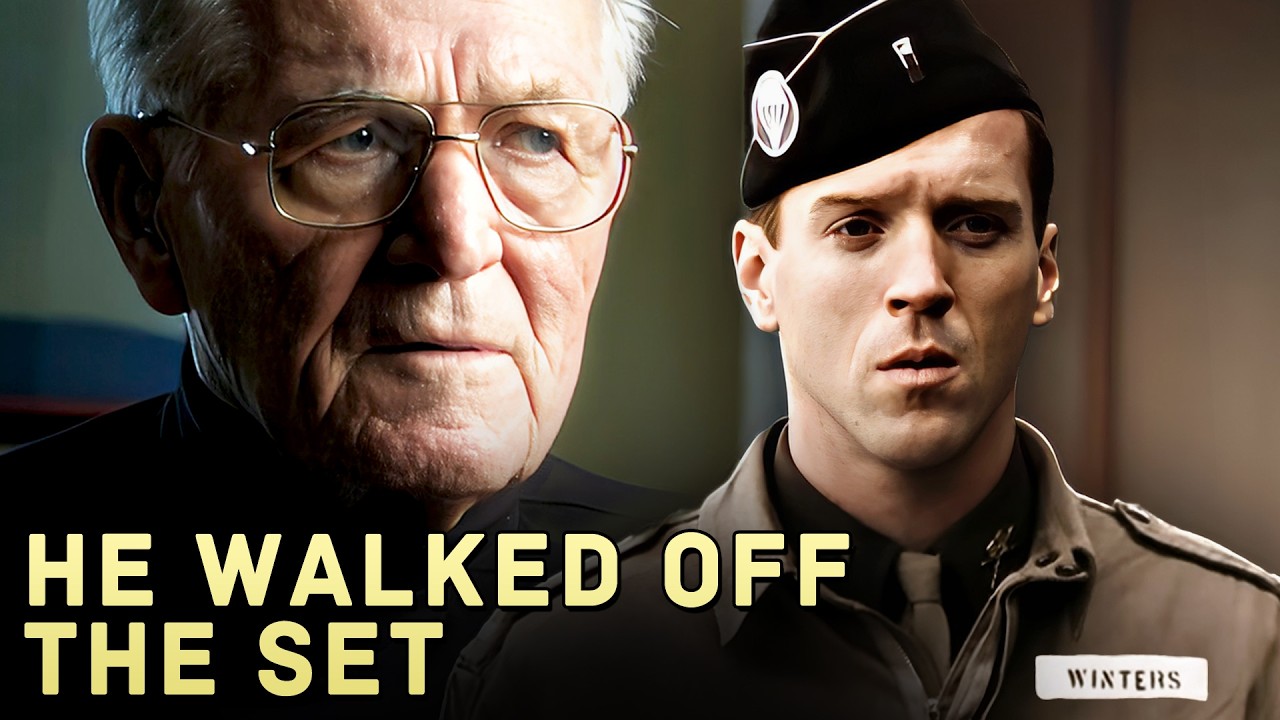 They were not just playing soldiers; they were embodying men they had studied, admired, and in many cases, idolized from archival footage and oral histories.
The truck’s canvas flap suddenly snapped open, flooding the dark interior with daylight. There stood Winters, flanked by producer Ivan Schwarz, his presence immediate and commanding. But as his eyes swept across the faces of the men inside, the color drained from his own.
Leech described the moment as surreal, noting that Winters’ face went “sheet white” as he stared into the truck. Without a word to the actors, Winters turned to Schwarz, muttered something inaudible, and walked away. He got into a car, left the set, and boarded a plane back to the United States that very day.
The reason for his abrupt departure, as Winters later confided, was the unbearable visual echo of the past. Looking into that truck, he saw not actors in costume, but the ghosts of Easy Company—the men he had led through the frozen hell of Bastogne, the bloody hedgerows of Normandy, and the final push into Hitler’s Eagle’s Nest. The physical resemblance between the cast and their real-life counterparts was uncanny, a casting choice that had been deliberate for authenticity but which proved devastatingly effective in triggering Winters’ post-traumatic stress.
For Winters, the war never truly ended. In a 2003 interview with Pennsylvania State Representative John Payne, he admitted that the adjustment to civilian life was a slow, agonizing process. “Do you think this guy you’re looking at has adjusted to this day?”
 he asked, his voice betraying the decades of unresolved pain. He spoke openly of flashbacks, of the mind’s relentless tendency to relive the horrors of combat, and of the small, unexpected triggers that could transport him back to the frozen forests of the Ardennes.
The set of “Band of Brothers” was not merely a film location; it was a meticulously reconstructed time machine. Every foxhole, every piece of equipment, every uniform was designed to replicate the European Theater of Operations with obsessive fidelity. For a man like Winters, who had suppressed the visceral memories of war for over half a century, stepping onto that set was akin to walking into a waking nightmare.
The sight of Talbert, Guarnere, and Toye—men he had buried or watched die—alive and breathing in the back of a truck was a cognitive dissonance too profound to process.
Leech, who has spent years reflecting on that brief encounter, expressed deep empathy for the major. “I don’t fault Winters at all for walking off the set,” he said, emphasizing that the veteran had endured more than most can comprehend. The actor noted that the moment was not one of anger or disrespect, but of overwhelming emotional overload.
 Winters’ reaction was a raw, unfiltered response to a psychological assault, a reminder that the scars of war are not always visible on the surface.
The incident raises profound questions about the ethics of historical reenactment and the emotional toll it can take on the very men it seeks to honor. While the production team had hoped Winters would offer guidance and validation, his departure served as a stark reminder that for veterans, the past is not a costume to be worn and discarded. It is a permanent state of being, a shadow that follows them into every room, every quiet moment, and every unexpected encounter.
Winters’ decision to leave also speaks to his character. He was never one for public adulation or theatrical sentiment. His leadership was defined by quiet competence, by a refusal to ask his men to do anything he would not do himself.
Facing the actors, he likely saw not tribute, but a painful mirror of the youth he had lost—the friends who never grew old, the laughter that was silenced on foreign soil. The weight of that recognition was simply too heavy.
 The “Band of Brothers” series, which premiered in 2001, went on to become a landmark of television, praised for its unflinching realism and its dedication to the stories of Easy Company. Yet, for Winters, the project was never a source of closure. He passed away in 2011, but his legacy endures, not just in the medals and the memoirs, but in the haunting image of a man walking away from a truck full of ghosts, unable to look back.
The story of his brief visit has since become a cautionary tale within the production community, a reminder that the men who fought the wars are not props for our entertainment. They are living repositories of trauma, and their reactions to our recreations are unpredictable. Winters’ walk-off was not a rejection of the actors or the series; it was a final, silent testimony to the cost of war—a cost that never stops being paid.
As the years pass, the number of living World War II veterans dwindles, and with them, the firsthand accounts of such moments. But Leech’s recollection ensures that Winters’ experience is not forgotten. It stands as a powerful testament to the enduring impact of combat, and to the profound respect we owe those who carried the burden.
In the end, Winters did not walk off the set because he was angry or dismissive. He walked off because he saw his brothers one last time, and the joy of that sight was inseparable from the agony of their loss.