On the night of September 12th, 1942, with the German 6th Army fighting its way through the ruins of Stalingrad, two Soviet officers stood before Joseph Stalin with a plan that would decide the fate of the city bearing his name. One of them was Alexander Vasilevsky, the 46-year-old chief of the General Staff, a man who had spent 14 years pretending his own father did not exist in order to survive Stalin’s Russia. The operation he placed on the dictator’s desk that night would become the turning point of World War II—and it would exact a personal price that his memoirs never fully recorded. Born on September 30th, 1895, in the village of Novaya Golchika northeast of Moscow, Vasilevsky was the fourth of eight children in a priest’s family with no money.
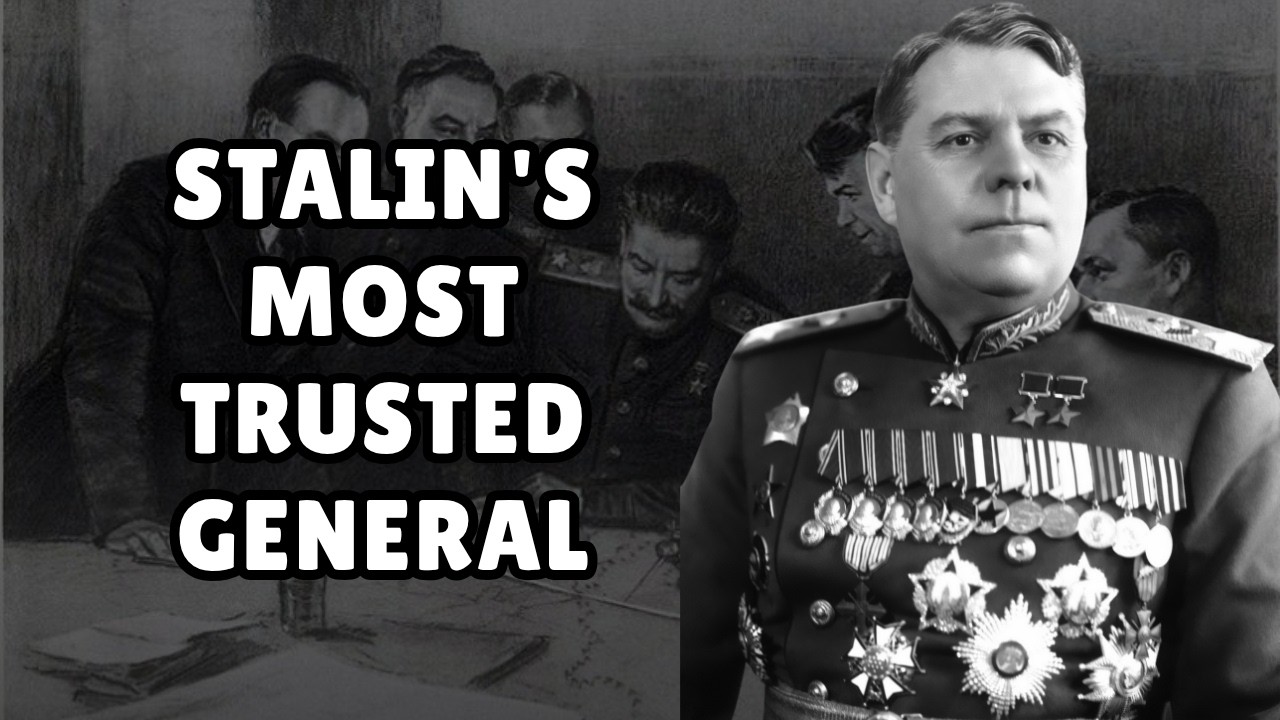
The children worked in the fields, and his parents made a financial sacrifice to send him to the Kostroma Theological Seminary, the only educational path available to a family of their station. He planned to become an agronomist. Then 1914 arrived, and the war dismantled that ambition. He graduated from an accelerated military course and served as a junior officer, fighting in the Brusilov Offensive of 1916.
By 1917, he had risen to staff captain. When he came home, Russia no longer had a czar or an empire—and had no use for the officer class he belonged to. He joined the Red Army in 1919, not out of revolutionary conviction but out of practical necessity. The old army was gone; this was the only army there was.
He fought in the Polish-Soviet War and against remaining White forces until August 1921. What distinguished Vasilevsky from the men around him was not ambition or politics. It was precision. He could study a map and see not just what it said but what it meant—where a plan would hold, where it would break, and what the enemy would do when it unfolded.
Other men saw the plan. Vasilevsky saw the war. That quality reached Boris Shaposhnikov, the chief of the General Staff and one of the few military men Stalin genuinely respected. Shaposhnikov brought him into the General Staff’s Operations Directorate, where they worked together for years.
By June 1940, Vasilevsky was first Deputy Head of Operations, planning for a potential German attack. At 44, nobody outside the General Staff knew his name. The Great Purge of 1937 and 1938 gave him his opening. Stalin destroyed his own officer corps: three of the five marshals of the Soviet Union were shot, along with 13 of 15 army commanders and 50 of 57 corps commanders.
The vacancies opened throughout the General Staff. Vasilevsky, technically brilliant and unconnected to the purged networks, rose into the gaps. He joined the Communist Party in 1938, later than almost any officer of his seniority—a caution that reveals how carefully he moved. Throughout his rise, Vasilevsky carried a secret that could have destroyed him at any moment.
His father was a priest, and in Stalin’s Soviet Union, a priest was an enemy of the people. Having a priest for a father made a man suspect, a potential counterrevolutionary whose loyalty could not be guaranteed. In 1926, Vasilevsky stopped all contact with his parents. He did not write, did not visit, did not acknowledge them.
For 14 years, he pretended his family did not exist. At some point before the war, Stalin asked him about his family. Vasilevsky told him the truth: his father was a priest, and he had cut off contact in 1926 to protect himself. Stalin, the man who had shot priests and sent clergy to the camps, told his chief military planner to reestablish contact immediately—to write to his father and help his parents financially.
In 1940, on Stalin’s instruction, Vasilevsky resumed contact with his family. He never publicly explained what that meant to him. On June 22nd, 1941, Germany invaded the Soviet Union. The Red Army was caught without warning, and in the first weeks entire armies were encircled and destroyed.
Stalin, who had dismissed the intelligence warnings, shut himself in his office and did not speak publicly for 11 days. Vasilevsky worked around the clock at the General Staff, organizing what could be organized. In August 1941, he was appointed Chief of the Operations Directorate and Deputy Chief of the General Staff. He played a central role in planning the Moscow counteroffensive launched on December 5th, 1941, the first German defeat of the war.
It was also the beginning of a pattern: Vasilevsky planned it, someone else’s name was attached to it. After Moscow, Soviet morale was dangerously high. Stalin ordered a summer counteroffensive toward Kharkov to keep the Germans off balance. Vasilevsky could see the reality more clearly than the optimism allowed.
The Red Army was not ready, and the German position was stronger than it appeared. He knew what was coming. He followed orders anyway. The Kharkov Offensive launched on May 12th, 1942.
Within days, the Germans counterattacked and began encircling Soviet forces. Vasilevsky and Zhukov went to Stalin and asked permission to withdraw and save what could still be saved. Stalin refused. When it was over, nearly 300,000 Soviet soldiers were lost.
Khrushchev later accused Vasilevsky of seeing the disaster clearly but failing to push hard enough against Stalin’s refusal—a criticism that was not entirely wrong. He had the technical clarity to see what was coming but lacked the personal force to make Stalin stop it. That was the central tension of his entire relationship with Stalin. On June 26th, 1942, four weeks after the Kharkov disaster, Vasilevsky was appointed chief of the General Staff of the Soviet Armed Forces, the highest military planning position in the country.
He had no time to settle in. By September, the German 6th Army was inside Stalingrad, and Soviet forces were dying in the ruins of the city. The city bore Stalin’s name and could not be surrendered. The question was how to win.
Vasilevsky and Zhukov presented their plan to Stalin on September 12th, 1942. The approach was counterintuitive: do not attack the Germans directly inside the city. Let the brutal, grinding fighting in Stalingrad hold the 6th Army in place. Meanwhile, strike the flanks, where the Germans had stretched their lines using less experienced, less equipped Romanian and Hungarian forces holding vast stretches of open ground.
Drive two pincers deep into the German rear, meet west of the city, and close the trap. Stalin approved the plan on November 13th. Operation Uranus launched on November 19th, with Vasilevsky commanding from the front. In four days, the two Soviet spearheads met at Kalach, west of Stalingrad, encircling 290,000 Axis troops.
On February 2nd, 1943, the last German forces in Stalingrad surrendered. The Eastern Front had turned, and the war began to run in one direction only. Vasilevsky was promoted to Marshal of the Soviet Union in February 1943. He was the man who planned Stalingrad.
He received the promotion. Zhukov received the fame. That, too, was part of the arrangement. In the spring of 1943, Vasilevsky and Zhukov convinced Stalin to do something that required real courage to recommend: wait.
The Germans were planning a massive summer offensive at Kursk. Every instinct in Soviet military culture said attack, press, never give the enemy time to prepare. They argued the opposite. Let the Germans come, build the defenses, absorb the blow, then counterattack when their offensive had exhausted itself.
Stalin waited. The Germans attacked on July 5th, 1943, and by July 12th their offensive had stalled. The Soviet counterattack that followed recaptured territory on a scale that had seemed unimaginable two years earlier. On April 10th, 1944, Vasilevsky received the Order of Victory, only the second ever awarded; the first had gone to Zhukov the same day.
The following month, during a post-liberation inspection of Sevastopol, his car struck a mine. He was evacuated to Moscow with a head wound from flying glass and was back at the front within weeks. In June 1944, Vasilevsky coordinated Operation Bagration, the destruction of German Army Group Center—one of the largest and most successful military operations in history. In two months, the Red Army advanced hundreds of miles, and Army Group Center ceased to exist as a fighting force.
On August 9th, 1945, three days after Hiroshima, the Soviet Union declared war on Japan. Vasilevsky commanded the Manchurian Strategic Offensive, which overwhelmed the Japanese Kwantung Army of one and a half million men in 24 days. He accepted Japan’s surrender in the Far East. In three years, Vasilevsky had planned the operations that turned the war at Stalingrad, shattered the German Army at Kursk and Bagration, and ended the war in the Pacific.
In 1949, he was appointed Soviet Minister of Defense, the highest military post in the country. The priest’s son from Novaya Golchika had risen as far as it was possible to rise. Stalin trusted him more than almost any other soldier alive. On March 5th, 1953, Stalin died.
Within months, Vasilevsky was replaced as Minister of Defense by Nikolai Bulganin, a politician rather than a soldier. He was made first deputy minister, then deputy minister for military science. In 1957, Khrushchev pensioned him off entirely. The reason was simple: Vasilevsky had been Stalin’s man.
Under de-Stalinization, that was not a distinction. It was a disqualification. He spent his remaining years writing his memoirs, which he titled The Matter of My Whole Life. He died on December 5th, 1977, and was buried at the Kremlin Wall—the same final honor as Zhukov, for the same kind of service.
He had hidden his father for 14 years to survive Stalin’s system. Stalin gave him his father back and then used everything he had. Vasilevsky planned the operation that turned the war, watched another man receive the fame for it, followed a fatal order at Kharkov without protest, and spent his career learning exactly how close to the edge he could stand without falling. He got every calculation right.
He survived Stalin, survived the war, and outlived almost everyone in the story. What he gave up to do that—his father, his voice at Kharkov, his name at Stalingrad—the memoirs record carefully. What they do not record is whether he thought it was worth it.